
We’re in June and I’ve finally remembered to catch up with posting about my findings with reading every RPG book I’ve backed on Kickstarter.
I ran a little long when writing about March’s books, so here’s the last seven games I’ve read for March:
Parliament of Supplements

By Mad Perriot
Read before? No
Played? No
This is a weird one, mainly as it’s not technically finished, but I think it’s as finished as it’s likely to be. That’s fine, I’ve backed a number of Kickstarters that didn’t come out at all and at least there are usable things here. It’s an anthology of modules for RPGs, some of which I’ll find useful.
World Wide Wrestling – Moves for things like beefing over social media or cutting a promo
Monsterhearts – A Skin and campaign frame based on The Wicked + The Divine and a new Small Town based on the town the author grew up in
Blades in the Dark – Academia rules in case you want to play students in a Duskvol academy instead of grimy thieves.
Vampire: The Masquerade 20th Anniversary Edition – the first module I won’t be using, a few mods involving combat.
Stars Without Number – I don’t own or know anything about this.
D&D 5E – inspiration, background, alignment and economy rules. I’ve been done with D&D for a while now.
Pathfinder – real estate rules. My rule for not bothering with D&D includes Pathfinder and other ‘D&D’s’, too.
So overall this is an odd collection of finished and unfinished hacks. I’m interested in trying out the World Wide Wrestling moves when I finally get to run that and Academia feels like it needs a bit of work on my part to pull things together if I want to run it. If folks want a fantasy school, it could be fun. The WicDiv content for Monsterhearts might not be something I’m as eager to get to the table unless a player asks, but the Small Town’s got a lot of promise.
Lovecraftesque
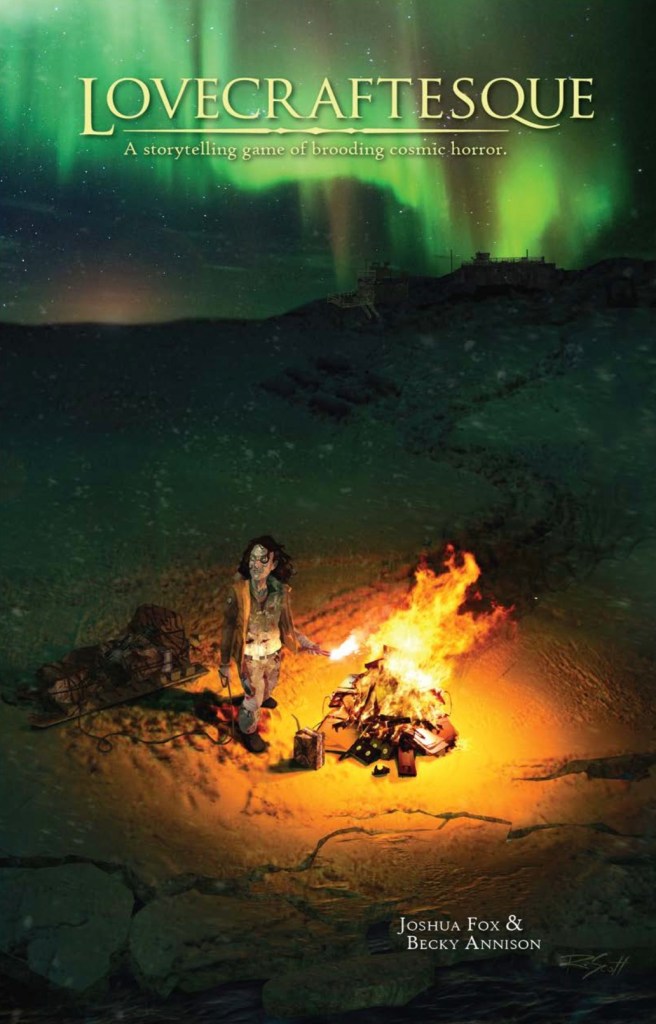
By Black Armada Games
Read before? Yes
Played? Yes
I’ve been a fan and patron of Black Armada for a while now, and it all started with this game. I’d already picked up Stealing Cthulhu, which was an influence for both this and Cthulhu Dark (coming later this quest). Listening to Annison and Fox at a convention talking about their project sold me on both their ability to make a damn good and reliable Kickstarter, but also the design philosophy at work.
Lovecraftian games are a tricky art. Call of Cthulhu’s a classic, but there are somethings it doesn’t quite do well. The conceit of being a group of investigators runs against the solitude of the Lovecraftian investigator, but this game solves the problem by having you all control one person.
The Witness is an investigator whose player can interact with the world, but not make anything up in it.
The Narrator describes the world as the Witness moves through it, seeding in clues as they go.
The Watchers are every other player, adding flavour and mystery, inhabiting NPCs if called upon by the Narrator.
You rotate each role as you go through three acts, getting weirder and weirder as it goes, with some incredible mechanics to help the arc of the story towards the horrific finale.
First of all, you are all told you can’t add anything supernatural or violent into the world… unless it’s something listed on a special card you’ll each get. You won’t know what everyone has, but people will hint in their direction of the mystery in ways which will evolve in each act. Some of them could just be strange magic or spaces, others might kill the Witness and bring in a new protagonist.
The other big piece of genius here is Leaping To Conclusions. At the end of every scene every player scribbles down a quick assumption about what’s going on. You won’t know everything, but you will know your special card and what you’ve played through. Then you play another scene and update your theory accordingly. There’s a beautiful thing that happens with this mechanic. You all start with different ideas and gradually tighten the net, changing your ideas to fit the scenes and the assumptions, ending up with a mystery with an answer which you all led towards and couldn’t have existed without you, but still feels unexpected. There’s something incredibly elegant about this system.
I’ve run Lovecraftesque a bunch of times and even hosted an evenin where myself and my friend Saffy ran two tables with one book and set of cards.
There’s a second edition on the way soon and I’m curious how it will have changed.
Trophy Dark

By Hedgemaze Press & Gauntlet Publishing
Read before? Yes
Played? Yes
This was a treat to myself which I started after finishing reading Exalted Third Edition. Trophy Dark is one of my all time favourite RPGs.
You play treasure hunters who are trying to take a treasure that doesn’t belong to them from a forest that doesn’t want them there.
Each character has a background, an occupation, a drive and possibly some spells. They also have a stat called Ruin. Characters are kind of a light touch, specifically as you’ll find out more about them as they delve into darkness and reveal who they are in these final moments of their lives.
The system’s nice and simple, needing light and dark d6’s. The main roll is a Risk Roll, where you take a light die if you have a skill or gear which will help, a dark die if you’re risking body and/or mind which you’re always doing if you’re casting a spell. As seen in Blades in the Dark you use Devil’s Bargains to potentially add another light die. You roll all of them, pick the highest and on a six you succesed with no problems. A four to five is a success with a complication and on a one to three then things go badly.
What’s beautiful about these Risk rolls is that the player making the roll says what they hope will happen and everyone else; players and GM, say what could go wrong. The GM makes the ultimate decision, but the kind of writer’s room approach is great for gathering suggestions and playing towards the eventual destruction of these characters.
The majority of the book is incursions which are built around a theme like: Dream, Moss or Void. They list out moments which could happen, conditions which might affect people and the five ‘rings’ as you get closer and closer to the end. They all follow the same rough structure even if they can all end up telling quite different stories. At the first ring, you’re lulled into a false sense of security and encouraged to go further. The second ring turns the environment against you. The third starts to point the group at each other. The fourth has the forest (or other location) wake up and confront the invaders. The fifth is where it goes insane and ideally, no one’s getting out alive or in one piece.
My first game had four players. One died in the fourth ring, sacrificing himself to save the others. The second was killed by the third who let herself be taken over by a weird entity she thought was her mother. The fourth used a ritual to cast her mind back to civilisation and to her imprisoned brother so she wasn’t in her body when she was ripped to pieces in the forest.
It’s brutal, it’s tragic and can be kind of artful with it. Trophy’s one of my favourite RPGs and I’ll be talking about it more on Who Dares Rolls, I’m sure.
City of Winter

By Heart of the Deernicorn
Read before? No
Played? No
I love Fall of Magic, a map-travelling game using a scroll as the board to play and coins as playing pieces. The system’s nice and simple, with tones that are poetic and forlorn. In Fall of Magic you follow a Magus to the origin point of magic as it’s leaving the world. In City of Winter, you play a family who will travel from their doomed homeland to a fantastical city. You’ll work out traditions, then you’ll age, die and get replaced by the next family members as the story of the group moves on. You start off playing on a scroll, then move to a large poster-sized city map. There are also a lot of cards, representing different groups and prompts for their traditions. I didn’t look too closely at them, as I still want some surprises for when I play it.
The game looks like it’s going to take a few sessions to play and I had a similar experience with Fall of Magic. It was a shame that our Fall game fell apart when one of the more shy players realised he was framing scenes and technically doing some GM type actions, got stage fright and couldn’t go any further. This means I’ll need to find alternative avenues to play this gorgeous game.
Playing Nature’s Year
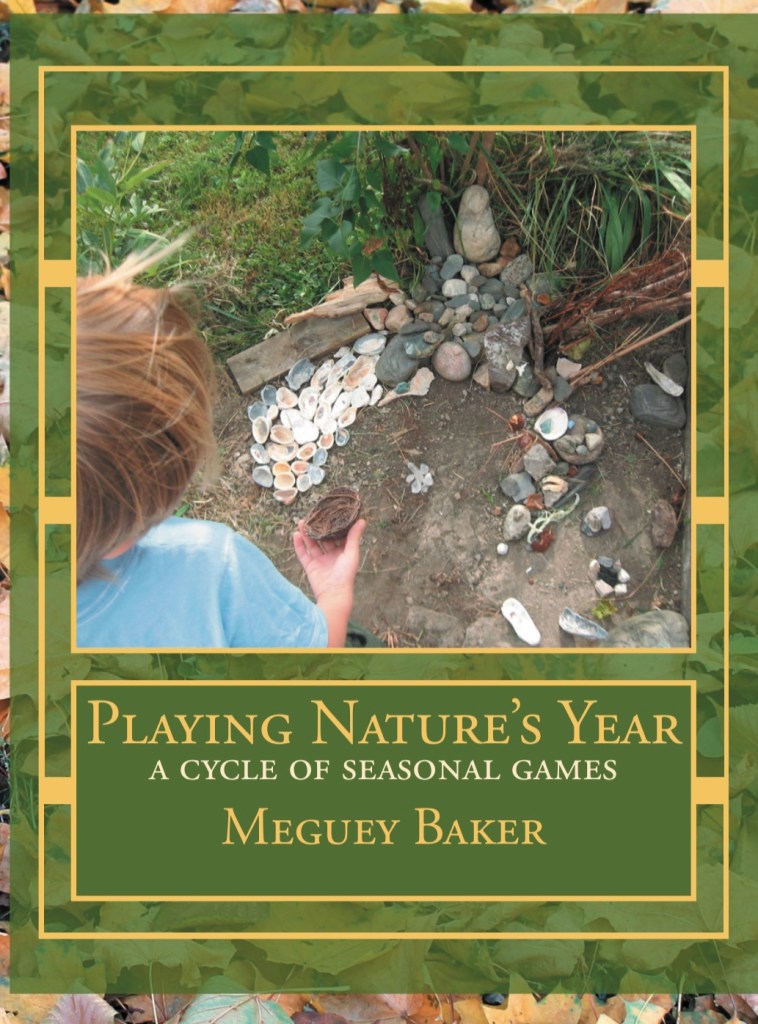
By Meguey Baker
Read before? Unfinished
Played? No
A compilation of dice games, each based around different seasons. I read this on my anniversary weekend with Emma in Rye. You need a lot of six-sided dice in different colours for each game and you’ll be doing different things with them. In one you’re all hunting a deer for a wish, in another you’ll be speaking to the dead. Some of these games feel like they could take a while to do, but there’s a good lot of ritual to them to make simple dice mechanics feel evocative, even emotional.
The games aren’t alone in the book, there are recipes, essays on the flora and fauna encountered in each season and commentary on the games. It’s something I might try to run pre-game with my group if they feel like they’d be up for a bit more of a contemplative experience at some point.
Apocalypse World Second Edition

By Meguey & Vincent Baker
Read before? Yes
Played? First Edition
Apocalypse World birthed the ‘Powered by the Apocalypse’ series of books, although it had a scrappier, more zine-like look to a lot of what followed. Set in an apocalypse which is vaguely defined, there are three things known: There are vehicles, there are guns, there is a psychic maelstrom tearing in at the edges of the known world.
The book explains that the game is a conversation and the moves each character has from the general list or their playbook explain when the conversation engages with the rules. Most of the time this results in rolling 2d6 plus a stat, with results of 10+ getting what you want, 6 or lower causing a failure and the Master of Ceremonies (MC) makes a reaction, then the sweet spot is a 7-9 which gives you a success at a cost.
The playbooks are:
- The Angel: The healer of the group, just about patching everyone up with a base and some great equipment.
- The Battlebabe: A dangerous person to be around, they are attractive and always trouble.
- The Brainer: A creepy psychic who wants to get into people’s heads, pulling their strings
- The Chopper: The leader of a biker gang, building both bikes and the game they fight with.
- The Driver: You’re the group’s wheels, building one or more vehicles which are like a second body to you. One which will hurt when you roll over your foes with it.
- The Gunlugger: A simple brute who is incredibly well armed.
- The Hardholder: You look after a community, providing jobs, help and trouble.
- The Hocus: A cult leader, receiving signals from the other side.
- The Maestro’D: The host of local entertainment, in deep with all kinds of shady dealings.
- The Savvyhead: You fix things and customise them, almost to a supernatural level.
- The Skinner: A beautiful person who can hypnotise or summon folks through the psychic maelstrom, but who is also a genius with a blade.
The playbooks have the stats of Hot, Cool, Hard, Sharp and Weird, which power moves. These are listed and then expanded upon for better player and MC clarification. You get some unique rules which only happen if you’re playing a set book, like the Chopper’s biker gang or the Hocus’ cult. There’s Hx (History) which players have with each other, and one thing everyone always brings up with this game: Sex Moves. These are rarely used, but like anything else where there’s rules, shows where the importance of the game is. Interpersonal drama, between the Hx and the Sex Moves, players are in messy relationships with each other and that will effect things.
The MC rules go into Threats and ways to build things to help with the drama. They also give lists: your Agendas which are overall motivations, guiding Principles and Moves you do when players fail or give you a golden opportunity. What they don’t do is provide specifics about the world or adventures, as these are actively discouraged outside of play. The playbooks will establish the world. The play will establish the world.
This second edition clears things up and adds more moves, specifically for fights, damage, vehicles and an overhauled system of jobs. Going through the whole book it feels like there’s a lot of repetition in it as moves get repeated in order to help provide clarification. All in all it’s good, but for teaching people new to the system I’d generally rather go with Monsterhearts, The Warren or a zine like Girl Underground.
Apocalypse World: Burned Over Hackbook

By Meguey & Vincent Baker
Read before? Yes
Played? Yes
If I have one regret about this book, it’s that it requires Apocalypse World Second Edition to play. If not for that, it would be a perfect replacement. This is a version which changes up the stats, removing Hot and combining the moves linked to that to Cool instead. Aggro gets added instead. The MC side of things is a little more chilled and the fights are refined. There are Hard Zones which are settings featuring locations to use, some are premade and you’re always encouraged to add more. There’s also no Sex Moves, as this is in theory a game which can be played by younger roleplayers. The thing is, that doesn’t stop this game going hard and weird.
The playbooks are also more specific and weird. I think I might even prefer them.
- The Bloodhound: You’re answering mysteries about the apocalypse, defining more about the setting and getting to say what’s true.
- The Brain-Picker: The equivalent of the Brainer, slightly less creepy.
- The Gearcutter: The techie, who can hit a point of being almost psychometric.
- The Harrier: A biker, but also a cult leader, as your gang are weird death-worshippers.
- The Lawmaker: A kind of sheriff, although you work out what the rules of your holding are.
- The Medic: The equivalent of the Angel, keeping everyone around you alive.
- The Monarch: A leader with a near-hypnotic presence.
- No One: A nobody, figuring out who they are as they play.
- The Operator: You have places to go and jobs to do, more than most people.
- The Restless: You’re a person and their dog, travelling through the least hospitable parts of the apocalypse.
- The Undaunted: A parent/cult leader (again), with urchins who help you.
- The Vigilant: You’re aware of monsters from the Maelstrom, but you also are the only one who can see them most of the time, and they’re hunting you.
- The Volatile: You’re extremely dangerous, the Battlebabe of this world.
- The Weaponised: You’re a combat cyborg with technology with a few flaws as well as incredible powers.
- The X-Earther: You came from a space station, bringing it and the inhabitants into play while you wander the ruined world.
If there’s one criticism I have of these playbooks, its that the flavour text at the start to describe them can be a little vague at times. I love the presentation of the unique rules for each one. The Hard Zones are useful.
I ran a game of the city building RPG, Ex Novo, where we created a kind of arboreal apocalypse, then the next session we used Apocalypse World Burned Over. It moved smoothly and went to some weird places with a cult and a strange monster bleeding over the psychic maelstrom in the middle of a market.
Conclusions
At a quarter of the way through the year I was at 18.48% through the books or 19% through the page count (which includes partially-read books like Trophy Gold, The Wildsea and Yazeba’s Bed & Breakfast.
I didn’t take any cheap wins last month or this month, I might do so in April just to reassure myself that this is a doable task. It might end up being the Barbarian’s Bloody Quest series of books from the Baker House Band as I’ve just added a ton of those to my list.


 Faked Tales