
This month’s been an interesting one for reading RPGs. It’s involved stretching the rules a bit, and while I’ve not caught up with where I should be at, I’ve definitely accelerated despite adding a number of things onto the list.
First up, I’ve been adding Kickstarters which I would have backed, but got for supporting people on Patreon. Also I’ve added an IndieGoGo to the list, which added one book and 500 more pages. I’ve not made this an easy task for myself.
Blades in the Dark
By John Harper
Read before? Yes
Played? Yes. A lot.
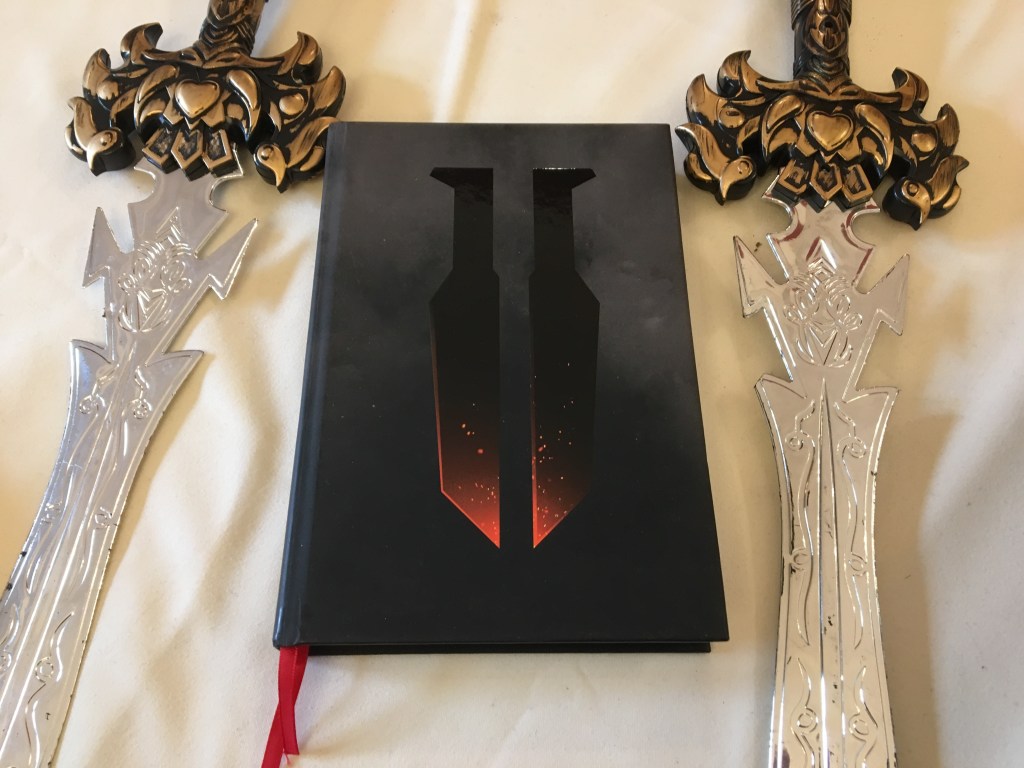
I’ve already said a lot about Blades in the Dark. I’ve written about it, I’ve written scenarios for it, and I’ll keep talking about it. So here I’m going to keep things quick.
You’re in a grimy Victorian-style world filled with crumbling buildings and flickering lights. Weird monster whale oil powers things including giant masts keeping an infinite amount of ghosts from the city of Doskvol. The sun’s broken and it’s almost always night. Bluecoats oppress the populace while the Imperial Army oppresses everywhere else.
This sounds grim, right?
The good news is that it’s the perfect place for you and your mates to rob it blind and make out like bandits. You start out in the gutters and the better you get at crimes, you might be able to retire comfortably as the best crooks in the city.
Your crew is either:
- Assassins – Imagine Hitman, but you’re a group
- Bravos – You’re bullies, but professionally
- Cult – You believe in something, possibly something awful
- Hawkers – Del & Rodney Trotter, but in a haunted city
- Shadows – This is the kind of ‘default’, where you’re burglars
- Smugglers – You get things from point A to B, generally illicitly
Your playbooks are:
- Cutter – You’re the muscle
- Hound – You’re a tracker and shooter
- Leech – You’re the gadgeteer, trapsmith and healer
- Lurk – You’re the sneaky one
- Slide – You’re the face
- Spider – You’re the brains of the operation
- Whisper – You’re able to channel the ghost field and toy with the elemtns
- There are also playbooks for people who die and become ghosts, ghosts who merge with humans making a ‘vampire’ and ghosts who get put in a big metal body
The system’s nice and simple, although I get when some folks feel a bit intimidated by it at first glance. There are a number of different systems in play and the game’s split between free play, doing a heist and then the aftermath/downtime. A physical copy helps as you can flip back and forth between the systems and sub-systems and the reference guides make it a doddle to run once you get the flow of it.
The main system’s where you describe what you’re doing and if it needs an action check, the GM will mention it, but won’t say which action you need, instead they’ll ask how you’re doing it. You can pick any of your different actions (e.g. Sway, Hunt, etc) and pick d6’s equal to that. The GM will pick the ‘position’ and ‘effect’ based on your choice, but that’s the kind of thing you don’t need to know at first glance. You can use teamwork for extra dice, or spend some of your own Stress. There’s also a thing called a Devil’s Bargain, where everyone else round the table pitches things that can go wrong no matter whether you succeed or fail, giving you a bonus now for causing future problems. You climb that drainpipe but a random person in the next flat saw you. We’ll see if they notify the filth about it.
There’s a lovely flashback mechanic where you dive into the heist and if you need to have made a plan, acquired something, befriended a guard and so on, you can spend more of your Stress, flash back a la Ocean’s 11, and see whether you succeeded. There’s also a harm system which is the weakest point, but you’re generally avoiding harm by making a Resistance roll, rewinding and saying “as a master thief, I would have seen that trap and dodged out of the way”, rolling and taking Stress to avoid harm. The joy there is describing the horrible effects and then skipping back, pulling a “well, actually” on the GM.
The setting is thoroughly planned, but with a view to making sure the players are at the centre of a living world. There’s no central characters apart from ones you’re robbing or being hunted by. The world’s evocative and luckily not in a way that’s tricky to explain to players who havent read the source material.
It’s just the best game.
Laser Kittens: An RPG about tiny kitties growing up
By Stentor Danielson & Cheyenne Wall-Grimes
Read before? No
Played? No

This was quite a fun novelty idea at the time. You play a group of young kittens who have special laser vision which does odd things. The powers all have names like “pew pew pew” or “dew dew dew” and do things based on the name.
There was a ton of excitement in my writing group about this one and the book looks nice, I just ended up a little underwhelmed by it. There’s a card system for bidding on narrative control, with black suits as positive and red ones as negative, so you’ll have to dump cards in to get rid of bad ones. It looks adorable and if folks were offering to run it, I’d probably give it a play, but I wouldn’t go out of my way to run it.
World Wide Wrestling: International Incident
By Nathan D Paoletta
Read before? No
Played? No

This was a bit of a weird one, as it’s a supplement for the first edition of World Wide Wrestling which has been superseded by the second edition. Apparently some of this is incorporated there, but for the sake of completeness here we are.
The chapters are as follows:
- Global Wrestling
- Expanding the Game
- Being More Creative
Global Wrestling’s really interesting as it shows different styles of wrestling from around the world and how to replicate them in the system.
Expanding the Game adds some extra rules to play with including ‘mythic moments’ and moves for the audience.
Being More Creative provides some sample wrestlers for you to use and ideas for things like wrestle school.
7th Sea: Second Edition
By John Wick
Read before? Yes
Played? Yes

I loved the 7th Sea RPG in its first edition, so I went big when I saw the second edition was on Kickstarter.
The players are swashbuckling heroes in the fictional world of Theah, which uncannily resembles historical Europe from around the 17th century, give or take a bit of fudging for the sake of drama. The world of the first edition was fun, but this time Wick actually got a bunch of folks in to help make it a bit better researched. Other books in the line would expand all over the globe, but this core book gives a great overview of the European nations as a focal ‘home’ for the cast.
- Avalon, Inismore and the Highland Marches are ruled by glamour and strange fae or fae-adjacent folk. They’re great at boats, drink quite a bit, tell stories and of course fight among themselves. While they were all ‘Avalon’ previously, there’s been more of an effort to separate them this time.
- Castille is Spain and feels more Spanish than it did in the first edition. It has some fantastic duellists, some religious extremism and influences from the Crescent Empire in its roots.
- Eisen is Germany, filled with mythical beasts and Witcher-style hunters. They have some incredible tactics and metals, even if their land is blighted by monsters and scarred with war.
- Montaigne is France, decadent and ripe for revolution. Nobles have strange blood-based teleportation and there are things brewing under the surface of the capital.
- The Sarmatian Commonwealth is based on Poland and is a rare democracy, where all people were made nobles, in order to stop the original nobles blocking any attempts at change. They also make pacts with weird spirits that might be demons.
- Ussura is Russia, a gigantic land where people worship Matushka, a kind of Mother Winter sort of figure, they shapeshift and again, the divide between nobles and poor feels like it might head in a revolutionary direction.
- Vestenmannavnjar used to be a viking nation and still has some who raid, who use runic magic. Mostly though, they’re traders and merchants now.
- Vodacce is Italy, and the John Wick faction. The ‘don’t trust these guys’ faction. They’re good duellists, deceptive tricksters and have fate witches bending probability to their whim.
The system is one I like, but I’m aware that’s not a universal opinion. The first edition has many fans who stuck with that and haven’t seen the improvements to the world between editions.
Where FFG kept the ‘roll & keep’ mechanic for Legend of the Five Rings and used their funny dice, 7th Sea does a kind of ‘roll & keep everything’ sort of thing. The idea is that to pass a check you need a success, then there might be other risks involved with the check (e.g. being noticed, getting split up). You roll, you group the results together in sets totalling 10 each and can use each of those sets to pass the check and mitigate any of those risks. Combat moves at a good, dynamic pace with mook rules and the only time the GM rolls is for villains.
Like Blades in the Dark, there’s a compelling world which in the core book and the supplements, inspires you to make a campaign out of the concepts contained in a nation, a city or even a block of streets. It’s weird and the use of many people from around the world, hopefully it’s a lot better researched than the previous edition.
I’ve run one shots and campaigns, I even got to be a player in a campaign of 7th Sea, I’ve reviewed it already. I’ll definitely be returning to it.
£1 Tabletop RPG Rulebook: Era: Lyres – Pocket Edition
By Shades of Vengeance
Read before? Yes
Played? No

I backed this on the promise of a game where you bullshit about your adventures and technically, that it what I got. The Era system’s a fairly basic attribute + skill d10 system similar to the World of Darkness, adapted to the different versions they use but ultimately still the same sort of deal. It gets a lot of love from a small, dedicated community and if they see something good in it that I didn’t, good for them.
This is a preview version of the full rules for Era: Lyres. Sure enough, you play a party of bullshitters, but you make up the story and roll using your standard set of stats. This makes lying particularly powerful and for some odd things like still using strength rolls for feats of strength. I guess you show off your moves to the audience. You also roll up the audience, individually, based on the location they’re at, and how much they’ll end up paying you.
This seems like an interesting idea for an indie game (or the card game Braggart) filtered through some fairly standard trad RPG rules and comes off a bit worse for it.
The Name of God – A Game of Outcasts and Urban Weirdness
By Alessandro Piroddi
Read before? Yes
Played? No

This game is an odd little one, originally just as a set of cards and some minimalist rules, it’s since been expanded a bit. You each take a card representing a god. Or at least, you might be a god. You might just be an unhoused person. You play through scenes of odd magical realism, going through ritualistic play until your character makes a final leap which may be their death or may cast aside their mortal form, bringing them back as a god. Yeah, so big content warning for suicide on this one.
Singularity
By Aura Belle & Josh Jordan
Read before? Yes
Played? No
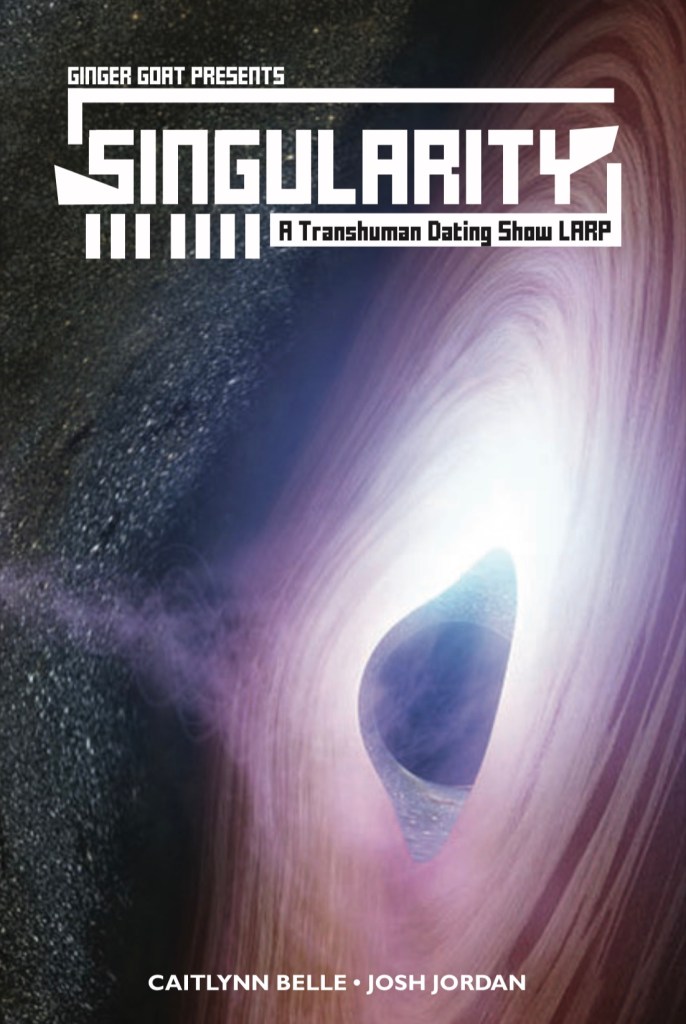
This is technically a LARP, although I might see if I can run it round a table with some folks. It’s a game playing out a dating show in the distant future. One player is The Host, one’s The Star (the carrier of an endangered parasite) looking for a partner and the other players take the roles of such contestants as:
- The Computer That Monitors Everyone
- A Dead Planet
- An Electric Man
- The Feelings of Everyone in the Room
- The Glitching After-Images of a Broken Webcam
- The Golden Emperor of Time and Space
- A Hologram
- A Sentient MMORPG
- A Song You Can’t Forget
- The Universe’s Strongest Android
- An Uplifted Tortoise
- A Viral Video Avatar
You go through rounds of questions and dates to see who The Star will choose. It’s fairly simple, but where it sings is with the strange contestants. There’s also a cryptic version and a superhero version.
Unbound RPG
By Grant Howitt & Chris Taylor
Read before? No
Played? No

This was the first Howitt & Taylor joint that I backed on Kickstarter and the only one I haven’t read. It’s an action game which uses playing cards with everyone bringing a deck along for their character and modifying things as they go. It’s not quite Wreck This Deck level customisation, but it’s still a fun idea.
The cards can be used to make a setting, and it’s recommended you scratch-build a game using the tools to hand, which is why I ended up dropping this as candidates to replace my Dungeon World campaign with.
You mix a Core and a Role, each of which give you abilities.
The Cores are:
- Devout
- Magi
- Outlaw
- Pactbound
- Warrior
- Wild
These are how you get your abilities, how you heal and they provide questions about the world and the group.
The Roles are:
- The Brawler
- The Deadeye
- The Protector
- The Striker
- The Warden
These give you your proficiencies, stamina, abilities and there’s a big list of example concepts for characters which you can have when you mix a Core and a Role.
As an example a Pactbound Warden might be a Demonic Construct and a Devout Striker might be a Chief of the Assault Exorcism Brigade.
You also give your character a Trait, and they include:
- Aura
- Companion
- Captain
- Dirty Fighter
- Fire
- Mighty
- Rage
- Shadows
- Spirit
- Transform
- The Unnatural
There’s some good graphic design for how to use the system, which I always appreciate and it’s interesting seeing an earlier Rowan Rook & Decard book already doing this.There’s a surprisingly large bestiary for a generic system and all throughout the book there are pieces of art showing off sample ideas for games. This game looks fine and would be interesting to run, but I feel like I’d prefer an established setting as that’s somewhere RRD really shine.
Continued in Part Two…


 Faked Tales