
I originally aimed not to run as long after splitting March’s reading list into two parts. The thing is, while some of these books were quick reads or didn’t make a great impression with me so I kept them quick, there are also some great books I read this month, and that led to me covering them far more.
Noirlandia
By Evan Rowland
Read before? Yes
Played? Yes
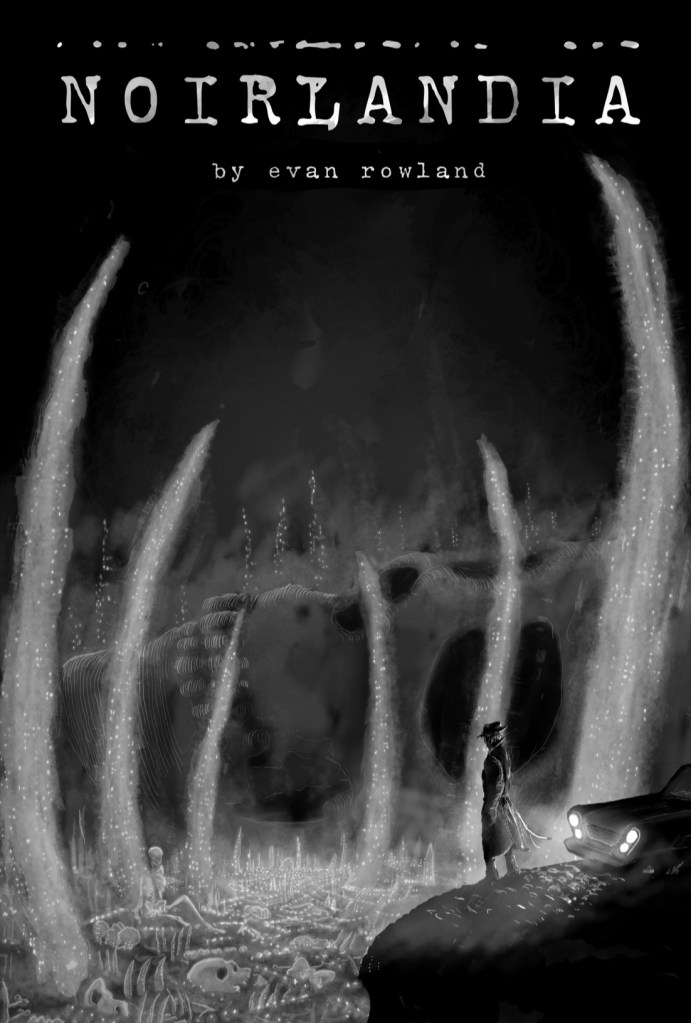
Noir’s one of those genres I like a bit more than average, but I”m not a massive fan of. I studied it in my Media Studies A-Level and it was a good time. Here, we’ve got an RPG which can run through a noir murder mystery all in one night. Even better, it’s a game that encourages using pictures, a cork board, pins and pieces of string.
You play through scenes as you investigate the suspects and locations around the crime, rolling dice and amending the murder board as you go, getting closer to the culprit.
There are rules for creating a mystery, but there are some fantastic premade mysteries provided. One of these is basically an investigation into Mario’s death with the numbers filed off which was the one I’ve run. It was a good time, and there are several genres they’ve put noir mysteries in.
Cthulhu Dark
By Graham Walmsley, Kathryn Jenkins & Helen Gould
Read before? Yes
Played? Yes
This is one of my favourite Locecraftian roleplaying games (for people keeping that, that’s Lovecraftesque and Cthulhu Dark). It’s an ultra-minimalist system which encourages both investigation where the plot won’t get stopped just because you rolled badly, but also embraced the utter nihilistic tragedy of it all. This is the game I’ve used safety tools the most with, the only one I’ve seen the Open Door tool used with, and it’s been so utterly dark that I’m really proud of my players for engaging with those tools.
The system’s simple and the Trophy games actually use rules inspired by them. You have two rolls: Investigation and Doing Anything Else. For both rolls you take one d6 if what you’re doing if within the realms of human possibility, one if your background or occupation might help and another of a different colour if you’re willing to risk your mind. You roll them and check your highest die. For Investigation 4 is a success, 5 is a success with something extra and 6 is a success where you see too much and the world gets a little strange. Specifically on a 1-3 you don’t necessarily fail, but things go wrong in a way that pushes the fiction forward. This is unlike old Call of Cthulhu games where a failed Library Use roll might hold up the story until you try again and success. Doing Anything Else rolls are a little different as you won’t see more than man was meant to see by climbing really quickly or running away from a security guard.
The different coloured die I mentioned earlier is called an Insight Die and there are a couple of times you might roll it. Whenever you do that, you check it against your only stat: Insight. If beats your current Insight then the stat goes up (in a roll, it also needs to be the highest die). At 6 Insight, you’re done, gone. Eaten, destroyed, broken by the realisation of the horrors of the world. Anything like that.
The rules are tiny, originally made to be contained on a sheet of paper, so why make them a massive book?
This book goes into the base rules, then expands them twice. One time is for players to know more, one time is for the GM and goes into the intent a lot more. There’s information on running games, on horrors you might face. Then there’s the majority of the book which are four settings:
- London 1851 & Screams of the Children: The only mystery I’ve run from the book. A house of women find a friend of theirs who was supposed to have run off with a fancy man. She’s returned, she’s missing her baby and is terrified. The investigation was harsh before it got anything supernatural, and has to this day been the one use of the Open Door safety tool that I’ve ever seen. I was so happy at a player for being willing to invoke it and sit out of the latter half, which was brutal.
- Arkham 1692 & The Doors Beyond Time: Set in old Arkham, the scenario sees a family being tormented the day after a witch trial. Perception is messed with and there’s potential to use this as a framing device for the rest.
- Jaiwo 2017 & The Curse of the Zimba: Set in a fictional African nation, the scenario deals with themes of colonialism and appropriation of beliefs which really should have been left alone.
- Mumbai 2037 & Consume: Set around a building so large that it almost defies physics, as a family look for one of their number who vanished. Not for anyone with a fear of heights.
The Kickstarter had a ‘season pass’ with two scenarios, one of which I’ve run as my first ever game with the system, set in Dustbowl America in the 30’s. I’ve run it once as a replacement system for Call of Cthulhu and it worked very well for that. This and Squamous are probably going to be my go to conversion systems.
Apocalypse World: Extended Refbook
By Meguey & D. Vincent Baker
Read before? Yes
Played? No

I thought I’d read all of the Apocalypse World 2E books right up until the start of April when I saw this. Oops. It’s more playbooks which are a bit weirder then the originals, which is saying something.
- The Child-Thing: A feral child and inheritor of the world, including the things which hunt
- The Contaminated: A kind of disease vector, but a bit more supernatural-themed
- The Landfall Marine: You’re part of a crew from space hoping to make Earth more habitable
- The No One: An interesting enigma who may eventually become a person
- The Quarantine: The Fallout playbook, where you came from a bunker in stasis and aren’t used to the weird new world
- The Show: The centre of attention with the ability to draw in fans and change the world
- The Skiller: A selection of new moves belonging to no playbook which you can select when asked to take a move from another playbook. It adds abilities not necessarily tied to any one thing, which is a nice idea
- The Symbiote: A hive mind
- The Waterbearer: You help people by providing water, making it a new challenge for folks to deal with, but also a valuable resource.
The Barbarian’s Bloody Quest, The Wizard’s Grimoire, The Last Adventure and The Thief & The Necromancer
By D. Vincent Baker
Read before? No
Played? No

These are a ton of short RPGs, so I’m lumping them together. I was so far behind, I needed some quick wins. Also I added these to the list despite not actually backing them on Kickstarter. As a member of the Bakers’ Patreon, I get their Kickstarters as part of that and if I was counting the Apocalypse World Burned Over books, I’m going to include these (also later on Under Hollow Hills and World Wide Wrestling 2E).
Each of these books are in pairs between a character book and an adventure book. These are generally for a hero and two GMs playing their enemies. The Thief & Necromancer is a bit different, with two players as heroes who are friends but sometimes may be in conflict.
Using The Barbarian’s Bloody Quest as an example, you have a series of questions which determine your initial stats and a sheet to hand to volunteers to play the wizards you’ll be butchering, explaining what they need to do. The Barbarian triggers moves and rolls dice when they need to in the fiction, while the Wizards have pick lists to mark as they go, all linked to prompts from the Barbarian’s moves. Eventually the Barbarian will find the right Wizard, but until then they’ll kill as many as they have to in order to reach their target.
It’s an interesting system, but one I’m not entirely confident about without playing first. I’ll have to print them out and test them on my group when we’re down a player or two.
Yazeba’s Bed & Breakfast
By Jay Dragon & M Veselak
Read before? No
Played? No
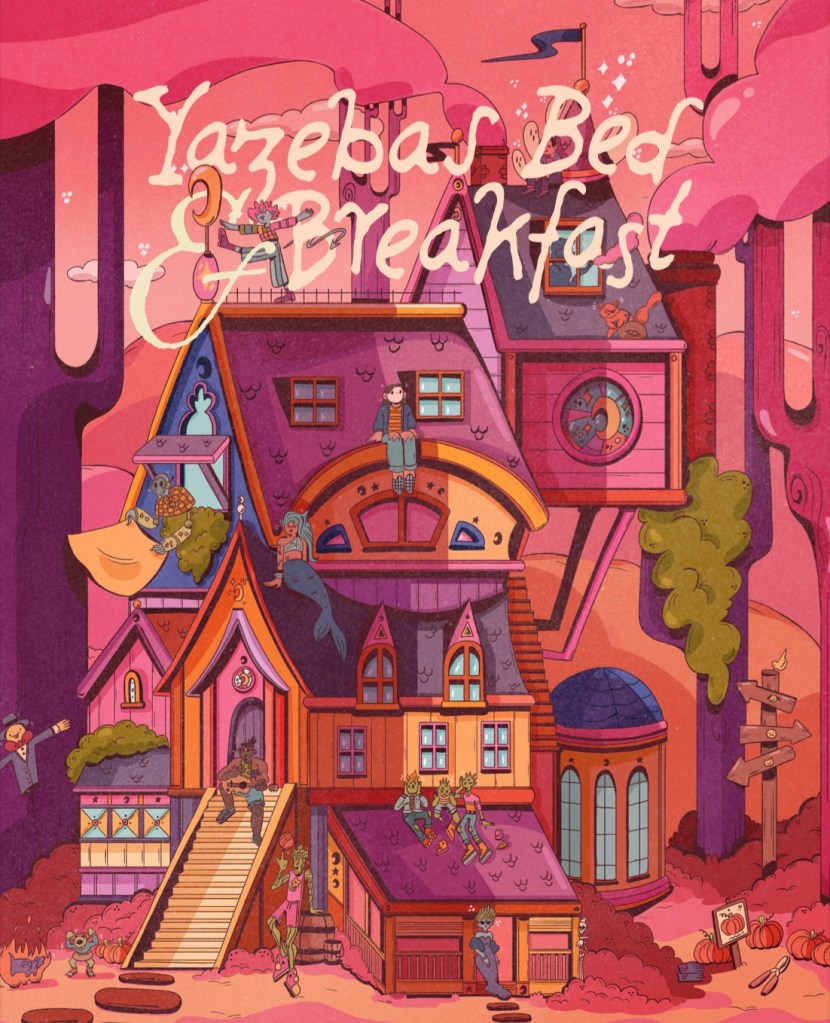
This is one of the biggest books in my marathon, and the one that made me realise this won’t just be Kickstarter in my quest. I’m looking forward to the physical version arriving, but as the digital version (and a video gamey VTT interface, oddly) are out, I figured I’d give it a read.
You’re playing through the lives of the staff and guests at Yazeba’s Bed & Breakfast. She’s a witch who closed off her heart a long time ago, but keeps letting odd people and outcasts into her home. This game delights in toying with the idea of what a roleplaying game is. The scenarios are all chapters in the book, but some of them are locked until you do certain things or fill in spaces in the book with stickers. There are a handful of guests, but more are unlockable and there’s even a bonus character.
The play of the game is easy enough, with characters gaining and losing tokens by performing actions which are disruptive, bad or dumb ‘whoopsies’ or positive, useful or supportive, ‘bingos’. There are only a few different types of chapter, mechanically, but they all change a bit with each one. At one point you’re doing the laundry but using actions which will disrupt the process in order to eventually get it right. You’re suggesting ways to entertain an impatient demon child (another player) and building tokens up on them or watching everything go awry if they ever run out.
The characters are shared, with each chapter suggesting a couple of fixed characters and guests, then the players can pick from anyone else they’ve unlocked. Each character has their own track of achievements or progress or programming.
- Gertrude – A perspective character, masked and living on the washing machine in a B&B where everyone has a room, she’s growing in confidence and learning who she is. They have an achievement list to evolve.
- Hey Kid – A pesky demon child, they don’t know who they are yet, other than a mischief. They’ll develop character traits and doodle a comic on their sheet. Eventually they’ll even become Hey Teen.
- Sal – A chill dude with a sweet van and an interest in music. He’ll be working on a song. He’s also scribbled all over his sheet already.
- Parish – A knight who was cursed into frog form and now works at Yazeba’s in the kitchens. His customisation is based around recipes.
- Amelie – A robot housekeeper who has programming you can customise as you play.
- Yazeba – The witch judging everyone else, gaining and crossing off enemies.

There are evolved versions of some characters like Hey Kid, The Moon Prince as an unlockable character and ways to retire some characters. You also get guests like an evil skeleton called Rag-And-Bones and The Rabbits in The Garden Who Wear Little Outfits.
It looks beautiful and interesting, I’m really curious about trying it out. There’s a demo version which was out in beta and I’m thinking about printing the proper book’s pages which were shown in that document. That way I can test the waters with my group before stickering the full book. The only negative I’ve got at the moment is that if you’re running from the PDF instead of the One More Multiverse VTT or the physical version when it shows up is that there wasn’t a file with the stickers to print out.
Broken Cities
By Côme Martin
Read before? No
Played? No

I’ve realised that any Côme Martin game will be an interesting one. This game is about existing and traversing a strange city, inspired by things like Italo Calvino’s Invisible Cities, making it doubly interesting to me.
The game uses a deck of playing cards to establish the city and the people travelling in it. The city has quirks and a need. And it can change over time. The people have primary and secondary goals, as well as odd pasts. The City plays a card as the focus of the scene and players react to it, making actions and either accepting or refusing any compromises the city makes of them. The city itself is mapped out using the cards and these can move around as you play.
The game is glibly written with a fun tone and a ton of footnotes, although only reading it the game feels like it’s not yet entirely in my grasp. While it could come across a little broad at first for traversing a city, you drill down into the oracles for what you draw and it gets suitably weird. I found this with the author’s Green Dawn Mall, too. I’ll have to play it and see how it goes. This feels like one of those games such as Brindlewood Bay and Trophy Gold where just reading isn’t going to be enough to make a solid judgement of it.
R’lyehwatch
By Jayme Antrim & Jesse Ross
Read before? No
Played? Yes… just recently

I’ve picked up anything Jesse Ross has done, and after the grim portents of the Trophy games, this one was a weird pitch. It’s Baywatch meets Call of Cthulhu. That’s the pitch. Luckily we’re in an age where a game with that basic a premise actually has good mechanics and rules ro back it up.
You’re all lifeguards with one out of three ticked and a role. You also get an ability or piece of equipment and there are nice tables to help you generate your character randomly if the whim takes you. There are negative quirks which you take to make tasks a bit harder in return for rewards. Every character automatically has the ‘slow motion’ quirk to justify running in slo mo like in Baywatch itself. Here it’s explained away that you’re in a spooky city where time doesn’t always work right.
The basic system is that you’ll be given a difficulty between four and six and a stat. You roll a number of dice: one if it’s your stat, one if your role works and one if you spend a Luck and use your perk. You roll the dice and aim to get the difficulty or higher. You can increase the difficulty by tagging in a quirk and gain a Luck point. If you’re successful, you can restore your Grit, the stat working as your health, your composure and your insight into the horrors.
There are tons of tables and pick lists to help you generate episodes, and two scenarios of which I’ve run one do far. It was really good fun, and I’m eager to run it for folks again in the future.
Conclusions
Out of these books, I’ve run three of them on the month I’ve read them.
I’ve added one IndieGoGo book and four which I got through Patreon, along with their companion books. Going forward, there will be other books from crowdfunding platforms beyond Kickstarter arriving, hopefully not so many as to make this an insurmountable task.


 Faked Tales