
Yes, I’m still behind, but I’m ploughing through anyway. I’m not even at the start of Zinequest yet, which might speed things up when that happens. Anyway, onto the games…
Cortex Prime: A Multi-Genre Modular Roleplaying Game

By Cam Banks & Fandom Tabletop, maybe Dire Wolf Digital…
Read before? No
Played? No
I’m not normally one for fairly trad generic RPG systems. Normally if I want a game for a specific genre or topic, there are already several specific games that can do that.
Cortex is a bit of an exception. I first read the most generic and uninteresting versions with Battlestar Galactica and Supernatural which felt like variations on Savage Worlds and not mechanically near enough to the shows they were emulating. Then two quite different superhero RPGs came out and I missed them both. Marvel Heroic had primarily premade characters and an interesting way of representing skills & powers in ways which would allow someone like Hawkeye to be in a team with Thor and not feel like he was a weakling. This was because it wasn’t all granular about how much you could lift, but a focus on the narrative impact of your abilities and the trouble you can end up in. Then there was Smallville, which sounded shockingly interesting for a license I really didn’t give a shit about. Characters had stats in values rather than physical attributes. You created relationship maps which also had dice in them. This way you could be invulnerable, but still have dramatic stakes.
Similar to Savage Worlds, you use sets of dice for attributes, skills, etc. They scale up and after rolling, you pick the highest two. It’s a fairly nice, simple method of rolling dice and represented in clear, clean infographics. The problem is that it’s quite easy to get a bit mixed up in all the widgets. When I first read the book this was a massively off putting thing, but returning it wasn’t as bad as I feared.
Similar to Fate, there are some incredible settings in the book. My favourite is a kind of Thunderbirds style disaster response game. It advances the climate catastrophe even further and has you with high tech vehicles trying to rescue folks.
I don’t think this is great for a new GM, although if someone made a Cortex book for a setting with the core rules built in, that’d probably help make it more accessible to newbies.
Trouble for Hire: A Game of Hi-Octane Road Adventure
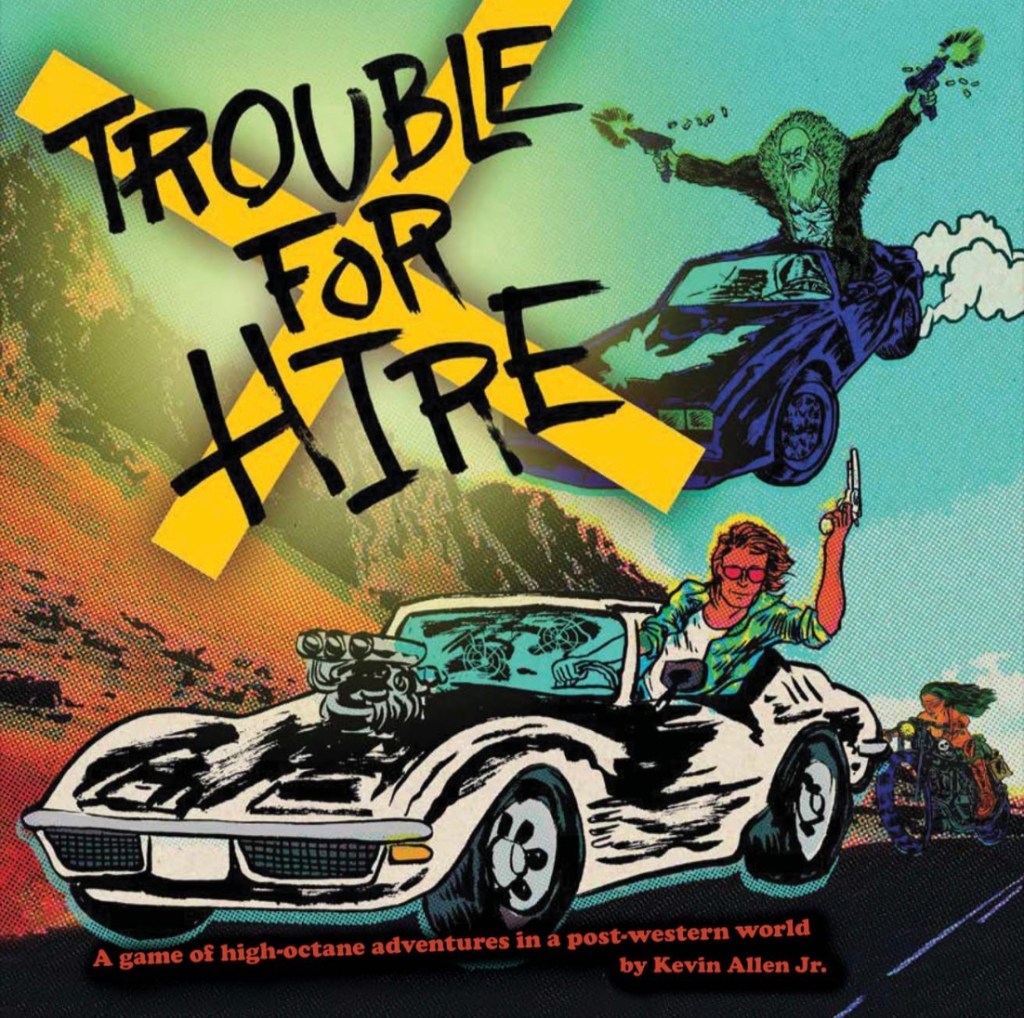
By Kevin Allen Jr & NDP Design
Read before? Yes
Played? Yes
This game is a lot of fun. This game follows Ruben Carlos Ruiz in action movie like tales of his often criminal misadventures on the road.
The thing is, you all control Ruben at different points in the game. There are eight roles and each player will switch them during the game:
- Ruben Carlos Ruiz – our lead, the person who interacts with the world either as a Wild Card, Fighter or Driver
- Los Campañero – Whoever’s Rubén’s sidekick for the story
- La Villanos – The bad guy of the story
- The Editor – a meta role, editing scenes, retconning things and switching things up
- The Road Through the World – literally that
- Los Espectadores – Any extras, whether a crowd or a named person who’s neither a sidekick or enemy
- The Rider – An enigmatic foil, acting as ally or enemy
- La Extraño – Anything supernatural
There are several scenarios which give a rough idea and dramatic beats which happen at set points based on how much you spend RPM, the currency of the game. Each role has actions which cost an amount of RPM and a few free ones. You get more by switching roles and the more you spend, the more you barrel Ruben through the story to its dramatic conclusion.
It feels like a glorious, energetic mess to play, pushing the drama ever forward. The scenarios in the book are good, and there are tools to make more. I definitely want to run this again, and I might have to get a physical copy of the book as it’s gorgeous in PDF.
Tall Pines – A Surreal Murder Mystery Roleplaying Game

By Miles Gaborit & Self-Critical Hits
Read before? Yes
Played? Yes
Tall Pines is basically Twin Peaks as an RPG using some decks of cards to represent the victim, the investigators, clues and even symbolism itself.
There’s been a murder, and through three acts, your characters will look into it, but also into themselves, uncovering the secrets in their town and each other.
Each Act has cards which provide clues. You take turns running through scenes, adding them and their relevant symbols, potentially unlocking a secret depending on the combination you get.
In addition to the clues and secrets, you have Symbolism cards which are played and recycled in interesting ways which keep the ones you play coming back up.

My first time running the game was a little inconclusive, partially as we ran short on time, partially as my lovely group can often be a bit noncommittal with who did a murder in order to keep their options open, and partially as I’d not explained enough that solving the murder is secondary to the personal mysteries.
The second time was stellar, as were the stories a friend told me when she borrowed it to run the X-Files-based expansion. That second time I ran it, we had a high school football star who had died and ended up not just uncovering the murderer, but ended up encountering a weird fraternity of murderous footballer werewolves.
The Veil: Cascade, A Post-Cyberpunk Roleplaying Game

By Fraser Simons & Samjoko Publishing
Read before? No
Played? No
I’d heard about Cascade and assumed it was a sequel to The Veil, which I backed and read for the first time on this quest. Cascade’s set after The Veil and experiments with a bit more of a posthuman vibe to it. There’s technology for people to transmit their consciousnesses into other bodies. There’s a bit more of a sense of exploring the self and what it means.
The new playbooks are:
- The Aesthetic: An artist who’s part of the local counterculture
- The Percipient: A sneaky scout who may be compromised by their creators
- The Denotation: You examine and hack the hybrid reality of physical objects
- The Mnemologist: A trader in memories
- The Telepresence: A newscaster/streaming reporter
- The Futurist: An observer of past, present and future, owned by a weird Society
There’s advice and hacks, as well as some scenarios which I personally find quite useful as it helps get a grip on what you do and how things work.
I originally thought this was a standalone sequel, but it’s definitely an expansion book. Not only does it need the first book for the core rules, but the concepts all feel like they add to it, rather than act as their own separate thing.
Damn the Man, Save the Music

By Hannah Shaffer & Make Big Things
Read before? Yes
Played? Yes
I hadn’t seen Empire Records until I was preparing to run this game, and the moment I did, this all clicked into place. It’s basically Empire Records the RPG.
You’re all employees of a struggling music shop preparing for a Big Shot musician’s arrival, balancing whether you help deal with the problem at hand or advance your personal goals.
There are a number of roles which have minor differences, mainly in the way you play:
- The Local Rockstar
- The Aspiring Poet
- The Troubled Artist
- The Brain
- The Overachiever
- The Space Case
- The Flirt
- The Kid (bonus)
- The Wizard (bonus)
The arc has players run through scenes where the boss gives out tasks and the cast either do them, ignore them to follow their own goal, or heal a relationship with a colleague. It’s going to be tricky getting all of these things done as you’ve only got a scene each per act. Things escalate nicely as everything goes on and people will have to start deciding what they actually want to achieve by the end of the day.
There’s a list in the back which acts as a nice cheat sheet, and example tunes along with the suggestion that everyone make up musicians so people who weren’t around in the 90’s or didn’t follow music aren’t left out.
This is a game that reads well and plays better, making for a quite specific, fun experience.
The Yellow King

By Robin Laws & Pelgrane Press
Read before? Yes
Played? Yes
This game’s actually four books in one, and quite an undertaking to read. I love Chambers’ King in Yellow series of short stories, so I had to get this. It uses the Gumshoe system, but tweaked into a simpler version called “QuickShock”.
Characters will investigate mysteries themed around Chambers’ stories and the horrors of Carcosa, with several ideas of what it might be and encouragement to kind of use all of them as a way of keeping things weird.
You each have characters made of two halves: Your Profession gives Investigative Abilities which will give you clues without rolling (e.g. Sculpture will let you see something off when looking at some sculptures). Your Background gives you General Abilities which can be spent when rolling a d6 to deal with a problem (e.g. someone with Fighting 5 might spend 2 points to make their Fighting roll d6+2). You get a couple of Pushes to ‘push’ the narrative based on your Investigative Abilities.
Combat’s a bit weird, and I created a couple of characters to run through a test combat. You pick an approach to the encounter, roll and try to get above a threshold based on what the approach is. There are cards for shock and injuries you might take depending on how bad things go. Combat tends not to last long which I always appreciate, and the concept of picking an approach worked better than I thought it would.
Rules & Paris
The first book contains the rules and the first setting. You’re all art students in 1980’s Paris. You don’t come from here (unless you’re a Muse, in which case you might). This way it keeps you a bit out of place and uncertain. There’s a big focus on weird art horror, which felt like it could go a bit Velvet Buzzsaw, a bit Grant Morrison’t Annihilator. This is the version I ran, with the group encountering a plaza which only existed in a painting and popped up occasionally, living sculptures, getting trapped in a painting as it repeated again and again and an attempt to create a weird reflection of the Eiffel Tower. It was great fun and very weird.
The Wars
The next setting puts the cast in part of a war which spans Europe but might pivot around France. The war started in the 1910’s and is still going by the late 40’s, with weird Carcosan technology in a kind of Wells/Verne style way. This is intended to be run after the Paris campaign, with character choices directed by what you played previously and the sides in the war based on events in the campaign. There are some interesting different group concepts such as people faking the presence of soldiers to misdirect enemy forces. Technology includes things like weird dragonfly planes, communication via haunted typewriter and weeping mines that float around like deadly jellyfish.
Aftermath
The third setting once again has players’ choices of characters based around who they were previously, but we move over to America. After the events of Paris (and the Repairer of Reputations short story), America became a weird dictatorship in worship of the King in Yellow, ruled over by the Castaigne Dynasty. Aftermath starts in the present day after a victorious rebellion against the dynasty and has you as forces dealing with what happens next. Everything feels like it’s kind of somewhere between the 50’s and 80’s after stagnation and dystopia. There are Carcosan loyalists and monsters still around, there are different political factions all with their ideas about how things should be run. The system adds a few changes to the rules involving the concept of your group, missions and influence.
This is Normal Now
The final setting, which is set in the present and has you playing the same characters in an alternate reality. This one’s our reality, or at least it looks that way. The characters have slight career changes and echoes from the other world. There’s obviously more going on, but it’s best discovered in play. This book also has advice about running the full campaign, moving through (and sometimes back into) other eras. The Yellow King is best when it is weird, jarring, meta and kind of artistic.
Misspent Youth & Sell Out With Me
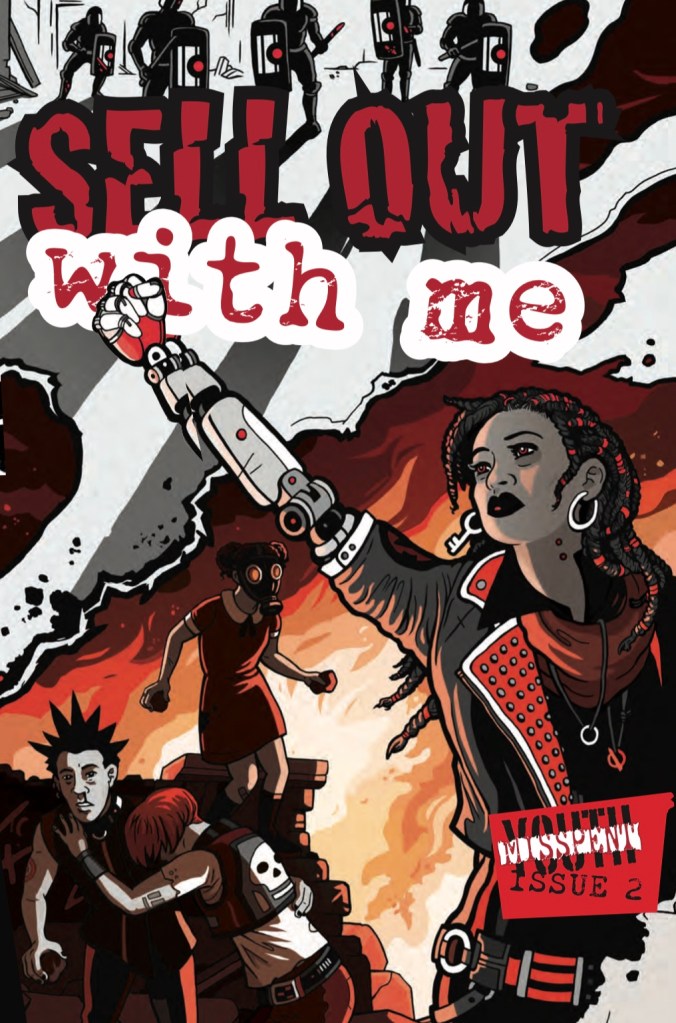
By Robert Bohl
Read before? No
Played? No
Technically the Kickstarter item involved here was just Misspent Youth: Sell Out With Me, but it’s an expansion to the main book which I bought from Robert Bohl’s remaining stock when he was having a closing business sale. Still, I needed to give it a reread to remind myself of the system.
Misspent Youth is a game about Young Offenders who are resisting The Man. It’s generally set in a dystopia, with people rising up and sometimes having to compromise their ideals to succeed. As the GM you literally ask “Who will rise up?” And hold out the dice for someone to take. The players and the GM mark out numbers on a track, claiming them as the story goes on. With any luck by the end, the kids have succeeded and not sold out too much along the way.
There are tools for making your own scenario and characters in the main book, but also a few premade ones (the Codex zine also has one I want to try where you’re all the nemeses of a bat-themed superhero).
Sell Out With Me has so many different scenarios, all grouped by themes. I’m going to list them all as there are so many, but these are the themes:
- Real Worlds
- Flip the Table
- One Giant Leap
- Youth is Wasted on the Young
- Make America Hate Again
- Venusian Worlds
- Fuck Labels!
There are so many RPG authors who have taken part in this, like Kira Magrann, Alex Roberts, Misha Bushyager, Quinn Murphy and more.
There’s also Outrageous Youth by Daniel Levine, a spin on the system turning it from a dystopia to a game about a band.
To be continued in Part Two…


 Faked Tales