
Welcome to part two of the RPGs I read in July this year. There’s a lot of Spire as it’s had several books on Kickstarter and I figured I’d read them all together.
Spire RPG

By Grant Howitt, Christopher Taylor & Rowan, Rook and Decard
Read before? Yes
Played? Yes
This was like coming home after so many books I’ve read for the first time. I’ve run Spire since the demo came out, I read it when the PDF came out, when the physical version arrived and again when I ran a lengthy campaign of it last year. It’s a good read.
Spire was a mile high city filled with strange magic, strange gods and a lot of drow. Then the aelfir came and took it over. They’re kind of like elves if elves were every villain in a Bioshock game with kind of eldritch powers. You play as drow who work for The Ministry, a spy organisation dedicated to bringing the aelfir down.
Your character is made from a Durance which is how you spent your years as an indentured servant of the aelfir (or what you did instead of that if you like to live dangerously). Then there are highly-thematic character classes:
- Azurite – merchants, able to cut deals, talk their way out of problems and see what people really want
- Bound – acrobatic vigilantes who enchant their gear with small gods to help them in their journey
- Carrion-Priests – worshippers of Charnel, a carrion god who worships the eating of the dead. Tactical masterminds with giant pet hyenas
- Firebrand – a shotgun-wielding revolutionary able to inspire riots and survive long enough to make a change
- Idol – a celebrity and artist, able to make a party anywhere and enchant people with their work
- Knight – formerly of an honourable order, now mostly drunk bouncers and enforcers
- Lajhan – priests of an approved deity, able to heal, earn trust and use that trust to their advantage
- Masked – a master of disguise, appearing to be a servant and able to put on a selections of masks for different effects
- Midwife – a caretaker who looks after the young and gradually becomes more and more of a literal spider
- Vermissian Sage – a genius who uses the forbidden interdimensional train line as a library, hiding place and can pull things out of it
The system uses a number of d10’s, with players rolling 1d10 for luck, plus one for a relevant skill, domain, any masteries from gear or abilities. Your highest die measures your level of success and whether you suffer any Stress. The different Stress tracks are unique in here instead of hit points, they act as measurements of your Blood, Mind, Silver, Reputation and Shadow. Stress builds up and the GM rolls to see whether you suffer Fallout, which takes away some of your Stress but has something awful happen. Sometimes this could be death, sometimes it could be a broken limb, debt collectors, or in one case in our campaign, a character’s Shadow fallout had their block of flats raided and public executions of anyone there suspected to be linked to the Ministry.
The system’s good, but the part that shines is the setting. There’s so much to use in a campaign here, so many NPCs, strange concepts and things for players to poke at. Howitt and Taylor do a great job of mixing a fun, weird world and the horror of both the situation and the things that lurk in Spire.
Spire: Strata

The first expansion book for Spire provides a closer examination of some areas in Spire, a couple of character classes and a bunch of campaign frames to start off your game of Spire.
The new classes are:
- Inksmith – a journalist-slash film noir protagonist, using magic to craft the story
- The Shadow Agent – A stack of fake identities with a person underneath, leaving their burdens behind as they shed their disguises
The domains covered in the setting are High Society & Low Society, covering areas all over Spire. I mainly used Ivory Row from this area, but I’ve taken bits from all over when running my campaign.
The frames are:
- Eye of the Beholder – An aelfir noble is ‘improving’ drow using horrible surgical procedures and mind-breaking methods. You need to plan an ugly death, the kind of thing to serve as a warning not to do this again. My group used a cannon and a cake filled with explosives
- Home is where the Hatred is – You’re pretending to be servants of a squabbling dynasty, trying to get to the sealed away heart of the head of the house in order to kill her
- Bisquiet – You’re infiltrating a grimdark fantasy Greggs popular with the aelfir, trying to figure out how to leverage this knowledge. My group put a dead aelfir in a pie, were discovered by an aelfir who’d already developed a taste for dead aelfir (these guys really are awful) and had to burn any trace of their existence
- The Fall of Glasshelm – An aelfir’s seen fit to clean up Red Row of drugs and lawlessness by buying everything up, gentrifying it and of course doing all manner of horrible things
- Better the Devil – You’ve returned to Spire after time away and an aelfir house so awful they were almost all murdered by other aelfir have returned. Yeah, that’s bad
- The Forgotten – A drow cleric who has been looking after any sick, disabled and poor drow has vanished and a suspicious new cult has been offering to take people in
- Ironshrike – A market has sprung up and something’s wrong with it, almost like the market itself might be aware and feeding
- The Sulphurous Presses – You set up a newspaper for the Ministry, having to deal with rivals and keeping yourself from being exposed as operatives
- Lines in the Dirt – You’re living in a building where the tenants are all being evicted. You’re going to develop relationships with the locals and keep them from having to move out
- Dark Harvest – After an operation goes wrong, you flee to the countryside, as much as they have that in a mile high city. The thing is, even the rural life is fraught with mystery and horror, Wicker Man style.
Spire: Sin
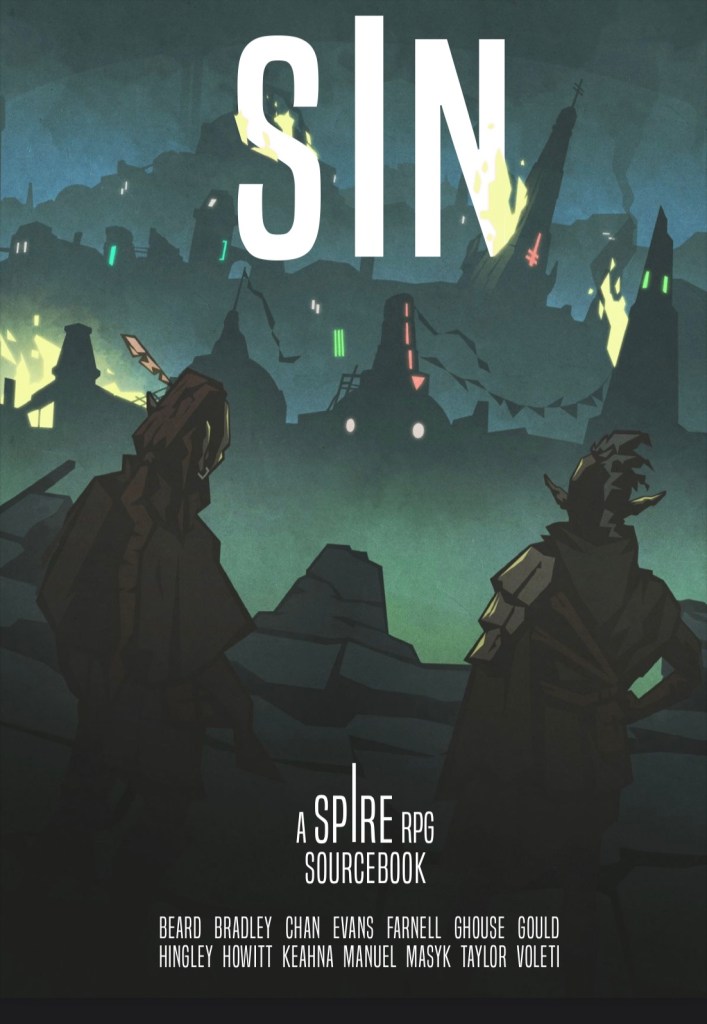
I thought I read more of this than I did. It arrived just as I was in the home stretch of a campaign, so I harvested it for anything related to the areas I was running a game in, then ignored the rest. That meant this was a lovely surprise. It’s also beautifully designed. The previous books look good, but the background was a little distracting.
The new classes are:
- Gutter Cleric – Your worship of gods is focused more on quantity than quality, talking to the gods who infest objects and making scrappy mirables
- Mortician Executioner – A bureaucratic murderer, you declare people dead and then make that a reality
The Domains covered are Crime, Order and Religion, with some fun new facts and even some maps. Crime is especially good, with a selection of brilliant pub names.
The scenarios are each shared out by domain:
- Second-Hand Rain – You’re installed as film noir style private detectives in the North Docks while weird weather’s going on
- Birth of Brother Harvest – A Solar cult to Brother Harvest has been doing some worrying things to manifest their murderous deity and the Ministry needs to nip that in the bud
- In the Hands of the Gods – You’re trying to take advantage of cult war over a holy relic
Legacy: Life Among the Ruins Second Edition

By Mina McJanda & UFO Press
Read before? Yes
Played? No
Legacy is a post-post apocalyptic roleplaying game about watching different factions over a long stretch of time, how they interact with each other, how they deal with problems that everyone’s facing and how that changes over time.
The system’s PbtA, but it scales in and out from your character and your faction, each with their own stats and moves. You all play your character interacting with each other, but when you’re with your own faction there are systems for making quick characters to make sure other players are still able to join in. Once a problem’s gone, you move forwards in time, make new characters and see how your world’s evolved.
The core book contains a lot of resources to use including playbooks for factions and characters, but between this and the follow-up Kickstarter there are a ton of world books you can use and resources for even more customisation.
I got excited while reading this, so I read The Engine of Life and End Game, which are the main toolboxes to add more things to the game. These include new playsets based around even more growth or nihilistic destruction, respectively. There are also scenarios in both books to experiment with the new playbooks.
I’ve run Rhapsody of Blood which my group weren’t as keen on as it felt like there was a bit too much going on at once, but I do want to get this to the table and see what the baseline Legacy is like.
Red Carnations on a Black Grave

By Cat Ramen & Aviatrix Games
Read before? Yes
Played? No
I hadn’t heard about the Paris Commune until I listened to an actual play of this… I think on One-Shot, around the time this was on Kickstarter. This topic is entirely my jam, being about the last revolution in France, both the highs and lows.
The game itself is played using a pair of characters each, going through scenes taking place from the founding of the Paris Commune, the ways it runs and the tragic end. It doesn’t feel like an easy sell, the same way as I love This War of Mine but can only get one friend to play it with me.
It’s all played out through character and scene cards, with free play each time developing the stories of each character. Eventually when The Bloody Week happens, one of your characters will die and one of them may die, depending on what you decide they do followed by a draw from the relevant deck. I’m jealous of a friend of mine who bought the physical copy as I just have the PDF. Hopefully I’ll get to play it at some point in the near future.
Wanderhome

By Jay Dragon & Possum Creek Games
Read before? Yes
Played? Yes
Wanderhome is a game about animalfolk in a pastoral setting, looking for a place to call home. There were bad times, ones which have displaced all of you and set you out on your journey, and one day your journey will stop, but not yet.
A Belonging Outside Belonging game, there are no dice and there’s no GM. Instead everyone has a playbook which says what characters are and are not, the latter of which is an interesting aspect I don’t often see in games. You have moves which you can always do like the Veteran drumming on the pommel of their sword, then there are moves which earn you tokens and ones which cost you tokens. They aren’t mapped onto your success or failure as the game doesn’t concern itself with that sort of thing. Instead spending a token might ease someone’s pain temporarily or know something about a place. Gaining a token can be for sacrificing something to help someone or leaving an offering for the small, forgotten gods. One of the things I love is that you also gain tokens for describing the beauty of the world, which encourages people to gain coins by taking a moment to bask in nature. When you’re travelling in RPGs characters tend to bee-line directly to their next point unless they’re ambushed. Some games like The One Ring have mechanics for travel, but they’re still fairly transactional. I like walking a lot in real life, and I appreciate that they’ve found a way to encourage people to linger.
The whole tone is like that, telling you to take your time, reminding players that any talk about the game is also the game. When you’re making characters, talking about what they’re doing, where they’re going and building things.
Each player has a character with their moves, but they also work together to make a location out of three natures. We talk through the creation and linger there, often arriving when some drama’s already underway and probably leaving before it’s resolved. Your goal is to wander, to spend some time in a place and to move on. It can feel quite different from other RPGs, but there’s beauty in it. At the time of writing I’ve played a couple of sessions online and I’m facilitating a campaign with my weekly group. I’m looking forward to getting back to some drama at some point, but I’m loving existing in this space.
Alice is Missing

By Spenser Stark & Hunters Entertainment
Read before? Yes
Played? Yes
Alice is Missing is a unique idea for a game. The pitch is similar to Tall Pines in that it’s a bit Twin Peaks-ish in a quirky American town hiding secrets. In this game, the protagonist is missing rather than dead. That’s not the unique bit, though, it’s that this is a silent roleplaying game.
You play Alice is Missing as the friends of the titular Alice, all talking on a group chat on their phones. After rounding out your premade character, you start a 90 minute timer and then play the rest in silence round a table or VTT. Every 5-10 minutes a player will turn over a card which might point them to a suspect or a location, or do other things. They can differ quite a bit, but one warning at the start of the game is that you need to know where the light switches are. Any communication is in the chat either to the group or in separate chats with people.
You won’t find Alice before the 90 minutes are up, but it’s less about that than it is about how your characters react to a tense situation. I’ve found the gameplay often starts fairly light and chatty, but as the timer gets further down and the event cards are more frequent, it can get incredibly tense. After the end, whether you’ve found Alice in trouble, safe or dead, it’s recommended to have some time to decompress.
So far I’ve played it three times, twice in person and once virtually. Each experience has been different thanks to the selection of different cards for each event, the decks of suspects and locations and the players I’ve done this with.
Alice is Missing: Silent Falls Expansion
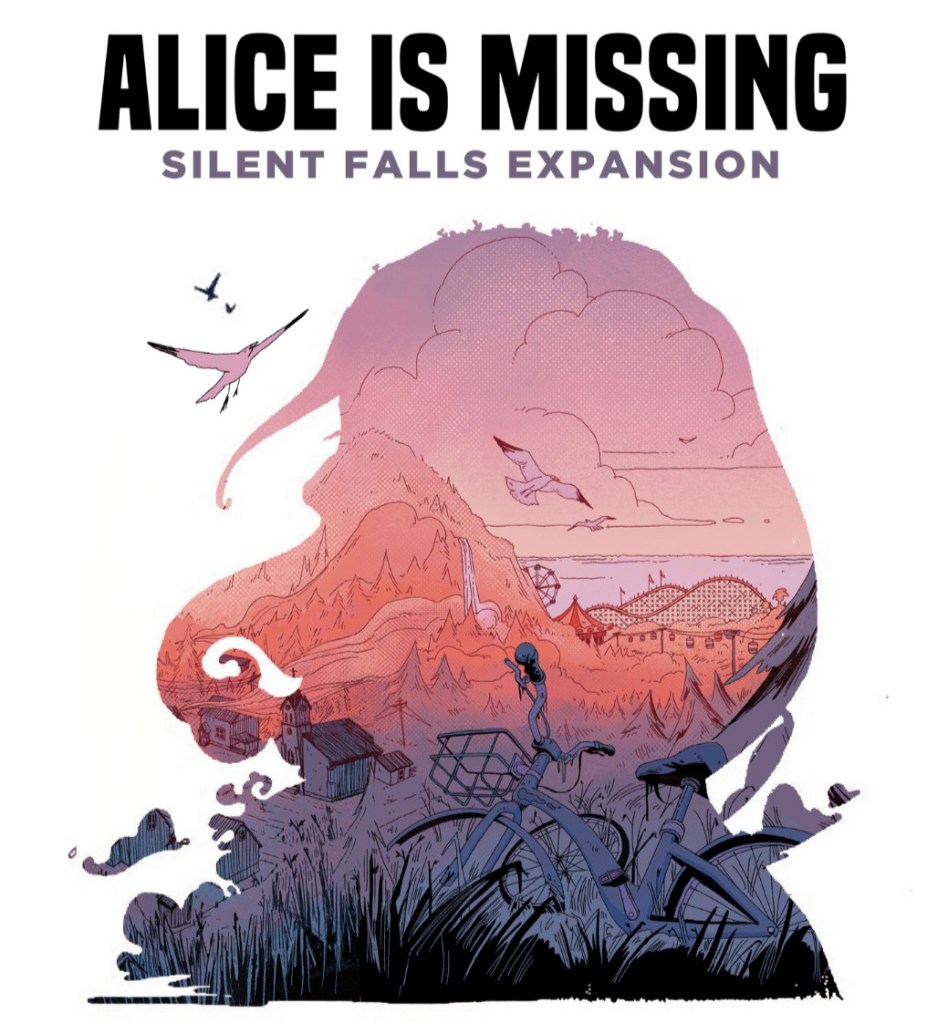
That said, I wouldn’t say no to more cards. Silent Falls is basically that, more of the same. You get six new characters to use alone or mis with the originals. The same goes for suspects, locations and event cards. There are also cards for little twists or additional things to add into the story if it all feels a little simple or like it’s going too well. This expansion has QR code versions of those cards. I’ve only read this in PDF, so I’ve not seen how that works yet, but I’m curious how it’ll work when the physical copy arrives.
Korg Slayer
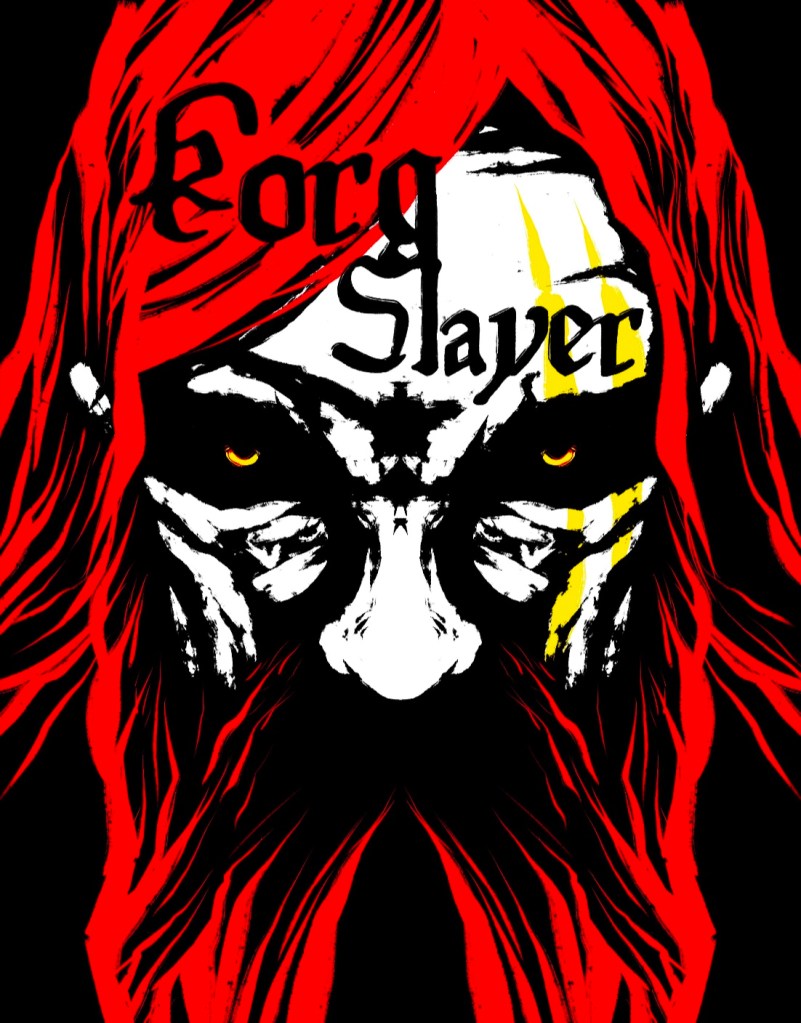
By Caleb Englike
Read before? No
Played? No
I love the idea of solo RPGs. A lot of them go into things like journaling, but there are a few games which go a bit more tactical. Rune even uses a mini and a grid for fights. Korg and Korg Slayer are so small they fit on a couple of plastic cards that easily fit in a wallet. In Korg proper you can shop for items or go exploring. The items you have and the luck of the dice will show how far you get and what might stop you, ‘push your luck’ style. There are traps to bypass and enemies to fight. Korg Slayer introduces boss level enemies.
The cards are neat, there are also PDFs which really take that Mork Borg style of artwork and go into a bit more detail about the places to explore and the things you’re there to kill. I’ve had Korg in my bag for a while in case I get some time to myself and want something to do. I’ve yet to play it, but I’ve added Korg Slayer to the plastic sleeve I’ve put basic Korg in.
Conclusions & Observations
With Spire I’ve hit a point where there are RPGs I’m incredibly familiar with and enjoy a lot. The later entries were all because I was using them (Wanderhome, Alice is Missing) or intended to and failed (Red Carnations, Korg Slayer).
I was on holiday for some of this time, and when I hit Legacy, I decided to just keep going with that style of game rather than move on. I did resist reading all of the Legacy books as there are tons of different campaign worlds to try for it. I’ll probably get round to reading some when I’m done with this quest. As much as my regular group didn’t gel with Rhapsody of Blood, there’s still something appealing with the baseline Legacy so I will try it again.


 Faked Tales