I’ve been speeding up through books and in the chronological read I’m finally hitting Zinequest which was when I figured things would accelerate given the smaller books.
This is also The Month of Mothership, as the final PDFs of the space horror RPG’s first edition arrived and that consumed a lot of my reading time. I even skipped ahead in my chronological read to go through everything I’d backed for Mothership over the years. Expect a lot of that here.
7th Sea Khitai

By Chaosium, Mike Curry, John Wick & Friends
Read before? No
Played? No
Like a lot of 7th Sea fans, I’ve been waiting for this one for a while. I love the 7th Sea RPG and Theah as a setting. The main Kickstarter for 7th Sea Second Edition had a ton of delays, but covered some areas beyond the fantasy Europe in interesting ways, often with people on staff to make sure there weren’t the kind of mistakes that some fantasy versions of our world (including 7th Sea) have done in the past. The thing about 7th Sea 2E is that it was too ambitious in the amount of books, the amount of staff, it seemed to burn bright and quick, leaving a lot of unfinished books and a second campaign based on Asia which faced a ton of delays. Chaosium acquired 7th Sea and eventually, Khitai came out.
The cultures covered in this book are:
- Agnivarsa – Moghul India
- Fusō – Japan
- Han – Korea
- Khazaria – Korea
- Nagaja – Thailand/Southeast Asia
- Shenzhou – China
What era are each of these cultures represented? Purposefully vague/the more swashbuckling eras. This may not be a game telling exactly the same kinds of stories as 7th Sea, but it still has swashbuckling action at its heart.
Characters start out from one of these nations with a background from a long list, five traits from a list of seven and skills. Similar to 7th Sea you grab ten-sided dice equal to your trait + skill, as well as any other bonuses you might get. You say what you’re aiming to do and the GM tells you what additional risks you might face. You roll the dice and group the results together in set totalling 10 or more. Each set solves the main problem and mitigates the risks. Fights work similarly, with sets taking out mooks or potentially injuring named enemies.
I’ve lived through the eras of D&D’s “Oriental Adventures” and even 7th Sea 1E’s attempts at handling Asia, this version has had a massive do-over and goes thoroughly into religion, cultural practices and the interaction between everyone. It feels like a lot of care’s been taken, similar to the second edition in general.
Each nation feels packed with interesting problems and places to visit, similar to the core 7th Sea Second Edition, each with big gaps where the players can be inserted to do heroic things.
Agnivarsa’s ruler has murdered his way to the top while his mother is forming a rebellion. Fusō’s been isolated and busy with civil war which has got in the way of its ambition to expand to its neighbours. Han’s got a mad king and the results of a slave uprising that it’s dealing with. Khazaria’s filled with nomadic groups and looking like it’s going to be invaded by Shenzhou. Nagaja’s an empire of city-states dealing with constant attacks from monsters and monster hunters who are often a problem, too. Shenzhou has a corrupt bureaucracy and seeks to invade everywhere, while being attacked by pirates and bandits.
There are definite themes of rebellion against those in authority, changing the status quo if it’s stagnating or fighting for its return if it was at all progressive.
The book is nicely laid out and instantly familiar if you’ve read 7th Sea itself. I’m still curious how the new take on traits works. In 7th Sea 2E you have five traits which are closer to old ability scores. In Khitai, there are seven based on what you value and you only get five of them. Like 7th Sea 2E you get bonus dice if you keep changing which skill and trait you use, so people won’t constantly be spamming the same thing. If there’s one criticism of latter 7th Sea books including this one, it’s that they have a lot of black & white art which feels a bit jarring compared to the pretty colour layout and art in the rest of the book. I’m aware the campaigns ran low on funds they could put in for art so this was a necessity, it’s just a bit of a shame.
I’ll definitely be running this at some point, like 7th Sea in general.
By the Author of Lady Windemere’s Fan

By Lara Paige Turner and apparently not Oscar Wilde
Read before? Yes
Played? No
You’re all actors who haven’t been paying attention to what theatre production you’re going to be doing. The director’s quit and the show’s starting sooner than you thought. It’s time to use the sets from whatever other plays have been going on and make your own production in the style of Oscar Wilde.
By the Author of Lady Windemere’s Fan is one of those games that sounds like an amazing resource for fun one-shots. Players make a character and between them list out some sets without discussing what they are, then you go through scenes, trying to make a play, steal scenes and generally work out how to make it to the end without everything going awry.
The game feels like Fiasco or What Ho, World in its tone. The voice of the book is really good, including talking about using a battlematt to map out the theatre, but warning that if you LARP the game, then you’re just doing a theatre performance. This feels like a perfect one-shot system for a night where you’re down a player.
Operators RPG

By Kyle Simons and Samjoko Publishing
Read before? Yes
Played? No*
I generally back anything the Simons siblings have launched on Kickstarter. Operators isn’t necessarily a theme I would have gone with, but my liklihood of running it has only gone up over time, mainly after watching the John Wick films.
Operators is a game of highly competent ex-military characters who go through fight and chase-filled action movie stories.
Characters have skills which go down the better you are, as you’ll be rolling Fate Dice and looking for + results equal to your skills. Minuses can cause complications. You have ‘specials’ which are your training, discipline and trademark, each of which help you fudge with the dice and some of them need to be ‘primed’ by referring to them in the narrative. This replicates the kind of Chekhov’s Gunning of things in stories, letting the audience know you’re a master hacker and then getting to use those skills later.
Fights are interesting, using a deck of cards to help narrate the beat by beat play of a quick fight between two characters. While I’ve not run the game, I’ve used the deck when writing prose to help cover the blow-by-blow play. There are chase cards which are similar.
A few Simons staples appear here, like suggestions of everyone making a collage on somewhere like Pinterest in order to create the palette for the players and GM to use.
If there’s one negative, it’s a personal one, as there’s a LOT of military fluff in here. Personally if I ran this kind of game, I’d probably go down the direction of a John Wick or a Kyle Starks comic about assassins rather than needing to know anything realistic.
Kids on Bikes RPG
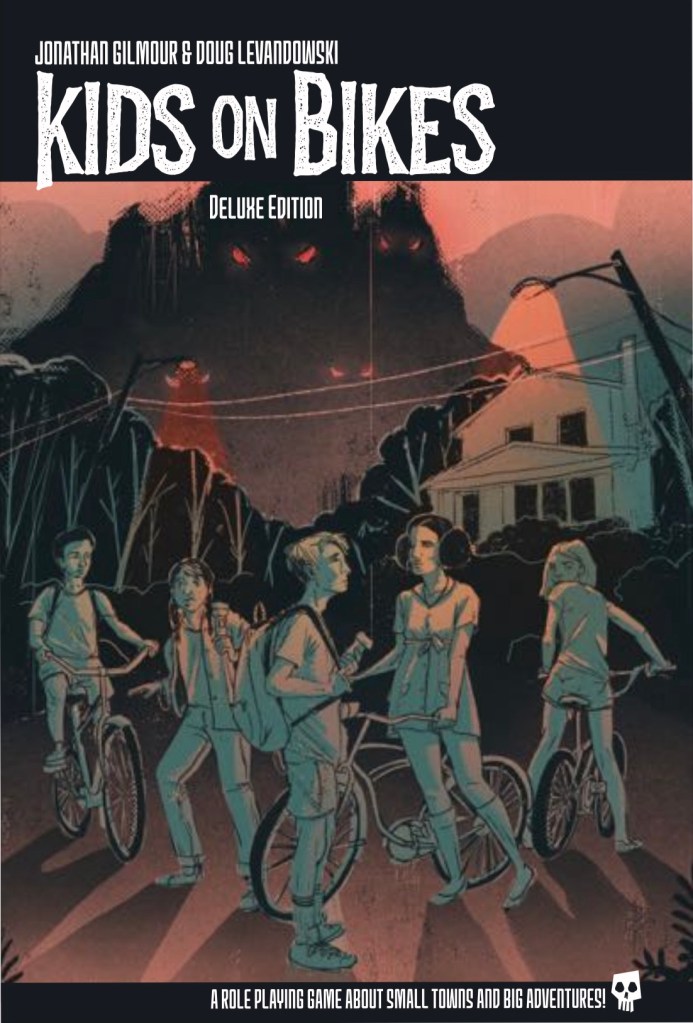
By Jonathan Gilmour, Doug Levandowski and Hunters Entertainment
Read before? Yes
Played? No
Kids on Bikes references things like Stranger Things, The Goonies, It and Paper Girls, as well as having a lovely art style of its own to represent stories of kids on bikes dealing with supernatural things.
Characters are fairly simple to build with escalating die types for their attributes and a selection of traits. It’s really simple, and goes beyond just the aforementioned bike-wielding kids as you might play teenagers or adults joining them on their journeys (again, like in Stranger Things).
The system’s pretty generic and broad, but there’s one core element which is different. There’s a Powered Character who isn’t controlled by any one player or the GM, instead they’re controlled by everyone as each player takes an index card with one aspect of them. It could be telekinesis or a fondness for cookies. That player can pipe up, directing the Powered Character to action. They have tokens making sure that their game-changing abilities are limited and you can’t just TK your way through all problems.
I backed the special edition which has a nice comic at the front and then a TON of scenarios in the back. These include a few sets based on the author’s towns when they grew up, or variations like “Dads on Mowers” which looked like it could be some Barbie movie style weirdness.
I don’t know whether I’d run this or not, the system feels pretty basic, but a lot of the worlds are inspirational enough that I might have to run one of them, just to see what it’s like.
Sigmata: This Signal Kills Fascists

By Chad Walker and Land of NOP
Read before? No
Played? No
Okay, here’s a controversial one. Probably more than it needed to be, but certainly enough that it had to have a follow-up supplement to modify, correct and clarify different elements.
At its basic level, Sigmata is a cyberpunk superhero game in a 1980’s dystopia where Joseph McCarthy became president and while he was got rid of fairly quickly, he put in enough tools for totalitarian rule to take over.
Players are enhanced by a radio signal and work for a rebellion because of this. They are ‘receivers’ with cool powers and cybernetic enhancements. They’re here to help overthrow the Regime and to expand the radio signal as they grow more powerful the nearer they are to it.
There’s a lot of fiction to the world, showing how America could very easily slide (both in the fiction and the real world) into fascism. The easy inaction from a lot of people and the intentional horrors done by the Regime.
The big problem here is that one of the core elements of resisting The Regime is that there are other groups who are sighting them, but most of them are incredibly problematic in different ways. It made the game feel like some weird centrist thing about having to work with one bunch of fascists and problematic actors in order to stop the main ones. Chad goes into great depth replying to this in his follow up, “Repeat the Signal”. The core book also mentions very early on about never giving fascists an inch and that all people have a right to exist, all people have to fight against any fascism and tyranny. Chad’s work in Repeat the Signal clarifies the four factions and specifies that they’re all based on the resistance against the Assad regime, but he feels obscuring things gave a message incredibly far from what he wanted. I’m not his defence force, but after reading both books it feels like the reaction to this project wasn’t entirely wrong, but was incredibly disproportionate and unnecessary in how loud it all got.
Anyway, back to the book. The system has players roll five dice, with d10’s equal to the stat being used and d6’s for the rest, trying to get a 6 on one or more dice. The amount of successes changes up how well or badly a success is. The four stats of Judgement, Guile, Valor and Aggression do pretty much the same things in fights, evasion and intrigue which are the main modes of drama. Repeat the Signal changes things a bit so you can be good or bad at different actions in those modes rather than having a high Aggression meaning you’re always Storming in fights, Rushing in evasion and Confronting in Intrigue.
I admit I’m not won over by these systems for dramatic scenes, but hopefully a playthrough of it would give me a better feeling. There are also different abilities, training and cybernetic pieces which can modify how you do things. After hearing about Chad’s work with Cryptomancer I expected it to be more complex than I’d like, but this is a bit simpler than that.
At the same time, like Operators, I felt the back matter about hacking in the 80’s was possibly a little too long when I read it. If I ran the game I’d probably be thankful for it, but it’s just a bit dry.
Summerland Second Edition

By Greg Saunders and Fire Ruby Designs
Read before? No
Played? No
One day the world became trees. Civilisation was shattered as they pushed through roads, buildings, cities. Then people started feeling the call and left civilisation behind, going into the forest and mostly, they weren’t seen again.
You play survivors of this arborial apocalypse, some of the few people who travel through the woods between cities, helping folks out but also too damaged to stick around communities for too long. Eventually you’ll heal and be ready to settle down, but not yet.
This uses the MiniSix system. You select a skill or attribute and roll d6’s equal to that number, one of which is a Wild Die which will explode if it gets a six, letting you roll it again and again, adding each 6 you get until you roll something else. Tags allow you rerolls and help can lower the difficulty of a task.
The world’s interesting and evocative, although I feel Wildsea which was released later might be an arborial apocalypse which might interest me a little more. The layout of the book is pretty basic and at times I found myself wishing they would get to the point. When looking for the core system there’s so much establishing terms before we actually see how the system works. Given the simplicity of it, an infographic or cheat sheet would have been really nice to help guide the eye through the system.
Hack the Planet

By Fraser Simons & Samjoko Publishing
Read before? Yes
Played? No
I last read this book on a coach home from AireCon in March 2020, just as things were beginning to feel really apocalyptic. I was going to read Apocalypse World Second Edition and couldn’t bring myself to given how things were going. Instead I read this which was also apocalyptic, but in a different way.
Hack the Planet is a Forged in the Dark cyberpunk RPG set in a world which has been environmentally devastated. As everything fell apart, three corporations finally did something to help. Kind of. They created Shelter One, a giant mega-city controlled by the corporations to such a level that the food grown is modified to monitor the people who eat it. There is, of course, classic cyberpunk disparity between the people most at risk from the elements battering even the people in Shelter One, to the decadent rulers in their own safe zones.
You play a gang of Glitches who have hacked their copies to be able to move off the grid and whose gang type can utilise the Acts of God in order to help their missions.
- Cleaners are mercenaries
- Clippers are a biker gang
- Shifters are storm-chasers
- Wired are fences of illicit goods
- Comets drop in to steal stuff from their airships
Characters are one of a few different playbooks:
- Edge – fighters
- Lens – trackers
- Torque – builder
- Fuse – infiltrator
- Haunt – hacker
- Faint – strategist
- Quirk – wanderer & scholar
There are some other game types in the back of the book along with all the stretch goals from the campaign. Keeping them a separated is quite nice for showing what’s part of the essential experience and what isn’t.
Mechanically this is Blades in the Dark. It’s an early hack, so it’s excusable for its lack of ambition in changing things up. The main differences are cybernetics which are mostly stat modifiers and Acts of God which are clock-based devastation which can hit in different ways during missions.
The thing is, I sound a bit negative in saying this hasn’t been too ambitious in what it’s done, but the system’s good and with the small mods here works with the setting. Then you get to Shelter One. Both the factions and the locations make the game. This is an incredible location filled with detail both from what places you’ve got to play in and the agendas of each faction.
I definitely want to run some games in this world, I love Blades in the Dark and Shelter One makes for an interesting, different cyberpunk setting. One which feels a bit less confusing than The Veil was and more relevant to our time than Cyberpunk Red.
Cartel

By Mark Diaz Truman & Magpie Games
Read before? No
Played? No
Cartel is a Powered by the Apocalypse game about people in or around a cartel, under the constant pressure that provides. It focuses more on the narofiction side of things and nicely elaborates what that means. It takes stories like Breaking Bad, The Wire and Desperado as its inspiration to tell desperate, dramatic stories.
The basic moves are framed around this kind of genre like, “Justify your behaviour” and “Turn to violence”, showing how you’ll be interacting with each other and the world. There’s also “Get fucking shot” which highlights the incredible lethality. You’re able to control an amount of that, but you’re best trying not to risk it.
You build up Stress instead of having hit points or harm (after all, if you Get Fucking Shot you just be dead). Like Darkest Self states, when you’ve got too much Stress you’re going to act up, lose yourself or do something else which will get you in trouble. You’re flawed characters, after all.
The playbooks are:
- El Cocinero – The cook, smart and vital but fairly low level
- La Esposa – The spouse of someone who’s involved in the business
- El Halcón – a ambitious lower manager running the street operations
- El Narco – upper management, in charge and responsible for keeping order
- La Polizeta – a corrupt cop, playing both sides
- La Rata – a mole in the organisation, always moments from being found out
- La Sicaria – the enforcer, brutal and surrounded by death
When Cartel was first announced there were concerns that it would be glamourising of the life in some way or cheapening the seriousness of it. The book does a great job of navigating making a compelling drama that’s larger than life the way a television show would be.
It’s an interesting setting and I’m curious to see how it plays, especially for a mini-campaign where you could get into some really messy situations.
Imp of the Perverse

By Nathan D Paoletta
Read before? No
Played? No
First of all, I’ve hired Nathan Paoletta to do a cover and logo for a project of my own in the past.
This book was a difficult read. I’d bounced off it a couple of times previous to this quest. I’m pleased to say that after a while of delving through and wondering if it would be the undignified end of this quest, I eventually got the hang of it.
In Jacksonian America, you are investigators who all have a demon on their shoulder. A ‘perversity’ made manifest that’s eager to nudge you towards being consumed by it. You’ll be carrying out investigations into people who have similar problems but are in a much worse state, often entirely taken over by their imps.
Success in your investigation is a given, but how well it goes and how much of yourself it costs if going to vary. The mechanical terms are a little tricky to get into, especially a month after reading this.
Ratiocination is how you discover clues, using your Standing, Resources and Reason are spent to get your clues, costing an amount equal to the current Anxiety of the threat which will escalate as the game goes on.
Exertion is the die-rolling process which can look a bit involved at first glance. This is the layout of how it goes:
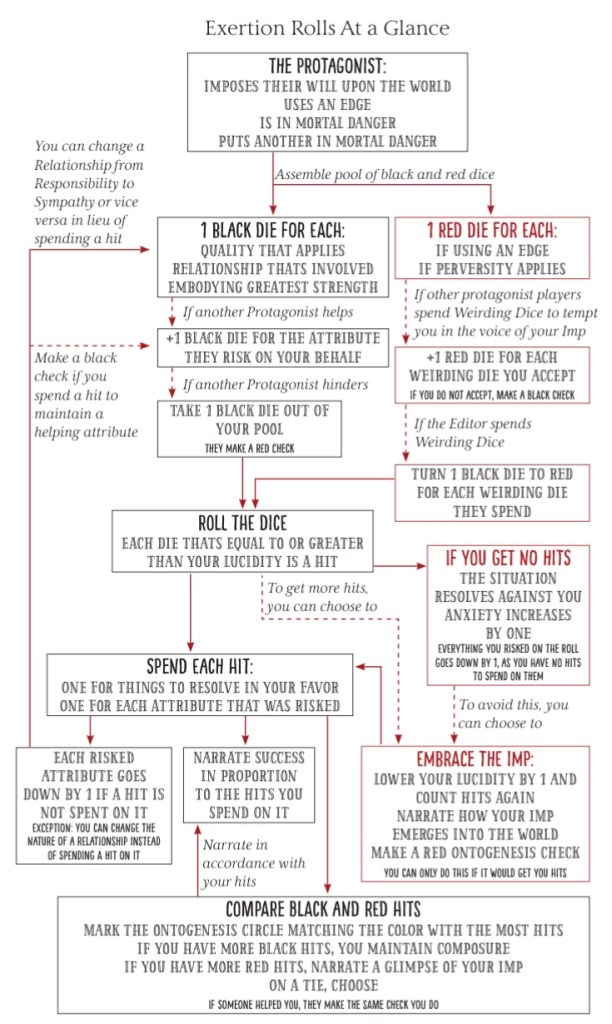
So yeah, it took a bit of time to warm to, and by the end I think I got it. I’d definitely be interested to give this a go, mainly for a one-shot and ideally as a player to get a feel for it. There are elements of the mechanics which remind me of Yellow King like the division of clue-getting and active rolls. There’s also a vibe of an American version of The Between (no, not Ghosts of El Paso). I think if I wanted to do something of this style I’d go with them first, but hopefully if this gets a play I’ll see how it stands out from them and not simply be baffled by the flow of the actions.
Journey Away

By Jacob S. Kellogg
Read before? Yes
Played? No
Here’s an interesting one. Journey Away is a chill fantasy game which works without big challenges and tells small tales set in a small area between a few towns.
Characters are fairly simply built with escalating dice for stats, although you’re not limited by how much you put in each one. This could mean you put all of the stats in at the highest level, but hopefully people will put in whatever’s fitting for the character.
Stories may involve travel between towns, encounters on the way, interactions with each other and the world, but it’s not going to have fights or world-ending battles.
Talking with one of my players about this, he was as horrified as I was at the idea of putting whatever you want in any stat and got a bit hung up on it. I think after reading enough Possum Creek type games I’m a bit more fine with it, but I definitely get the concern.
It’s a nice idea, but I think it sits in an odd halfway house between lighter, more traditional games and the kind of games like Wanderhome which don’t concern themselves with ideas like success or failure and don’t even present the tools which normally engage with those things.
Star Crossed

By Alex Roberts & Bully Pulpit Games
Read before? Yes
Played? No
Star Crossed is a fascinating concept, inspired by the horror game Dread and the idea of doing it, but kind of in reverse. You and another player create characters who are attracted to each other, but can’t be together.
You decide who is the ‘lead’ and who is the ‘follow’ like in dance. Then you take turns taking actions as you play through eight scenes. Some actions require you to pull from a tumbling block tower, and actions like talking require you to be touching the tower to help create a sense of rare importance to the conversations.
A lot of the actions earn you points and collectively you’re wanting to build up a lot of points before you knock the tower down. Yes, unlike Dread you actually want the tower, and your characters’ inhibitions, to fall. The thing is, if it falls too early then this is just a clumsy moment, an awkward revelation or a brief fling. Leave the tower standing by the end and you’ll both let the moment pass. This does mean you’ll pass through a number of scenes, but you actually don’t always want the game to go to the full amount of scenes.
This is a game I definitely want to try, although the only tumbling tower I have is a slightly uneven WH Smith own brand tower which I’ve covered in fake blood and the names of dead Dread characters, which feels like it’d only be fitting for some very specific genres of Star Crossed game.
At time of writing, there’s a BackerKit campaign for an expansion to Star Crossed.
Dream Apart & Dream Askew

By Avery Alder, Benjamin Rosenbaum & Buried Without Ceremony
Read before? No
Played? No
We’re at the founding of Belonging Outside Belonging. I downloaded a copy of Dream Askew a long time ago when it was a much smaller book, and a while after release, it received a proper printing in a book alongside another game in the same system called Dream Apart.
Both games use modified versions of the same system. You have No Dice, No Masters (the other term, which as far as I know is synonymous with Belonging Outside Belonging). Each player creates a character from a playbook, filling in details and possessing moves which gain tokens or require the expenditure of them (weak and strong moves, respectively). You also have a ‘lure’ which encourages people to interact with you in certain ways in order to gain themselves a token. Each player also takes a part of the GM type role in controlling part of the narrative beyond their character. This could be a group of people, a concept or a part of the community. The player with a specific environment defines anything relating to that thing, asks players questions about how they relate to it and throw in story elects based on it.
Dream Apart
Dream Apart is about a queer commune during the apocalypse. The world’s going to hell, but you were already living that kind of life, so your community’s hopefully going to be alright in among it all.
The roles are:
- The Iris – Marked by the psychic maelstrom
- The Hawker – A trader and hustler
- The Stitcher – The person who fixes things and people
- The Tiger – The one who fights
- The Torch – An inspirational figure
- The Arrival – someone new
The setting elements are:
- Varied Scarcities
- Psychic Maelstrom
- Society Intact
- Digital Realm
- Outlying Gangs
- Earth Itself
Dream Askew
Set in a Jewish shtetl, a small market town in the countryside, you’re interacting with other communities and with the unseen world.
Roles include:
- The Sorcerer – someone who interacts with the invisible world
- The Matchmaker – you’re trying to help arrange matches and handle gossip
- The Midwife – you help the births in the community and have seen all manner of things in your work
- The Klezmer – a charmer and performer
- The Scholar – a smart and methodical person
- The Soldier – a protector of the community, lost and violent
The setting elemtns are:
- The Market
- Unseen World
- Goyishe World
- Text & Traditions
- Gossip & Reputation
- Wild Forest
I have minimal knowledge of that side of my family who lapsed over the generations. Luckily in this game there’s a glossary and a lot of information to make it feel accessible for folks.
Looking at the listing of the roles and settings you can see why both use the same skeleton but how they differ quite a lot from each other. It’s also been adapted into several different games whether it’s Umbrella Academy style superheroism in Molotov College, travelling animals in Wanderhome, space adventures in Galactic and more.
I’ve wanted to read this for a while, but the PDF copy I’ve got kept crashing iBooks. I’ve redownloaded it for this quest, so this is the first time I’ve been able to read it since the original, smaller version of Dream Askew.
Behind the Masc

By Beau Sheldon & More
Read before? Yes
Played? No
This is an anthology about looking at masculinity in RPGs, with a number of different materials and articles. All of the pieces have a set of designer notes explaining the purpose behind them which is a nice touch. The authors all have a wide range of backgrounds and experiences which definitely helps make this a good, broad look at the topic.
- The Mabon Monastery – a D&D 5E background about moon worship.
- Ming Dynasty Transgender Man – Artwork
- Chosen of the People – A premade character for D&D 5E
- The Minotaur – A Monsterhearts Skin about protection and of course, a labyrinth
- The Harlequin – Artwork
- The Demi – A Monsterhearts Skin about being a demigod, impressive, powerful and of course, in need of the prayers of your worshippers
- Palisade – A Twine game which I have not tried and can’t speak on
- Echoes – An audio only game which I’ve also not played yet
- The Grifter – An Apocalypse World playbook about being a tricksy so and so
I will say, this is possible the only thing I’ve backed which includes some 5E content. I’m a fan of Beau and there’s enough other material that I don’t begrudge it being here.
Flotsam: Adrift Amongst the Stars

By Joshua Fox & Black Armada
Read before? Yes
Played? Yes
I was writing about Belonging Outside Belonging earlier and here’s another version of it already.
Flotsam is a game about the people living in the lower decks of a science fiction setting, living under the pressure of numerous internal and external challenges. There are tools to create your own setting or several premade ones included. Like Lovecraftesque before there’s an amazing teaching guide which allows you to run the game just with the printed resources.
The system feels a little simpler than the other BoB games, although that might be because it’s the first one I facilitated and the teaching guide did a lot of hand holding.
The playbooks are:
- The Thunder – an enforcer
- The Spider – a sneaky character
- The Voice – a community leader
- The Cast-Off – an outcast
- The Sybil – a prophet
- The Hybrid – a human mixed with an AI or alien
- The Scum – someone connected to the community
- The Outsider – someone trapped in the station from outside
- The Vapour – an AI, ghost or something else
The situations are:
- The Community
- Poverty
- The Gangs
- The Above
- The Spirits
- Outside
- The Resistance
- War
There are more situations than there can be players, allowing you to pick and choose which elements are relevant in your game. The premade scenarios definitely take advantage of this, with required playbooks and situations for the minimal player counts, then others which can be added with each player.
I’ve facilitated a one-shot using The Grey Plague scenario where we were in the bowels of a space station, mostly abandoned to our own devices due to a medical outbreak the upper levels didn’t want to get too near. We had dwindling amounts of medicine and unscrupulous people who’d learnt where the drops of supplies were landing. There were some stand-offs in allotments, intrigues with a hologram bartender playing multiple sides and a drunken enforcer with dwindling authority. It was a really fun time and more dramatic than I thought a game with this structure would be. I’d love to give it another go sometime.
The next part will be basically all Mothership books, so look forward to that…


 Faked Tales