
I’ve got a few more games this time, with a few interesting later PbtAs which do some interesting things with the system. Ther may not be many, but I’ve actually had a pretty good go at running all of them.
Voidheart Symphony

By Miranda McJanda – UFO Press
Read before? No
Played? No
Legacy: Life Among the Ruins had a spin-off called Rhapsody of Blood which was a kind of Castlevania legacy game, as generations of heroes fought evil castles in the past. Voidheart Symphony remixes that idea and brings it to the present.
No longer are you generations of heroes, but normal people living in a normal world. But something’s festering inside it. A wound in the world which is spreading through susceptible minds. The Castle forms around them in a strange dreamspace and starts to infect reality.
In the human realm, players have to deal with life’s problems and their investigation by rolling 2d6 against various gauges representing health, money, notoriety and so on. If both dice beat the gauge then you’re fine, one means a success at cost and neither means bad things.
When you find a way into your enemy’s specific bit of The Castle then it becomes a Powered by the Apocalypse game, with your characters getting their own different set of stats and cool weapons. You can also take items through with you, imbuing them with extra abilities and calling on your friendships in the real world for help.
I’ve not played Persona 5, but I’ve seen my partner play some of it and it’s a heavy influence here. You live out a normal life, go into a strange other realm, fight your way through and take down a boss to improve the world.

Character playbooks are:
- The Authority
- The Captive
- The Harlequin
- The Heretic
- The Icon
- The Inhuman
- The Penitent
- The Provider
- The Watcher
Each of these have fun things they can do in the real and dream worlds, and are further customised by taking tarot-themed Covenants with PCs and NPCs alike.
This is a big game with a lot going on. I love that PbtA games use reference sheets and they’re a good indicator of what to expect from a game. This has a LOT of reference sheets. I’ve heard an actual play which flowed pretty well and I love the idea of something which feels like a Persona/Hunter: The Reckoning sort of thing. While Rhapsody didn’t do well with my group, hopefully in time I’ll be able to test this out on them.
Electric Bastionland RPG

By Chris McDowall – Bastionland Press
Read before? Yes
Played? Yes
Bastion is the most important city. A sprawling, growing mess. Players have failed at a career and have £10,000 in debt. They’re going to get it by going on dangerous adventures.
I’ve listed out character classes or occupations for these games. I won’t be doing that here, as the majority of the book is over 100 ‘Failed Careers’ for your characters. Your highest and lowest stat dictates which career you’ve got and whoever’s the youngest player at the table determines why the £10,000 debt war incurred. Each career has some gear, a short blurb and a couple of tables giving you your money and health, as well as some random things (roughly) scaled to that result.
As an example, result 30a is the Amateur Amputator. They get a bonesaw (d6 damage) and some ether. At £5 starting money that means I unsettled my patients with my paranoia so I get a tiny pistol (d6 damage) that I always keep one hand on. At 6 Hit Protection (HP) I also liked to bring a bottle of Strong Perfume to work.
The system’s an OSR game, but with only Strength, Dexterity and Charisma as your stats. You roll a d20 for a Save, aiming to get equal or lower. If you’re in a fight then you don’t roll attack, just damage. Everyone gets an amount of Hit Protection which absorbs damage and regenerates after a bit of a rest like a shield in a video game. After that it goes into Strength.
There are some great methods for generating maps of Bastion and the spaces outside of it. I’ve run a two-shot of the game where the group were exploring a Waste Forest. I really enjoyed it and definitely want to go back. I think the high point is still the character and world creation, seeing what strange things come from it. Luckily the rest of the game was fun, but I think that’s where a lot of the thrill came from.
Retropunk: Cyberpunk roleplaying game

By Fraser Simons – Samjoko Publishing
Read before? No
Played? No
This is a gorgeous-looking book and another cyberpunk offering from Fraser Simons. It’s a city crawl, with several interestingly made cities in the back from different authors, each with missions to complete.
Your characters are Glitches living off-grid like in Hack the Planet, but in a world with a lot of virtual overlays over things like The Veil. It’s all got a cool, retrofuture, almost vapourwavy aesthetic to the book.
Characters are either Specialists, Heavies or Breakers, with special abilities linked to those classes. Rolls use their Approaches and while this is an OSR-ish game, the system feels reminiscent of Forged in the Dark with the use of Approaches and the way outcomes happen.
This is a very pretty looking book, but out of Simons’ cyberpunk outings I think I still prefer Hack the Planet.
Last Fleet RPG

By Joshua Fox – Black Armada
Read before? Yes
Played? Yes
I love the Battlestar Galactica reboot, irrespective of the finale which I consider to be mainly fine. Like Lost, ultimately it’s about the journey and any long form ongoing media is going to have to have issues which they could have solved if they had somehow known how long they were going to get, when cast members would change and so on.
Anyway, I’m not here to judge the existence of BSG, I’m here to look at Last Fleet.
This is a Powered by the Apocalypse game which replicates the experience of the BSG reboot. You play a fleet of the remaining survivors of the human race, on the run from a relentless force at the same time as handling shortages within the fleet and real or imagined traitors. The default setting has its own potential bunch if infiltrators which are more like a strange fungal network who can chew up people and spit out replacements who may not even know what they are.
There are roles like Tactician, Engineer, Scientist, Marine, Pilot, Influencer & Investigator which provide a move and a defined role as the playbooks are a lot more about what kind of person you are:
- Aries – an impulsive hothead who runs in and pushes the big red button, whether verbally or in a fighter
- Taurus – a dependable, principled character who’ll take a lot of punishment but won’t compromise their beliefs
- Gemini – someone with shady motives, generally crime or mutiny-based
- Cancer – a leader who might be a bit too softhearted and let bad actors get away with things
- Leo – a charismatic leader who inspires followers, hopefully for good and not for culty reasons
- Virgo – an overachiever who takes on too much, pushing themselves beyond the limit
- Libra – a diplomat and manipulator, who might get up to unscrupulous things
- Scorpio – a sleeper agent, losing time and doing awful things they then need to stop and/or cover up
- Sagittarius – someone who loves discovering new things and may stumble into bad situations
- Capricorn – a tactician who may go too far for victory
- Aquarius – an investigator who wants to get to the truth no matter the cost
- Pisces – the supernatural-adjacent playbook with weird visions
You might have noticed a few things about these playbooks. All of them have things they do and ways that might go too far, might break. Instead of health you have Pressure which you’ll constantly be pushing at. The book highlights some moves which raise and lower pressure as being particularly important to the gameplay loop.

There are breaking points which are a combination of some communal and then one or more specific to each playbook. These help give you a scripted moment of acting out, like Monsterhearts’ Darkest Selves.
The fleet itself is created with its core abilities and problems, then you see how the wear and tear of your constant attempts to escape take you. Hopefully home, or to safety, but it’s rarely that kind.
Handily there are two quickstart scenarios and there’s even an alternate version where you play Ancient Greek people trying to outrun death’s vengeance after stealing immortality.
Trophy Loom

By Jesse Ross & Others – Hedgemaze Press & Gauntlet Publishing
Read before? Yes
Played? Yes… kind of
I ran a campaign of Trophy Gold earlier in the year but I didn’t count this as being read back then even if I often referred to it. Trophy Loom’s the setting book for Trophy Dark and Trophy Gold, providing information on the realms you’ll be travelling and the places around them. It’s also anti-canon, to encourage you to use what you want or roll to see what’s there.
It would have been enough if this was a book of tables. If it was a listing of places. It accomplishes a lot more, than that, managing to evoke the strange beauty and horror of the world of Trophy.
The book starts in civilisation, much like your standard treasure hunter might. Specifically, the book provides details about the capital city Ambaret. Districts and traditions are provided in d66 lists. There’s also a nice set of tables about the people of the land which gives even more names for NPCs and random character traits for humans, faeborn, manikins and beast bitten.
Civilisation is fleeting in Trophy though, so the middle section of the book goes into The Borderlands, taking you from wealthy holiday homes to the haven of most Trophy treasure hunters, Fort Duhrin. There’s a scale of law to chaos for each settlement and tables about an outlaw band, about local gods and cults.
The last third of the book, like the last act of most treasure hunters’ lives, is occupied with Kalduhr. The forest grows and consumes. It’s the place where so many Trophy Incursions are set, and this helps fill in some detail. Again, it’s all in d66 tables, so you can roll and inject something random on the way to an Incursion, in-between them or use them to inspire your own stories.
Like fantasy RPGs of old, there are treasure tables at the back, which include such wonderful things as “Coffin of tarnished metal, wrapped in chains and locks. It seems empty and makes no noise when shifted” or “A crown of smoky black crystals woven in bands of tarnished gold”.
I made most use of the Fort Duhrin tables when I ran Trophy Gold, which I guess was to be expected. I used tables about the sisters, waystations, tales about the Witch of Nevask helped inspire other witches.
Venture & Dungeon

By Possum Creek
Read before? Yes
Played? No
This is not one, but two Belonging Outside Belonging RPGs, reflecting fantasy roleplaying games in different ways. Both use the same system as Dream Askew & Dream Apart, where there’s no GM or dice. Players take a character and an element of the setting, asking questions, making weak moves to gain tokens and spending them to make strong moves.
Venture shows us heroes in a fantastical world, finding places to adventure and weird things to do. First up you determine the setup of the quest together, then you set forth. Each character class has a list of things they’re trying to find out through play as well as the main quest.
Roles are:
- The Paladin
- The Fighter
- The Bard
- The Rogue
- The Wizard
- The Cleric
The Setting has:
- The Darkness
- The Celestial
- The Arcane
- The Mundane
- The Authority
- The Underbelly
These seem a little broad, but with the quest established at the start and a focus on the internal quests, they should work well enough.
Dungeon zooms out to the game table itself, with you telling the stories as the characters who play the characters. There’s some interesting bleed between the two places. Not quite DIE level, but in what feels like a much more light-hearted way. The characters each have a role at the table and for their character. The setting elements are all fantastical, with a number of aspects of the dungeon, but also a ton of monsters.
The playbooks are:
- The Cleric
- The Fighter
- The Rogue
- The Wizard
- The Little Sibling
- The Game Master
You’ll note a few oddities there. The character classes reflected often share elements with the person playing them, so when you’re making The Fighter you as what both your characters have given up out of: A Home, A Family, A Gang of Friends, A Support Group, A Mentor or A Happy Ending.The Little Sibling is a glorious mess and while my little sibling wasn’t this bad at the table, it’s common to hear tales of people who did have this experience. The GM may be playing the world in the game, but they have things like traits they project onto NPCs and so on.
The Setting Elements are:
- The Dungeon
- The Denizens
- The Powers-That-Be
- The Mysteries
The Monsters are:
- The Restless Dead
- The Glamorous Ones
- The Gazing Monstrocity
- The Great Dragon
- The Mind Devourer
- The Vampires
Green Dawn Mall – A Zine Quest Game
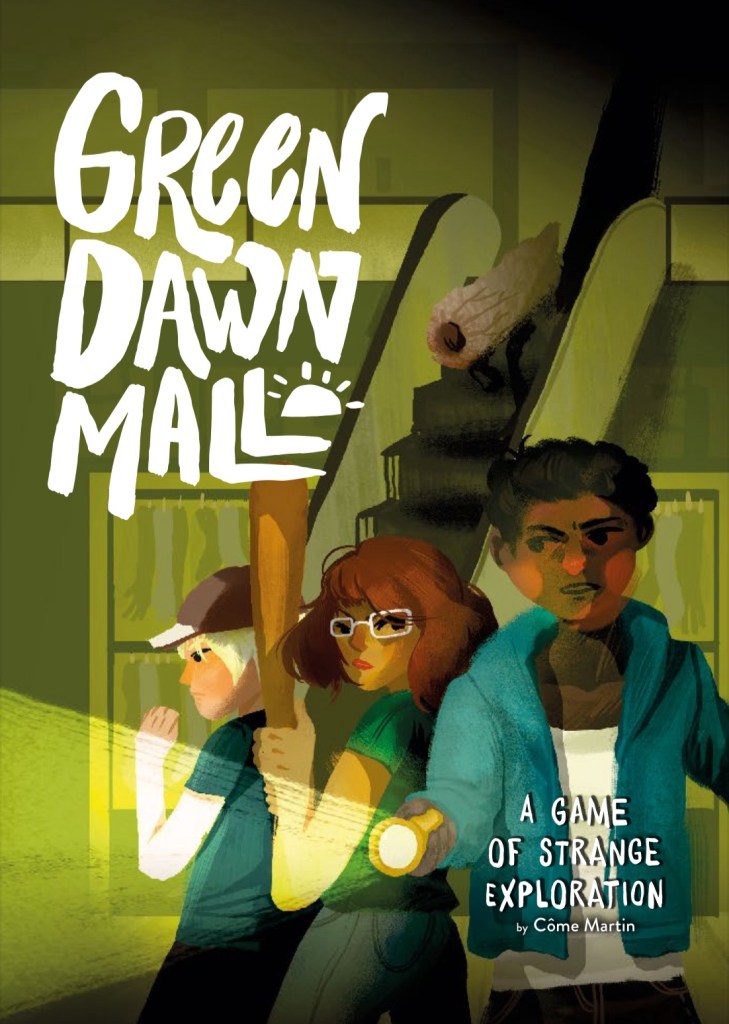
By Côme Martin – Emojk
Read before? Yes
Played? Yes
I’ve reviewed Green Dawn Mall on Who Dares Rolls already so I won’t go too far into it here.
Green Dawn Mall is a surreal ‘mall crawl’ where you make your way through a strange place that lives under and connects shopping malls. There are so many tables for shops, each escalating in weirdness as you get deeper, and rules for places above and below the mall.
When I ran it, the group were trying to find a friend who was desperate to clear up her scaly skin so she went to a potentially mystical pharmacy. The group entered through the basement of a real world mall, found themselves navigating a chaotic roller-rink, talking talking with fish and being pursued by mannequins. They wrecked a toy shop, stole a car and eventually managed to rescue their friend before going hom.
It was somehow disturbing and wholesome all at once. I really enjoyed reading the book and the surreality worked well in play.
Conclusions
I’m finally only 6% behind where I should be after spending most of the year much further behind. This is feeling more doable, but I’m also planning n how to deal with ‘overtime’ if I go over 2023 and still have books to read.


 Faked Tales