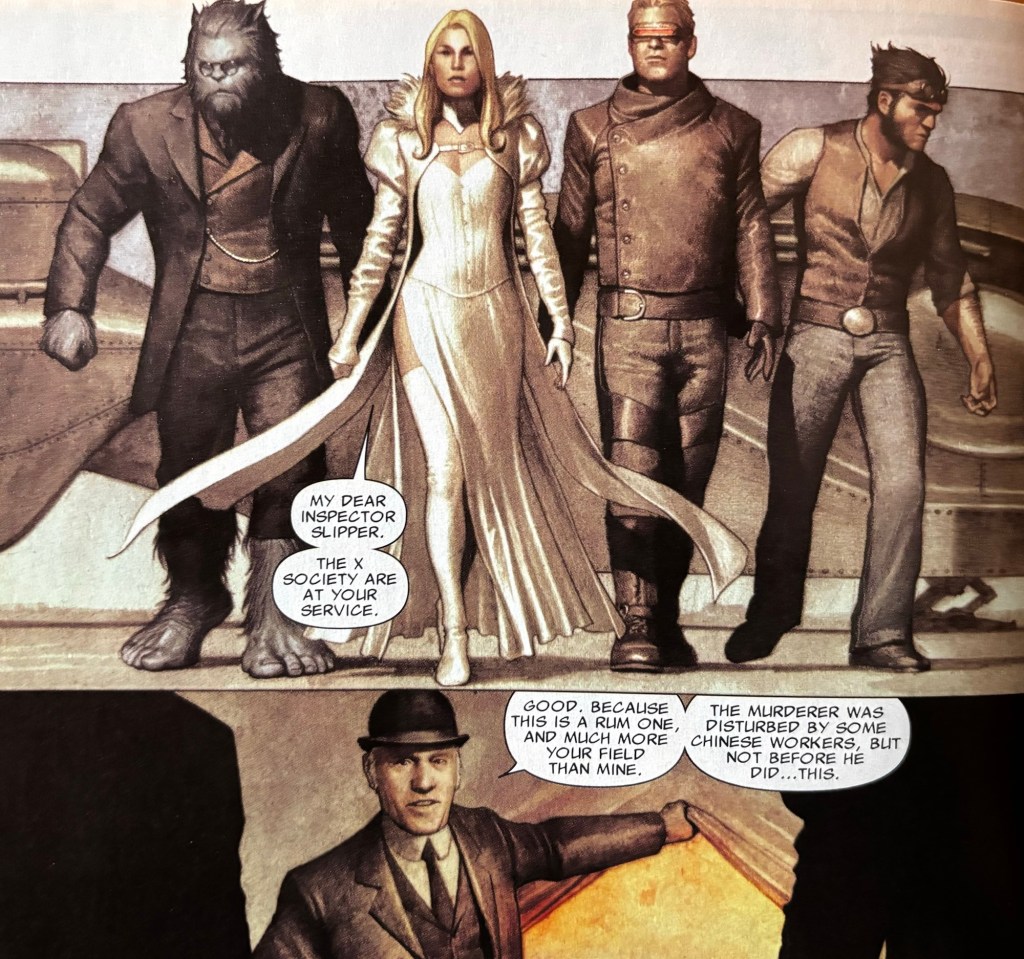
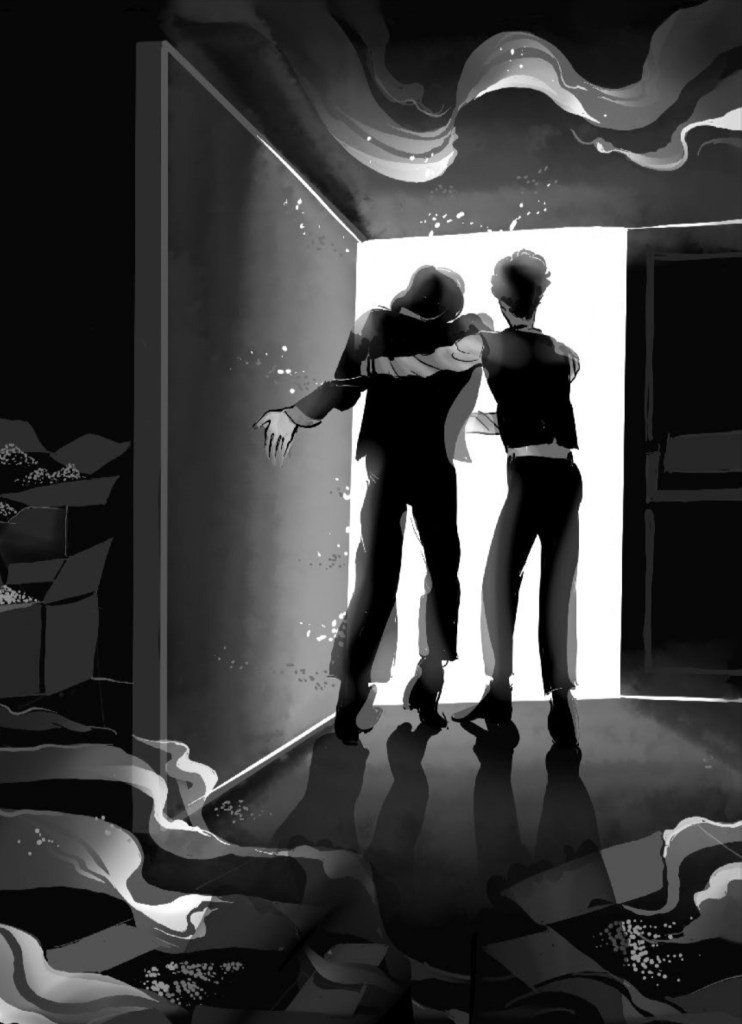
A Victorian X-Men team from an alternate reality, about to solve a murder!
The Between is a game from The Gauntlet which recently finished a campaign on BackerKit. The game’s about Victorian monster hunters who are incredibly messy people. As they investigate mysteries, they often become part of them and could often be seen as pretty villainous.
The X-Men are a group of superheroes made by Marvel who despite their intentions are often hated and feared by humanity who sees them as their own extinction. They try to help other mutants from human, mutant and robot threats. The journey to mutant liberation is a fraught one and the team’s often populated by people who have at one time or another been villains.
I’m a fan of both these messy groups, and while I was watching The Between’s campaign break the record for how much overtime it was running into on BackerKit, I decided to do something involving both these fandoms over on BlueSky. I enjoyed doing it, but I thought I’d expand on it here.
The Between’s protagonists, all about to investigate a mystery.
The American: James Howlett aka Logan aka Wolverine
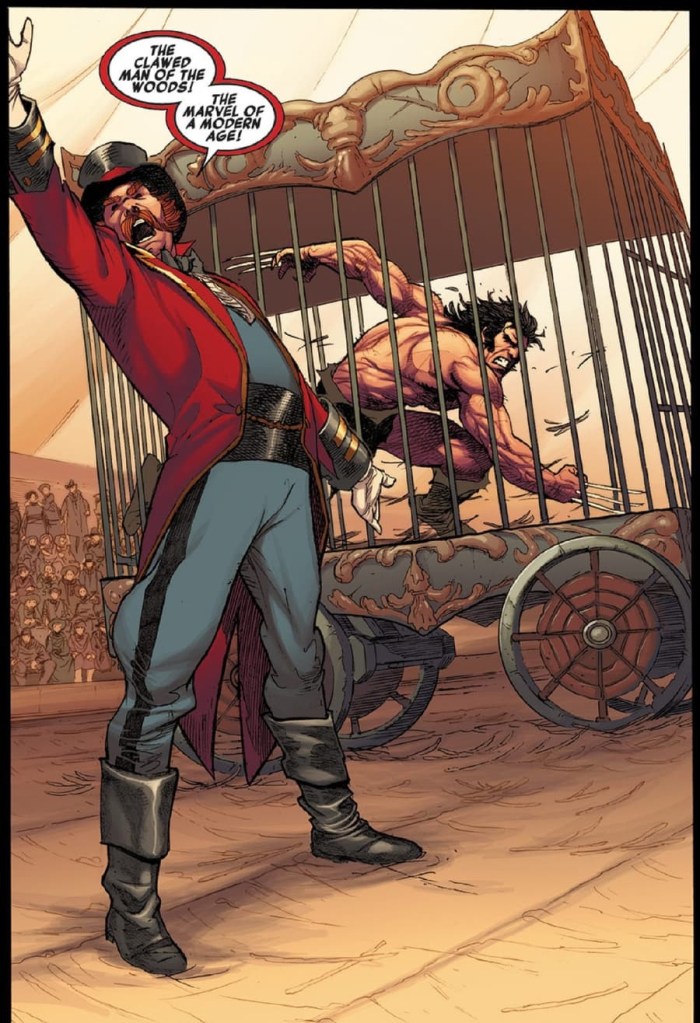
Wolverine’s past. Not a great moment.
We’re going to gloss over the fact that Wolverine’s technically Canadian, because he’s pretty perfect for this role.
The American is the ‘werewolf’ playbook, born of a wealthy family originally, cursed by a feral rage which comes out at night. They’re hunted by officials and the fear that they might become a threat to everyone around them.
James Howlett was born to a wealthy family and marked by tragedy, taking the name Logan and resorting to a feral life in the wilderness. Over the years, he was hunted, made into a weapon and managed to eventually break free of everyone, joining the X-Men. Even so, he’s prone to a berserker rage which can be deadly when coupled with his unbreakable bones.
The Explorer: Professor Charles Francis Xavier aka Professor X
The X-Men’s Problematic Dad
Here was the playbook & character mix-up that made me think of it. The problematic boss.
The Explorer is the ‘campaign’ character, with a relationship with the Mastermind where they have had connections and will be intertwined in their chess match. They travelled the world, colonised places, have a mountain range named after them and left behind a lot of scars. Now they have a lot of contacts from their place of privilege and can call on them for help. Their Masks of the Past don’t look into their backstory but instead show The Boy, who was taken in and abandoned by The Explorer. Their final Mask of the Future has The Boy return and physically destroy The Explorer.
Charles Xavier is the founder of the X-Men and a king of hubris. In his youth he travelled the world, sometimes even with his stepbrother Cain. He met ‘Magnus’, they worked together until they fell out, then he got his legs crushed and went home in a wheelchair. He founded the X-Men and in the name of doing good, often did some abominable things with his telepathy. Folks often mention that he created a child army and… that’s not entirely wrong. He did things like wiped the memories of everyone who knew Hank McCoy in his hometown to make it easier to adopt him, completely wiped Magneto’s mind once, had a whole second X-Men team who died, enslaved a robot and turned it into a Holodeck. The list goes on. I think to make him work as The Explorer, his contacts would have to be his students. I’m not sure who The Boy would be, but there are a lot of candidates.
The Factotum: Forge
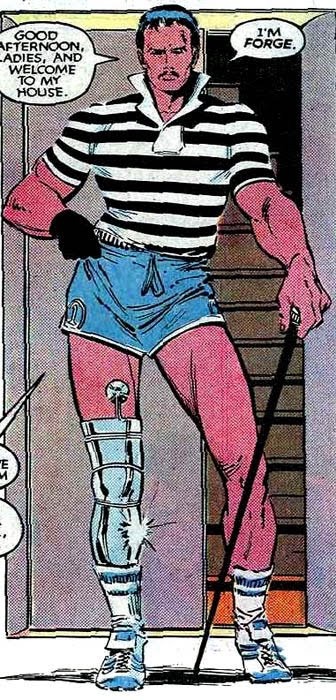
The first appearance of Forge in his little shorts, showing off his bionic bits.
Forge has almost never been a core member of the X-Men and that’s part of the point here.
The Factotum is a servant at Hargrave House, they have their own background and life, bur that’s not important. They are probably the most competent person in the group, but they will not get recognised for it, living a life of service instead.
Forge aka Maker does have a place of his own unlike the Factotum, generally Eagle Plaza in Dallas. Like the Factotum he has his own dreams and ambitions (a lot of them being Storm), but they will always be unfulfilled. He’s rarely been part of the X-Men outside of as a support role. He makes their technology, repairs them and even in a leadership role with X-Factor ends up helping others out. On the nation of Krakoa, he helped give Domino a weird biological arm-weapon and Wolverine an adamantium surfboard. Now that’s service!
The Mother: Dr Henry Philip McCoy aka The Beast
Beast and an army of clones he’s intentionally made weaker than him, making a clone army of Wolverines.
The Mother is clinical, rational and has a grim project. They’re the ones most eager to get their hands bloody, to dig up graves and assist the authorities in order to get what they want. They have a creature they’re making, one they’re emotionally attached to, harvesting body parts and eventually animating it.
The version of Beast I’m thinking of here is the one from the modern age, where he was the Henry Kissinger of mutantkind, carrying out clinical genocides and cloning an army of Wolverines to assassinate people in the name of Krakoa. The truth is, he was always leading down this path. He experimented on himself and went all grey (then blue). He traded a mentally unwell unhoused woman to Mr Sinister for information. He killed an alternate reality just in case it was bad. Then there was all of the mutant CIA stuff.
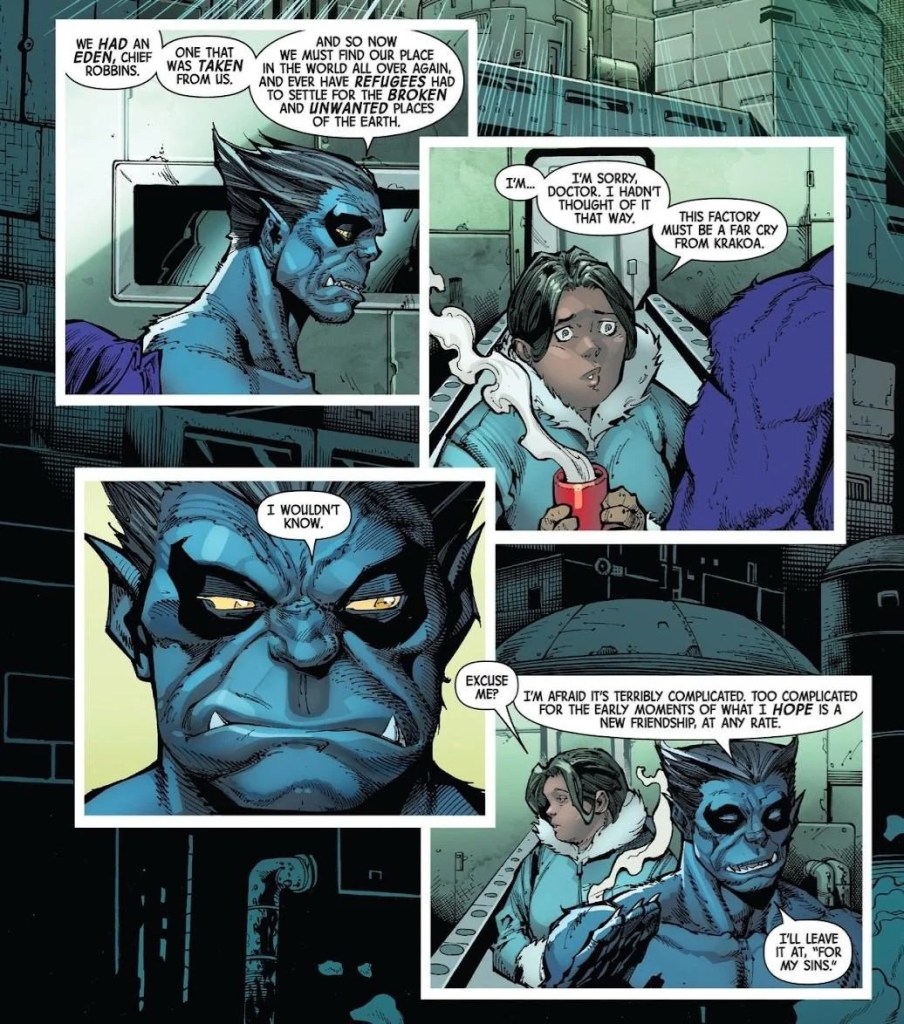
The Orphan: Dr Hank McCoy aka The Beast
Hank McCoy The Younger
This was a fun thought, so I had to follow it.
The Orphan is an unlockable playbook, accessible if The Mother completes their project and things don’t go too badly. They’re helpful and bear the sins of their creator. You have some friends, but also may give in to the occasional rage.
Beast left behind a backup version of himself from his Avengers stoner friend of Wonder Man era as he felt it was useless. The X-Men decided to use it to help stop the older, more evil Beast and his clone army. Now this Hank’s the reigning Beast. He’s aware he’s atoning for things another version of him did, a version he could become. He’s not quite a clone, but he’s angry about what he’s done, what he could do and how things have turned out.
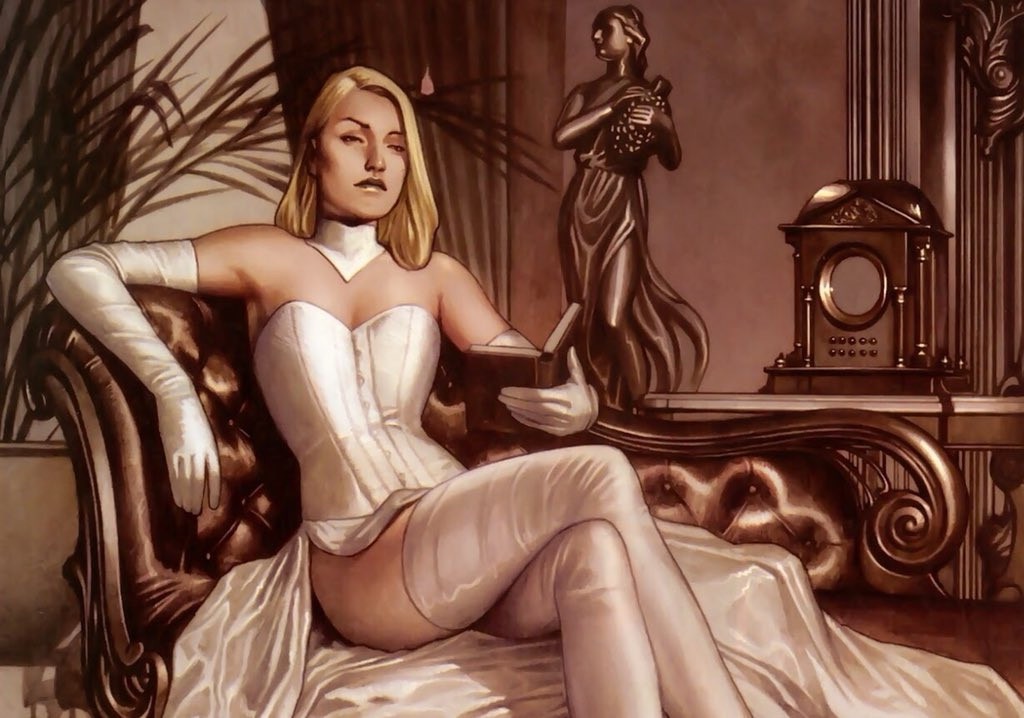
The Undeniable: Emma Grace Frost aka The White Queen
Emma Frost in the Victorian alternate reality isn’t too far away from the regular version.
This was difficult. I nearly went with Storm, but there are enough elements of Emma Frost which work better with it.
The Undeniable is a Dorian Grey kind of character. They’re beautiful, immortal and heartless. Somewhere, there’s a work of art looked after by a cult. When hurt or when they transgress, the work of art is scarred somehow. They have a lot of potential to be a real villain.
Emma Frost started out as a villain and a member of the Hellfire Club, one of the most Chris Claremont creations he made in his run writing the X-Men. Despite this, she actually was a good teacher (apart from the time she exploded a horse… it’s assumed she was on a LOT of drugs during her Hellfire days). She joined Generation X as a teacher and then the X-Men after a mutant genocide. Since then she’s alternated between active team member, teacher and reverting back to her Hellfire Club ways. To use her as the Undeniable, the work of art AND the cult could be her students. That way they get worse or end up dying, like too many of her students have, all while she remains a flawless diamond.
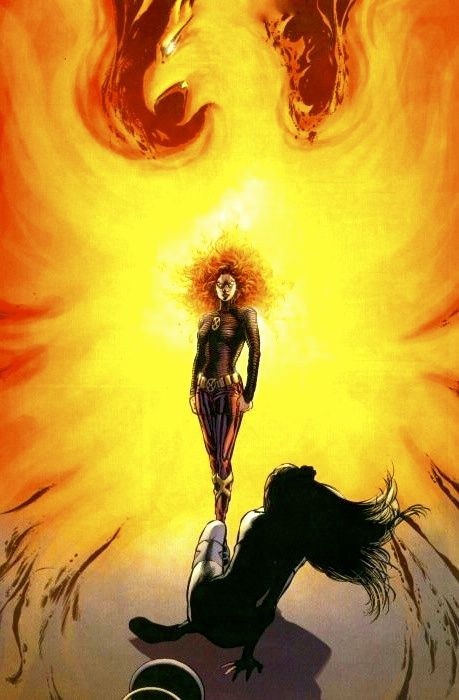
The Vessel: Jean Elaine Grey aka Marvel Girl aka Phoenix
Fire and Life Incarnate
Another perfect fit with very little change needed.
The Vessel is as close as you get to a Magic-User in The Between. The magic specifically comes from dark forces who are attracted to The Vessel. They’re drawn to darkness and threatened to be consumed by it.
Jean Grey is a good person, more than you’d think for The Vessel, but that doesn’t mean she’s a nice person. The Phoenix was drawn to her and took her place for a time, living as her. Later, it became more clear that it was still Jean in some way, even if it wasn’t her body. As Phoenix, she is fire and life incarnate. She’s killed a planet, she made Mastermind so cosmically aware that it broke his brain. While Phoenix died and became Jean again, the pair have been linked many times as Phoenix can never really give up Jean. Just re-flavour the dark forces and maybe have the Witches as worshippers of it.
The Mastermind Theodora Braithwaite: Max Eisenhardt aka Erik Lensherr aka Magnus aka Magneto
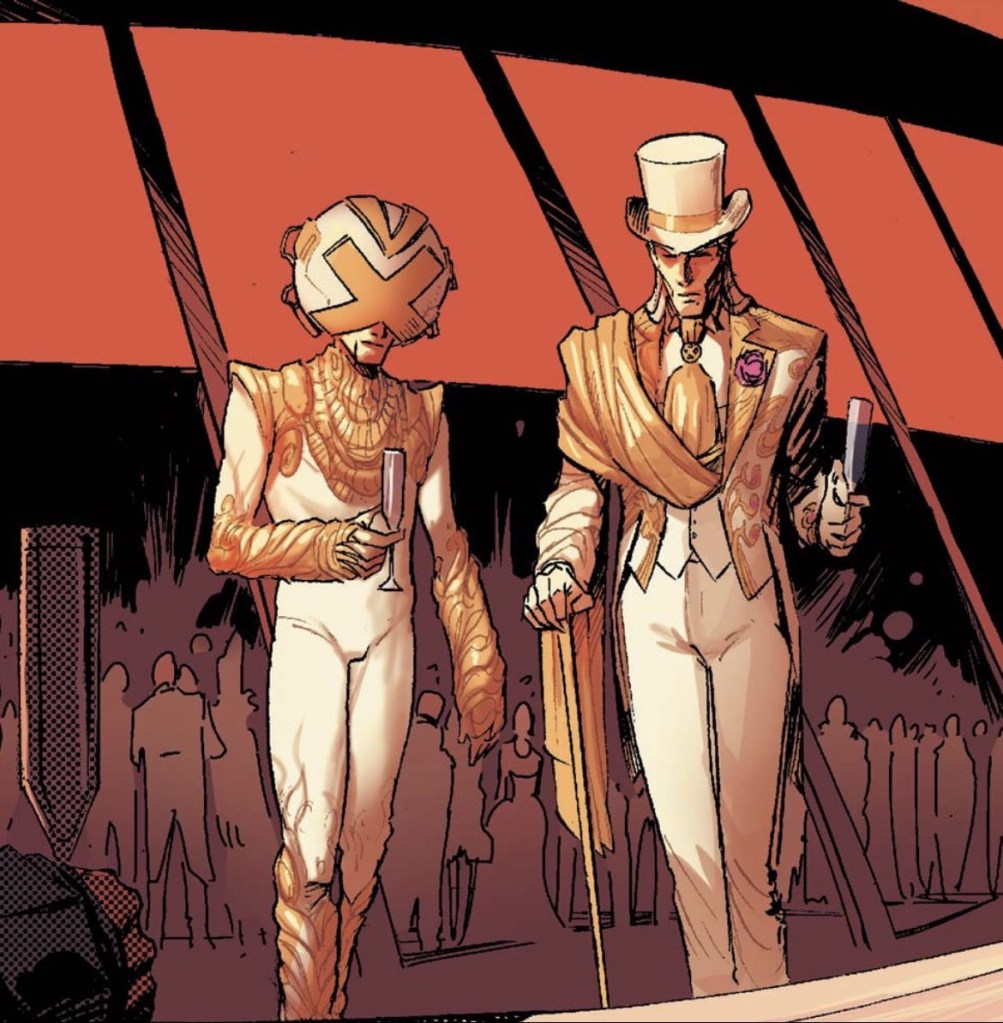
Professor X and Magneto in their coordinated outfits at the Hellfire Gala.
This isn’t really a playbook, but the season’s big bad. Theodora Braithwaite was a victim of colonisation, a pirate and after a falling out with the Queen, wants to use a campaign of terror to take control and rule without any concern about morality. She’s ominous and ever-present, a Moriarty figure to the hunters of Hargrave House.
Magneto is the best friend and worst enemy of Professor X. The two are intrinsically linked, each others’ biggest defender and hater all at the same time. Magneto, as the saying goes, made some valid points. He knew that mutants may get tolerated but won’t get accepted, not really. He wanted to take over for mutantkind, viewing them as superior and ignoring any assimilationist/integration-based ideas. He’d be a great Mastermind to have linked to the Explorer.
Bonuses:
You can hear Limp Bizkit in the background of this panel.
The Martian is an alien with strange powers and inherited weapons. My choice for him would be Adam X, The X-Treme, specifically the version from Fabian Nicieza where he was a bit more of a Luke Skywalker than a Limp Bizkit fan. His powers allow him to electrocute people’s blood, but it has to be exposed, so his costume is covered in knives. He also skateboards, because he’s from the 90’s.
TheInformals are helpers to Hargrave House. You play a number of them, each with their own abilities but also all doomed. To be honest, these are probably the New Mutants or New X-Men, as they’re all useful but to have a terrible amount of casualties. Poor Doug. And Jay. And two of the Stepford Cuckoos. And so on, and so on.
The Legacy is hunting a beast, defining it at they go. I was tempted to say Cyclops as my boy’s not appeared on the list yet and hunting Sinister would work here. Instead, I’m going to say Bishop, given his hunt for a traitor to the X-Men and his combat abilities. Sometimes he goes through periods of trying to be peaceful, other times he burns the world to make his hunt easier.
The Underground is an Alice in Wonderland type character, thought to be mad and having spent a lot of time in a strange Wonderland. This is one of the new ones, so I don’t know a lot about it, but my first instinct is Longshot. Longshot comes from a strange wonderland called The Mojoverse, run by spineless creatures who get nightmares from our television signals and turned that into their belief system. Longshot’s often lost there, leading resistance efforts and then getting mindwiped. He’s often more Dorothy than he is Alice, but I feel this works. Oh, and he’s also his own grandfather/grandson, but that’s neither here nor there.
The Volatile would be Beast or Forge if they weren’t already claimed. As someone who keeps modifying themselves in volatile ways with science, you could probably get away with having Mr Sinister as them, as he has been someone who keeps tinkering with his genetics. Alternatively if you want someone a little less evil, there’s Greycrow, who has a ton of cybernetic modifications and is always tinkering with himself. He’s also emotionally pretty volatile.
The Dodger is Gambit, obviously.
That is all and I will not be taking any questions.
00:03:55 What Non-Star Trek Thing We’ve Been Enjoying: Still Wakes the Deep, Kew Gardens’ Halloween Trail
00:09:58 Star Trek: The Animated Series “The Eye of the Beholder”
00:35:37 Star Trek: Prodigy “A Tribble Called Quest”
00:56:03 Star Trek: Lower Decks “I Have No Bones, Yet I Must Scream”
Talking points include: Pokémon, which Pokémon wore sunglasses the best? Dave Willis, Still Wakes the Deep, big ups to The Chinese Room, Alien Isolation, Kew Gardens, Merry Xmas Everyone, that song from X-Men Apocalypse or whatever one it was, Charlie tries to remember X-Men: Dark Phoenix, Roger Dean album covers, sand trouts in Dune, that one Flight of the Conchords song where a leg gets eaten, Play-Doh, Morph, vast, desolate landscapes, does The Federation still have Timpsons? You don’t put the Scottish in a zoo, space zoos, Equilibrium, at some point Charlie should watch Star Trek, dunking on Chakotay, picking up a story partway through, Peter David’s weird universal Majel Barrett thing, X-Men, I Have No Mouth And I Must Scream, Todd in the Shadows, Miles gets angry at Charlie, the show and himself for having to listen to Oliver Anthony Music, Anthony Michael Hall, self-destructive insubordination at work, bones and teeth aren’t the same thing, Charlie’s childhood rabbit and the little bunny gulag, Monty Python and the Holy Grail, Nolan North, Vegeta & Goku workforce dynamics, trying to stop from having any Big Bang Theory rants, can you tell Charlie’s vamping for time because he forgot who wrote I Have No Mouth and I Must Scream? The Spoony Experiment, Awesomed by Comics, Miles was right to be a despairing heap on a men’s room floor given the election results. Oh, and occasionally Star Trek.
It’s truly horrid.
Pedant’s Corner:
While I don’t recall Karate Kid being in a zoo in The Legion of Super-Heroes, there was a tragic story about Beast Boy of Lallor dying defending a girl from a zoo animal.
The fish that nibble you in those baths are not piranhas. DO NOT have piranhas nibble your feet.
Oliver Anthony Music has since given up music, I assume it was pressure from us at Casual Trek.
Peter Pan isn’t killed in the holodeck, but Robin Hood
Casual Trek is by Charlie Etheridge-Nunn and Miles Reid-Lobatto, guest starring Reanna Reid-Lobattto and a sample of Harlan Ellison’s I Have No Mouth and I Must Scream.
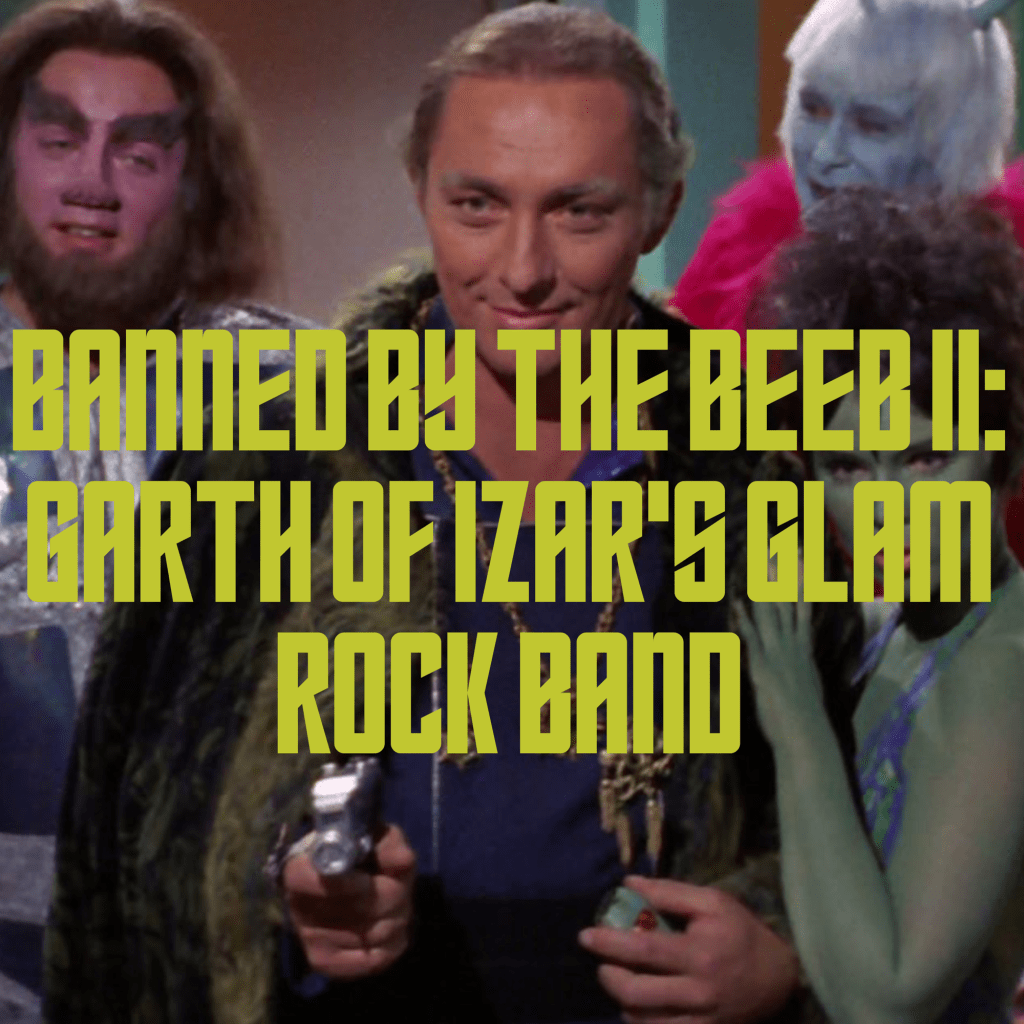
Who’s your favourite band member? I like Stone Tellarite and Green Batgirl
Dust off your illegal VHS tapes and be prepared to write a strongly worded letter to Points of View because we’re back with the second part of our ‘Banned by the Beeb’ two-parter looking at three more episodes of Star Trek that suffered the wrath of British censorship.
We’re back with three episodes, the final two banned TOS episodes, starting with ‘The Empath’ where William Shatner has to do some Dark Place style slow-motion running and McCoy definitely violates some medical practices as our latest butt-headed aliens the Vians pull out the chains and then with ‘Whom Gods Destroy’ where Kirk and Spock are repeatedly taken in and out of rooms and forced to ask chess questions by a mad-man in mismatched boots. Which episode is more controversial – SHOOT THEM BOTH, SPOCK! But after that, the fun and hijinks go away with ‘The High Ground,’ a TNG episode banned due to a line about Irish Reunification and Miles and Charlie find themselves having to ponder the age old question, can a show written, produced and made by Americans talk about how fighting for independence against oppressive colonialist Imperialism and somehow seem to conclude that it’s a bad thing, actually. Or, as Miles’ wife Reanna said as she watched the episode with him ‘Gosh, this has aged well.’ There are some things we can try to make fun, not everything.
Episodes discussed
‘The Empath’ (11:37)
‘Whom Gods Destroy’ (42:59)
‘The High Ground (01:08:30)
Oh Data…
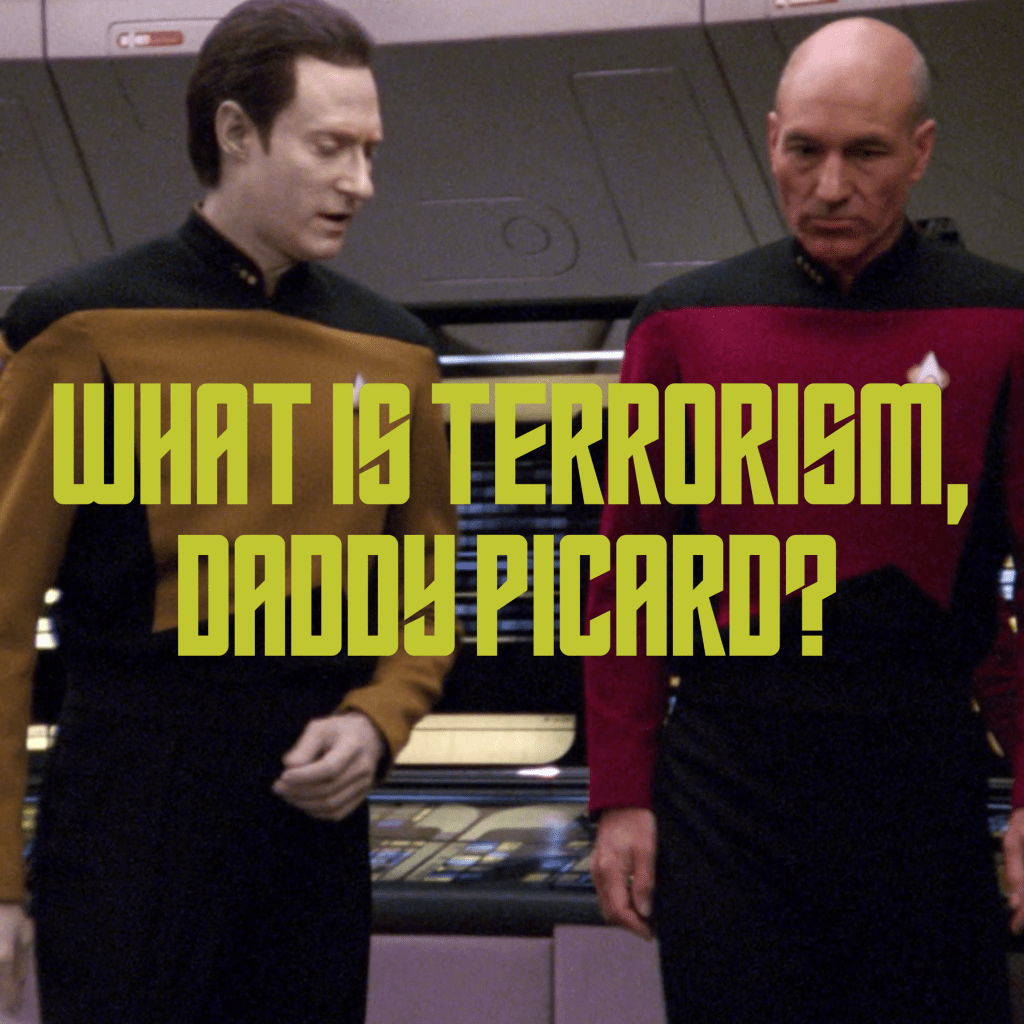
Talking Points Include: THEY PUT BABY SUPERMAN IN A MICROWAVE?!?!, Judge Dredd killing the Jolly Green Giant, dialogue censorship in American comics, Miles’ 12th Wedding Anniversary is a good excuse to go off on how amazing the film ‘Lifeforce’ is, Alex Garland’s ‘Annihilation,’ Patrick Stewart’s first movie kiss, Charlie has a physical subscription to 2000 AD (Lucky Bugger, Miles has to do digital), 2000 AD and Judge Dredd Megazine, SHIFT Magazine that Charlie has a story in, Alan Moore’s ‘The March of the Sinister Ducks,’ ‘Love Child’, Miles tries his empathic powers, the three different alien physicalities of Star Trek, DeForest Kelley’s favourite episode, Hurt/Comfort fanfic, sometimes you can tell that the cast know the show’s getting cancelled soon, Hellraiser and the Cenobites would hate dealing with Starfleet, old make-up techniques, how the characters have become less real over the first three seasons, William Shatner doing his slow-mo running, the British hatred of Morris Men and all they stand for, how a lot of modern comedy lacks actual stakes, The Beatles vs. The Rolling Stones, Jeff knows what he’s done, Yvonne Craig (TV’s Batgirl) as a dancing girl, Mental Health doesn’t work how Star Trek thinks it works, lots of shouting, oh God more Am-Dram, Legion of Super-Heroes, did Wayne’s World ruin the name ‘Garth?’ Double-Nerve Pinch, ‘Pointy-Eared Bum Head!’Garth’s really bad Glam-Rock band, did the BBC have a point? Power-Mad-Starbucks Supervisors, padding, Kylie Minogue, Michael Bolton, where do Americans know Kylie Monogue from? the Troubles, the IRA’s attempt to assassinate Thatcher in the 80s (in Miles and Charlie’s hometown no less!), Picard is unable to answer the important question ‘What is terrorism?’ and ‘but doesn’t terrorism occasionally work for good outcomes?’, does Magneto have a point? Imperialism, Colonialism, Centrists are the worst, it really stops being fun talking points for The High Ground, the actor playing Finn seems to be going for a Jack Nicholson-esque drawl to sound dangerous, but he just sounds utterly checked out. And sometimes Star Trek.
Pedants Corner: ‘Neighbours’ was a long running Australian soap-opera that would air in the 5:30 timeslot Monday-Friday evening BBC 1 slot after the kids’ programming ended and before the 6 o’Clock News.
Casual Trek is by Charlie Etheridge-Nunn and Miles Reid-Lobatto
We have an interloper in the podcast! It’s Sean Corse of Famicom Dojo and Two Boobs Watch the Tube fame, here in the spirit of Nerd & Tie unification.
This episode we’re looking at the Unification trilogy, a multi-part story that spans multiple Star Trek series and over 800 years! First up, Picard and Data go to Romulus to hunt down Spock, who might have turned traitor! We also have Riker chatting up a multi-armed widow and a junkyard guy who has way too many face-folds.
Then, we fast forward to Discovery in their grimdark future era and while unifying the Romulans and Vulcans is a good thing, this is actually still all about Michael. Oh, and Tilly, take the damn job already!
00:05:43 What non-Star Trek things we’ve been enjoying: House of the Dragon Season Two, Paddington 2, Taskmaster New Zealand
00:21:30 Star Trek: The Next Generation “Unification I & II”
01:13:26 Star Trek: Discovery “Unification III”
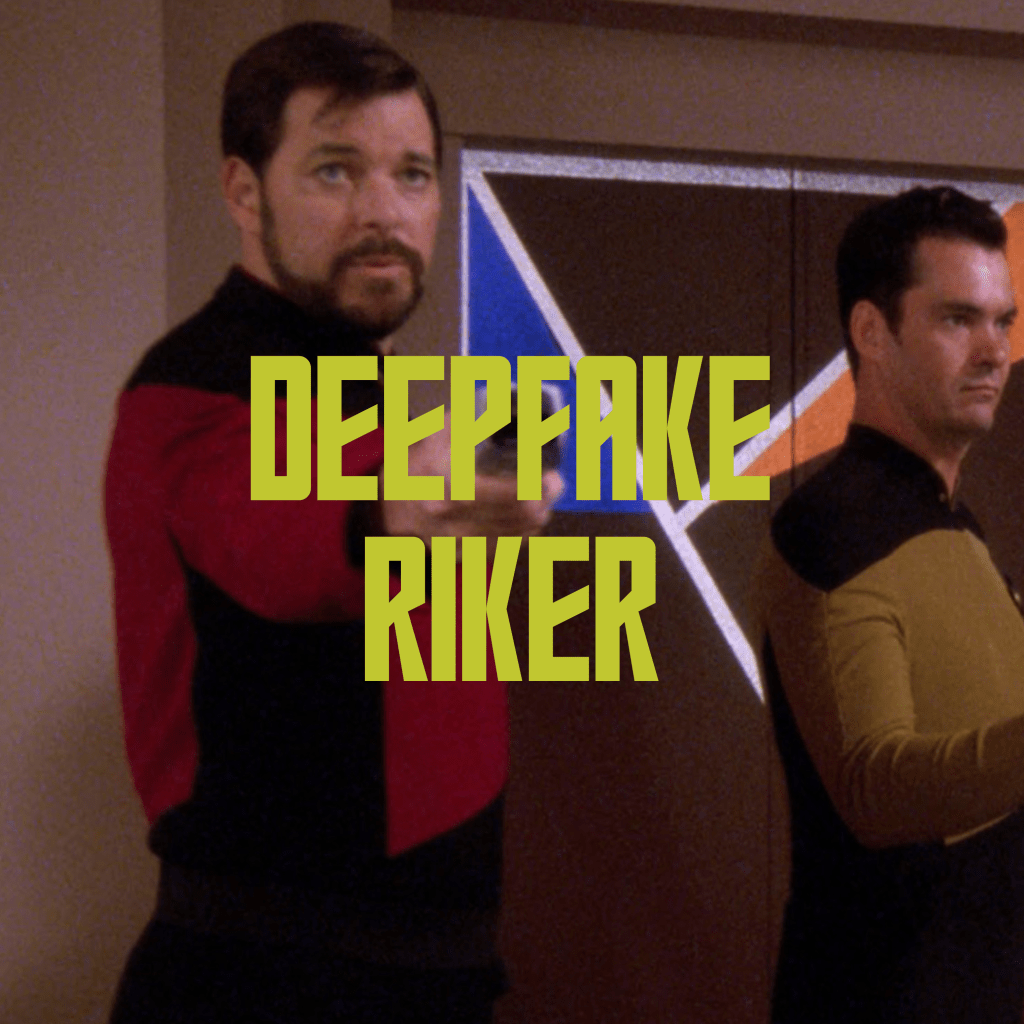
Talking points include: Three Kingdoms, Third Doctor, Farscape, Sean paying for Twitter, Famicom Dojo, Two Boobs Watch the Tube, Quantum Leap (old and new), A World of Ice & Fire, the old Indiana Jones video game, Tom Bombadil, lengthy definitions of “Twee”, Ted Lasso, Kate Fox’s Watching the English, Taskmaster New Zealand, Americans understanding Vic Reeves, Adam Adamant, Bono’s Vertigo Comics look, Miles is coming for David Tennant, Actually liking a U2 track, our threat of a Lost podcast, the guy played by Cameron from Ferris Bueller’s Day Off (also from Bunheads), some X-Men level convoluted BS, Come On Eileen, Romulan retirement plans, sleazy space bars, Hitchiker’s Guide to the Galaxy, Riker deepfakes, are Bones and Spock married? Golden Landis Von Jones, Jimmy from Degrassi, Marion Morrison, Todd in the Shadows, two Brits out-awkwarding an American, Brexit, heists, Space: 1999, we’re all about the cheese, Blake’s 7, Fringe Season Five, Will Section 31 be Guardians of the Galaxy or will it be Borderlands the Movie? Oh, and occasionally Star Trek.
Pedant’s Corner:
Vic Reeves was not on Taskmaster, but Bob Mortimer was
We all butchered the name of U2’s Hold Me, Thrill Me, Kiss Me, Kill Me
The Enterprise switches the lights OFF, not on, when they pretend to be a wreck
I have no idea where Sean got the thing about plant-based Vulcans
Carbon Creek took place in 1957
Casual Trek is by Charlie Etheridge-Nunn and Miles Reid-Lobatto
It’s Christmas Day and we’re giving you the gift of a new episode of Casual Trek and we’re now, as is traditional, gifting each-other an episode of Star Trek each to cover for the holiday season.
There must be something in the air because both Miles and Charlie decide to go with a nice present instead of any potential lumps of coal. Miles desire to make reperations for Tek War results in us getting a good example of film noir in Deep Space 9’s Necessary Evil while Charlie gifts Miles a chance to talk about both racism and post-war SF with Far Beyond the Stars, another Deep Space 9 classic, thank goodness there’s seven season of Deep Space 9 or we might be in trouble!
Episodes include
DS9: Necessary Evil (13:49)
DS9: Far Beyond the Stars (41:44)
Talking Points include: Christmas Traditions with the family, The Goes Wrong Show and Fawlty Towers, Is there a bad episode of DS9? The strange Mandela Effect of the Meat Loaf song ‘I Would Do Anything For Love.’ Thanks to the court case, we are now no longer allowed to say that Sean Orange pays for Twitter while then going on to probably offend all our US listeners, while Charlie makes some small attempt to curb his unreasoning hatred of Blake’s 7 (Miles wrote these notes BTW) Yes, we’re doing Threshold when we hit the 100th episode of Star Trek covered for the show. Miles’ Most Passive Aggressive Handover at Starbucks. Prequels needlessly making big introductions of everything, including Hercules Poirot’s mustaches. Quark’s Code-switching. Hiding stuff in walls. Miles has been a dick at many a job. The closest character we could compare Odo to is Judge Dredd… not great. Claude Raines in Casablanca. How long can a collaborator remain on the sidelines? One more ALLAMARAINE for the season. We’ll see how long it takes Charlie to hate Blake’s 7 again. SF Writers of the Post-War Age, Golden Age vs. New Wave, Policy Brutality, The Harlem Renaissance, LET’S GET POLITICAL AT CHRISTMAS TIMES, don’t trust Centrists, Police Brutality in Riverdale, the ideas of Science-Fiction that can change the world, THE CURRENT EDITOR IN CHIEF OF MARVEL PRETENDED TO BE JAPANESE IN ORDER TO GET WRITING GIGS, the problems with our Big List, what is a ‘Unit of Star Trek,’ Top Trumps, the NPR Star Wars Radio Dramas
Don’t they look so merry.
PEDANT NOTES: Miles refers to Kira as a Collaborator instead of a resistance fighter as I meant to. Claude Reins doesn’t shoot the Nazi in Casablanca, but helps cover up Rick’s role.
NEXT WEEK: Saddle up partner as we head to the Wild West… in Space!
You can find Casual Trek “Another Casual Christmas” on Spotify, all good podcatchers and here.
Most of my RPG Quest posts have been two posts for each month, but between some shorter books, industrial action meaning a little more time for reading and general momentum, I read 37 RPG books. Here’s the last batch.
Two Summers
By Emojk – Côme Martin
Read before? No
Played? No
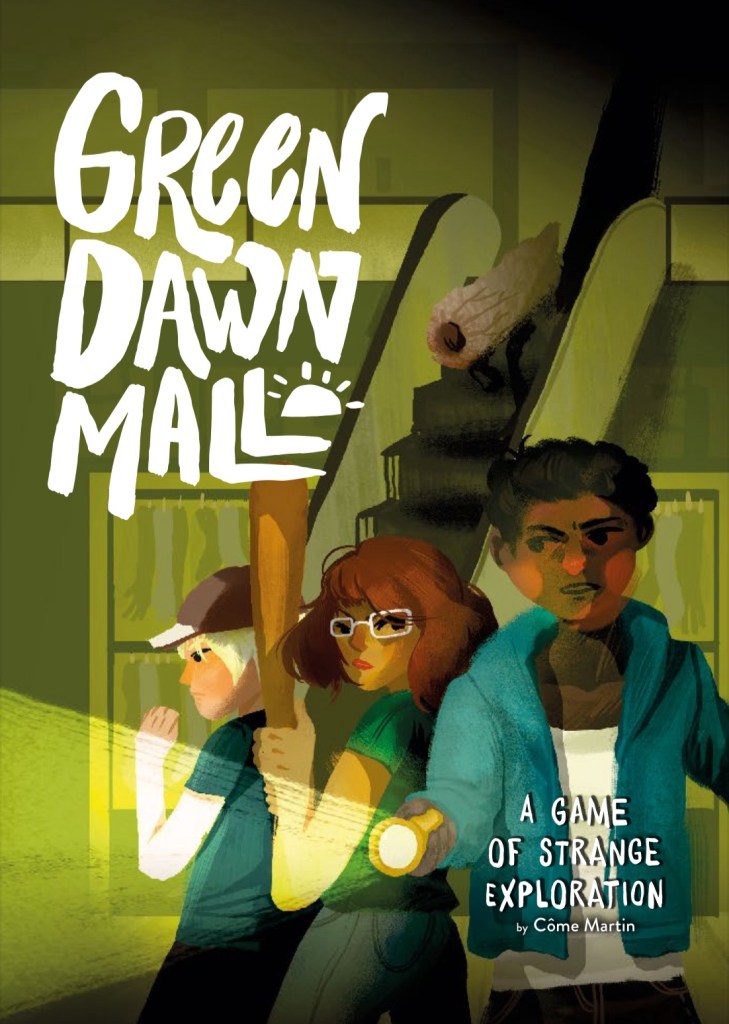
One of the few RPGs I played with The Gauntlet during one of their open gaming days was with Côme Martin, so I when he launched Green Dawn Mall I checked it out. It was a fun enough experience that I’ve become a serial backer of anything he does.
Two Summers is based on an old RPG build that the author apparently made in his childhood and updated. It’s set during the teenage years of a group of characters and then also them a a few decades in the future going on another, related adventure.
There’s a very casual tone with rules on pieces of graph paper spread throughout the book. Session Zero takes up a lot of room as there are a lot of rituals to go through. Players start with their teenager and take traits bit by bit as they answer questions. You also make concerns for them which are all suitably teenage. As you take each step, you create and link items on a relationship map between the characters. Once that’s done, you make a shorter version of this for them as adults, modifying traits and concerns, accordingly.
Play is expected to go through about six sessions of three hours, flashing back and forth between the past and present, following the characters as they meet different obstacles. The end should bring the teenagers to the end of their grand adventure and the adults into some changes which may last into their future.
Tonally, this is a fairly light game. There isn’t anything supernatural, although there can be with a supplement which allows for darker tones, time travel and parallel worlds to be used. There’s also a smaller, one-shot version of this game which was released as a demo. As much as I like the look of this game, I feel like I’m probably more likely to try out the one-shot version before doing a full miniseries.
Back Again from the Broken Land
By Cloven Pine Press – Alexi & Leah Sargant
Read before? Yes
Played? Yes
The first game I played in person after the pandemic lockdown subsided was Back Again from the Broken Land. It felt fitting.
A fantasy RPG using Powered by the Apocalypse mechanics, this game specifically replicates the moments in Lord of the Rings after Sauron’s been defeated and when people need to go home. They’re small and should not have been in a war this big, should not have faced threats so epic and all-consuming. Still, they did and shockingly they ended up playing a pivotal role. Now the Doomslord has been defeated at great cost to everyone involved, and it’s time to go home. But can you, after all of this? After all you’ve seen? All you’ve done?
Starting from the end of the heroic journey, the game places characters in the remnants of the final battlefield. Friend and foe alike are reeling. Players determine what the Doomslord was after, what they were like, why their minions are still a threat and then have playbooks to pick from:
The Shepherd
The Volunteer
The Bodyguard
The Burglar
The Wayfinder
The Stargazer
The Imposter
The Haunted
The Turncoat
Each of these playbooks has one named Burden and slots for more. You’ll be unlocking new unnamed Burdens and aiming to clear them on your journey home. This is the core part of gameplay and some of the peril you’ll face may cause you to take on new ones as you go. You may have played a pivotal part in the downfall of the Doomslord, but you’re still small, able to slip beneath notice and escape from peril. You don’t have any badass combat moves to fight against things, instead you run, hide or make a desperate stand. The latter of these actions could well mean the end for your character.
There’s peril, sure, but there’s some loveliness in the main set of moves, called the Homeward Bound moves. You name a burden in quiet moments, writing in one of the unlocked slots. The perception type move involved gazing into the distance either physically or into your memories. Share a Meal is a pivotal move, where you tell a story of home and roll to see how many people can use this moment to clear a named burden.
Blessedly, there are examples of stories of home, the journey and doom. The latter are in the form of checkboxes, unlocked when players hide from the hunters and then used rather than dying at a future point.
At the end of the game, players consult their epilogue against different stories. Everyone gets one Story of Growth, while those who named and cleared burdens get another. Those who didn’t clear named burdens have to add elements from the Stories of Amends and those who have unnamed burdens have to use Stories of Isolation. They may have gone home, but are still haunted after it all.
This was a joy to run and is up there with R’lyehwatch and Escape from Dino Island as perfect modern one-shot RPGs.
Quest: Character Book & Treasure Book
By The Adventure Guild – T.C.Sottek & Grim Wilkins (character book) and Marianna Learmonth (treasure book)
Read before? Yes
Played? No
Anyone remember Quest? Quest was hot shit for a brief moment a few years ago. It was co-created by someone from Polygon so there were some great inroads to help publicise the game. It was very pretty with some incredible art from Grim Wilkins and had a lot of thought on the layout.
What helped Quest, as well as all this, is it was actually a pretty good game. One which I like to think is a perfect introductory system either for people who are brand new to the hobby or who have only tried D&D before and don’t know how other systems work yet. A lot of the game psychology of ‘say yes or roll the dice’, fictional positioning and so on are pretty standard for indie RPGs but are presented in a nice accessible way for newcomers. Characters have a very open character questionnaire which will establish where they sit in the fiction for a lot of things and will roll 1d20 with no modifiers for anything they’re chancing their hand at. As an example one of my group was a doctor cursed into the form of a giant grasshopper. He could diagnose people without rolling, but trying to manage fine motor skills was a die roll. Then there are abilities which are the special sauce, the actual tangible mechanics for each class as presented in skill trees which you can unlock.
I came late to Quest, picking up the digital version and still longing for a way to get a physical copy of the book and cards in order to better run offline demos for people. Unfortunately the company’s going through some issues and looking for a person to take the game on at the moment.
Before all that happened, they ran a second Kickstarter for a pair of expansion books.
First up is the Character Book.
In other games this might be referred to as a Monster Manual, but this is much broader than that, and the themes of the system are a lot more geared towards interaction with the world in a non-combat fashion. Fights may happen, especially against entities like Assassins, Blood Jelly or the Chaos Goat, but at the same time there are people who might be mentors, underlings, friends, quest-givers or even environments to traverse.
Quest has a fairly light touch when it comes to genre, bringing some characters with robotic-looking devices or planet-eating monstrosities. What’s nice is a lot of the descriptions of characters tie in with each other, with a list of major alliances in the back to help you gather characters up if you want the group to encounter a specific group with a specific goal.
The entries are presented with a piece of art, a name, a small segment of flavour text for when you first encounter them, the story of the monster and any abilities. Like characters, there’s a lot of fictional positioning in the abilities and a number of them are simply narrative. Finally there are just two stats: the health and the damage of the characters. They generally scale up through the three tiers of character: Commoner, Minion and Boss, but that’s not always the case.
Finally, there’s a framework for the creation of these entities. This is good as there was only really fairly light guidance in the core game book.
Second is the Treasure Book.
Again, this fits a need the core game book had of more interesting treasures. Just to put my old man hat on for a moment, I remember in D&D Third Edition where it felt like magic items were getting more commonplace as a way of rewarding players that felt almost mandatory, to help with the scaling of challenges. Every adventurer would have +1 weapons which didn’t really do much other than that. I kept hold of an old Dragon Magazine issue which had random tables of minor effects, appearance changes and so on, in order to make any generic +1 weapon a little more interesting.
Luckily with Quest there’s a whole book of unique items, each with weird descriptions and most of them illustrated in this tome. There are a handful on each page, with all manner of odd mechanics.
Early on that light touch with creating a continuity begins with a series of items made by ‘Brell’. Unlike Bigby or Melf or whoever the old D&D spellcasters were, these all seem like items you’d find in an eccentric shop somewhere, with things like Brell’s Tent in a Tin, Brell’s Everlasting Bear (a size-changing gummy bear, not an eternal bear, although I might use that for a Quest adventure one day).
There are random magic potions, marbles, pipes, all manner of things. There are weapons, but the book doesn’t seem to have a discernible order for types of item to help you find them. There are different levels of rarity instead, going from uncommon things (e.g. a jar of fireflies) to rare (e.g. a disposable persona) to legendary (e.g. a map of the multiverse).
Items generally have a thing they can do in the fiction as their rules. The Everlasting Bear tells you that it changes your size, it doesn’t say what that encompasses statistically as Quest has no statistics. It’s kind of a given that if you want to smash a door you couldn’t damage in your regular size, you either can do that effortlessly or if its reinforced then maybe you go to the dice. Nice and easy. Some items cost Action Points for special effects and weapons have a damage rating, but that’s about it for hard mechanics.
Like the character book, this generally does in a kind of cute tone, with a lot of little fun references and game-changingly weird effects.
As ever with Quest, I don’t think I’d run it for a specifically grim game. For something more light-hearted, these are perfect. The digital copies of these books also came with PDFs of the decks of characters and treasures, which would be great to hand out at a table, especially to kids learning RPGs. They’d get to see the art and have the mechanics in a very readable style.
Thursday
What a concept.
By Eli Seitz
Read before? Yes
Played? No
I love a good time loop, and this game allows you to play through a Russian Doll type scenario. This is Belonging Outside Belonging, so it’s got no GM which is an interesting ask for something pretty maintenance heavy like managing a repeating timeline.
The playbooks all have questions which they’re looking to answer, locations, vibes and a set of strong, regular and weak moves. The latter of which includes “Die” which triggers the ill-fated deaths of each other player, then resetting the timeline.
The choices of playbooks are:
Artiste
Misanthrope
Sellout
Trendsetter
The players also takes a setting element:
The Loop manages the loop itself and ends scenes
The City establishes scenes and helps to build location
The Home Team is your allies
The Away Team is your enemies
It’s an interesting looking game, it feels a little slight which is something fairly common with ZineQuest entries. In this case it’s because I feel the mechanics of the type of story being told might be a little tricky. I could see myself suggesting that we keep a bit of paper in the centre with the timeline as it resets to and any changes that we make to it as we go along.
Low Stakes
By Craig Campbell
Read before? No
Played? No
From Russian Doll, we move over to What We Do in the Shadows (and to a lesser extent Being Human).
Players take the role of supernatural entities (and occasionally a human) who have to cohabit together. Characters have a pool of Confidence to spend and a state of having Clout, which only one player holds at a time, but can be stolen by anyone.
The supernatural entities are: Vampires, Psychic Vampires, Werewolves, Ghosts, Mystics and yes, humans. But none of these are character classes, instead providing a power and some fictional positioning. Instead the character playbooks are:
The Anachronism
The Caregiver
The Grump
The Instigator
The Judge
The Peacock
The Rebel
The Stickler
These are all more based around personalities than anything else, each with their own things they have difficulty with and ways of snatching the Clout.
Stories have a quick outline which can be picked or determined randomly using a series of tables, each around different themes like, “Bureaucracy” and “Lost Pet”.
The core mechanics are based around improv rules (mainly yes… and), or die rolls depending on your Problem Areas and Clout. You’ll be adding complications as things change, then holding Confessional scenes like a lot of modern sitcoms, gaining an amount of confidence and/or giving people complications depending on what you do.
In a way, this feels like a competitive RPG, but in a fairly light-hearted way. Whoever has the Clout can finish the episode when they want, but someone else might steal it and try to finish things on their terms.
Paranormal, Inc
By Alicia Furness
Read before? Yes
Played? Yes
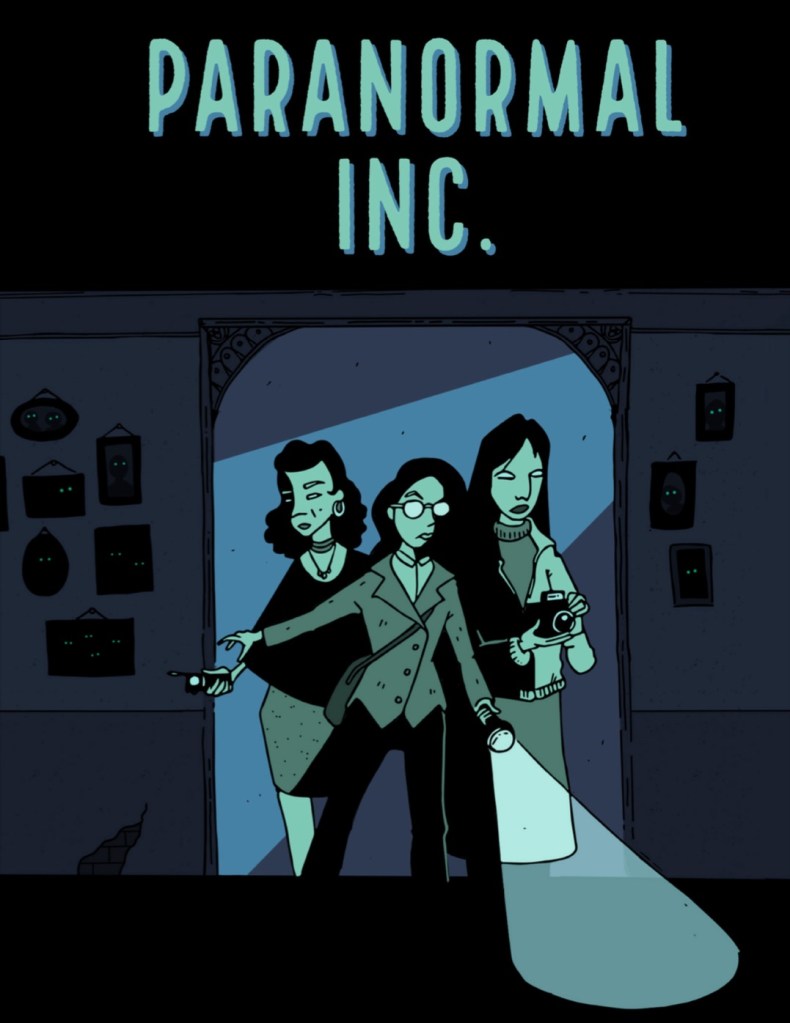
I love the Carved from Brindlewood framework and what better to use with it than a Scooby Doo/Ghostbusters kind of game. Paranormal, Inc has players all taking the roles of people investigating the supernatural including:
The Scientist
The Skeptic
The Medium
The Intern
The Bookworm
The Ghost
Each of these characters gets a set of stats, a vibe and some moves. They also have Personal Hauntings which are kind of like the Masks in other CFB games, often modifying your stats or giving conditions.
A big innovation of this game is the lack of a GM. CfB games don’t have a fixed solution to a mystery anyway, but instead clues to find and locations and people to interact with. This game shares those roles between everyone, splitting a deck of playing cards into:
Locations (Hearts)
Clues (Clubs)
NPCs (Spades)
Paranormal Events (Diamonds)
These decks each have an entry for each card. Locations have Paint the Scene questions for the group to help flesh things out. NPCs have a quote to help give you an impression of them. Clues and Paranormal Events give you multiple choices of items in order to better pick what fits to the location and method of acquiring clues.
Each mystery has a goal to each and you go from location to location, interacting with what’s there, unearthing clues and hopefully piecing together a mystery by the end. Paranormal Events are spooky occurrences which could be a problem and normally go off whenever you enter a new location.
Like other CfB scenarios there’s an establishing question to kick things off, then the play can move naturally from there.
These are all elegant changes to the systems found in Brindlewood Bay. I still remember some of the early PbtA variants and how they felt like they weren’t doing enough to change the game. This feels like it’s captured the spirit of the system but does some great things to establish itself as its own thing.
Outside of the main book, there have been a lot of mysteries made, including a sequel to a Brindlewood Bay mystery, with “(Another) Night at the (Whaling) Museum”. Playbooks for a kid and a talking animal have been published, too.
I’ve hosted a game of Paranormal, Inc and really enjoyed the sense of momentum and light-hearted spookiness as we tried to uncover the truth of spooky events happening in a dark alleyway outside our intern’s flat.
The One Ring, Second Edition
By Free League Publishing
Read before? No
Played? Yes
Okay, this is a slightly embarrassing one to be looking at right before the end of the year, given I’ve been playing it intermittently throughout 2023. In my defence, I’m not GMing and I have looked at the starter set’s rules.
The One Ring is unsurprisingly a Lord of the Rings game, set between the trilogy and The Hobbit, where dark forces are growing, Bilbo’s back in his home and the Fellowship hasn’t formed yet.
Characters are fairly easily built, with a combination of a Heroic Culture and a Calling, then a few XP to help make people a bit more unique. You also customise them with gear, including some personal items, and choices of Distinctive Features.
The Heroic Cultures are:
Bardings
Dwarves of Durin’s Folk
Elves of Lindon
Hobbits of The Shire
Men of Bree
Rangers of the North
These give you some distinctive features, a set of skills, a lifestyle and a table of choices for your stat spread.
The callings are:
Captain
Champion
Messenger
Scholar
Treasure Hunter
Warden
These give you a few more favoured skills, a specific distinctive feature and a Shadow Path, which is how you can get pulled towards bad actions and corruption.
Rolls are made using a Feat Dice which is a d12 with 1-10, an eye of Sauron and a Gandalf rune for negative twists and magical successes, respectively. You also roll an amount of Success Dice (d6’s) equal to your dots in a skill, in a fighting proficiency and if you’ve got some signature gear that helps out. These all get rolled against a Target Number established from your three main stats of Strength, Heart and Will.
There are a number of modifiers to this. If you’re Favoured or Ill-Favoured then you roll an extra Feat Die and take the highest or lowest, respectively. You can spend Hope to add a Success Die to your roll (or to other people’s rolls) and if you’re Inspired then you get two Success Dice instead.
There are a number of sub-systems. Fights put people into different positions at the start of the round, allowing you to pick your turn order and giving access to some special actions based on where you are. You’ll be chipping Endurance off of each other until you start taking Wounds and then you know things are going to go badly. People didn’t get injured in Lord of the Rings and just walk it off, after all.
Exploration is a large part of the game, with groups traversing lands, encountering problems or sometimes sights that are quite lovely. You’ve got patrons who can give you abilities and missions, a Fellowship phase for downtime, levelling and healing. There’s also the Shadow, where you might gain shadow points for evil actions and you might start getting noticed by Sauron’s growing forces.
The book is nicely laid out to help with these phases and actions, but I think that possibly some reference sheets might have helped with. I’ve been a player in a game of this for ages, but I don’t know how much of all of this we’ve engaged with (or maybe others have and I’ve simply forgotten about things like the extra dice for signature items).
Towards the back there’s a lot of nice detail on locations in Eriador, a selection of enemies to fight which I thought was pretty small originally but there’s a good amount of variation within each broad category. Finally there’s a site-based adventure to get people started. I could say I didn’t read this book to spare the GM the adventure, but it’s been a while since we played it. I think being an almost 250 page hardcover book, I’m generally out of practice with them.
I’ve previously played the D&D 5E version of this, Adventures in Middle Earth, which I found turned Tolkien fantasy into basically D&D, with all the looting and fighting and threatening people in taverns that you expect in any game of that. The subsystems there felt bolted on in a cursory manner, not really gelling with 5E’s baseline mechanics. In this game, there may be a number of systems, but they’re all in dialogue with each other.
I don’t know if I’d run a full campaign, although I’ve got a couple of vague ideas for ones. I definitely want to try running the starter set adventures for folks as they were good fun to play and feature the players as hobbits.
Token
By Glowing Roots Press – Gabriel Robinson
Read before? No
Played? No
Another Rooted in Trophy game, this one’s more self-contained than Gabriel’s previous outing which acted as an epilogue to a Trophy Dark incursion.
This time, the game is only for two players: A Seeker and a Dweller, drawn to each other in the Forest. The Dweller is already there and has become strange, monstrous. The Seeker is breaking in from elsewhere, and both have their own instincts pushing them forwards and a secret which will only get revealed at the end of the game under certain conditions.
There are numerous tables to help roll or choose the elements of their character, or several scenarios at the end of the book to set things up.
Play goes back and forth, starting with the Seeker. Instead of the Hunt Roll from Trophy Gold there are Reflection Rolls, where you’re looking through the Forest for clues. These can give you a token, which you’ll need three of to conclude the game. If you fail or roll a partial success, The Forest gets a token. If you come up against a threat, you make a Challenge Roll which will give you a scar upon failure or help remove a token from The Forest.
You can help each other, even though you’re not directly in contact most of the time. You can offer an Enticement which will pass tokens back and forth, heal scars and unfortunately give The Forest a token. These also redefine your initial instinct, changing your original goal as you go.
If you get too scarred or The Forest gets three tokens, you lose. If either of you get three tokens, then the other player tells you their secret. An exchange of Tokens could happen, changing up the instinct one last time and bringing the game to an ending.
This looks like an interesting use of the Trophy system, and I’m curious to see how it plays.
I’m Sure You’re All Wondering Why I’ve Gathered You Here This Evening
By Logan Jenkins
Read before? Yes
Played? No
I watched the recent version of “And Then There Were None” a little while ago, when I was writing a murder mystery. The pitch of this game sounded a little like that, but maybe if you throw in Battle Royale as well.
The default setting has players brought to a remote island and a fancy manor. It’s wealthy owner is dead and all their wealth will go to one of you. Specifically, the one who survives until dawn.
That’s right, this is a competitive RPG. A manor is set up, people are given their motivations and secrets, Non-Player Guests are created and everyone’s set loose through the manor. The GM is the ‘Butler’, managing the game.
Players take a turn each hour, hiding, manipulating each other, rummaging through rooms and of course carrying out a lot of murders.
The game runs off a deck of cards with a number of oracles and guides to help interpret things. First up is your Secret, which determines your proximity to the Deceased. Then there’s the actions themselves, which often involve finding belonging cards which are determined by the suit and value, or spending them to make murder attempts.
Once characters die, they become ghosts in order to keep playing and haunt the remaining players. If you’re lucky, then you might even possess a body and be back in the game!
This is a one-shot game and lasts for seven rounds going from midnight to 7am. It feels like a good amount of time for something so heavily PVP. It also has a nicely light tone, which also helps. Finally, there are several different premade Deceaseds such as Santa, Xena, the head of a weird school, someone in a cyberpunk setting and more. That creates a nice variety to the game. I did build a Roll20 room for this filled with different weird icons, a map and deck of cards, but the game got cancelled, so hopefully I’ll get to try it one day.
Vampire Cruise
By Amanda Lee Franck
Read before? No
Played? No
Two vampires had what they thought was a fantastic idea: If they get a cruise ship them the human passengers will be like an all you can eat buffet of people who’ll come to them. The problem is, it’s not actually been a great idea and they’ve had to be less picky than they’d have liked, bringing random passengers along with a cult who booked a whole floor.
Vampire Cruise is a systemless adventure in the weird OSR style. The cruise ship’s given both top down and sideways maps in the centre and the inside covers of the book. It’s the kind of cruise ship that has a castle inside, a massive climbing wall, an auditorium and so many other things to explore. As this is a cruise with folks stuck at one place at sea you also have tables of guests, staff and vampires which are all good fun.
There’s a list of events which go from ping pong tournaments to matters of a more apocalyptic variety. It assumes the players will disrupt things so everything’s loosely laid out and easy to adjust, bending to react to the players. This is the main structure of the adventure, being more event-based than location-based. The locations are key, but they’re also often changing, with people moving through and different items popping up from tables.
And oh yes, the tables. There’s one for room service, jobs the group can have, items in storage and more.
Oh, and there’s a zombie shark, so that puts this up there as one of the best books I’ve read in this quest.
Eat the Reich
By Rowan, Rook & Decard – Grant Howitt & Will Kirkby
Read before? No
Played? No
It’s World War II, you’re a bunch of vampires and you’ve been dropped on occupied Paris with one mission: Drink all of Hitler’s blood.
What a concept. Do I need to mention any more?
I mean, I guess I probably should. It’s a Rowan, Rook and Decard game, so it’s got that gleeful chaotic energy to it. This is also a game that has premade characters and is probably not going beyond a session, the same way games like Lady Blackbird do.
The vampires are:
Iryna – a warlock and swordfighter
Nicole – the muscle and explosive expert
Cosgrave – a wideboy necromancer
Chuck – a cowboy!
Astrid – animalistic predator
Flint – a kind of adorable bat monster
The system has people build up dice pools using a stat and bonuses for gear and/or abilities. The GM rolls a threat pool at the same time and both players ditch anything that’s a 1-3. On a 4-5, players deal damage, defend or gain blood. On a 6 it’s a critical effect which doubles the previous result or activates special abilities. The GM just deals damage on a 4-6. This is a fairly simple system, as you’ll mostly be ripping and tearing through Nazis, killing your way to Hitler on his airship parked by the Eiffel Tower.
There’s a sector map, helping establish where players are and the level of threats as they close in on the tower from Sector Three and going inwards. Not every location will be used and the descriptions of the locations are economical with information. You won’t need much, just enough to get a sense of the place and the threats before you unleash vampire chaos.
There are some sub-boss type characters who provide threats about as weird as the player characters, and then there’s Hitler at the end of it. They do a good job of not making Hitler super-competent or amazing at things. Having listened to enough about Hitler’s reading habits and drug habits thanks to Behind the Bastards, I feel they’ve got a Hitler that’s very much in that space.
This is a fun-looking game and a beautful book. The design is stunning, the layout is messy without becoming an obstruction and the colours pop vividly. I read this in PDF form, but I can’t wait to get the physical version.
Conclusions
This was probably my best month for reading RPGs, I’m almost caught up with where I should be at this time of year. There might be time for one post for the first half of December, and then I’ll see you in 2024 for the last post and my thoughts on the quest.
I read a few extra books this month. I also have my history with Deadlands to talk about and a few other interesting items.
Deadlands: The Weird West
By Pinnacle Entertainment Group
Read before? Yes
Played? Yes
I was a Deadlands fan a long time ago, buying the First Edition just before realising a Second Edition has recently been released. I ran a couple of campaigns of it over the years and got massively obsessed with the Doomtown CCG.
I played Savage Worlds once and it was fine. I killed the character of Paco from GMS Magazine in an Arthurian RPG, which might have been a bit bad, as he was playing my son. I remember this as he entered Onslaught Games once during Tabletop Day and shouted at me, calling me out as a murderer. I was in the middle of a game of Bang!, a Wild West betrayal game. So that didn’t do well to earn the trust of everyone round the table.
After enough time away from Deadlands, I decided to back this new edition. I got excited about it after talking to my old GM, Graham, who is an endless font of enthusiasm for games. Little did I realise it didn’t actually come with the current version of Savage Worlds. I quickly remedied that.
Savage Worlds is a toolbox game, one which I like, but often find the layout of a little frustrating as far as getting new players on board. Seriously, the book takes about 80 pages before giving any indication of how the system works.
Deadlands is primarily a setting book, getting people up to speed with the world in a way which is a lot more welcoming to newbies. There’s a little information for veteran players as they retconned a lot of the elements from the old editions and decided to actually do that in canon.
For those that don’t know, Deadlands is a game set in an alternate Wild West where things went decidedly spooky. There are mad scientists, magicians who gamble with dark forces and people who are kind of zombies.
The book is a fairly trad one, acting more as a list of different topics, providing the new character options, new gear, subsystems which are specific to Deadlands compared to Savage Worlds and new character types. There aren’t classes as such, but there are builds which ban be made with specific advantages:
Agents – Basically ‘Men in Black’.
Blessed – People whose religion allows them to perform miracles.
Chi Masters – Martial artists.
Harrowed – The undead, also a group you can join if you win and are lucky(?) enough to draw the right cards
Hucksters – The aforementioned people who gamble with the devil for magical power.
Mad Scientists – Inventors of strange devices (although it’s also a kind of magic but shh, don’t tell them.)
Shamans – Practitioners of Native American spirit magic.
Territorial Rangers – The newer version of the Texas Rangers
There are some new rules like Fear Levels, which to a meta-level players are generally trying to lower. The corruption that goes through the Weird West is measurable at the GM level and helps you work out how to narrate the way the world works in the fiction.
You get a broad look at the Weird West, going through each of the locations and a nice bestiary to give you a glimpse into what’s out there.
This is an overview, more than anything else. There’s an additional companion which has some slightly weirder, more specific things. Deadlands has a lot of adventures out there between the old and new editions, which flesh each area out nicely. It’s a fine book, but feels like you need a bit more in order to run a great Deadlands game.
I’ve run a long campaign of Deadlands using the Horror at Headstone Hill boxed set, which was possibly one of my favourite premade campaigns. I may be down on the book at a fun read, but it is a useful reference guide.
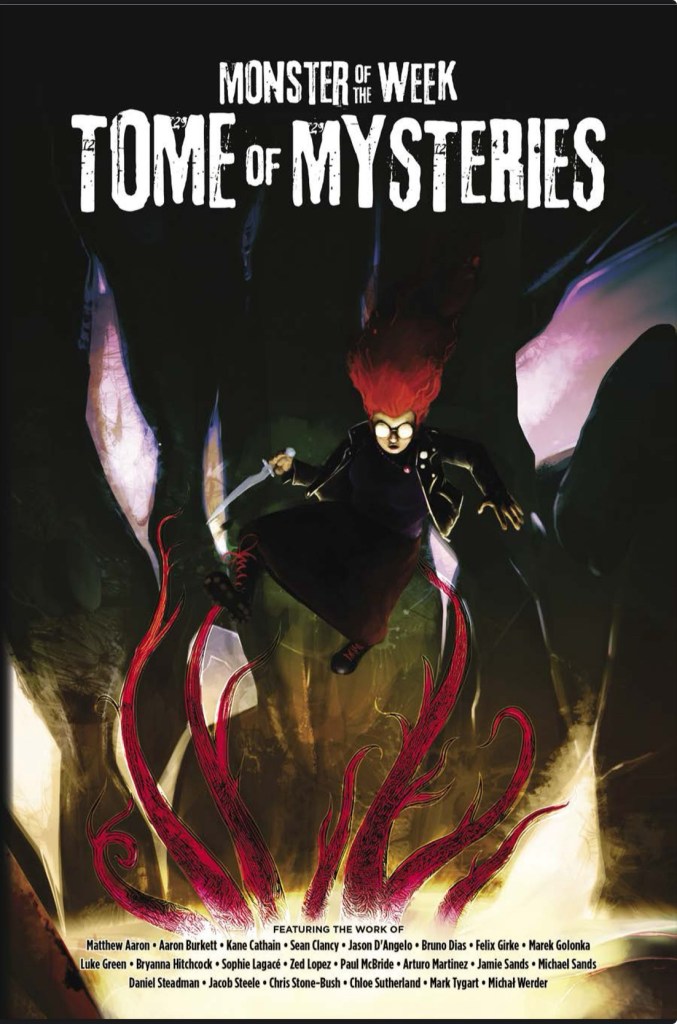
Monster of the Week
By Evil Hat & Generic Games – Michael Sands
Read before? No
Played? Yes
Here’s another part in this quest where Charlie makes a rod for his own back. The only Monster of the Week book I crowdfunded was the most recent, the Codex of Worlds. I’m going to be running this after The Betweek: Ghosts of El Paso, so I figured I’d read all three books even if two of them were surplus to requirements.
Monster of the Week is a classic PbtA game, one which has been revised over the years. Replicating Buffy, Supernatural and countless other monster hunting television shows, comics and books, you each take a playbook which embodies the kind of hunter you are:
The Chosen
The Crooked
The Divine
The Expert
The Flake
The Initiate
The Monstrous
The Mundane
The Professional
The Spell-Slinger
The Spooky
The Wronged
No offence to Monster of the Week but I started reading it, thinking it felt a little bit basic. The book won me over, but it took a little bit of time. The problem I’m finding after reading a lot of Carved from Brindlewood games is that they tend to make other mystery games feel a little shallower. MotW’s focus is quite different to a Brindlewood game, though. You’ve got a mystery each week, a monster of some sort, and you need to find out how to take them down.
You generally can’t harm the monster without doing some kind of research, or hunting up the food chain to it. The mystery’s fairly light, the fights fairly bouncy and then you’re on to the next one.
There are ‘season’ mysteries which are dealt with as a scaled up version of regular ones, and a few fun ways of playing with McGuffins like ‘Big Magic’ in order to allow weird rituals and one-off shenanigans which aren’t necessary to be reflected mechanically.
Monster of the Week: Tome of Mysteries
By Evil Hat & Generic Games – Michael Sands & Others
Read before? No
Played? No
You’ve got a fairly simple, if robust system, why not start having some fun with it? Monster of the Week’s an older PbtA, like Dungeon World, with a number of hacks and modules by other people. This supplement definitely helps breathe some new life into the game, as will the next one, something which DW never had.
First up are four new playbooks, not necessarily needed but still welcome.
The Gumshoe
The Hex
The Pararomantic
The Searcher
Then there’s a lot of advice including things like running convention or lunch break games, solo gaming and having different Basic Moves using the Weird stat to reflect science, intuition and so on.
Finally, there are a TON of mysteries. I like making my own, but I also love being able to use pre-built mysteries. There’s a lot to harvest here, whether it’s taking a whole mystery or just harvesting some for parts.
Monster of the Week: Codex of Worlds
By Evil Hat & Generic Games – Michael Sands, Marek Golonka & Others
Read before? No
Played? No
I’d promised to run Monster of the Week after a lot of badgering from one of my group. That was before this was crowdfunding, and I’m pleased that it came out as it feels like it adds a new factor which will really make a Monster of the Week campaign sing.
Inspired by Blades in the Dark, there are Team playbooks:
Agents in Black
Always on the Road
The Chosen One and the Entourage
Guardians of the Borderland
I.M.P.S.
Interdimensional Crisis Team
The Last Survivors
League of Double Lives
Mercenaries
Mystery Club
The Night Shift
Suburban Watch Group
Touring Band
Whistleblowers
Wild Hunt Fugitives
Each of these gives the group origins, benefits and a big bad out of several choices. There’s also a starting mystery for each of the groups, which is a good thing to have if you’re picking your team in the first session and need a bit of lead time to get the longer term plans ready.
There are also Other Worlds which are more specific campaign frames:
This Strange Old House
Gothic Century
Dreaming with the Gods
Monster Marches
Bone Spear
After that, there’s some guidance about making your own worlds, but there’s so much here to use which looks really fun. I’m definitely going to provide about 50% of the team playbooks as ones for my group to pick from. There are a few that just won’t get over and some I’d rather not run for, but a lot of them look great.
Galaxies in Peril
By Samjoko Publishing – Kyle Simons
Read before? No
Played? No
I love superheroes in comics, I like reading RPGs and seeing how they try to replicate superhero stories. I like the Simons brothers’ work, but I missed Worlds in Peril when it came out. That’s the predecessor to this game and used Powered by the Apocalypse mechanics. This game uses Forged in the Dark as its basis and promises games going from street level like Defenders or galactic level like the Fantastic Four.
Like Beam Saber, this was a big FitD book with a topic I like the idea of and just didn’t get round to reading. Similar to Beam Saber, I’m surprised at how close it sticks to the FitD framework. I’m used to things like Quietus and CBR+PNK which rip the system apart to do fantastic things. There are some systems like Hack the Planet which doesn’t go that far and still feels like it’ll be great.
This version of the system is interesting. It feels like it sticks close to Blades and it has made some understandable changes. You have Resilience instead of Stress as a way of reframing your pool of power. Your powers are primarily based around fictional positioning and then you also pick three levels of special effect that cost you Resilience. Luckily there are some examples, although they’re broad enough that they scale to crazy levels which aren’t always going to be valid for every type of hero.
The playbooks are few, with some very specific examples in mind, and are separate from the types of powers you might have:
The Agent
The Inventor
The Leader
The Occultist
The Vigilante
There are also only three types of team:
Detectives – Taking on cases and crimes.
Explorers – Learning new things, exploring the world and the universe
Rebels – Fighting bad guys and fighting for causes
The game has a really nice way of physically mapping out your campaign with maps and stickers (or the virtual equivalent of those).
There are some interesting ideas here and some good reframing of some FitD elements, but I do worry that the playbooks can’t quite make some superhero characters. I tried to put together a Fantastic Four with them and there wasn’t really a role for Johnny Storm and a lot of choices were more ‘making do’ with what was there.
Brinkwood: Blood of Tyrants
By Far Horizons Co-op – Erik Bernhardt & Others
Read before? No
Played? No
The pitch for this is a great one: A fae-powered Robin Hood and Merry Men fighting a vampiric Sheriff of Nottingham. It’s also Forged in the Dark, which is always a sure bet with me.
Brinkwood is set in a fictional fantasy land where the rich have turned into vampires, using coins mixed with blood. They control and oppress the public and have one of three specific bosses to pick from, flavouring their corruption over the land.
The Duke who represents industrialisation and dehumanising the poor
The Countess who represents decadence turned to rot
The Baron represents all-consuming, gluttonous late stage capitalism
Characters are part of a group who fled into the titular Brinkwood and bargained with the fae. They carry out daring raids and attacks, you know, regular Merry Men stuff. To help you, characters put on one of several masks which give them extra abilities and have their own XP tracks. The masks each represent a different fae and make certain demands of their wearer:
Judgement
Lies
Riot
Ruin
Terror
Torment
Violence
Characters have a Folk which determines their look and an Upbringing which gives them traits and associates. There are classes, but they’re just a selection of action dots rather than whole playbooks.
There’s a structure to the campaign, albeit not in the same strict framework as Band of Blades.
I love the look of this game and I want to give it a try at some point. When I’m not racing through the rest of the RPGs I’ve Kickstarted, then I’ll be checking out the extra book with all the stretch goal material as I’m sure it’ll be fun.
Thirsty Sword Lesbians
By Evil Hat & Gay Spaceship Games – April Kit Walsh
Read before? Yes
Played? No
There are a lot of good fantasy games using Powered by the Apocalypse mechanics. There was a time when it was pretty much just Dungeon World, which tried (to various success) to ape Dungeons & Dragons. The cool thing about these later games is that they strike out, aiming to do something different. They each use the genre emulation of PbtA design philosophies to do a specific thing and in this case, it’s to tell very queer fantasy stories about lesbians who fight with swords, declare their love, act like chaotic disasters and generally have a lot of fun.
When I first read this, I thought it was a very standard PbtA framework, but in a bit of a modern She-Ra style. Rereading it I’m definitely more down with what’s going on here (not that I’m against anything being like the modern She-Ra, this is one of multiple Kickstarters I’ve backed on that premise).
The game does a lot to help with the main aspects of sword fighting and flirting. There’s even a bullet point list of flirts like, “tilt up their chin with the point of your sword” or “wipe a smudge of engine oil from their cheek”. The fighting and the flirting are pretty closely linked, as one of the options for the fight move includes a flirt or provocation of the enemy to gain a string on them. Yes, there are Strings like Monsterhearts, just slightly less transactional feeling.
As well as basic moves around things like fighting there are Heartstring moves, which are how you figure people out, influence people or get smitten. There’s also a “Finally kiss, in a dangerous situation” move which is frankly, perfect for this game.
The playbooks are as follows:
The Beast
The Chosen
The Decvoted
The Infamous
The Nature Witch
The Scoundrel
The Seeker
The Spooky Witch
The Trickster
The book itself is over 200 pages, with almost half of it being settings and adventures to use. They’re both specifically different, with campaign frames to base things in (e.g. cyberpunk, a coffee shop) or more directed adventures (e.g. disrupt a wedding or Basically Fire Emblem: Three Houses!)
I’m not a lesbian, I’m a cis guy, but I like the tone of the book. Like Bluebeard’s Bride, there’s a little stage fright about doing something so specifically for women and doing right by it. Some of the campaign frames don’t entirely appeal to me more as I’ve got other things which might do that genre, or I’m just not a fan of that thing (the coffee shop one, for instance). I love a lot of the settings and adventures, the one where you disrupt a wedding which has been ordered by a Heterosexual empire and the Three Houses one are big favourites. I’d probably run one of those, although I can see myself using this more for fun one-shots rather than full campaigns.
Wildsea
By Mythopeia – Felix Isaacs
Read before? No
Played? No
The world ended not from pollution or disease, but from trees springing up everywhere, so high no one would be able to see the ground. People and creatures alike changed to adapt to this new, weird world.
A long time later, people have made their homes on treetops, on the mountaintops which are barely visible and on ships. Oh, the ships. They sail across the leaves with blades and chainsaw to rip a path before the trees grow back. People make their lives on this grand sea, whether it’s providing tours, running supplies between settlements or even daring to explore the depths beyond where the sun reaches.
You play characters made from a combination of three parts:
Bloodlines:
Ardent – what’s left of humanity.
Ektus – big cactus people.
Gau – living fungus.
Ironbound – half-ghost contructs.
Ketra – translucent people from down below.
Mothryn – cool looking moth people.
Tzelicrae – colonies of spiders living in a bipedal husk.
There are also several origins which include people raised on ships, on the few scraps of land that surface occasionally, and even ghosts.
The final part of a character their current post, which there are several of, including pirates, chefs, repairmen, gunslingers, scribes, wreckers and more.
Characters are formed of parts from each of these three things, including an Edge, Skills, Drives and Gear.
You’ll be making challenges with a fairly standard d6 system where you roll a pool of dice and look for your highest result. A 6 is a success, a 4-5 is a partial success and 1-3 is a failure. Doubles add a twist and Cuts remove your highest results to reflect difficulty. There are also tracks. A lot of tracks. They’re basically like clock in Blades of the Dark, although there are also bits of guidance about making tracks where events pop off at certain times. Some character aspects like your massive height can protect you but mark its track. The same with armour. Locations and problems also have tracks to mark things like something in the leaves, following you. It’s a simple system, but it looks like it works well here.
The book has an explanation of the elements of characters before the character creation which felt a little jarring, but once I got to the listings of character elements I was a lot more impressed by it.
The back of the book has a lot of explanation about the world at the different levels of the trees, from the very treetops to vague rumblings of what goes on underneath. It’s a sinister world down there, and something I think a supplement will be covering. You get ideas about settlements and hazards, as well as a lot of lists of creatures, infections, towns, groups and so on. There’s a lot to work with which I always find necessary in a very specific, unique world like this.
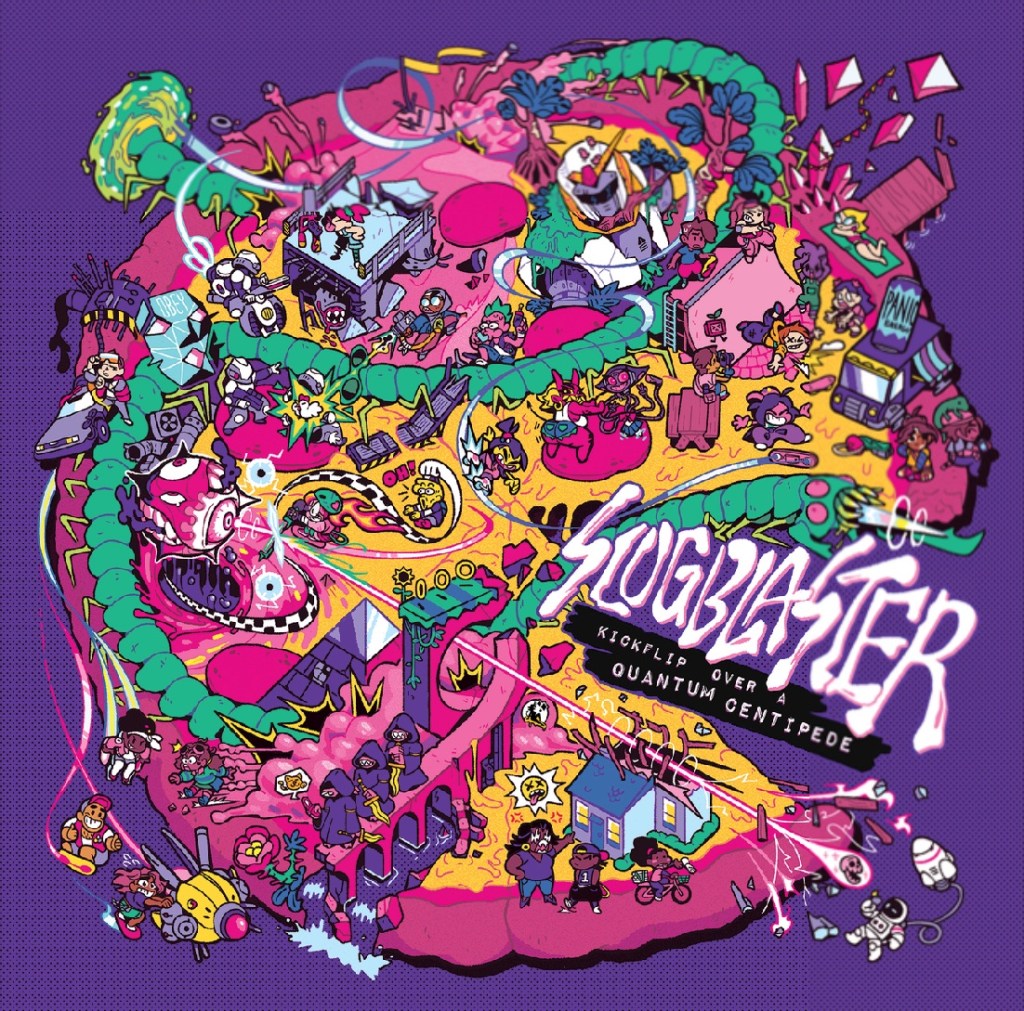
Slugblaster: Kickflip over a Quantum Centipede!
By Wilkie’s Candy Lab – Mikey Hamm
Read before? No
Played? Yes (beta version)
I love Forged in the Dark games. I also love Tony Hawks Pro Skater. Here’s a game which combines both of those and then mixes a whole junk drawer of random stuff as well and it is glorious.
Slugblaster sees the players taking on the role of a gang of youths who travel from their home dimension on Null (rhymes with dull and rightfully so) all across the multiverse into strange places to skate, face off against rival gangs and generally get into scrapes.
The roles are all fairly broad:
The Grit
The Guts
The Smarts
The Heart
The Chill
Each of these get a budget of Boost and Kick to help add dice to your normal pool of just 1d6 or to increase the impact of your result, respectively. You can also get Dares which are the equivalent of the Devil’s Bargains from Blades in the Dark.
Each playbook also gets some traits, some gear and an arc of things which happen for an amount of Style or Trouble. Each player also gets a sweet device which will help them perform tricks or face off against things from the multiverse when you accidentally land in a world that’s all monsters or about to explode or whatever.
The vibe of the book is very fun, very slapdash 90’s/early 00’s through a nostalgia haze of Crazy Taxi, The Adventures of Pete & Pete and so on.
Once you’ve been through the multiverse having fun (and there are so many different worlds provided both from the author and stretch goal writers!) you’ll go back home and have Trouble to contend with. Real life might come crashing down around you, there might be problems for your crew. You’ll be gaining and banking Trouble during your runs, gradually seeing it go up and knowing that it’ll be there, waiting for you when you get home.
I ran a demo using the earlier version of the rules and my group did some sick stunts on a mech graveyard before their rivals could. They also accidentally blew up one of the mechs and skated away from the explosion in a video which got them a lot of cred with other Slugblasters. It was a riot and I’m looking forward to revisiting this game someday.
The House Doesn’t Always Win
By Michael “Wheels” Whelan
Read before? No
Played? No
I’m a fan of Dicebreaker and Wheels from their staff has created a couple of games. This one’s an interesting game about resistance and fighting forces greater than yourself. I admit with the playing card style keeps making me think it was a heist game, but it’s a broader ‘resistance’ sort of thing.
The system uses a set of playing cards, with a fun ‘push your luck’ kind of system. The GM sets a difficulty number and a suit of cards for the skill used. Clubs are brute force, Hearts are persuasion and Spades are Finesse. Players draw card by card until they either get the number of cards matching the difficulty or four of any other suit, which causes a failure. They can choose to stop early for lesser failures, and if they draw any face card matching their suit they succeed.
Characters have a fairly simple sheet and are made by picking one of the face cards. You reduce difficulty for one of the three card types and add it for another. There are also abilities you can pick, modifying the way you interact with cards a bit further.
The Diamonds are laid out in a row where they can get swapped into the player deck, acting as wild cards. The Jack, Queen and King of Diamonds are the targets of the mission the players are on. For a one-shot, you’re only taking down one of them. For a full campaign, you’re going through three missions to take them all down.
The system is without a default setting but has tools to help make your own missions, as well as a generous helping of premade scenarios. This is the sort of game where I’d probably go for one of those rather than making up my own, just as it’s more likely to hit my table when I’m demoing a one-shot.
I’d be interested in running this at some point, I think the card-by-card draw will cause that fun Dread-like tension where even though you’re slowing down the action for the resolution mechanic, the suspense will keep people’s attention on the table.
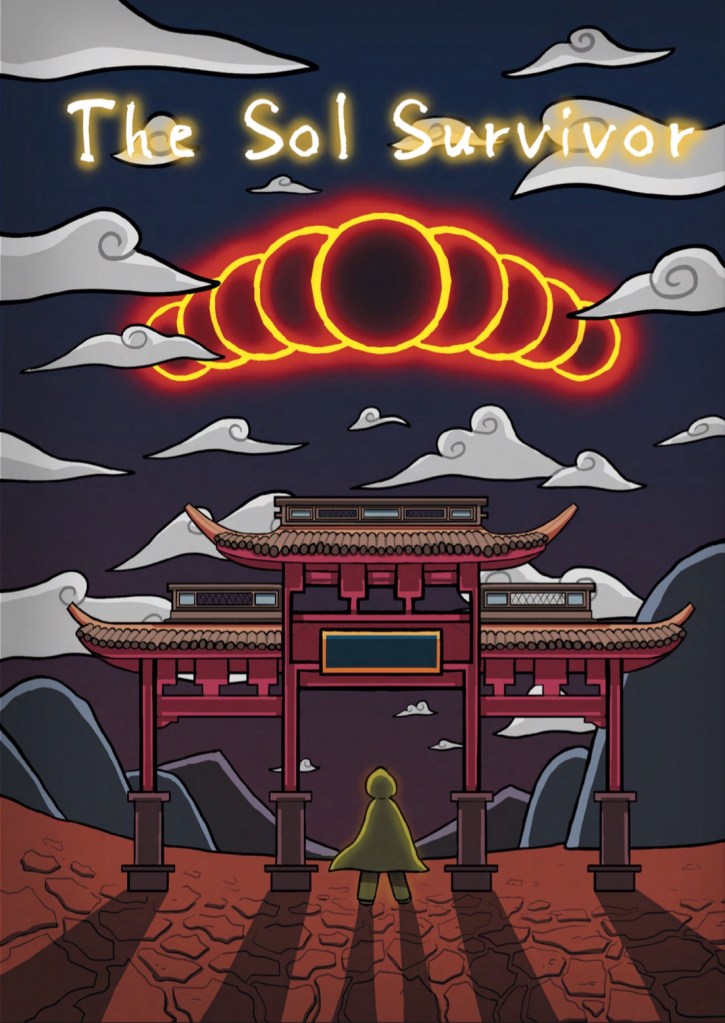
The Sol Survivor
By W.H. Arthur
Read before? Yes
Played? Yes
First of all some due diligence: I’m a friend of Arthur’s and playtested this game for him.
The Sol Survivor is a one-shot story game about accompanying the sun in mortal form across the land after being shot out of the sky. As allies ranging from merchants to dragons, you’re aiming to restore it to power in the sky. Each player will take control of the sun from time to time, while everyone else plays friends, allies and travellers who accompany them on their journey. Some players might be the same person for the whole game, some might drift in and out of their lives or have a fleeting glimpse.
Similar to Lovecraftesque the group will take turns being The Narrator, The Sun, an Ally or simply adding extra flavour/NPCs to scenes.
The sun has a ‘faith counter’ d6 which they’re looking to keep on their travel while they face threats. The game will keep going until the journey reaches a natural conclusion or the Sun has lost all their faith, then they check against multiple questions and draw cards, looking at the lowest result. This is compared against a track of all faceup and facedown companion cards, to see if they make it back to the heavens and if they can bring themselves to shine again. This means that while technically you can try to get the Sun back up in the sky at any point, you want to keep going to gain more companion cards, but also don’t want to push your luck as the Faith of The Sun may dwindle and vanish.
There’s a bestiary which gives a different person or creature for every value and colour from a deck of cards, allowing a good amount of variation in both threats and companions. The interpretation of them in either role is interesting to figure out in play, and worked better than I first thought it would during our playtest.
This sort of system is interesting to tell the story of an individual protagonist even if they’re not as much of a focus for players as whatever ally they’re taking the role of. Arthur released an SRD which does make this an easy target for hacking into different tales as well as this one.
Our Shores: Navathem’s End
By Santa Posadas & Pamela Punzalan
Read before? No
Played? No
This is part of the Our Shores trilogy of games where Sandy Pug helped South-East Asian authors bring their games to Kickstarter, which isn’t normally possible.
A PbtA-ish game, Navathem’s End is a high fantasy game where you play the agents of a Tower, an organisation spread throughout the three continents to try and stop apocalyptic events from happening. Previously in this world there were nigh-apocalyptic events thanks to a cult. The Core Seven rose up and stopped the apocalypse, then becoming beings of worship for people. In the new age, a mage woke The Colossals, gigantic gods which the agents must put down.
Characters pick from different types of Agents:
The Crafter
The Command
The Control
The Medic
The Scholar
The Shield
The Weapon
Each of these has skills which are close to moves in PbtA games, and three stats: Blood, Crown and Will.
There are several Origins which give some background questions and EXP triggers. While there are some core ones listed in the main book, the back also has several alternative ones to choose from. There’s also a Hubris Bond, which is a link to one of the Core Seven which the character has, giving them more EXP triggers. A theme of the game is hubris and as heroic as these foundational heroes were, their hubris is something which echoes through their bloodline and their students.
There are also several types of magic which can be used to add to your playbook if you want, being either a Mageborn or Awakened Mage:
Biochaotic – Life mages
Fulgurchaotic – Storm mages
Pruinchaotic – Frost mages
Pyrochaotic – Fire mages
Telechaotic – Psychics
A big difference from other PbtA games is the rolling mechanic. You roll 2d6 on a scale of success, but on a 14+ you succeed too much. Again, hubris is a big element here. You get EXP for failing or succeeding too hard, and there’s an Advantage/Disadvantage system which uses rerolls instead of the “Roll & Keep 1 more die” version that a lot of other games use. Skills don’t seem to add new moves, but modify existing ones which is good as there are a lot of moves. The game suggested that Forged in the Dark was an influence as well as PbtA and in the Moves you can see how some of the aspects of Forged in the Dark games have been adopted.
The world is thoroughly detailed and fortunately has a number of campaign seeds to help people get an impression of the sort of story that you’ll be telling. There’s some information on how to make your group’s Tower and who staffs it, which will help drive up investment in it and their mission. There are some great example Colossi for the group to take on, with illustrations showing just how epic they are in scope.
I admit I found some of the language a little odd on my first pass through the book. I think part of it is getting used to a different take on systems and styles which I’m used to a slightly more prescribed version of, similar to how Fantasy World read quite differently to Fellowship, being an Italian PbtA game.
Our Shores: Maharlika
By Joaquin Kyle Saavedra
Read before? No
Played? No
The third of the Our Shores books (after Navathem’s End and Capitalites which I read much earlier in the year).
This is a mech game, but with a few differences. People went into space and there were massive alien monsters to fight in the galaxy of Arkipelago as people were colonising it. Eventually, the remaining people broke into massive corporations and went to war with each other as well. During this time, Meka were developed and used as massive battle suits.
Unlike other mech games, the Meka are piloted by spirit warriors, the titular ‘Maharlika’ who can commune with the entities that inhabit the Meka in place of the AI of other mech fiction. There’s a lot more mysticism involved in communing, but at the same time this is still very much a mech game.
You’ll be making your characters who roll on a kind of PbtA-style scale of success. As a human you’ll roll 1d10+stat, in a Meka you’ll roll 1d20 instead, reflecting that difference of scale. A 10+ is a success, 6-9 is a partial success and 1-5 is a failure. This makes the odds feel a little closer to Quest as far as the ladder of success once you’re in a Meka, although with modifiers, you should be capable to a lot when you’ve suited up.
Unlike PbtA games, there aren’t moves to make, in fact, like a lot of tactical RPGs there are several combat actions to take instead. There are references to a grid and to spaces. It’s the kind of thing which feels closer to trad games. It’s always interesting to see an indie RPG do things to play in the more tactical combat field, although its often not quite my flavour.
The book has a ton of Meka components to make your particular version, also corporation-specific components and a ton of example Meka to help make things easier. I think for a mech game, I’m still more likely to go with Beam Saber instead of this, but it was an interesting read.
That’s two thirds of this month’s RPG reading done, just one more to go.
Okay, crunch time, I’ve got this month and next to try and read everything I’ve backed on crowdfunding platforms. I’m ahead more than I have been for most of the year and I’ve been beasting the marathon for this month. Let’s do this!
The Artefact
By Jack Harrison
Read before? No
Played? No
The field of solo RPGs has led to some fantastic ideas over the last few years, with people telling all kinds of strange stories by themselves with just a short game and a few tools.
Here, you play the story of an artefact, a magical device with its own will, possibly one that’s more useful than my friend’s mace which would speak when it detected a slope.
You pick one of several items, each of which is a scenario in itself:
The Weapon
The Shield
The Instrument
The Ornament
The Deck
The Footwear
The Staff
The Tome
The Automaton
You then play through the stories of the owners of each item, asking questions of it as it goes from owner to owner throughout the years. As part of the process you draw the item and then modify it as time goes on. The owners are picked or randomly determined with questions to ask about them. Once they’re done with you, stop and rest for an amount of time based on whether you’re immediately found or left alone for up to a decade. Like Morningstar’s The Skeletons, this is something which can nicely pace out real time by simply pausing what you do.
Palanquin
By Genesis of Legend – Jason Pitre
Read before? Yes
Played? No
A short zinequest game about a royal Heir who’s fleeing for her life. Her family’s been murdered in a coup, but the game’s not about that, it’s about the journey. The GM plays the young Heir and the players take the role of the people trying to smuggle her out to freedom, each given a name, backstory and role:
Ulu, the Veteran
Xanling, the Scholar
Tanalor, the Magister
Madani, the Faithful
Peryani, the Hunter
Illic, the Shadow
You can see how each of them has a specific focus which will help them over others deal with protecting The Heir. They also have reasons they might be seen as not pulling their weight, and links to The Heir from their background. This includes Illic, who was a criminal helping The Heir with her escape.
They each get chances to save the Heir in each situation, and talk about their past, their motives and so on. The more they explore things within the group, the better the dice pool the Heir has gets and if they all fail to save her, she’ll roll and try to save herself. Once you’re done with the listed sets, you’ll reach an epilogue where the fate of everyone is decided.
It looks like a light, neat little game and a good one-shot that tells. you everything it needs for the scenario, giving you a lot of space to work with and develop.
Candlelight
By Glowing Roots Press – Gabriel Robinson
Read before? No
Played? No
I’ve made it pretty clear through my words over the years that I’m a big Trophy fan. When I saw third parties starting to make their own Trophy games, I had to check them out. Gabriel Robinson’s a person who’s contributed to official Trophy books and other Gauntlet work including the recently released (at time of writing) Silt Verses RPG, so I knew this was going to be a good time.
Candlelight is a game that can stand alone, or act as a sequel to a Trophy Dark game. In it you play the souls of the dead, trying to work their way back through the way they came and away from the forest that is trying to consume them. Along the way they have baggage to deal with and things which they may encounter trying to stop their progress.
The game mostly uses the same system, but flips the five Rings into Gates that you’re traversing. You have a Hope score and a Despair score, both of which end your game when they are maxed out. A success on a roll will help raise your hope.
Instead of Rituals you have Dirges and instead of Ruin rolls you’ll be making a Reckoning to see whether your Hope or Despair goes up in a horrific moment.
There are still Devil’s Bargains, but this time it may summon an entity from the Forest which may be its own problem.
The game explains how to make characters from your dead Trophy treasure hunters, but also gives tools to convert other games into Candlelight if you get a TPK.
This was a good read, like so many Trophy games, and is definitely one which I want to try if my weekly group play another Trophy Dark game.
Sunken
By Mike Martens
Read before? No
Played? No
Another third party Trophy game, this one rewrites the Trophy Dark rules and takes one of the incursions from the main book, remixing it to make a new tale of familiar horrors. You then also get another couple of nautical scenarios to round it out.
While this is a self-contained book, it also has a few changes to the Trophy Dark system.
You sail under a specific flag, which gives you your Drives
Magic is represented by prayers to the Saints
Light and Dark Dice are replaced with The Flesh (light dice), The Deep dark dice) and The Heavens (a new, divine dice). Calling to The Heavens replaces Devil’s Bargains and provides some fortune if it is your highest roll, but advances your Fall if it is your lowest
A Covenant of Silence is the remixed scenario, where the grew find a ghost shop from the East Passage Company. They loot and investigate, but the cargo might not take kindly to their presence. This takes influence from things like Alien.
The Wreck of Futility ruins the characters’ ship in some ice, all too near a strange vessel with mechanical beings. This is inspired by The Borg form Star Trek and The Terror
The Colossus Beneath is a bit closer to Bioshock, with a strange culture found under the sea, decadent and on the edge of its own ruin.
You Got a Job on the Garbage Barge
By Amanda Lee Franck
Read before? No
Played? No
This is a fun OSR-ish dungeon all set on a garbage barge. You got a job on the barge and there’s a lot going wrong with it. There are NPCs roaming which you can interact with, and so many critters. There’s also a lot of trash, some is useful, some is sold in shops and some is just… there. You get locations like “The Rebar Forest” which is a maze of rebar on some metal scrap. “The Fox Bilge” which contains a fox snake. It’s all gloriously messy and weird.
Given the kind of place this is, there’s an adventure, such as anything can be called that here, called, “Your first job is to keep the gas lake from exploding” so good luck with that.
A critter from the garbage barge
Personally, I think I’d probably run this with Into the Odd, Electric Bastionland or Troika, as those are the kind of weird OSRs that are taking my fancy at the moment.
i’m gonna be
By Laura Lovelace
Read before? No
Played? No
A short solo game about going on a journey, using a mixtape. There’s one of these already called Ribbon Drive by Avery Alder and it’s very good. That’s specifically a group experience though, and this is a solo one with a bunch of tables to work out what you encounter as well as how to tie the track on the mixtape to it.
It’s a shorter game than Ribbon Drive, taking just one person’s mixtape rather than swapping regularly between multiple people’s. The comparison’s a bit unfair, but it is there. Personally I’m more likely to go through this, as it feels like the kind of game I could simply do by myself with some dice, a notepad and a mixtape in an afternoon.
Another thing of note is that I have a PDF now, but I thought I only had this in its tiny physical edition which is very cute and came with stickers.
Disk Horse 1: Off to the Races
By Fiona Maeve Geist
Read before? Yes
Played? No
This game is a statement about the Satanic Panic, which affected roleplayers a long time ago, primarily in America. I never experienced this myself being someone who started roleplaying in the 90’s in a fairly self-contained group who only encountered other roleplayers several years into our gaming time. Still, it’s a fascinating time. We’ve all read Dark Dungeons, some of us have seen the film adaptation of it and the Tom Hanks film, Mazes & Monsters.
Disk Horse is an RPG about playing an RPG. One player is a private detective trying to deal with their own baggage but also trying to prove that Mazes & Monsters is evil, leading to all kinds of odd behaviour. They have a set of character creation details for themselves, then the players have theirs with all kinds of personal goals and character quirks. One player plays the GM who has their own set of rules, they have a game they don’t really know the rules for and their moves involve mostly making things up and pretending to look for rules.
It looks very silly and fun, although it might be better with either a physical version or printouts of each characters’ creation rules to help speed things along. I love the idea of this kind of weird shit and it’s a fun read, even if it feels like it’ll be a hard sell at the table given the modern lack of familiarity to this era.
Night Reign
By Sinister Beard Games – Oli Jeffery
Read before? No
Played? No
Another Rooted in Trophy game, Night Reign feels like quite a departure and thematically, a little closer to Blades in the Dark by way of the Hitman games.
You were servants of a noble house who were murdered, and now you’re going to take a vicious, bloody revenge on the people who did it. The city is of the kind of technological level as Doskvol, but the weird thing about isn’t an endless night, but a nightly rain which is strange, slick, toxic and can power things.
The game gives a list of different houses, their specialities and their rulers as a kind of shopping list of murder. There’s also a scenario at the end of the book which makes for a good example of how to design future hits.
The system uses cards instead of dice, and some tokens to show your progress in an incursion. Your character draws cards based on their dots in a talent and on any cover identity you’re adopting. You draw cards one at a time, aiming to get as close to 21 at possible without going over. Sound familiar? Odd that. There are tables of results for different types of roll (stealth, guile, violence). If you stop early it might be a problem, but at least you can stop. If you go over, you’re fucked and things go really badly.
As well as a deck of cards with Aces to Tens, you also have a second deck with face cards, representing The Sisters. You can draw a card from their deck to guarantee a result of a 10, but things are going to get weirder for you. The Sisters are almost like the opposite of Trophy’s Saints, entities that you curse, that you wish on other people and try to avoid the notice of.
This is a 50 page game, so the land of Laefendport doesn’t have a massive amount of coverage, but there’s enough to start you off and you can build from there. The same with the incursions. It’s really interesting to see how a game like this can so briefly evoke a unique world and structure for a campaign.
Pasión de las Pasiones
By Magpie Games – Brandon Leon-Gambetta
Read before? Yes
Played? Yes
Pasión de las Pasiones is a game about telenovelas. I’ve never watched a telenovela, but I know soap operas, I like good, dramatic soap operatic stories from my years putting in time with Eastenders to my love of The OC and X-Men. Even if like me, you don’t know proper telenovelas, Brandon Leon-Gambetta perfectly explains through his writing and through the mechanics of the game how to reflect that style of storytelling.
This is a game of pensively looking out of a window, throwing evidence in an easily accessible waste paper bin, making a glorious entrance down a set of stairs, having a heated stand off with your twin and riding your horse into a courtroom. It’s a game that doesn’t half arse anything.
This is PbtA, but without stats. Instead, each move asks you a couple of questions which gives a +1 to your roll when you answer ‘yes’ to them. Each playbook also gets a question which is unique to them. This creates a roll of 2d6 plus up to three, like a standard PbtA spread and helps encourage you to act certain ways or do certain things in the fiction.
The playbooks are:
La Belleza – Beautiful, showy and able to draw people in, but also able to be evasive with giving their heart away.
El Caballero – The guileless blunt instrument of a hero, dashing, and easily manipulated.
La Doña – The scheming matriarch, caring at times and quietly vengeful.
La Empleada – The employee, naive and in over their head.
El Gemelo – The twin of another playbook, the opposite of what they are, but looking uncannily like them.
El Jefe – The boss, wealthy, in charge and violent, but often through underlings.
The Treasure at the End of This Dungeon is an Escape from This Dungeon and We Will Never Escape This Dungeon
By Riverhouse Games
Read before? Yes
Played? No
I already liked Riverhouse Games’ games, but this kind of title would have made me instantly back it. The title feels like a post-rock band’s album name. Maybe it will be.
You are adventurers, each with their own rules, trying to navigate a dungeon with a small number of rooms. You will always be going through these rooms. They may change gradually and you may change gradually, but you will always be going through these rooms. You may die. You may scream. You may question your existence, but you will always be going through these rooms.
The adventurers include:
The Muscle, who protects people and can’t due, but removes rules whenever they would.
The Mage who loses spells but gains secrets at they die, also gaining the ability to merge spells.
The Thief… shh, their rules are secret and I’m not going to spoil it.
The Healer has a selection of miracles and oaths they have to serve, but change each time they die
The rooms each have their own rules and elements that are expanded on as you go:
The Gatekeeper
The Puzzle
The Trick
The Battle
The Treasure at the End of this Dungeon is an Escape from this Dungeon and we will Never Escape This Dungeon
I love this idea for a game and ended up reading Fractals Fractals Fractals Fractals, the book of extras which were wisely kept separate from the main book, which should remain pure. The additional character classes and rooms are a great addition to an already fascinating game, and will help to keep things interesting if you play it multiple times.
Beam Saber
By Austen Ramsey
Read before? No
Played? No
This is another one which has been a long time coming, only got a final version this year, but because I’m reading these mostly in the order of their campaign on Kickstarter, here it is.
Beam Saber is a space-faring mech game where multiple factions are all fighting over Earth, once abandoned and now returned as a nice token victory. There are broad factions: Autocracy, Corporatocracy, Democracy, Oligarchy and Theocracy. These allow people to flavour them for their own campaign or use the specific examples later in the book.
The game itself is Forged in the Dark and I’m not sure why, but I expected it to be a lot less Forged in the Dark than it ended up being. The gear system’s quite different to allow the creation of mechs and vehicles for missions. There are also some skills which are specific to the mechs, mainly about moving and smashing things while piloting. It’s a good change which fits the theme, unlike some other FitD games where the theme and system clash a bit.
The playbooks are:
The Ace
The Bureaucrat
The Empath
The Envoy
The Hacker
The Infiltrator
The Officer
The Scout
The Soldier
The Technician
There are also several team playbooks which will help direct the types of missions you’ll be going on:
The Consulate
The Frontline
The Logistics
The Mechanised Cavalry
The Profiteers
The Recon
The R&D
The [REDACTED]
I admit my first thought with a mech game is that it would focus pretty much exclusively on combat, but I’m interested to see what the other squads would be like. They also explain why you get playbooks like The Bureaucrat. It feels like you’ll need to work with the players to make sure everyone’s on the same page.
Because this is a space-faring mech game, there are quite a few differences to things like the new actions and how they work in fights, how downtime works and development of your tech. Handily there is a premade campaign, descriptions of the different powers to work for, locations and example mechs. The latter is really useful as some players might not want to have to build their mechs or to have a baseline to modify.
I grew to enjoy Mobile Suit Gundam, primarily through the Gundam Warriors series of video games and through watching the entirety of Mobile Suit Gundam shortly after. I haven’t seen anything since then, but I loved the last mech game I ran (a preview version of the sadly abandoned Souls of Steel). I was originally a little intimidated by the size of the book and the many, many draft copies which happened over the last few years, but reading it was nice and easy. I’d be interested in trying this game at some point.
World Wide Wrestling 2E
By NDP Design – Nathan Paoletta
Read before? First Edition
Played? No
I’m not a wrestleboy. My main knowledge of wrestling comes from The Mountain Goats’ “Hail the Champ”, a season of Glow and whenever War Rocket Ajax talk about wrestling. That said, it’s a thing that’s adjacent to a lot of the fan spaces I’m in, it’s ludicrous, entertaining and has a fun mix of reality & fantasy to it.
World Wide Wrestling is a Powered by the Apocalypse game where people replicate the running of a wrestling show. I’ve seen some games which had you build wrestlers and then fight them against each other like it was a combat in D&D. In this game, you’re booked to win or lose the show. You’re generating Heat with your opponent and trying to make the Audience pop. It’s not all predetermined though, as sometimes fate will get in the way, sometimes you’ll have a different idea from what Creative set up for you.
This is the second edition of the game and includes a few changes, a number of which I don’t recall as it’s been years since I read first edition and I never got to play it. I do know it has a lot of International Incident incorporated into it.
Playbooks include:
The Ace
The Anointed
The Anti-Hero
The Call-Up
The Clown
The Fighter
The Hardcore
The Jobber
The Luchador
The Luminary
The Manager
The Monster
The Provocateur
The Technician
The Veteran
Some of these sound a little samey to an outsider, which I’m sure first edition was a little more clear at, but there are probably reasons behind the changes. A nice touch is a guide to complexity for the roles.
The gameplay loop is in the form of a show, where you cut promos, Creative sets up matches between players and NPWs (non-player wrestlers). There are several different formats which can be called upon to mix things up and stop games from getting too formulaic. There’s a fun mechanic to turn players whose wrestlers aren’t involved into announcers, giving a little mechanical push if they want, mainly to help encourage drama.
I’ve had WWW on my list of games to try for a while now, more for one-shots than anything else. I’ve been thinking about making an alt-UK where the counties are like the old wrestling territories. The other thing I want to do, more in a one-shot capacity, is to have a wrestling league where the personas are all based on the group’s old characters. A rabbit, a Night Witch, a weird little gnome. I reckon it’d be a fun love letter to previous games and the kind of bombastic personas that would make for an entertaining game.
This month’s books are going to be split into three parts, as I managed to get that much reading done. Next up will include me making a rod for my own back as I read several Monster of the Week books, only one of which is technically part of this quest.
I’ve got a few more games this time, with a few interesting later PbtAs which do some interesting things with the system. Ther may not be many, but I’ve actually had a pretty good go at running all of them.
Voidheart Symphony
By Miranda McJanda – UFO Press
Read before? No
Played? No
Legacy: Life Among the Ruins had a spin-off called Rhapsody of Blood which was a kind of Castlevania legacy game, as generations of heroes fought evil castles in the past. Voidheart Symphony remixes that idea and brings it to the present.
No longer are you generations of heroes, but normal people living in a normal world. But something’s festering inside it. A wound in the world which is spreading through susceptible minds. The Castle forms around them in a strange dreamspace and starts to infect reality.
In the human realm, players have to deal with life’s problems and their investigation by rolling 2d6 against various gauges representing health, money, notoriety and so on. If both dice beat the gauge then you’re fine, one means a success at cost and neither means bad things.
When you find a way into your enemy’s specific bit of The Castle then it becomes a Powered by the Apocalypse game, with your characters getting their own different set of stats and cool weapons. You can also take items through with you, imbuing them with extra abilities and calling on your friendships in the real world for help.
I’ve not played Persona 5, but I’ve seen my partner play some of it and it’s a heavy influence here. You live out a normal life, go into a strange other realm, fight your way through and take down a boss to improve the world.
Character playbooks are:
The Authority
The Captive
The Harlequin
The Heretic
The Icon
The Inhuman
The Penitent
The Provider
The Watcher
Each of these have fun things they can do in the real and dream worlds, and are further customised by taking tarot-themed Covenants with PCs and NPCs alike.
This is a big game with a lot going on. I love that PbtA games use reference sheets and they’re a good indicator of what to expect from a game. This has a LOT of reference sheets. I’ve heard an actual play which flowed pretty well and I love the idea of something which feels like a Persona/Hunter: The Reckoning sort of thing. While Rhapsody didn’t do well with my group, hopefully in time I’ll be able to test this out on them.
Electric Bastionland RPG
By Chris McDowall – Bastionland Press
Read before? Yes
Played? Yes
Bastion is the most important city. A sprawling, growing mess. Players have failed at a career and have £10,000 in debt. They’re going to get it by going on dangerous adventures.
I’ve listed out character classes or occupations for these games. I won’t be doing that here, as the majority of the book is over 100 ‘Failed Careers’ for your characters. Your highest and lowest stat dictates which career you’ve got and whoever’s the youngest player at the table determines why the £10,000 debt war incurred. Each career has some gear, a short blurb and a couple of tables giving you your money and health, as well as some random things (roughly) scaled to that result.
As an example, result 30a is the Amateur Amputator. They get a bonesaw (d6 damage) and some ether. At £5 starting money that means I unsettled my patients with my paranoia so I get a tiny pistol (d6 damage) that I always keep one hand on. At 6 Hit Protection (HP) I also liked to bring a bottle of Strong Perfume to work.
The system’s an OSR game, but with only Strength, Dexterity and Charisma as your stats. You roll a d20 for a Save, aiming to get equal or lower. If you’re in a fight then you don’t roll attack, just damage. Everyone gets an amount of Hit Protection which absorbs damage and regenerates after a bit of a rest like a shield in a video game. After that it goes into Strength.
There are some great methods for generating maps of Bastion and the spaces outside of it. I’ve run a two-shot of the game where the group were exploring a Waste Forest. I really enjoyed it and definitely want to go back. I think the high point is still the character and world creation, seeing what strange things come from it. Luckily the rest of the game was fun, but I think that’s where a lot of the thrill came from.
Retropunk: Cyberpunk roleplaying game
By Fraser Simons – Samjoko Publishing
Read before? No
Played? No
This is a gorgeous-looking book and another cyberpunk offering from Fraser Simons. It’s a city crawl, with several interestingly made cities in the back from different authors, each with missions to complete.
Your characters are Glitches living off-grid like in Hack the Planet, but in a world with a lot of virtual overlays over things like The Veil. It’s all got a cool, retrofuture, almost vapourwavy aesthetic to the book.
Characters are either Specialists, Heavies or Breakers, with special abilities linked to those classes. Rolls use their Approaches and while this is an OSR-ish game, the system feels reminiscent of Forged in the Dark with the use of Approaches and the way outcomes happen.
This is a very pretty looking book, but out of Simons’ cyberpunk outings I think I still prefer Hack the Planet.
Last Fleet RPG
By Joshua Fox – Black Armada
Read before? Yes
Played? Yes
I love the Battlestar Galactica reboot, irrespective of the finale which I consider to be mainly fine. Like Lost, ultimately it’s about the journey and any long form ongoing media is going to have to have issues which they could have solved if they had somehow known how long they were going to get, when cast members would change and so on.
Anyway, I’m not here to judge the existence of BSG, I’m here to look at Last Fleet.
This is a Powered by the Apocalypse game which replicates the experience of the BSG reboot. You play a fleet of the remaining survivors of the human race, on the run from a relentless force at the same time as handling shortages within the fleet and real or imagined traitors. The default setting has its own potential bunch if infiltrators which are more like a strange fungal network who can chew up people and spit out replacements who may not even know what they are.
There are roles like Tactician, Engineer, Scientist, Marine, Pilot, Influencer & Investigator which provide a move and a defined role as the playbooks are a lot more about what kind of person you are:
Aries – an impulsive hothead who runs in and pushes the big red button, whether verbally or in a fighter
Taurus – a dependable, principled character who’ll take a lot of punishment but won’t compromise their beliefs
Gemini – someone with shady motives, generally crime or mutiny-based
Cancer – a leader who might be a bit too softhearted and let bad actors get away with things
Leo – a charismatic leader who inspires followers, hopefully for good and not for culty reasons
Virgo – an overachiever who takes on too much, pushing themselves beyond the limit
Libra – a diplomat and manipulator, who might get up to unscrupulous things
Scorpio – a sleeper agent, losing time and doing awful things they then need to stop and/or cover up
Sagittarius – someone who loves discovering new things and may stumble into bad situations
Capricorn – a tactician who may go too far for victory
Aquarius – an investigator who wants to get to the truth no matter the cost
Pisces – the supernatural-adjacent playbook with weird visions
You might have noticed a few things about these playbooks. All of them have things they do and ways that might go too far, might break. Instead of health you have Pressure which you’ll constantly be pushing at. The book highlights some moves which raise and lower pressure as being particularly important to the gameplay loop.
There are breaking points which are a combination of some communal and then one or more specific to each playbook. These help give you a scripted moment of acting out, like Monsterhearts’ Darkest Selves.
The fleet itself is created with its core abilities and problems, then you see how the wear and tear of your constant attempts to escape take you. Hopefully home, or to safety, but it’s rarely that kind.
Handily there are two quickstart scenarios and there’s even an alternate version where you play Ancient Greek people trying to outrun death’s vengeance after stealing immortality.
Trophy Loom
By Jesse Ross & Others – Hedgemaze Press & Gauntlet Publishing
Read before? Yes
Played? Yes… kind of
I ran a campaign of Trophy Gold earlier in the year but I didn’t count this as being read back then even if I often referred to it. Trophy Loom’s the setting book for Trophy Dark and Trophy Gold, providing information on the realms you’ll be travelling and the places around them. It’s also anti-canon, to encourage you to use what you want or roll to see what’s there.
It would have been enough if this was a book of tables. If it was a listing of places. It accomplishes a lot more, than that, managing to evoke the strange beauty and horror of the world of Trophy.
The book starts in civilisation, much like your standard treasure hunter might. Specifically, the book provides details about the capital city Ambaret. Districts and traditions are provided in d66 lists. There’s also a nice set of tables about the people of the land which gives even more names for NPCs and random character traits for humans, faeborn, manikins and beast bitten.
Civilisation is fleeting in Trophy though, so the middle section of the book goes into The Borderlands, taking you from wealthy holiday homes to the haven of most Trophy treasure hunters, Fort Duhrin. There’s a scale of law to chaos for each settlement and tables about an outlaw band, about local gods and cults.
The last third of the book, like the last act of most treasure hunters’ lives, is occupied with Kalduhr. The forest grows and consumes. It’s the place where so many Trophy Incursions are set, and this helps fill in some detail. Again, it’s all in d66 tables, so you can roll and inject something random on the way to an Incursion, in-between them or use them to inspire your own stories.
Like fantasy RPGs of old, there are treasure tables at the back, which include such wonderful things as “Coffin of tarnished metal, wrapped in chains and locks. It seems empty and makes no noise when shifted” or “A crown of smoky black crystals woven in bands of tarnished gold”.
I made most use of the Fort Duhrin tables when I ran Trophy Gold, which I guess was to be expected. I used tables about the sisters, waystations, tales about the Witch of Nevask helped inspire other witches.
Venture & Dungeon
By Possum Creek
Read before? Yes
Played? No
This is not one, but two Belonging Outside Belonging RPGs, reflecting fantasy roleplaying games in different ways. Both use the same system as Dream Askew & Dream Apart, where there’s no GM or dice. Players take a character and an element of the setting, asking questions, making weak moves to gain tokens and spending them to make strong moves.
Venture shows us heroes in a fantastical world, finding places to adventure and weird things to do. First up you determine the setup of the quest together, then you set forth. Each character class has a list of things they’re trying to find out through play as well as the main quest.
Roles are:
The Paladin
The Fighter
The Bard
The Rogue
The Wizard
The Cleric
The Setting has:
The Darkness
The Celestial
The Arcane
The Mundane
The Authority
The Underbelly
These seem a little broad, but with the quest established at the start and a focus on the internal quests, they should work well enough.
Dungeon zooms out to the game table itself, with you telling the stories as the characters who play the characters. There’s some interesting bleed between the two places. Not quite DIE level, but in what feels like a much more light-hearted way. The characters each have a role at the table and for their character. The setting elements are all fantastical, with a number of aspects of the dungeon, but also a ton of monsters.
The playbooks are:
The Cleric
The Fighter
The Rogue
The Wizard
The Little Sibling
The Game Master
You’ll note a few oddities there. The character classes reflected often share elements with the person playing them, so when you’re making The Fighter you as what both your characters have given up out of: A Home, A Family, A Gang of Friends, A Support Group, A Mentor or A Happy Ending.The Little Sibling is a glorious mess and while my little sibling wasn’t this bad at the table, it’s common to hear tales of people who did have this experience. The GM may be playing the world in the game, but they have things like traits they project onto NPCs and so on.
The Setting Elements are:
The Dungeon
The Denizens
The Powers-That-Be
The Mysteries
The Monsters are:
The Restless Dead
The Glamorous Ones
The Gazing Monstrocity
The Great Dragon
The Mind Devourer
The Vampires
Green Dawn Mall – A Zine Quest Game
By Côme Martin – Emojk
Read before? Yes
Played? Yes
I’ve reviewed Green Dawn Mall on Who Dares Rolls already so I won’t go too far into it here.
Green Dawn Mall is a surreal ‘mall crawl’ where you make your way through a strange place that lives under and connects shopping malls. There are so many tables for shops, each escalating in weirdness as you get deeper, and rules for places above and below the mall.
When I ran it, the group were trying to find a friend who was desperate to clear up her scaly skin so she went to a potentially mystical pharmacy. The group entered through the basement of a real world mall, found themselves navigating a chaotic roller-rink, talking talking with fish and being pursued by mannequins. They wrecked a toy shop, stole a car and eventually managed to rescue their friend before going hom.
It was somehow disturbing and wholesome all at once. I really enjoyed reading the book and the surreality worked well in play.
Leaving the mall.
Conclusions
I’m finally only 6% behind where I should be after spending most of the year much further behind. This is feeling more doable, but I’m also planning n how to deal with ‘overtime’ if I go over 2023 and still have books to read.
We’re in the last quarter of the year, so it’s crunch time. I have admittedly neglected reading various interesting games I’ve picked up from Itch and a few bigger RPG books have ended up as surfaces to lean on while I’m writing this article. I will get round to them, but after all these books!
Bleak Spirit
By Chris Longhurst – Certain Death
Read before? Yes
Played? No
I haven’t played Dark Souls. It’s a point of contention with my brother and one which he raises fairly often. I get it, and I’ve played a bit of Bloodbourne which I enjoyed but couldn’t get too far in. Between my impaired coordination and infrequent playing times, I found putting in an hour or two in every couple of weeks didn’t really help.
Bleak Spirit is a Dark Souls style RPG which uses a variation of Lovecraftesque, and it deals with the subject matter in a way I like. One which doesn’t need keen hand-eye coordination or memories of attack patterns.
In Bleak Spirit the group controls a wanderer traversing a haunted, broken world, gathering lore and hunting for an adversary.
Taking turns, players are either:
The Wanderer – traversing the world, talking, fights, surviving but never talking about what’s going on in the world or inside the Wanderer
The World – establishing everything the Wanderer encounters and that kind of scene is being played
The Chorus – Adding detail to descriptions, playing some voices and flavouring things to fit their special cards
There are three types of scenes:
Danger presents monsters or traps
Interaction introduces people
Feature shows the landscape
Each scene adds to the lore of the world and there are some strict amounts for both types of scene and scenes which you’ll get in each act before the grand finale against the antagonist.
Lovecraftesque is a great game with some fairly ritualised play. This feels like it dials that up a bit, and mutates the rules in an interesting way. I backed the book on PDF but have since bought the cards to better help running this at some point. Like Lovecraftesque there’s a teaching guide and some premade scenarios, which I also find to be useful as I don’t know how long after reading this I’ll actually get to play it.
Heart: The City Beneath
By Chris Taylor, Grant Howitt – Rowan, Rook & Decard
Read before? Yes
Played? Yes
Heart is a follow up to Spire, set in a mile-high drow city occupied by elves and filled with all manner of weird magic. There’s a city beneath which is somehow much weirder.
The Heart has a number of different potential origins or reasons for being, but the exact one doesn’t matter. It messes with reality, warping things that get too close. This creates an environment for dungeon crawling which is somewhere between Borderlands and Annihilation.
Unlike Spire, you can play Ancestries beyond the drow, adding aelfir, humans and gnolls to the mix. You also get Callings which give you an ability and ways of levelling up. Importantly, they’re all defined by your motivation to keep delving in somewhere as weird and horrific as the City Beneath.
The classes are:
Cleaver
Deadwalker
Deep Apiarist
Heretic
Hound
Incarnadine
Junk Mage
Vermissian Knight
The system has players gather a dice pool based on their Skill, their Domain, any Masteries and then roll them, looking at the highest result for their level of success. Failure and damage (physical, mental or other) add to different types of Stress, which eventually turn into Fallout the GM rolls against your Stress and fails. It’s a nice, simple system with a lot of customisability between the character classes and callings.
The Heart campaign is quite different to Spire. Here you play strange, lost people who are going on delves through the ever-changing lands underneath Spire. The closer you get to the Heart, the weirder things get.
There are different locations which can be used and tools to make your own, along with a beastiary which could be larger, but gives a great indication of the kinds of horrors to expect. In my short demo, my group escaped fractal seagulls, found a cult living in a wall, coin-toothed traders, a lake made of spiders, courts of the ghost pigs and one of the group even died and was replaced with an alternate reality version of himself.
I’m not a massive dungeon crawler guy when it comes to RPGs, but this is a way that really appeals.
Root: The Tabletop Roleplaying Game
By Brendan Conway, Mark Diaz Truman – Magpie Games
Read before? Yes
Played? Yes
I love the Root board game by Leder Games, where factions of animals all scheme and make war in a giant woodland realm. There’s just enough backstory in the board game to get people in the mindset for an adorable-looking game with some real sharp teeth. A lot of the setting is through play and through Kyle Ferrin’s gorgeous artwork.
The Root RPG takes that concept and positions each player as individual vagabonds looking to survive in a woodland filled with warring factions. The Marquis de Cat have invaded and are industrialising the woods, the Eyrie Dynasty is old, stuffy and wants to reclaim the woods, the Woodland Alliance carry out daring acts of resistance against the others.
As a vagabond, you work for any of those factions or the denizens who have to live among all this warfare. You get playbooks taken from the roles the Vagabond player in the board game chooses from:
Adventurer
Arbiter
Harrier
Ranger
Ronin
Scoundrel
Thief
Tinker
Vagrant
The playbooks are simpler than a lot of PbtA games, with one side for your rules and the other with a questionnaire about your character’s past.
This game differs from other fantasy-based PbtA games by having an emphasis on combat skills, roguish skills and weapons.
If you have a combat skill then it unlocks a unique move with any weapons which have a matching skill. It feels a little clunky at first, but running a demo I got used to it, and while I bought the PDF I also bought a deck of equipment cards to help when I’m demoing.
Each playbook has access to different Roguish Feats which help emphasise the daring actions the group will take, as well as the mischievous tone of their deeds.
There’s a great deal in setting up the woodland and making sure it’s a living place, even with a sample clearing. There are several Free RPG Day modules which provide pregenerated characters and clearings filled with potential drama.
Root: Travelers & Outsiders
There’s a supplement which was made at the same time, so I’m lumping it in as a core text rather than a stretch goal.
This book adds four factions from the Root board game who can be mixed with the previous factions. The Riverfolk Company are hypercapitalistic traders. The Lizard Cult offer aid to the needy but also sacrifice them. The Grand Duchy are an invasive force filled with political infighting. The Corvid Conspiracy are a crime syndicate.
There are new weapon skills, roguish feats, gear and all-new playbooks including:
Champion
Chronicler
Envoy
Exile
Heretic
Pirate
Prince
Raconteur
Raider
Seeker
None of these are Vagabonds in the Root board game, so it’s interesting seeing the increase in variety. There are similarly new natures, connections and drives to open these up a bit. One other new addition is a set of moves based on the animal species you’ve picked. Things are kept a little broad as a few traits had to be lumped in together.
There’s an alternative method of setting up the woodland by playing three rounds of the board game and measuring things from there. Finally, there are a couple of new clearings which specifically use the newer factions.
While I’ve got other fantasy PbtAs I want to try out, if my group want to do some high fantasy violence, I’d like to try a campaign of Root out.
Under Hollow Hills
By Meguey & Vincent Baker – Lumpley Press
Read before? Yes
Played? Yes
The Bakers made Apocalypse World and the PbtA framework, but few other people know how to rip it apart and play with it as well as them.
This game’s about a fairy circus and the people travelling in it between fairyland and the human world. You travel to a new location, scout it out, check out the locals, then you put together a performance fitting what they want, or need, to see. Then, you move on. It’s a simple loop and the language of play makes it feel like a great variation from wandering heroes slaughtering their way from land to land. You’re still scouting, you’re still hitting a dramatic crescendo, but here it’s all art and emotion.
You’re mostly fairies, so things like age, time, seasons, gender and even death are just plays. You can mess with them as you feel fit. A fairy may die in a scene and come back in the next one. What are normally ‘Moves’ in PbtA games are ‘Plays’, each given their own score and decoupled from any stat. You don’t have health, but as time moves or at some other points you might change your style between summer and winter. Then there are mortals, who have a slightly different pairing of styles from bold & cautious. They also might have reasons to be pretending to be fae, and if they die then it’s for good.
The playbooks are:
The Boondoggle Hob
The Chieftain Mouse
The Crooked Wand
The Crowned Stag
The Feather-Cloak
The Interloper
The Lantern Jack
The Lostling
The Nightmare Horse
The Seeker
The Stick Figure
The Troll
The Winding Rose
Each playbook gets a selection of similar basic plays and some that are their own. They also get potential roles in the circus, as everyone needs to pull their weight, even if they’re there specifically to complain about things.
I’ve run a demo of this game, set in an art fair at an old pub in the Northeast. The group helped an old lady come to terms with retirement and took her to fairyland in a touching scene. The Stick Figure had some fun, disturbing performances where they fell apart, the Crowned Stag summoned hordes of animals and the group helped a local goat cause havoc on a golf course.
Agon
By John Harper – Evil Hat
Read before? Yes
Played? Yes
If John Harper makes a game, you back it. It’s a rule. By this point I already knew that was the case, but I saw the subject matter. My dad studied Greco-Roman Ancient History when I was a kid so I grew up with these myths.
Here you all play your own version of The Odyssey, but you’re also competitively out-heroing each other as you go from island to island, trying to find your way home. You play mortals or demi-gods, who make die rolls by yelling out their name, their epithet and what they’re rolling, also whether they’re calling on their favour from a good or their pathos. This was a game that got me hired to run demos as I ran it in a game store and the staff saw my group were having great fun yelling and competitively being heroes. I’ve run it since with only two players and it had a very Hobbs & Shaw vibe, but if one of them was the son of Hades.
There’s guidance to make islands, and several prebuilt ones so that the Strife Player (GM) can launch them into challenge after challenge with no prior work. Each island plays out in the same pattern: the heroes rock up and see the initial problem, they take on a number of tasks and then can access the finale. They compete to see who takes the lead and that player decides which stat will be used in the finale. Players split between those looking to take on the final challenge or save the locals for less glory. There are rewards, the players sail off and the mists take away that island, while revealing a new one. Eventually, hopefully, they’ll find their way home.
Visigoths Vs Mall Goths
By Lucien Kahn
Read before? Yes
Played? No
The moment I heard the name I knew I was in for a fun time. This game’s about time travelling Visigoths and 1990’s mall goths all getting up to hijinks in a weird mall. It’s not like Green Dawn Mall with a level of underlying horror, this is all about the hijinks.
Players are split into teams trying to accomplish goals which often clash against each other.
Visigoths are split into three classes: Conquerer, Charlatan and Runecaster.
Mall Goths are split into Theatre Techs, Witches and Cyber Pets.
Rules are pretty simple with 2d6 plus any modifiers, the highest result succeeds and both people do on a tie, but the situation escalates dramatically. People can get Hurt Feelings as that’s the only kind of damage available here. If you attack someone, then you both get Hurt Feelings. If you have two then you’re emotionally overwhelmed and need to calm down or talk it out.
The main thing here is the mall. There’s an intricate map detailing each store, each staff member and their allegiance to either or neither side. Players have a set amount of time in a day in order to complete their mission and sabotage the other side.
There are several different scenarios which each give a selection of goals and modifiers to the world the players are in. Some add X-Files type investigators, others add metal heads as new rivals. All in all, this looks like a ton of fun. As a competitive team-based game, it’s all fairly light and unlikely to cause real life hurt feelings as the rivalries are all pretty lightly handled at the end of the day.
This was a shorter list than September’s, but I’ll stop here and pick up next time.