By Marks & Spencer
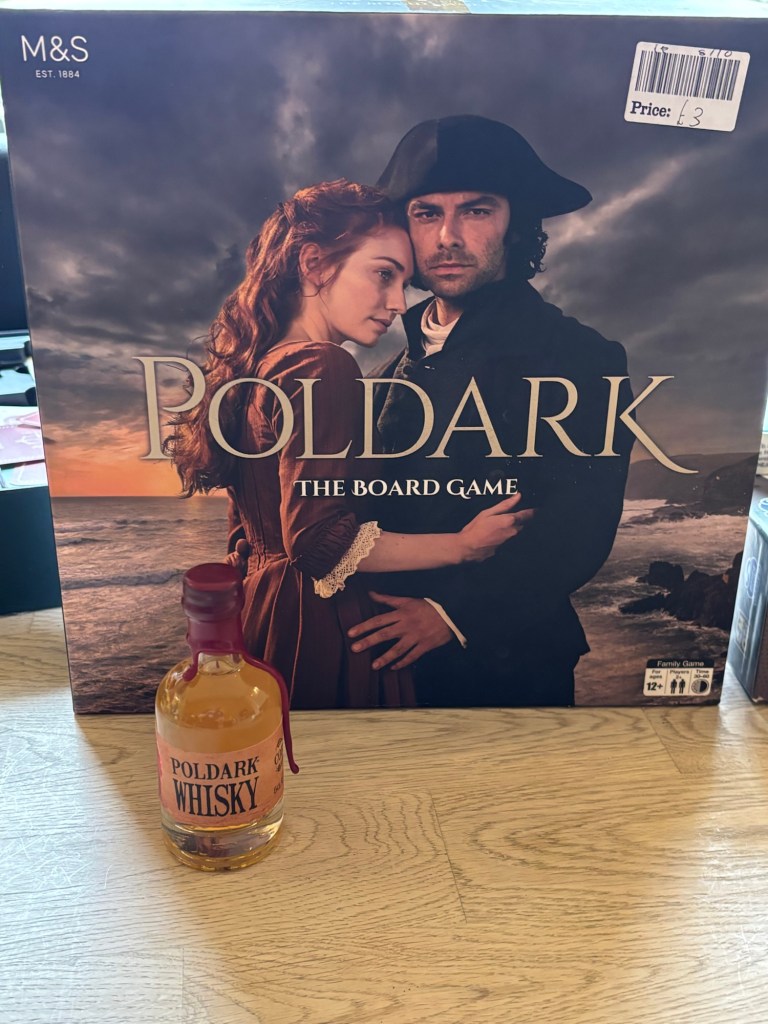
It had been a while since I’ve played a licensed board game from a charity shop, so when I saw a Poldark board game from M&S at the Martlet’s charity shop for £3, I had to give it a try.
Of course, it’s a Poldark board game from acclaimed board game publisher Marks & Spencer, so it took a while to get it to the table.
I took it to a mini-con my friends and I have each year called CabinCon, but it still didn’t get to the table until my partner and I were the only ones left. Then, more to get rid of it from our luggage than anything else, she agreed to play it with me.
I will warn you, I have no idea what Poldark’s actually about. I knew it was some kind of steamy period drama with Aidan Turner and Eleanor Tomlinson looking hot. That’s about it. So part of my review will also be trying to figure out what Poldark is without bothering to check IMDb or Wikipedia.
The Components
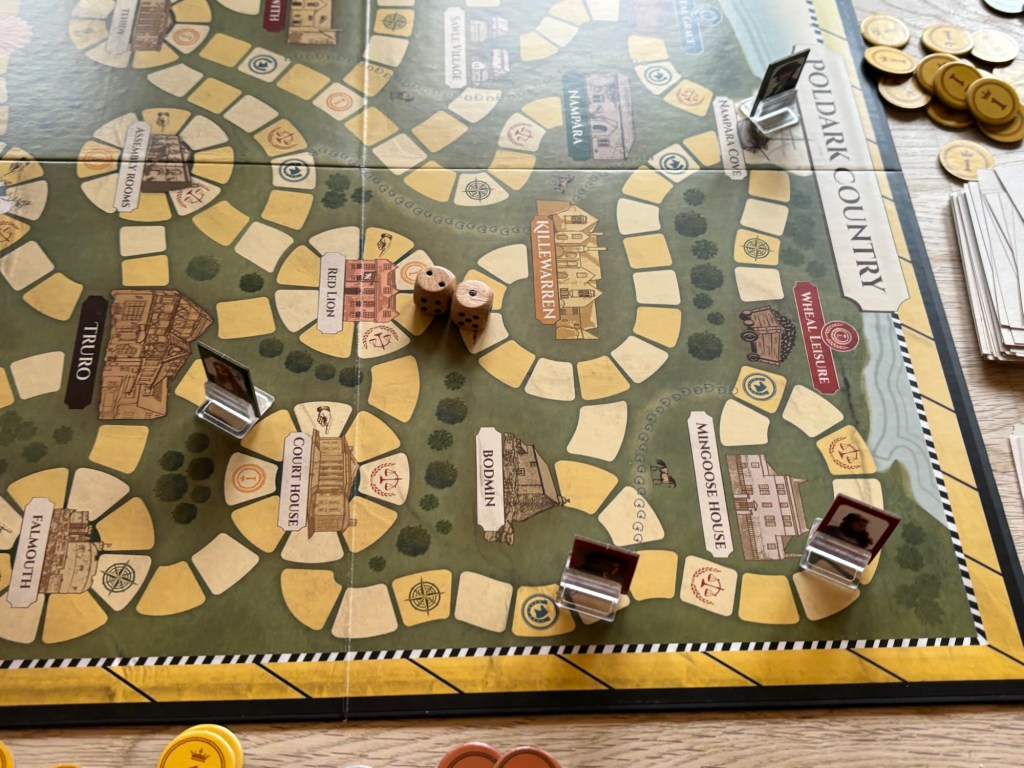
M&S is generally seen as a fancy place in my family, and this game rides that line between fancy and cheap. There’s a pretty solid-looking board, although the spaces reveal that yes, this will be a roll & move game. At least the spaces aren’t numbered, so there’ll be an element of choice.
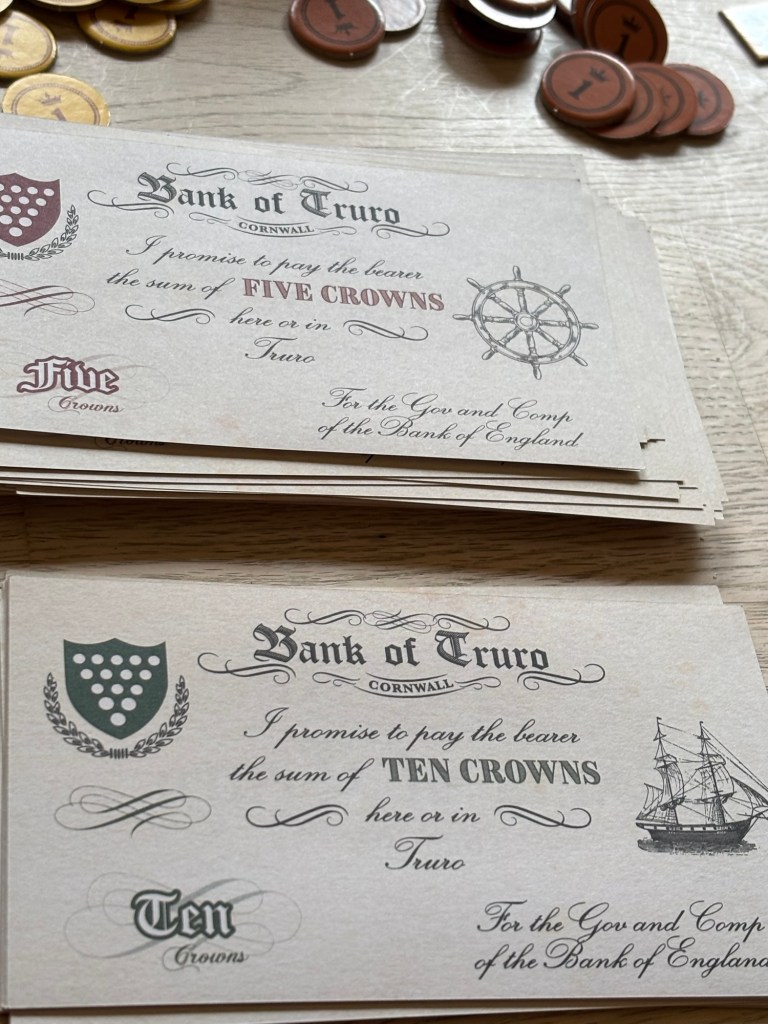
There are a couple of pretty standard dice, a few small decks of cards, cardboard coins and overly large paper money. Those notes are the fanciest part of the components, sullied only by me realising I didn’t have a notepad on me and using three of them for my notes. Finally, there are six pawns which are small photos of the three couples in the cast, inserted into plastic standees. These are the cheapest part, and the only ones where you’ll see any photos from the show.
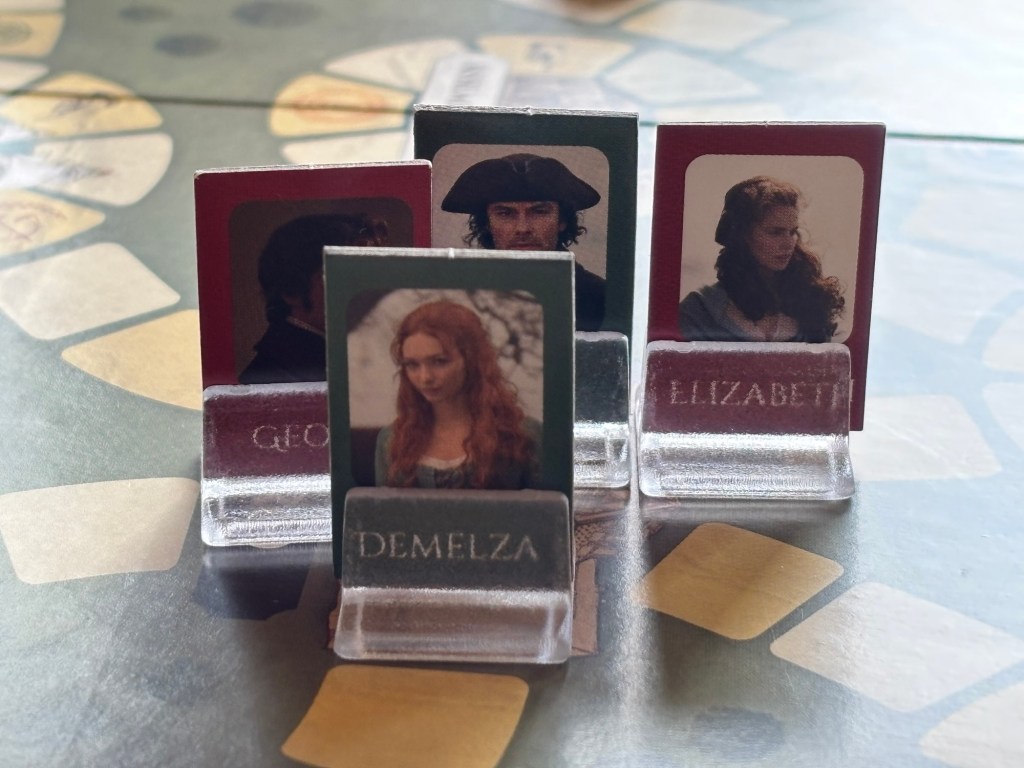
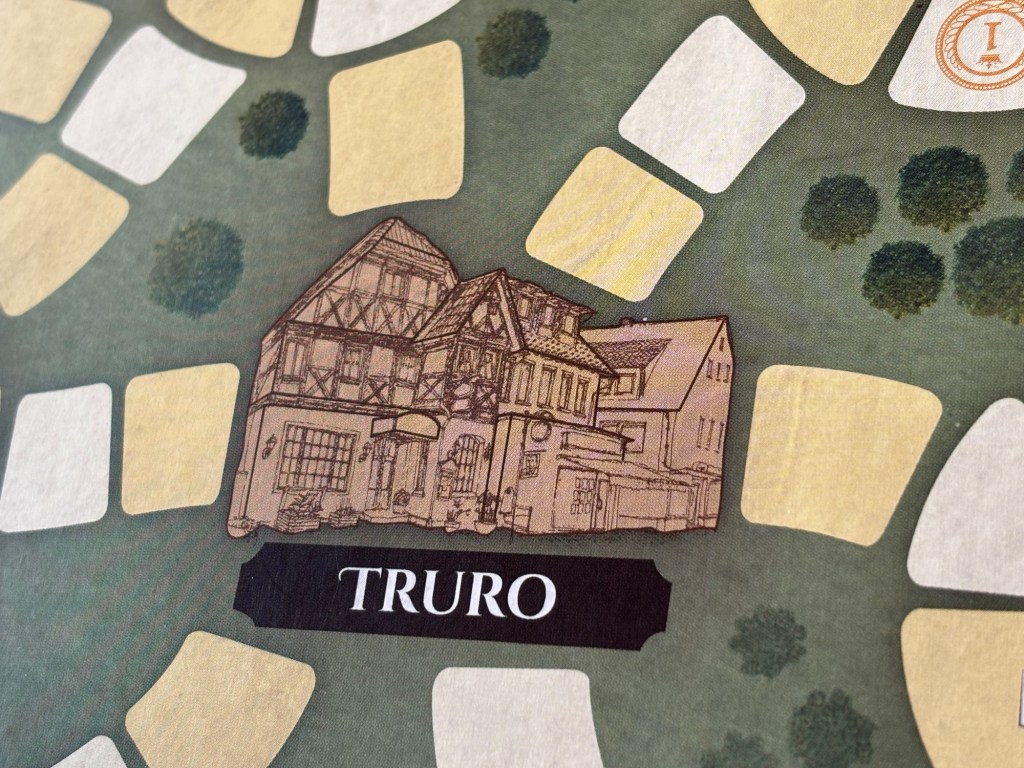
The game plays for 2-6 players, with 2-3 controlling a couple each and 4-6 controlling individual characters in a couple. There was a moment where I thought it would be fun if the game had you rolling two dice and assigning one to each character. Apparently not. You roll two dice and pick which result to apply to both partners. Then you move them, drawing positive, negative or horse cards when you land on those spots. You have objectives which will get you money and you can buy shares. You’ve got to get as much money as you can and park your pieces in Truro before the mutually decided upon time is up. We picked 35 minutes, as it was the shortest they suggested in the book.
Emma took Ross and Demelza, the main couple. I took George and Elizabeth, who looked closer to some villain-coded or at least a bit haughtier than the other couple. I can’t remember their names.
Each couple started in their homes with an objective, a horse and some money. Because we were picking one die for both characters, the couples started off travelling together and took a little time before splitting off. Elizabeth hired a new servant and made five crowns. My mission was to get one of the couple to Bodmin. Thrilling, I know.
Emma asked me how long was left. 24 minutes.
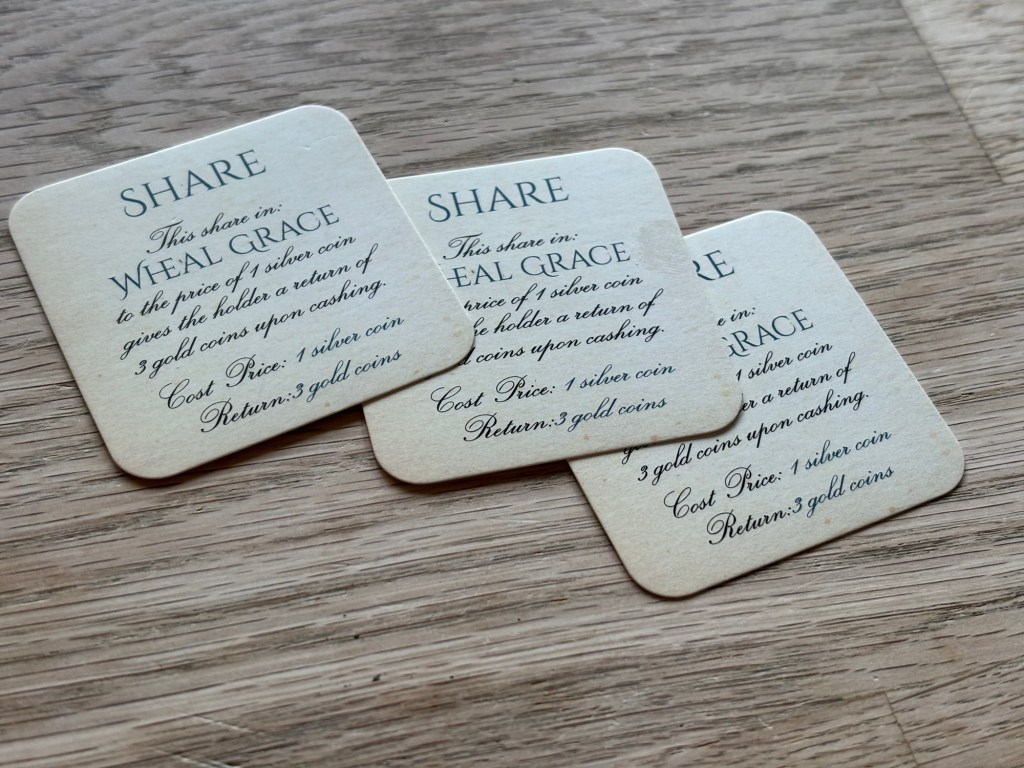
I bought some shares (thrilling!) and Ross invested in a mine (wow!). Was this what Poldark was about? We got into doing a lot of pre-measuring which helped kill some time during play. Demelza got a loop of objective cards allowing her to bounce between locations in the south of the map. One of Ross’ tenants found a pitch for their market, which gave him some money.
I realised I needed both George and Elizabeth in Bodmin, something which took a while to get into place. When I realised I’d need both of them to have the right result to end up on the space, I gave up and landed on an objective spot to replace my active one. My characters were ships in the night, passing by Bodmin but destined never to arrive.
Emma asked how long was left. 15 minutes.
Ross raced across the map with a horse and decided to get in on the shares action. You spend a horse to move across blue hoof print paths on the map, I assume riding the horse to death and then leaving it there in the ditch. Elizabeth bought some shares in copper. Again, thrilling tales and I can see why a shirtless Aiden Turner was needed to sell this story. There was a fire in a barn, which cost some money. Luckily other cards meant the same farm was somehow also making money.
George sold a prize bull and ran around the bank, unable to get in because of die rolls. Emma dropped a dice and I paused the timer, telling her that there was no cheating and waiting down the clock trying to find a dice.
It didn’t matter, as Emma managed to get both Demelza and Ross into Truro in rapid succession. She was done with the game. I still had time on the clock to get my couple in. George was near enough that he got into Truro, reducing me to 1d6. Elizabeth picked up a Christmas gift (somehow gaining her money) and overshot Truro. Oh yes, we needed exact numbers to get in. I rolled again, overshot again, and again. After overshooting four times, I finally got into Truro.
I finished with 61 and a half crowns. Emma finished at 73.
The quality was surprisingly okay for all but the player pawns, which felt as low budget as other charity shop games I’ve bought. The play was boring and at times frustrating. For the many decks of cards, they all did the same things. Opportunities and Traits would gain and lose you the same amounts of money. Objectives gave you the same money even if they required harder things from you. Horses and shares were all identical, just with different names.
I’m still not sure what Poldark is about, but I’m pretty sure it’s just hot people who are into property and business.
Understandably, we left the game behind in the CabinCon rainy day cupboard. If anyone finds it, I apologise for stealing three pieces of paper money in order to write my notes for this review.
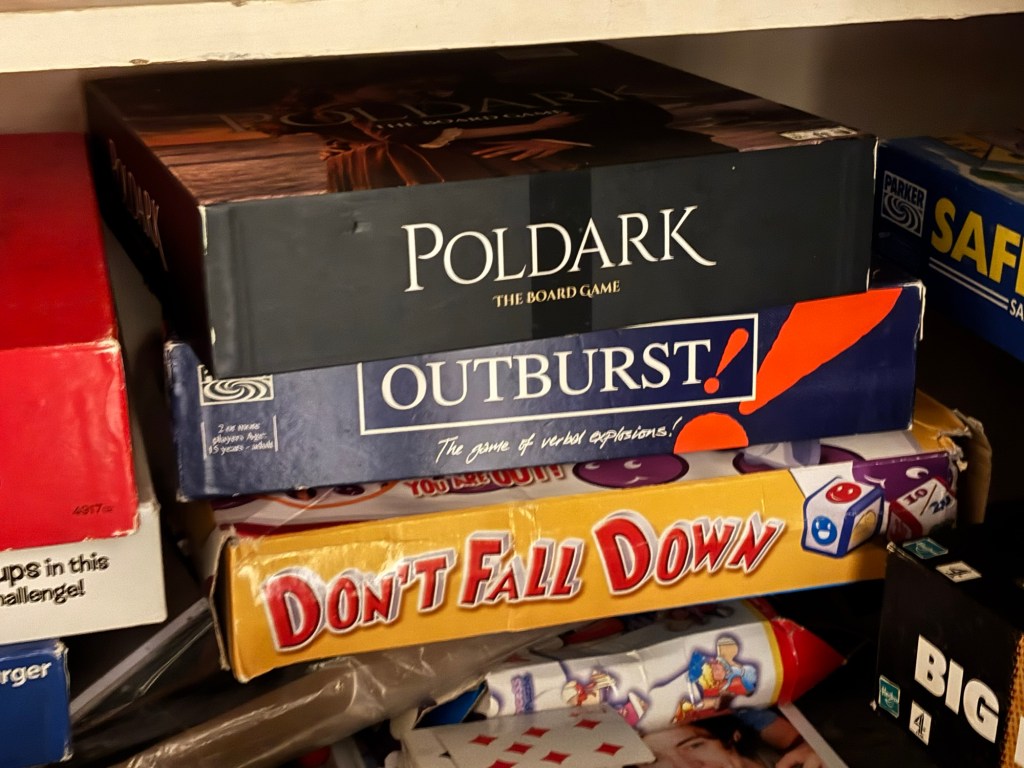
Hopefully I’ll have some more terrible charity shop board games to review in the future. If you’ve got a lead on one, please message me on BlueSky where I’m Skyshark.


 Faked Tales