RPG a Day 2020, Part Seventeen – Some Cosy Games

Today’s theme is “Comfort” so I thought it’d be good topic to have a look at some slightly more cosy games.

I like the idea of RPGs with some slightly calmer concepts, especially in this year of our Hellworld 2020. One of my first experiences of wanting to run RPGs was going around Arundel Castle as a kid and wanting to experience stories in that sort of an environment. Not slaughtering orcs or massive battles, but something more exploration-based and pastoral. It’s possible to have quieter moments in some more popular RPGs, but it’s kind of difficult when the mechanics incentivise murder and loot acquisition.

Journey Away by Jacob S Kellogg
Journey Away

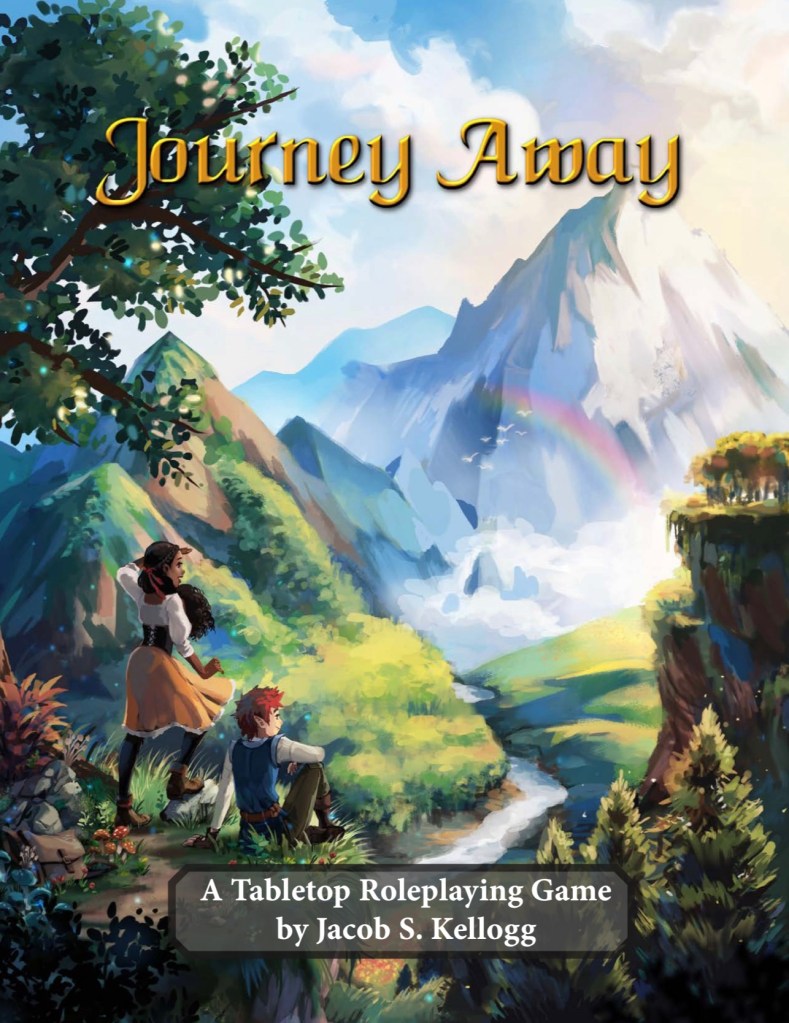
Journey Away is a game which advertised itself on being without conflict. You make characters who are going on a journey in a small pocket of land, with stats you work out and give ratings to with no demand on how many of each stat you have. The older GM in me balked a little at that idea in the kind of, “What if players just put the highest rating possible in everything?” But then this isn’t about that so much. It’s a bit short and simple, but something I want to try out just in case it does work, as it’d be great if it did.

Sleepaway by Jay Dragon

Sleepaway

Using the Belonging Outside Belonging system, Sleepaway is about young camp counsellors in a spooky summer camp. You look after new campers and have serene moments all while the Lindworm who tormented you in your youth is still there. It’s not without challenge and still has some spooky moments, but it looks like it’ll be great at showing those wistful camping trip moments. As an additional point of note, Wanderhome by Jay Dragon is on Kickstarter right now and looks like it’ll be an even more perfect game for this sort of theme.

Brindlewood Bay by Jason Cordova

Billed as ‘Murder She Wrote meets Shadow Over Innsmouth’, this game is about a book club of old women who happen to also solve mysteries. There’s literally a Cosy Move in the game. It has techniques like painting the scene baked into the system and a move where you can recall how your favourite mystery novel character solved a problem similar to what you’re facing. One thing I love is that you don’t even know who the murderer is until the players collect clues and process who the murderer was out loud.

Weave by Minerva McJanda

Weave is a game about young wizards in a world where magic is all created through clothing and the act of making it. If you have time and resources to work your magic then you succeed at what you’re doing, but if you don’t have both those things then life can get a bit tricky for you.

You’re on a kind of pilgrimage to discover the secrets of items belonging to different communities and by staying with them, you gather enough information to create a kind of clothing golem which will teach you secrets. It’s beautiful and interesting, with diceless mechanics and colouring in patterns for the different rote spells you can cast through your clothing.

You can build up relationships, but then when you’re done with your current step of the pilgrimage you move on, ever forward until you have made enough stops to learn your last spells and graduate. It was a really simple system, the book itself is tiny with every other page punctuated by example patterns people could make or get inspired by. Still, it worked for a two-session game and would carry on even better for a campaign.

Finally I also have:

Tavern, by Graham Walmsley

Tavern is a game I’ve had for a while but haven’t played yet. It’s a story game about daily life in a tavern. Not really even a fantasy one, although you probably could do that. You are the staff of the tavern, serving food to the locals, hearing some of their stories and then they set back out. You won’t always get a full story from them, but you’ll get bits of these people’s lives. You’ll use playing cards to represent them, but also the meals being prepared. It sounds like a fascinating little experience of liminal relationships and quiet moments shared in a pub. And what’s more cosy than a little chilled time in a pub with friends?

Posted in rpg | Tagged , , , , , , , | 1 Comment

RPG a Day 2020, Part Sixteen – Dramatic Battles and Managing Epic Scale

We all like a big fight, don’t we? Those bits in things like Game of Thrones where we’d have a lot of drama and tension, then a massive cathartic battle and the fallout. Or in Lord of the Rings, or any of those kinds of games.

The problem I have with these sorts of moments is it all scales out a bit too much. People become dots on the map or it ends up a bit board gamey. It becomes a tricky balance of making sure everything feels epic but personal at the same time.

I’ve had players take on whole units before, but that meant people were all split up and controlling multiple characters with NPCs serving as a kind of plot armour.

Here are a few aspects from my Fallen Kingdoms campaign, which had moved from D&D 4E to Fate Core.

The Battle of Leonis.

First of all I did a bit of a Mass Effect 3. The group were a resistance force building up armies for their big battle against the draconic forces which had through spin doctoring and outright murder become the rulers of the land. They went to places they’d allied with previously, fought and impressed rivals and found new people to help out. Each one became a card which was part of their forces. They even kept a record of how many people were offered up by each area. I loved Mass Effect 3 (don’t @ me) because it got all the doors you opened in the first games and closed them. There were conclusions to so many stories and rewards were more people on your side for the big final fight. If you failed in a mission there would be less (or no) people donated to the cause.

I kept things zoomed in at a player level. The group had their own missions, even though there were generals taking their orders and units doing all kind of things. They were able to issue some orders, but they had personal goals during the battle and some would split off to do diplomatic missions, emergency aid or carrying out assassinations. Personally as the GM, their good or bad decisions and the fallout from them impacted the overall level of success or failure which would happen. There were some rough schedules of things which would happen and some plans were just doomed (when the fire dragons weren’t distracted and could attack the giant wooden dwarf war mechs.

Even though I kept things personal for the group, I also let them see the overall view. The players aren’t characters and they needed to know that big things are happening. They worked for all those units, they’re invested in the big battle, so why not give them the big picture?

Harder They Fall, such an epic game.

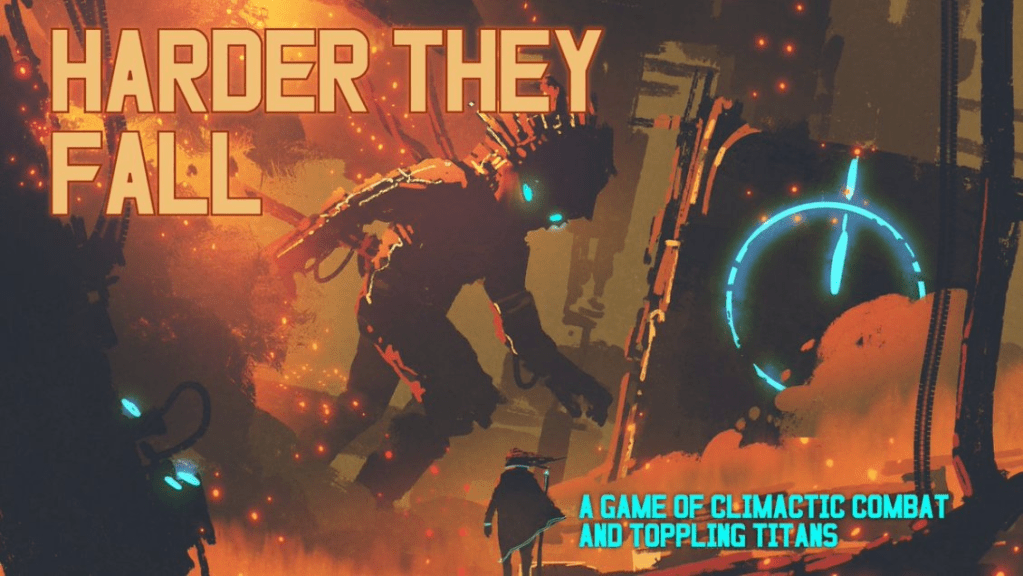
Finally, a system’s actually been released which handles big unit battle really well. Minerva McJanda created Harder They Fall as a way of using dominoes to run big combats. It’s something I’ve done before in Dungeon World and will probably do again. Each unit (or person, if they’re a big or powerful person) has traits and actions they can try to do which aren’t just ‘I do a fight’. You can reposition around people, carry out underhanded tactics, draw folks in and so on. If you think you’re near enough you can try knocking the chain of dominoes over to see if you hit your foe. Or you could get archers to shoot enemies, plucking out individual dominoes making an attack useless. It’s high stakes, but you can run it and still have the heroes survive. No one’s getting taken out by a stray arrow unless they really want to be. I wrote a review on Who Dares Rolls and really recommend this as a way of playing mass combats.

Posted in rpg | Tagged , , , , | 1 Comment

RPG a Day 2020, Part Fifteen – Framing Scenes

Establishing a scene can be tough sometimes. You need to communicate information to the group quickly, and as a player you need to parse what’s being said for value.

It’s easy enough to say, “There’s a room with four kobolds” and leave it at that, but it’s pretty dull. Some GMs oversteer by describing everything in extreme detail. “The room is a slick green from a broken pipe leaking out refuse, there’s a battered old wardrobe which reminds you of home. It has been fitted out as a kind of makeshift bed, a weapon rack, a campfire and a hopefully dead rat on a spit which drastically needs turning. Oh, and there’s four kobolds.”

I get the instinct to describe everything first so people will take it in and then mention the kobolds, but it’s likely to get forgotten about the moment you say they’re there. This is bypassed in using tiles, maps and miniatures, but then that pushes imagination away and becomes simple backdrop to the grids and any markers for terrain. So back in theatre of the mind style play what do we want to do?

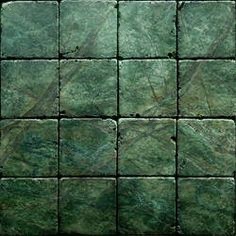
I couldn’t find a tile filled with trash so just imagine piles of trash.

Personally I like to hit the high notes. If the group are seeing a threat they won’t take it all in anyway, they’ll be alert. “The room’s slick and green, filled with trash. Four kobolds are arguing over a half-dead, half-cooked rat.” This way we’re adding a vague sense of what’s there, the enemies and what they’re doing in the room. They’re naturally part of the world instead of a mob simply standing and waiting to see an enemy.

Keeping details but making them a little vague can be useful, too. A player might ask questions about whether they could use any of the trash as a hiding place or a weapon and the answer can easily be ‘yes’ without contradicting anything you’ve said before.

Rather than using box text in encounters, I like to encourage this style by mentioning a couple of elements for the room which I can riff off, like, “4 kobolds & their camp. Slick w/sewage. Trash.” And that way I can keep track at a moment’s notice and if I end up not using something I can cross it off for my own continuity.

I do love some mischievous kobolds.

One final thing about scene framing which I love is a technique I first heard about from The Gauntlet, called “Painting the Scene”. This is where you can set the scene, but also invite questions from the group to help flavour a place. I love sharing ownership of a world and a story with players as it drives up their investment in it and means it’s not just being created by one voice. In this case, you might travel up the Dry Altar Mountains and as GM I might say:

“The mountain road is long, winding and you feel it difficult to keep a sense of direction. There are statues and ruined temples belonging to long-forgotten gods. Which ones stand out to you the most?”

Then the players can add things which could include a temple to add safety, a source of water in the dry mountains, hints to the backgrounds of the characters or even a threat. Other questions could be things like, “What tells you this market was once prosperous?” “What obvious tells does the waitress have that she knows more than she’s letting on?” And so on.

If you’ve not heard of this technique, I know surrendering some of the reality of the game over to the players might seem daunting but I definitely encourage it. As a form of worldbuilding and getting your players invested it’s great fun.

Posted in rpg | Tagged , , , | 1 Comment

RPG a Day 2020, Part Fourteen – Online Game Banners

Here’s one in the “Charlie’s been running RPGs for twenty-six years but is still learning” category of entries.

I love a good online tool for managing a campaign and have mainly used Obsidian Portal for these past few years. My groups have rarely engaged with them to a level I’d like, but then I also forget about them. I think my high point was in a game of Amnesiac City, an RPG world I’d created and ran using the New World of Darkness system. In that one I had entries for different things including faceclaim photos of the cast, updated with a black and white version with “DEAD” in big red letters. I started the page in season two with one cast and as the final season brought new and old characters together, it was incredible seeing the group being whittled away.

The original campaign’s deleted so I don’t have an image of it, but I do have this X-Men cover image.

Anyway, banners. One thing I’ve never quite managed to get right is the banner, the first thing you see when you enter one of these pages. My last big campaign recorded on Obsidian Portal was Dungeon World Exodus, set in a gigantic city made of cities. There’s not really been a great way to show that other than to take more photos of Mark Oakley’s Thieves & Kings as I love the sweeping city of Oceansend but that doesn’t quite feel right. Being a comic, the panels didn’t really fit a banner. In the end I looked for old city walls and found this:

It’s uh… not great. I’m pretty sure I did it in a rush. It’s worse given that the second campaign was in a pastoral setting in one of the central cities inside Exodus, so this was an entirely unnecessary image.

I think my best work was on a sadly now deleted Dr Who RPG where I put an ice cream van against a weird landscape because that was the group’s TARDIS. I’ve not been able to find a copy so I can’t show it to you, but I assure you it looked pretty good.

I’ve been a little less customised with my approaches to banners lately. Masks and Band of Blades ended up being art from their main books, looking like these:

The Masks opening page on Obsidian Portal.
My Band of Blades opening page.

Next time I make a campaign with a good amount of lore I’ll try to make another custom banner and hope that adds to the buy-in from the group. Who knows, maybe I’ll end up commissioning something from Fiverr or somewhere similar.

Posted in rpg | Tagged , , , , | 2 Comments

RPG a Day 2020, Part Thirteen – Short and Long Rests are a Dull Mechanic

I’ve resisted the D&D bashing so far this month, but here we go. Rests are a really dull mechanic and should be changed. Admittedly a lot of D&D needs changing and I don’t think I’ve ever seen anyone run it rules as written in my entire roleplaying life because of that. But I’m talking about short rests, which aren’t just in D&D. They’re something a lot of games to do heal up.

D&D Third Edition was when I first realised that for a game about adventurers, players were way more cautious than they needed to be. Encounters were balanced to take down a percentage of the supplies (HP, spells, feats, etc) of the group and you should run them down a few before resting. Only players rarely realised that and would explore a small number of rooms before resting, and then repeating that. This happened in Hackmaster Fourth Edition as well, with my group making their way a couple of rooms at a time through a dungeon and then taking half a day to ride back to town and hide.

My old flat mate Ash simply reset the dungeon when he ran games. If we went to town to heal up and sell loot then everything would be exactly as it was before we did anything. It was videogamey and accomplished nothing because we’d only push our luck a little further before we realised we needed to rest and then everything would reset again.

Why aren’t there umbrellas in D&D?

I played Lost Mines of Phandelver with a group of old friends and my brother last year, to get him playing a tabletop game with folks and to just hang out with them, even if I didn’t really want to play D&D. Both travelling and in the first dungeon there were multiple long rests for the group, whenever we got near to 50% of our health. It cut into the action and we had to make sure where we were staying was safe, set up watches, etc. It never really felt right, seeming way too cautious, but at the same time it was a step which had become necessary at first and second level.

Games like D&D and Hackmaster are pretty damn lethal early on, so you’re going to need to grasp onto your health, especially if you’ve spent ages making your character. This means a short rest is going to be needed unless you’ve got a good pool of hit points like D&D 4th Edition, Fantasy Craft or Dungeon World.

My proposal would be to nick a mechanic from Lady Blackbird to replace long rests: refreshment scenes. It’s also a good way to make use of Inspiration, as players can have a little scene going through the dungeon and then they’ve healed, they’ve got some uses of abilities back and so on. Personally as well as not having seen D&D rules as written, I’ve also barely ever seen Inspiration get handed out either. It’s a shame as alongside Advantage/Disadvantage, it’s one of the good new mechanics from D&D 5th Edition. This would be another good way to encourage engaging with that mechanic.

Lady Blackbird’s refreshment scenes

Some examples of Refreshment Scenes could be:

• Sharing some rations or a drink around a half-dead campfire the bandits you killed were using
• Catching fish in a nearby stream or hunting deer in the woods
• Burying a beloved henchperson
• Checking armour for any damage and recovering arrows

A short roleplay scene during these kinds of moments as a way to earn Inspiration and the benefits of a short rest could be really interesting. Codex: Gold from The Gauntlet has The True-Gold Forge, a set of tables which can be used for characters round a campfire as prompts about their origins or wishes to add even more flavour. It’s the kind of thing which if you weren’t feeling inspired about how to have a refreshment scene, you could use one as a prompt.

Posted in rpg | Tagged , , , , , , , | 3 Comments

RPG a Day 2020, Part Twelve – Sending a Message to Players with Love Letters

I first heard about Love Letters in the Gauntlet’s podcast and I instantly knew it would be something fun to play with. The main games I heard of using Love Letters were Apocalypse World and Monsterhearts, but I’ve used them in a number of other games. One of my players even used them in a D&D game last year.

So what is a Love Letter?

It’s a small letter written to a character rather than a player. It can cover some downtime actions, a time jump between seasons of a campaign or what a character was up to when a player was missing. Start out by addressing the character, mention the situation they’re going through and include a couple of the following:

• Some open questions for them to ask, “Who called you away on urgent business?”
• A binary option or two: “Did you report your indiscretion to high command or hide it?”
• A mechanical flourish, like a custom move in a PbtA game or a saving throw: “If you report your indiscretion roll +Charm. On a 7+ this infraction will be overseen, on a 10+ you won’t have internal affairs watching you in the next mission. If you hide your indiscretions, roll +Guts; on a 10+ you hide all evidence, on a 7-9, what did you forget to hide?”

That sort of thing. I have some specific examples below from Masks:

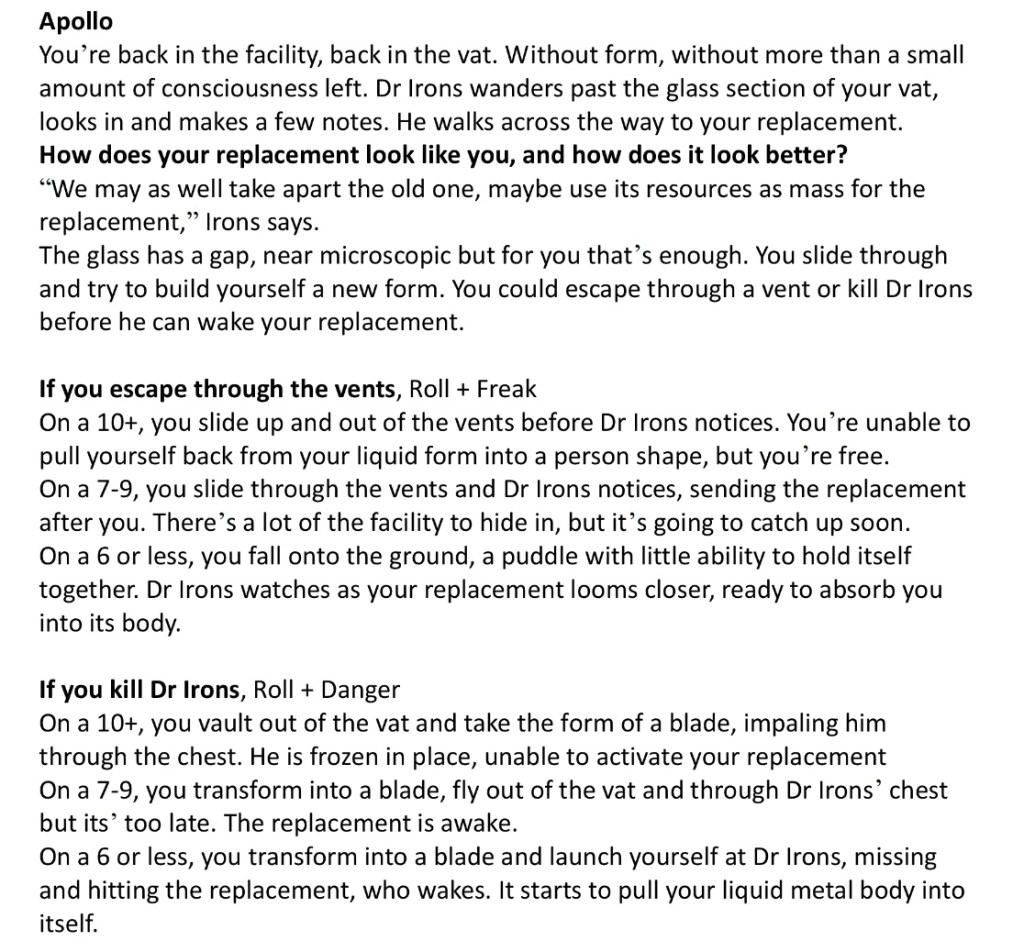
First of all I have a dream sequence. The group got caught and put into a hallucinogenic dream state. For this kind of thing you could run a long sequence where the GM has to run the scenes for each character back and forth, which would in my case cut out 75% of the group at a time. As this was most of the way through the season I figured I knew enough to create the nightmare sequences for the group and gave them Love Letters to read at the start of their next session. Here’s one for Apollo, a liquid metal boy who was using The Newborn playbook:

Apollo’s nightmare

This meant that even though the hit of information was pretty quick, it got to play with Apollo’s specific origins and neuroses. It allowed a chance of fighting back against it all and most importantly for Masks, filled him with angst.

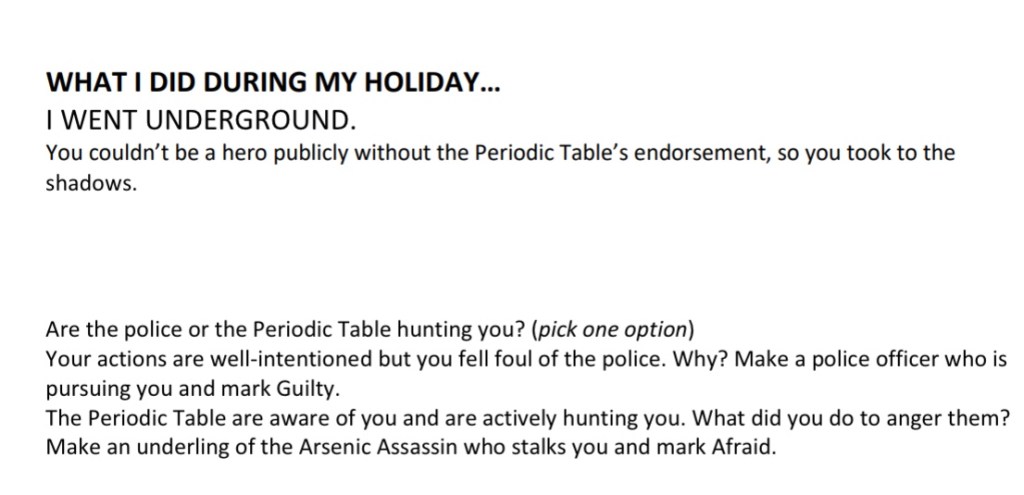
Next up we have a combination of Love Letters which I used between season one and two. At the end of season one, The Periodic Table of Evil made their presence known to the world, pretending to be a new superhero group. Given the sheer amount of them, they took over the city. This meant there were different options for some of the group. I folded the following three to the group only saw the opening statements about what they did during the summer. Our fourth player’s character was trapped in the timestream and the player wasn’t about that week, so he would return to the present after the Love Letters had been dispersed.

The players saw, “What I did during my holiday” followed but “I sold out”, “I retired” and “I went underground” as the three options which couldn’t be duplicated. They decided between them who took which action.

Steel picked this option
Apollo chose this option
Stalker chose this option

I also gave personalised Love Letters to each of the players for their characters as well, so help add some more lore to the world and events to establish the setting for season two. Here’s Steel’s. She’s the Reformed playbook and a former supervillain’s sidekick. Her alter ego was best friends with a socialite who was the former sidekick to the most popular hero in the city.

Steel’s summer

I definitely recommend this as a technique, especially if a campaign’s had a bit of a break or a season gap.

Posted in rpg | Tagged , , | 1 Comment

RPG a Day 2020, Part Eleven – My RPG Reading Stack

I have a stack of books on one arm of the sofa. Sometimes it gets moved over to the coffee table or the little end table next to the sofa. They’re all on my reading list and some have been there for a while. They’re a good reminder of what I need to go through. At the moment they include Misspent Youth, the second Yellow King book, Fellowship’s three tomes, Hillfolk, Girl Underground and Heart.

My pile of books on the arm of the sofa.

Some of these are recognisable from my wishlist of games to run. I’ve actually already read Heart and Shadow Operations in PDF form, I’ve even done a readthrough of Heart on Twitter but the physical book’s different. The texture of the cover’s nice, even though it’s not the fancy edition. The smell of the book is evocative. It brings back memories of the smell of the AD&D Player’s Handbook which I used to own. I finally finished reading Yellow King: Paris to a level where I feel I’ve processed the information, so that’s gone back and been replaced by The Wars. I reckon I’ll get through all the books and then revisit them when I run a campaign. Hillfolk was a rare charity shop find which is cool. It was £10 a book for it and the expansion. The PDF is a real sod to read as there are many columns and the sidebars aren’t defined enough. I want to read it as the scenarios look really interesting, but I feel I’ll need to go through this physical copy to better deal with the layout. As much as I like the look of Trail of Cthulhu, I had similar problems with focusing on the PDF and need to get a hard copy of that, too. Fellowship was all done on DriveThruRPG when there was a sale and looks really interesting. Girl Underground’s the only physical ‘ZineQuest 1 title I bought and I’m pleased as it’s small and lovely looking. Then there’s Misspent Youth which was from Robert Bohl’s closing down sale. Again, it looks gorgeous in the physical edition, but mainly for the scrappy style it has.

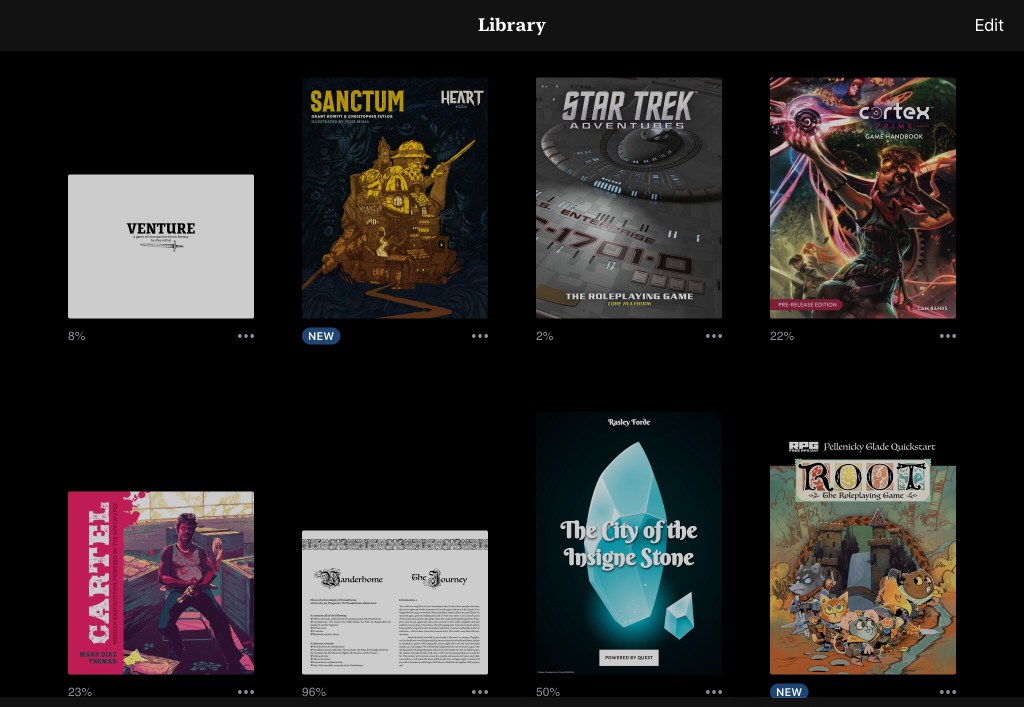
Seeing the books out in a stack definitely helps prioritise them compared to the books on my iPad. I can kind of keep up with the library on my iBooks, but things drop off quickly, especially if I’m using a few PDFs to run a game as those end up taking precedent. Then when other things get added it creates a block of titles which push everything else down, such as when I picked up the Star Trek Humble Bundle. I’m writing this a couple of days ahead, so I can’t even tell what’s going to be the recently read items in iBooks. Let’s have a look…

My virtual stack. You’re lucky as you’re seeing this without all the cracks my ipad has.

Let’s see… I was talking about Belonging Outside Belonging descriptors to an old GM when defending my dislike of stats in the ‘height’ and ‘weight’ fields in traditional RPGs compared to more narrative looks. I realised I hadn’t actually downloaded the preview copy of Venture, which is why that’s there. Star Trek Adventures is a 2d20 System game which I bought on a Bundle of Holding as I’ve been in a big Trek mood. Sanctum, like Venture, I owned but hadn’t got round to downloading yet. Cartel’s a late arrival but I’m curious about what it’s like. Root’s from Free RPG Day, there’s a third party Quest adventure as I want to see how people are using it. Cortex Prime’s another PDF that’s conquering me slightly like City of Mist, but I’m eager to work my way through it. Finally there’s Wanderhome, which I’m trying to resist backing just because I’ve been backing a lot of projects.

I love having most of my roleplaying game collection on my iPad, even though it’s horrendously cracked, but there’s something very nice about leafing through a physical book.

Posted in rpg | Tagged , , , , , , , | Leave a comment

RPG a Day 2020, Part Ten – Games I Want to Play

My list was as follows:

Earlier this year there was a whole thing about people listing a dozen RPGs they hadn’t played or run and wanted to. I joined in as it seemed like a fun thing to do. Back then it was pre-lockdown and made for a nice, actionable list of games to run at community RPG nights along with my weekly group.

• Brindlewood Bay
• Comrades
• DIE
• Fate of Cthulhu
• Girl Underground
• Good Society
• #iHunt
• Pasión de las Pasiones
• Quietus
• Trophy Gold
• Warmer in the Winter
• The Yellow King

A game I want to run, a kind of Shadow Over Innsmouth meets Murder She Wrote

There are some games like Spire and Heart which I’ve run before and would like to do, then others like Band of Blades which I’d booked myself in for running with my weekly group. We got maybe half a dozen sessions into Blades before lockdown and started Dishonored as something light which I needed to do for a review. That game took longer than expected and my community nights took a while to get off the ground.

As of August 10th, I’ve run two of the above games, Pasión de las Pasiones and Trophy Gold. I’ve bought several more RPGs which I want to run as well, some of which I have.

The Socialite, one of the playbooks from Good Society.

Squamous and Quest were two games I really wanted to test, while Alice is Missing and Fellowship are something I want to try in the near future which aren’t on the list. I’m sure there’ll be more, as well, but I’m still eager to get the games on my list run. I’m also trying to balance out the amount of time I spend running and playing games so I don’t render my partner an RPG widow, so I also know I’m on a strict clock and unlikely to get all twelve run. I want to get at least half of them run by year’s end.

One of the many Alices who may be missing.
Posted in rpg | Tagged , , , , , , , , , , , , , , , , | Leave a comment

RPG a Day 2020, Part Nine – Light and other minor spells

Back when I ran AD&D I kind of stumbled into good bits of DMing from time to time. Not always and I didn’t really know to weaponise them as much as I should have, but I had my moments.

Potions were one of the first things, where I’d write in the Dungeon Master’s Guide what colour each potion was and the group would have to figure out what they did. They could identify them or test them on someone (to help this, each potion had 1d4 uses).

A spooky potion

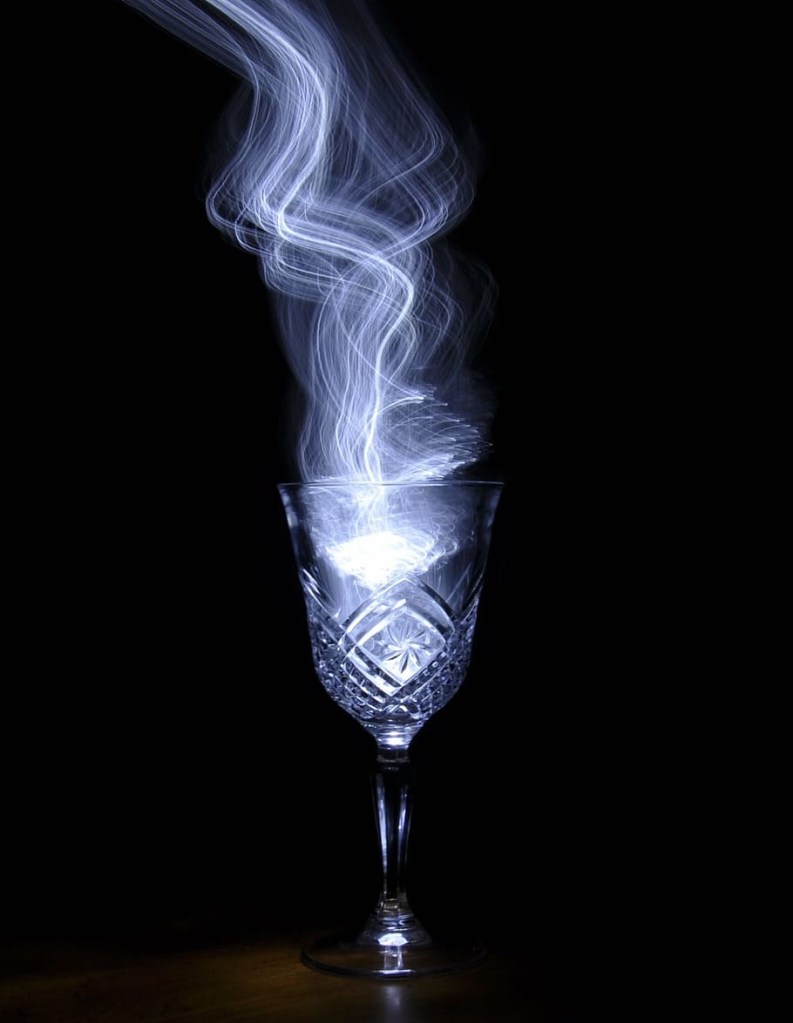
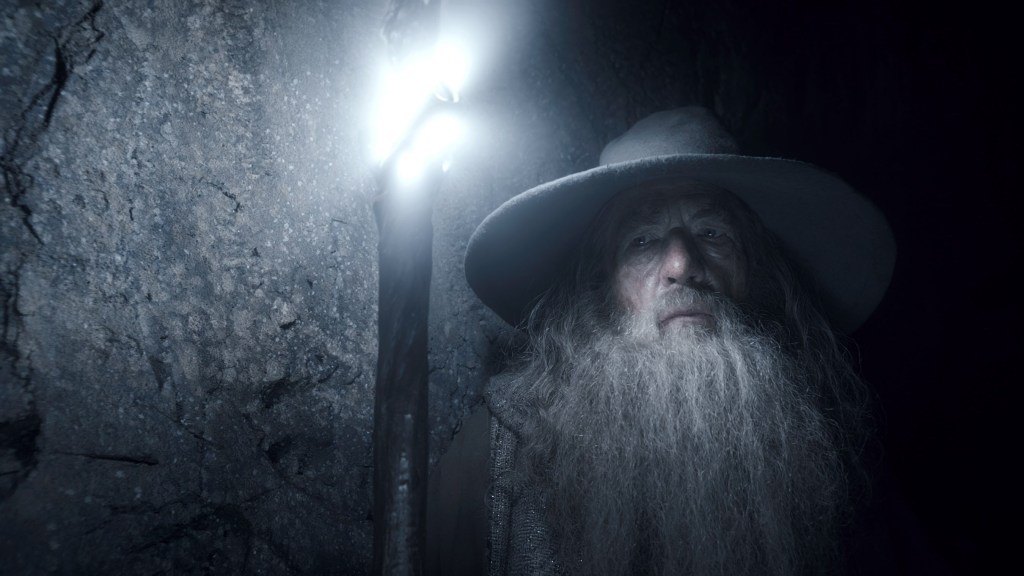
Anyway, this is about light. Ages before “Okay, what does that look like?” as a common mantra, I would ask that about people’s magic. Light and Magic Missile were my favourites. I didn’t really know the limits of Light and I didn’t really care to. When a player cast it, I asked how it was created and what it looked like. For one player they would have the tip of their staff glow. Another had an object he touched, which could be a players’ sword or someone’s eyes. One had glowing fireflies around them and some would just say, “I don’t know, it just gets brighter” and you know what? That’s fine too.

Gandalf, using a light spell

Magic Missile would often get aspected to whatever the theme of the magic user tended to be. It could be a lesser version of their more favoured spells (a little fireball, for instance). Flying skulls was a favourite. Most of the time they’d be some kind of glowing balls of light or fire.

Magic Missile!

Even in a more traditional game, it’s definitely worth asking what the special effects of magic look like. It also means player innovation can shine with problem-solving using the minor differences their special effects might bring, like the magic-user casting Light on someone’s eyes.

Posted in rpg | Tagged , , | Leave a comment

RPG a Day 2020, Part Eight – Shades and Other Props

I was running a campaign of the Cubicle 7 Dr Who Adventures in Time and Space RPG when my group started to get a real habit of using props to represent their characters.

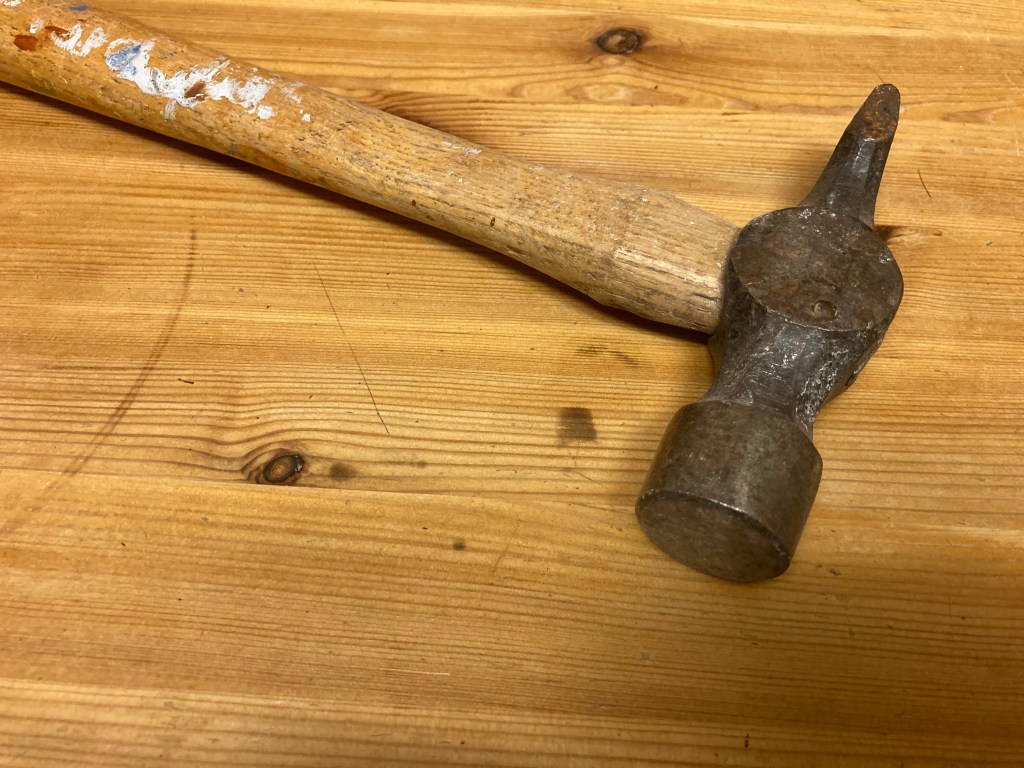
Not this hammer, but another, similar hammer.

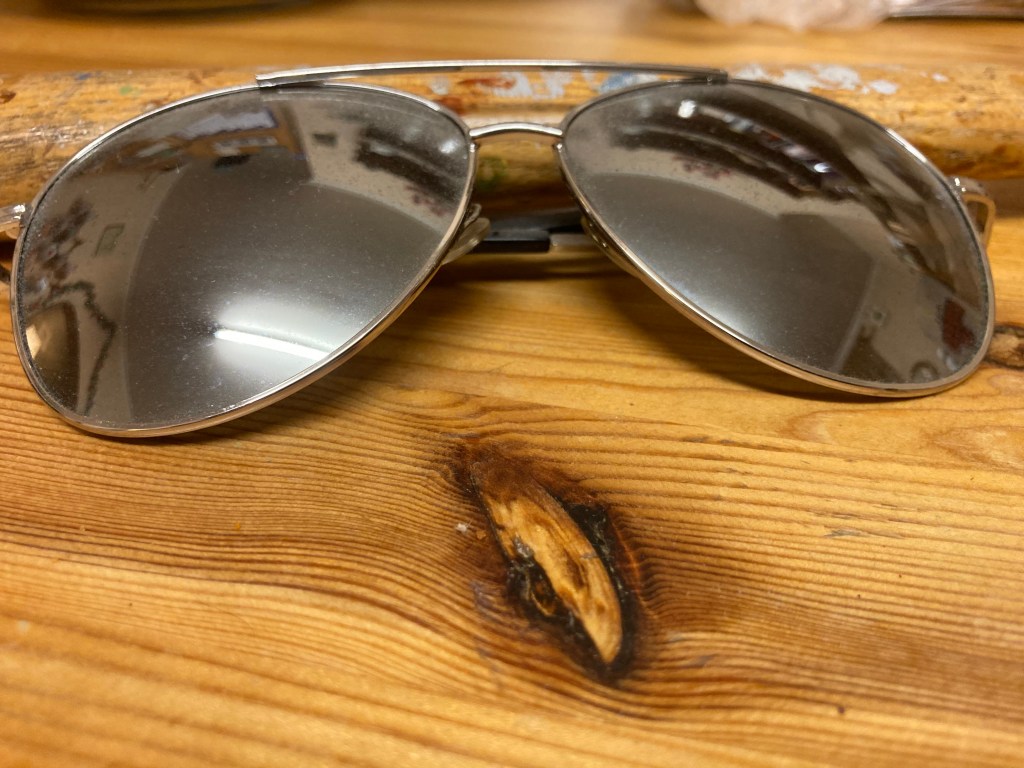
It started with a hammer, as we had one laying around and The Student (our Time Lord) had a cosmic hammer instead of a sonic screwdriver. Steve, the player of The Student, kept it around and was fidgeting with it a lot. Shaun, another member of the group, started out playing a pre-career David Bowie until he felt he needed to change it up. He took on the role of a gambler from the future who was on the run from debt collectors. To represent how different his character was from the last one, he reached around for something to use. We didn’t really use miniatures as I’ve been a big theatre of the mind person for years now. He grabbed some 3D cinema glasses as we had a small stack of them floating around, despite never remembering to take them the few times we watched a 3D movie. That became his character instantly. He wasn’t just a gambler, but he was a gambler with hi-tech sunglasses he never took off whether he was indoors or in the 16th century. People treated him a little oddly for it, but it was an affectation encouraged by the prop. We also had a time agent who’d had all memories of his successful missions wiped and his time traveller wrist thingie (I forget the name) broken so he could travel through space but not time. He kept looking at his watch as his equivalent to the shades. Finally we had Parker who didn’t have anything, but that suited his character. Parker was a big old scoop of vanilla ice cream with no real traits or desires other than to watch action movies and order take-out, making him the perfect straight man to the rest of the cast.

Also not the same sunglasses, but a completely different pair entirely.

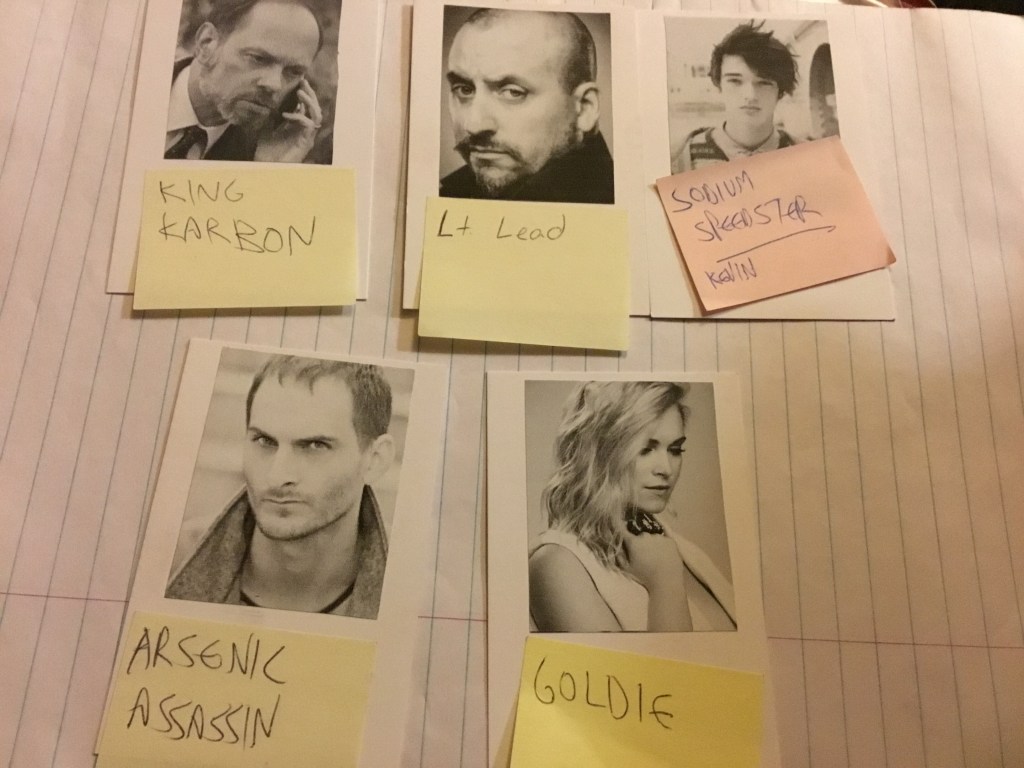
As a further note, I like the idea of some kind of representation of characters in games. I don’t really use miniatures on a grid or anything, but if folks want to bring them along to represent their characters then that’s cool. After a game of Monsterhearts at Dragonmeet by the fantastic Richard Williams, I copied his idea of putting a bunch of actors and models’ headshots onto index cards and using those as character pawns. Even better, rotating the same stacks meant a kind of meta-continuity between them where folks would begin to associate some characters with certain roles. I feel having a physical prop like a pair of sunglasses, gloves (I’ve had that happen before) and other items as some kind of reminder of the character to be an evocative tool. For Shaun, wearing the sunglasses meant we knew we were talking to his character.

Some of the Periodic Table of Evil from our Masks game.
Posted in rpg | Tagged , , , | 1 Comment