The Top 36 RPGs I Played in 2020, in Alphabetical Order – Part One (Adventures in Middle Earth to Comrades)

I started the year with a weekly roleplaying group and a fortnightly community night I ran for the Dice Saloon in Brighton. I was doing pretty good as far as opportunities to try out roleplaying games and attended AireCon, possibly the last of the UK cons we had this year before having to resort to digital spaces.

Then 2020 happened. My RPG community nights stopped right away, understandably, and it was a couple of months before I started to work out ways of running the sessions online. I was invited to a one-shot of Blades in the Dark and finally got to experience it as a player. The monthly group I had a year or so back started fortnightly sessions and a Blades one-shot I ran turned into a campaign. So I’ve got a weekly game, two fortnightly ones and a monthly game as well. That’s more than I had in the Before Times.

Running online’s not without its problems, especially as one of the perpetual victims of Virgin Media. So far only one game’s had to be bailed on from tech issues, although some came close. Most of my games were run with Discord for audio & dice rolls, then a Google Sheet ‘character keeper’ to keep character information. Sometimes I’ve used Jamboard for scrappy maps, and I’m finally getting used to Roll20 for my Blades & Deadlands campaigns as they have great character sheets to help automate things for players.

Adventures in Middle Earth
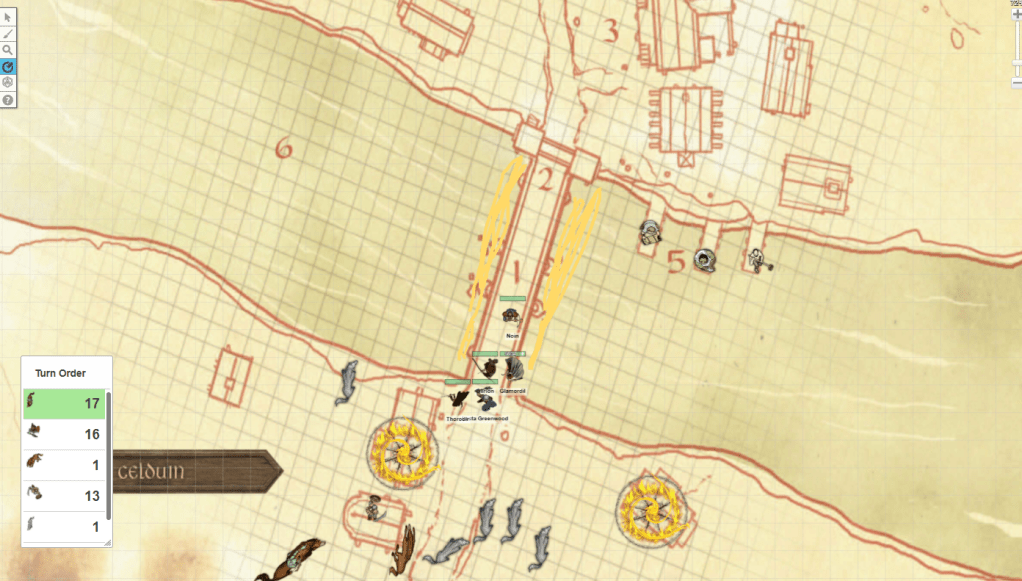
Our big fight and a LOT of fire.

Let’s get the D&D spin-off over with. My old London-based monthly group got together early in lockdown to play through Adventures in Middle Earth. The GM, Dom, is a big Lord of the Rings fan and brought a lot of knowledge and energy to the campaign. The rest of us had extremely variable knowledge of the subject, but it didn’t matter as the GM made it all accessible as a setting.

I played a surly elf survivor who I realised I’d made worryingly similar to Cloud Strife once I started playing FFVII Remake. He was eager to be brooding in a corner, but also pretty vain with it, especially when he won a gladiatorial fight. He grew close to and supportive of the group despite wanting so hard to be a dark loner. There was a great (if long) fight against an army and a troll which my character managed to almost solo-fight, which was good to have done, even though the fight itself was a bit slow.

The system was D&D 5E and even with the Lord of the Rings trappings still ends up having the same behaviours as a D&D game. There were some moments where I wasn’t quite sure what the original adventure writer wanted and that it was hammering us into fighting several endless battles which would get finished by a dues ex machina on one side or another. I went along to this as I loved the company more than I did the system, which is pretty much the only time I end up doing D&D these days.

After Hours
This was a playtest of a Powered by the Apocalypse game about supernatural creatures leading very mundane lives. Characters are made from two playbooks, reflecting the monster side and the mundane side. I was a hound of tindalos who’d decided to enter linear time and became a messenger. He was well-meaning and able to travel through angles in things. The other players were a vampire who worked in an off license, a dragon lawyer who channelled a bit of Eternal Law when he was pondering things from a rooftop with his wings out, and a witch doctor who was also a doctor to witches. We made an Under-London which had supernatural communities living there and a worrying growth of traditionalist vampires who didn’t want non-Euclidean horrors like my character lurking around in there.

The world-building for this game was stunning, with so many interesting ideas being thrown around. We only had a couple of stories with the characters as the GM was running multiple playtests and it sounded like it was getting a bit much. My character managed to consume a great many things and accidentally went full Cronenberg at one point in a nightclub when things went awry. I really look forward to seeing how the design of this game goes.

Alien
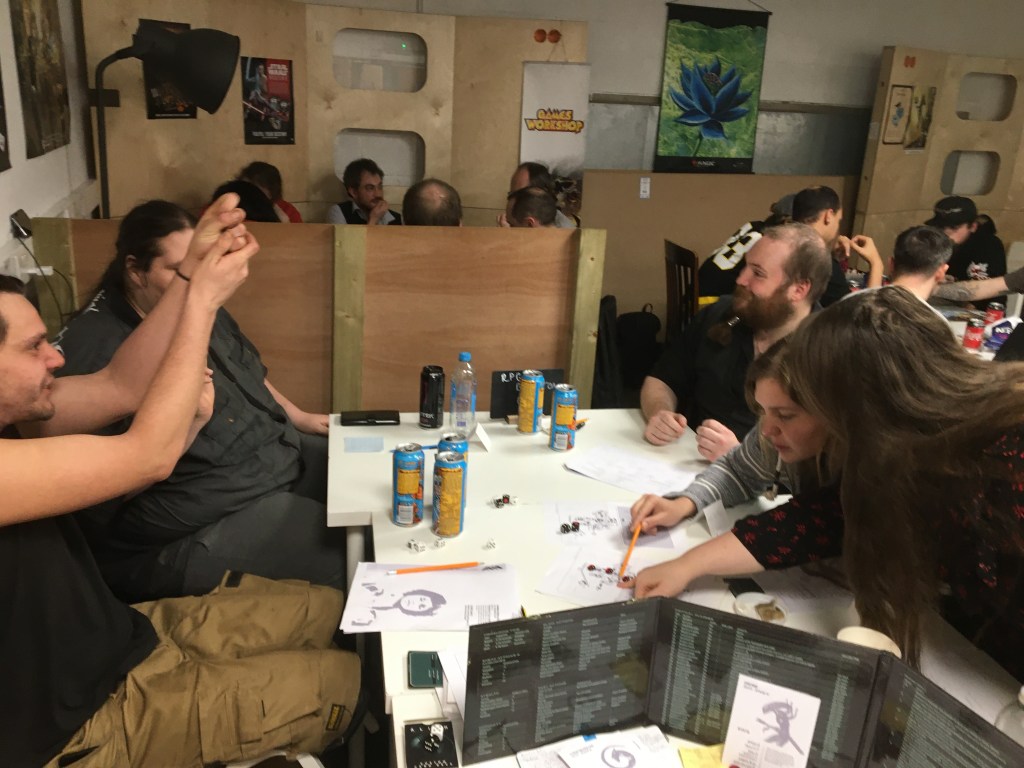
If you see this Alex, I’m so sorry about showing your hair yet again but this was the best photo I had of the game.

This was an impulse buy at Dragonmeet 2019 and for once I resolved to run the introductory game as soon as possible. It’s a trad-style RPG from Free League who make gorgeous RPGs I own and haven’t ever run or played.

This was a community night game, specifically using the scenario in the core book which was supposed to last for an hour. It didn’t. The scenario also came with pregens and a couple of backup NPCs… which turned out to be needed.

The game had some of my community night veterans and a player who was new to roleplaying and took to it like a duck to water.

My GM-facing map, far scrappier than the one I gave to the players and also one with the actual truth written on it.

Alien uses a dice-rolling engine where you full a pool of d6’s and aim to get even one result of a six. As play goes on you add Stress dice to reflect hyper vigilance and growing tensions. They can add successes, but a result of a one on a Stress dice makes you panic. The fallout from panicking characters added some great tension, had people spend all their ammunition firing wildly and even attack each other at one point. I only had a couple of xenomorphs in the demo and they were terrifying, unpredictable and deadly. Looking at the numbers, I was concerned the players would walk over the xenomorphs but in one round of combat my fears were assuaged and a character was dead. It was taken in good humour, especially with back up characters for the group to play.

I’ll be putting up my full review soon.

Band of Blades

Band of Blades was fantastic, albeit a little paper-intensive. Here’s some of my kit for it.

A band of disgraced mercenaries were brought in to help with a war against The Cinder King and arrived in time to see the empire fall. Now, they flee east to Skydagger Keep with a horde of the undead at their back.

Band of Blades is a fantastic grim fantasy RPG which sees players controlling a military unit like they’re playing a game of XCOM or Fire Emblem. They make command decisions and then select characters from a shared pool as they make their way across the map to a grand finale. This is the second Forged in the Dark game and a fantastic experience.

One of my players, Wade, is my chaos engine. Normally he can’t keep characters alive, but the moment he realised that losing people makes the whole army worse, he started trying to look after the rookie he was trusted with. Then as the quartermaster of the group he started working out how to make a mobile cannon unit.

We made it about a quarter of the way through the campaign before lockdown began and hopefully we’ll return to it one day, as the mission structure was very fun to follow and I wanted to see how the group would cope.

The initial mission was incredibly tense with the group having to bomb a bridge while waiting for refugees to cross and stopping their supernatural pursuers. They fled and made camp in old, long-abandoned trenches from before the front line moved. From there, the group moved quickly on to a road up to mountains. They recovered supplies from an old monastery which had been sacked and scouted a fort taken over by the Cinder King’s forces (based extremely vaguely on Cardiff Castle). They had to gather intel and resist doing too much to draw attention to their forces, using more rookies than anything else as the specialists were too injured and resting. The group rested at a mountain town and that’s sadly where things were left.

I need to go through my notes, but I’d love to make a session report for the campaign so far.

Blades in the Dark

A Jamboard zone map I put together for Blades, which feels like the easiest way to run it at the moment. I put it on Roll20 with tokens from a generator my friend Graham showed me. A lot of unconscious gang members, some ghosts and more question marks than the players would like.

This is one of my favourite RPGs and the first Forged in the Dark game. It’s about carrying out heists in a grimy, haunted city. I took part as a player in a one-shot, making a whisper who was too friendly with ghosts had some rough times trying to grip onto the side of a boat while summoning the drowned dead to cause a distraction.

My old GM, Graham, wanted to try Blades and I summoned some players to take part in a one-shot. They had enough of a fun time that we reconvened a month later for a second heist, then another. The group are using the premade characters I’ve put together for demos and we’re using a Roll20 environment I’ve built.

The themes of the campaign are beginning to take place with the Bluecoats up to something involving framing some of their own people, the Imperial Military moving in on their patch and Skovvish refugees fighting back against them. They’ve turned into a bit of a family unit and are beginning to see how the heists and the agendas of the gangs are changing Duskvol as the story continues.

The game has had the group start out trying to steal back a ghost-charming artefact a gambler was using to cheat at cards. There were some curious plans, but the group managed to steal the item and flee when a bit of a panic was caused. My next session had them planting evidence in a priest’s office in order to ruin the Imperial Military’s trust in him. The priest had been taking in Skovvish refugees and was far too chummy with the Imperial Military who were closing in on policing areas of the city which belonged to the Bluecoats. The mission went far better than the escape, which took a bit of cunning and some noise to gain the group some time to get out. The priest hung for the evidence which was found in the end, but that was after the job. Finally, the group had to break into some old Bluecoats docks being used by the former Bluecoats gang, the Grey Cloaks. They’d stolen evidence which would get an old Bluecoat convicted for his brutal actions at a protest and you KNOW they’re brutal if the Bluecoats are actually prosecuting someone. Some spooky mist summoned by the whisper, some distractions up top and drilling through into the basement meant the group were able to get in and out nicely. While the group weren’t badly wounded, I was pleased to note that most of the group had used up a lot of their supplies. I’m slowly increasing difficulty as there are six players and they’re doing far too well. We’ll see what the next year will bring.

I started a session report and need to see if I’ve ever just reviewed the game. If not, I’ll be adding it to my list.

Brindlewood Bay
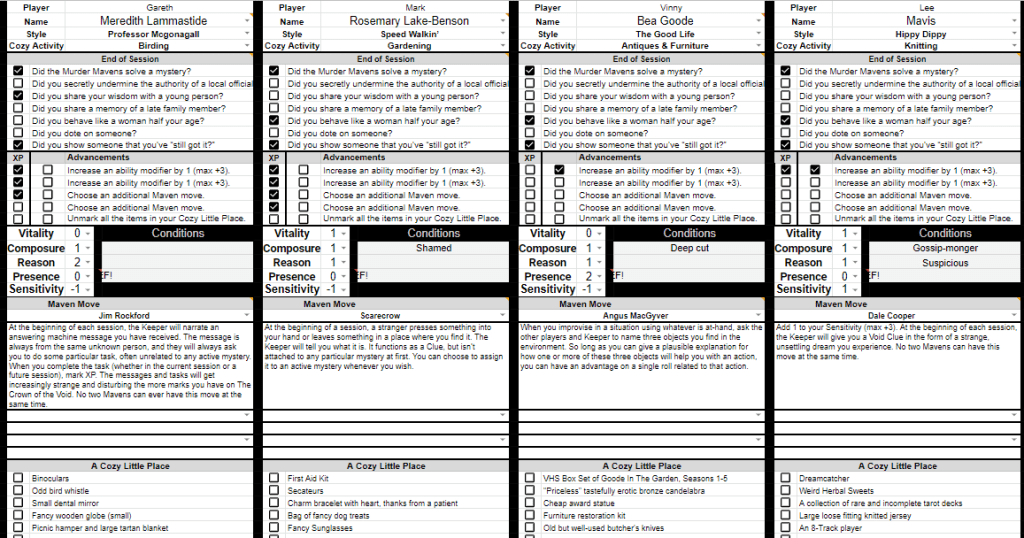
The Murder Mavens. I think my favourite item one of them had was a VHS boxed set of their old television program, which even managed to see play.

This is one of two Gauntlet games I’ve run this year and both have really impressed me with the mechanics involved.

Brindlewood Bay is a kind of eldritch spin on Murder She Wrote. The players are part of a book group who meet to discuss the mystery novels of Robin Masterson. They also solve murders and as time goes on, will uncover a strange conspiracy in the charming coastal town of Brindlewood Bay.

The game has mysteries which have a setup, murder and some leading questions to help the players frame things. Then the Keeper has a list of clues and locations, but not the answer to whodunnit. Instead, you seed clues based on the ‘Meddling Move’ the murder mavens perform, fitting them into the scene. The players then work out how to link the clues together and make a Theorize move which will, more often than not, be the correct answer.

I ran a one-shot of this and three mysteries with my weekly group. It ended sooner than I’d have liked and one of the players had a little difficulty being proactive with the clues, but overall I really loved running this game. I’d love to see a full campaign of Brindlewood Bay and to play with the increasing level of strangeness which happens as the game goes on.

The one-shot was The Long, Dark Teatime of the Soulless, with the group making their way through a B&B to find their friend’s murderer. Time passed and a few revelations at night meant a mad dash to get to the bottom of the mystery.

The campaign started with Dad Overboard, where the patriarch of a family has died ‘accidentally’ while on the family yacht. That took a couple of sessions for the group to finally resolve after a failed Theorize. We then did Lies & Dolls, which the group investigated one specific direction of and didn’t touch the rest of it. This mystery, about an academic found dead in a doll museum, didn’t ever finish, although I seeded the characters into the next scenario. Finally, we did Dead Man’s Hand which went down the best with the group. A bit more of a ‘bottle’ episode, with everything taking place around one small area, the group really dug into the mystery. I love my current group, but I feel this needed a bit more of a ‘leap before you look’ attitude and I wonder if the group might fare better returning to it, knowing that there’s mechanically no wrong answer to what you do.

Carolina Death Crawl

My printed deck of Carolina Death Crawl, paper for notes and you’d better believe we had an X Card to hand for the game with this kind of brutal subject matter.

This was the first game I ever reviewed for Who Dares Rolls back in the day. I was stuck working out what to run for a community night and found my cards for this game. It’s a tale of desperate Union soldiers who are native to Carolina, making their way through their home, destroyed by war and occupied by the Confederacy. The group are generated with a couple of cards and run through scenes as they flee back to headquarters after committing atrocities. As the game goes on, characters die one by one, then haunt the rest.

The group started out fairly light-hearted, but there were some painful reconciliations with family members and a strange encounter with a travelling circus who had got lost. The last time I hosted the game I wasn’t sure whether I had the emotional stamina to revisit it. I did this time and would be interested to return to it again in the future, but aim to die early as I ‘won’ my first game and came very close to being the last survivor this time.

My original review can be found here and my in-character account of the events here.

City of Mist
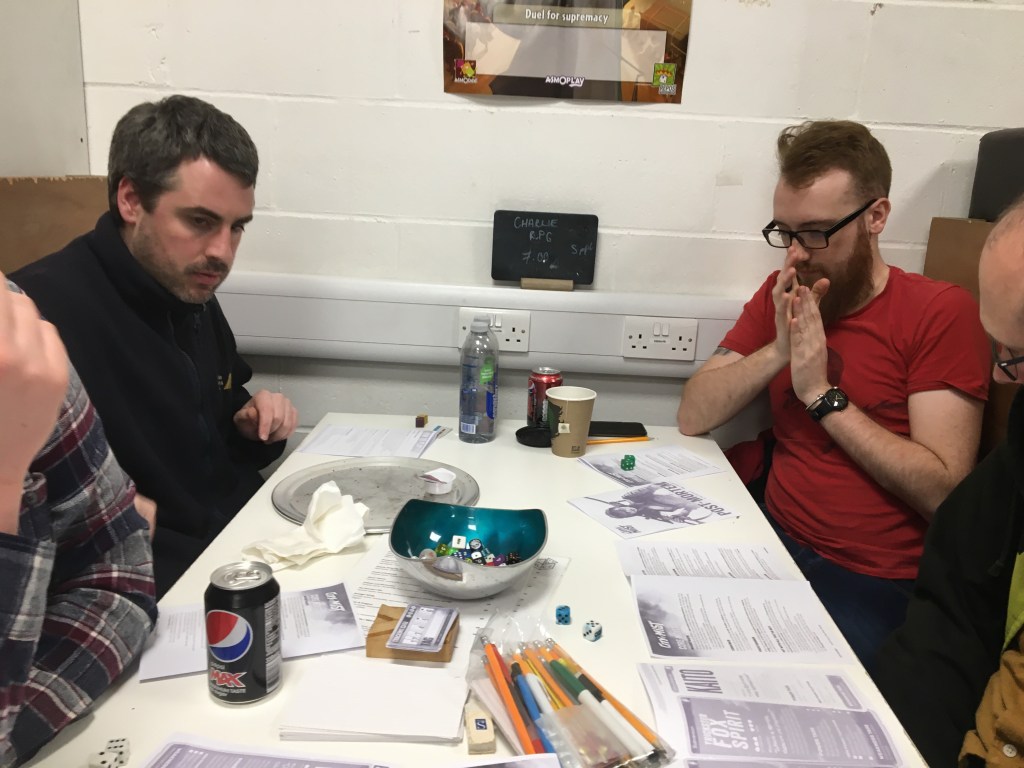
My group, The In-Fighters, at the Dice Saloon.

This was the roleplaying game whose book kicked my arse again and again. I was given a review copy which is a nice, rare occasion. It promised a kind of mystical version of the Marvel Netflix type stories. After an initial skim, it looked like it would be more like Fables meets Marvel Netflix shows, as the group are all powered by fairytale and mythological concepts.

I powered through reading the massive tome (I had the original combined edition rather than the split one, and bought two of their starters as this has had a few re-released and new starter kits). It felt like it wanted to merge Powered by the Apocalypse style indie RPGs with some elements of traditional games. It had some good elements, but a lot of bloat.

I ran one of the premade mysteries for my weekly group, taking a couple of sessions to get through. It was good, but for the amount of work, I know there are better games out there for this sort of thing.
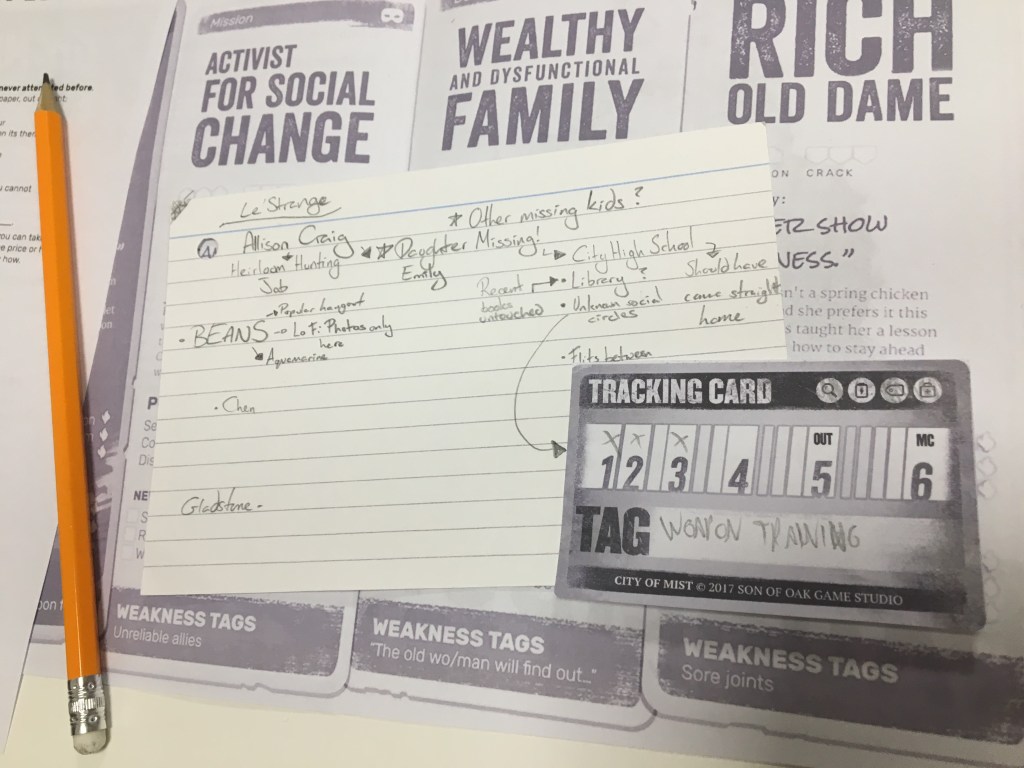
Some of my players’ notes, a tag card and underneath it, the playbook.

The mystery started off quite nice and simply with the group in their terrible dive bar, summoned into helping a couple of friends in a scenario which saw them sneaking in an empty school at night, getting embarrassed by shitty teens in a coffee shop and uncovering a giant horrible flesh ball made out of people. It went bizarre and a little horrific near the end, but was all round a fun investigative game.

I wrote a series of articles on the game, on reading it, running it and the selection of alternatives and expansions to it.

Comrades

In the glamdark future there are only extraneous facial tattoos and scowls.

This game was on my ‘2020 bucket list’ before 2020 became all… 2020. I was tempted to scrap it from the list as it felt like it might be a bit of a bummer for folks. I had a revelation and ran a game set in the X-Men’s Age of Apocalypse event. This was when Legion went back in time to kill Magneto, accidentally killed Professor X and Apocalypse used this advantage to take over America. The group played humans who were stuck on Cortez Island (formerly Staten Island) and planning to disrupt Fabian Cortez’s parade in honour of a statue of himself. I only had two players, as Jessica Jones and a depowered Loki. Together with J Jonah Jameson, they managed to secure some explosives and blow the statue up right at a pivotal point of the parade.

The system doesn’t do anything incredibly different from other PbtA games, although there are some fun campaign elements based on the actions of the group. Still, thematically it was really fun to do and a game I’d be curious to try out again. If I get a bit more time with the game, I might review it.
Posted in rpg | Tagged , , , , , , , , , , , , | Leave a comment

Cosy Horror and Explosions

This year’s been a bit of a weird one, hasn’t it? I feel like I’ve been incredibly productive and nowhere near productive enough, which will hopefully even out to make an averagely productive time as far as my writing goes. Here’s a brief update on some of my projects.

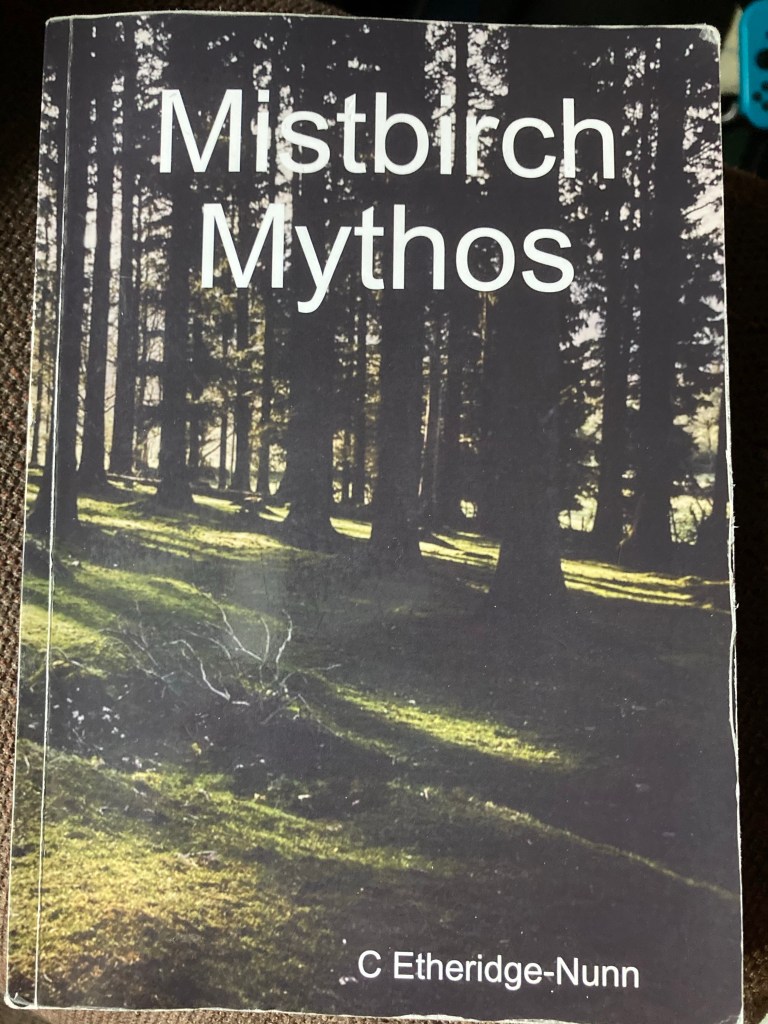
My proofreading copy of Mistbirch Mythos

Mistbirch Mythos

My prose output this year has mostly been in relation to a series of cosy eldritch murder mysteries. It’s set in a small village filled with lovely people and weird horrors. I drafted Mistbirch Mythos last year and have been proofreading it, reading it out to my writing group and then making changes since.

At the time of writing, I’ve got 24 scenes left to edit out of 43. My aim is to get this completely done by the end of the year, then I can send copies out to readers. If I can edit one a day then I should be able to get this done, or even better, editing more than one a day means I’m finished earlier and can focus on the next big thing.

This isn’t the cover of Lightning, otherwise I’d totally have kept it. This is the very glamorous notepad for the changes, proofing and edits of Lightning Season One.

Lightning. Again.

My KDP exclusivity for Lightning’s first novella went away this year and I decided it was a good idea to pull it.

Lightning’s a series of novellas covering families of superpowered aliens living on Earth and the hijinks that ensue. It’s my baby, but it also needs work. I have the season written and I love a lot of it, but it needs some heavy changes as it was written and then benched a few years ago. The world has changed a lot since then. I’ll get into more of that next year, though as 2021 will be my Year of Lightning, prose-wise.

I’ve tweaked Episode One and have a nice new cover as I wasn’t really feeling the last one. When Episode Two is ready, I’ll launch Episode One on Amazon, Itch and several other platforms.

This year I’ve seen a couple of friends have issues with their writing. One of them has been polishing the same thing over and over again, which I recognise I can fall into the habit of, especially with Lightning. The other, WH Arthur, has actually been releasing a ton of indie RPGs on Itch and even has a Kickstarter for one of them. I’m going to use him as a good inspiration to get Lightning Season One out of the door. Done. So next year I want to see if I can blitz through rewrites, edits and get at least a few episodes out of the door.

This is not Explosion High art, but I’ll be sharing it nearer to the end of the year. Just you wait…

Explosion High!

Artist Hunt 2020 has been a major factor this year. Matt Hardy of Mad Robot Comics fame saw my seven or so pitches and asked me to focus on two. I’ve done that and then spent most of the year fretting about trying to find artists. I’ve not had to do that since secondary school and the comic company my friends and I tried to create. This meant a lot of staring at different sites looking for artists who might work, overthinking things and then calling up Matt to help get me back on track with the mission.

One of the projects, Amnesiac City, is still an ongoing issue and I’m still looking for a suitable horror/mystery artist. I got to issue three of scripts and I’m paused until I find an artist.

The other project is Explosion High! and that’s gone amazingly quickly. For the project which didn’t have a script at the start of the year, it suddenly shot ahead. It was the first thing I wrote in the ‘rona times, in a kind of manic burst.

Since then I managed to get not one but several artists who will be joining me on this adventure. I’ll say more over the coming months, and showing off some fabulous art from the Explosion High crew.

Posted in General | Tagged | Leave a comment

RPG a Day 2020, Part Thirty-One – Alternatives to Experience Points

When I ran Dungeons & Dragons, experience points were often a pain. Third Edition had too much maths in working out encounters, as you’d have to calculate challenge ratings, you were recommended a set amount of encounters and were encouraged to play with balance. It was a whole faff and to be honest I gave up within my first year. I kind of made up how much the group earned, as it wasn’t as up front as it was in AD&D or as simple as the later D&D 4th Edition.

D&D 5E suggested ‘milestone XP’ as an alternative and I immediately jumped on board with that instead of measuring XP the classic way. You worked out when the group should level up and did exactly that. For Hoard of the Dragon Queen I levelled them up seven times in eight chapters, totalling I think about 11 or 12 sessions. The pace felt fine and gave the players more to have fun with at the end of each session.

Actual XP tends to work better in point-buy games like World of Darkness and Legend of the Five Rings, but there are even more fun ways of handling advancement.

PbtA Games – Failure

I first learnt about Powered by the Apocalypse games by listening to Actual Play podcasts and it seemed perfect for that style of play. I picked up bits and pieces just by listening to it, but buying Monsterhearts and Dungeon World really helped. One of the things which I really liked was that failing a roll gave you experience points. A few XP would earn you an advancement and the better you got, the rarer XP would become to match it. Not every PbtA game has it as a mechanic as it’s a design philosophy rather than a strict ruleset to design games with. Still, it’s common enough that you’ll still see it appear in games.

Lady Blackbird – Keys

Keys are a lovely mechanic. They give you two different ways of advancing. Normally a key will give you something minor to do for one XP, or you can do something to completely invalidate the key in order to advance immediately. This encourages more than one type of play, and actually having things pay off narratively in the session. Here’s an example:

Cake Arkham’s Keys

Blades in the Dark – Desperate Actions

Blades in the Dark uses a pool of d6’s for actions, with the highest being your result. The consequences differ on your ‘position’ between Controlled, Risky (the default) and Desperate. Each position has a different set of consequences for your roll. A Controlled situation means even a failure could simply mean you need to regroup. Desperate positions are the worst you can get, but there’s an incentive to go through with the action. Whether you succeed or fail, as long as you survive, you get an experience point.

A desperate leap!

7th Sea Second Edition – DRAMA!

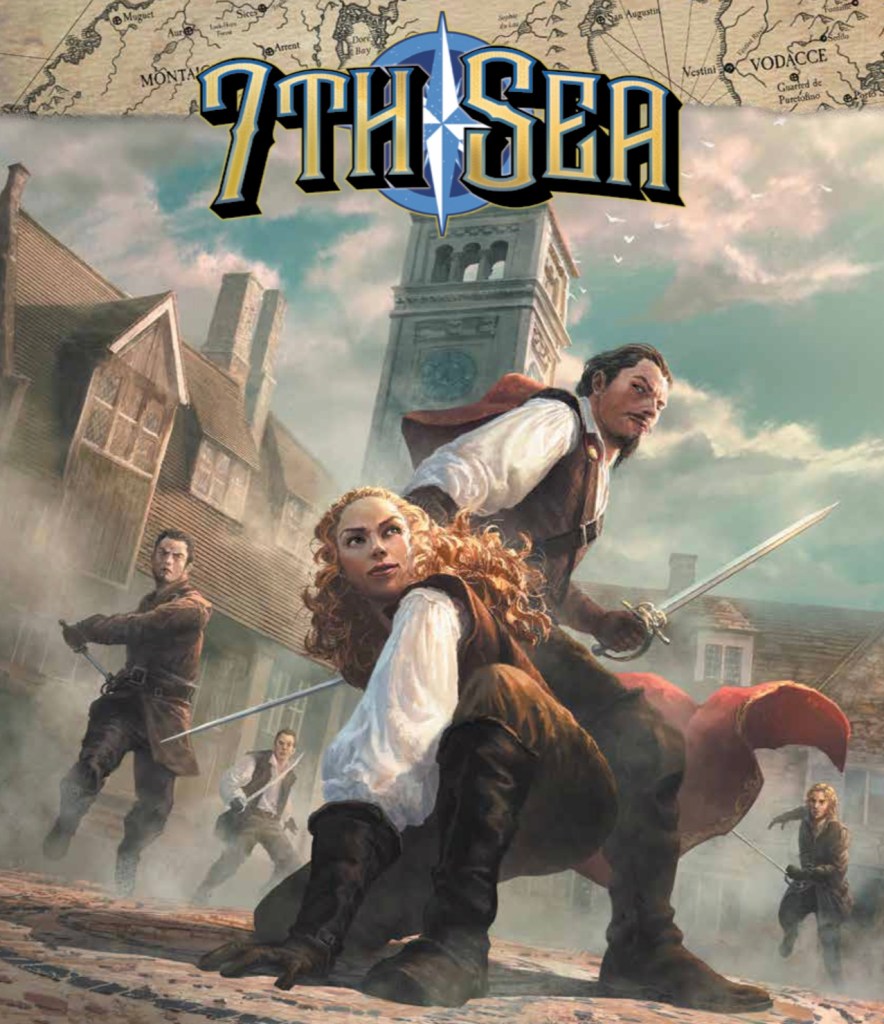
I’m a fan of 7th Sea Second Edition, although its half-tempted to replace the advancement system with Lady Blackbird’s Keys. I actually did do that with the 7th Sea demo I run for the sake of letting players advance quickly and give a little character motivation.

Anyway, the system. The player comes up with a story they want their character to go through, a reward for completing it and the first step on the journey. This can be a lot to ask of players, but it can help the players inform the GM the kind of story they want and weave things in.

A short arc could be that you want to become a better swordsman, which will end with you getting an extra dot in your Weaponry skill. The only thing left to do is to the first step. That could be, ‘find a mentor’. There, a nice, quick storyline to be seeded throughout the group’s story.

A longer arc might be, ‘avenge my mentor’s death’, which will end with you getting the mentor’s unique blade back from her murderer. The first step could be, ‘find out who killed my mentor’ or ‘steal the documents detailing my mentor’s last days’. When you complete it, you and the GM come up with the next step, which might be, ‘find the location of the man who killed my mentor’, and so on.

7th Sea Second Edition

I love the idea of this system. I get that not every player can come up with these arcs as easily and would love a supplement with more examples people could use for their characters on the Explorer’s Society, in order to provide hooks for players to use.

Heart – Beats

This is a late entry as I’m literally using the Heart book as a surface to write on and only just realised its another perfect example of alternative XP triggers.

Heart has Callings as part of character creation. These are your reasons for delving in the horrendous abstract horror dungeons which lurk under Spire. A Calling could be, ‘Adventure’ where you’re a fool who wants songs written about them or ‘Heartsong’ where you’ve had weird, prophetic dreams about the Heart itself which are calling you.

Each calling has a checklist of Beats, which you pick a couple of at the start of each session. These could involve getting incredibly drunk, slaying a monster far larger than you or even taking some minor Blood fallout when you get hit a lot. If you trigger that Beat in play, you get an advancement. You can switch some of the Beats as you go and there are a large number to choose from.

A Penitent Calling
Posted in rpg | Tagged , , , , , , | Leave a comment

RPG a Day 2020, Part Thirty – Fun with Portals

Today’s theme is portals, and as loathe as I am to keep banging on about my Dungeon World campaign set in Exodus, it’s got some sun experiences with portals which work for this day’s theme.

The initial premise of the campaign was that there was a light and dark world, Zelda-style. The light world was the world of Exodus, and the dark world was the old reality which the populace of Exodus fled from when it was taken over by Rath, The Antigod. In the prelude, the first portal had already opened. It was small, but there was enough space to get a beach ball-sized sphere through. It landed in the Elven district, Lasseska, and burst forth with an avatar of the Antigod. With enough power, he transported Lasseska to the dark world and a bunch of barren, dead woodland to the light world. For the prelude, the players saw all of this from the position of the heroes of the age, all corrupted by the Antigod into being the bosses for the first season of the game.

Imagine this sort of thing, only Sauron won, teleported a city to hell and was banished back to it for a while by prismatic wolves.

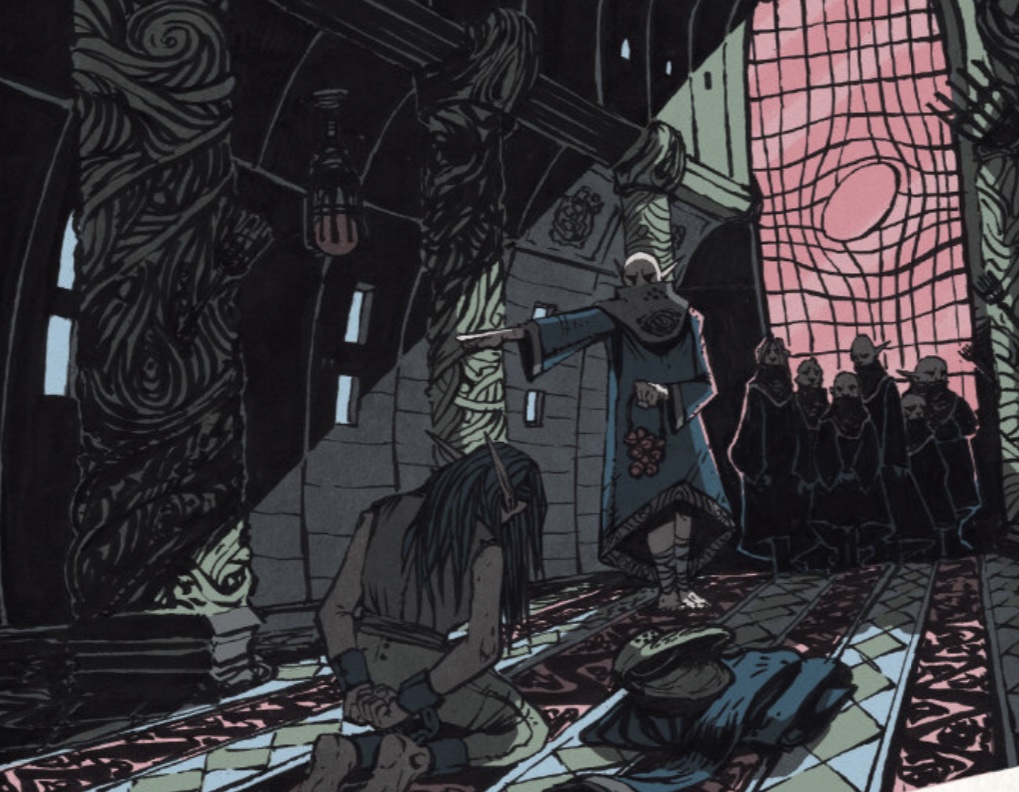
In the rules of the multiverse, Rath and the horrific undead gods had been caged in the dark world, unable to get anywhere. They needed things or people from other realms to charge up enough multiversal energy to open up portals. It took a thousand years and as many lost items from the multiverse for the big attack and now they had a ton of displaced elves to play with. They could only go so far, so they opened tiny portals to communicate to cultists, sometimes even sending the heads of their worshippers who could be reanimated and interrogated on the other side. The group saw this bit by bit, but mainly dealt with the sub-bosses in the light world.

There was a brief interlude where the group accidentally ended up in the dark world, eventually finding a shapeshifting gauntlet from another universe (specifically this was the arm of the shapeshifting liquid metal character Apollo from Masks, but that never really came out). With the help of Xel, a devil who’d escaped the dark world and really didn’t want to stay there any longer, they teleported home.

The season one finale had an amazing portal moment, as the group disrupted a wedding between the last surviving elf noble (who the group’s ranger fancied) and an elf forced into working for the sub-bosses. The ceremony was being used to gather the remaining elves together, open a door to hell and finish what the invasion of Lasseska started. The last of the sub-bosses they needed to deal with was a dragon the size of a small city, so things began to look tense when it showed up. The ranger rode in, rescued his elf girlfriend and rode into the hell portal which was opening, followed by the rest of the group. It made for a fun season end.

This but with a wedding, a dragon and a bunch of fools riding into it.

Season two’s first sessions were all about the group out of hell and back to where they thought a war was probably still going on. They found the few survivors of Lasseska, freed them from their dire situation and travelled to the walled city of Epitaph. One of the group, Grifford, was from a corrupted order, who had made Epitaph into their home, where they were consolidating multiversal energy to take the city to the light world. Oh yeah, and the city turned out to be a giant robot scorpion. You know, usual fantasy things. The group waged war on the city, took it over and drove it to the Lasseskan refugees, then activated the portal generator in the city’s tail.

I guess kind of like this, but a city.

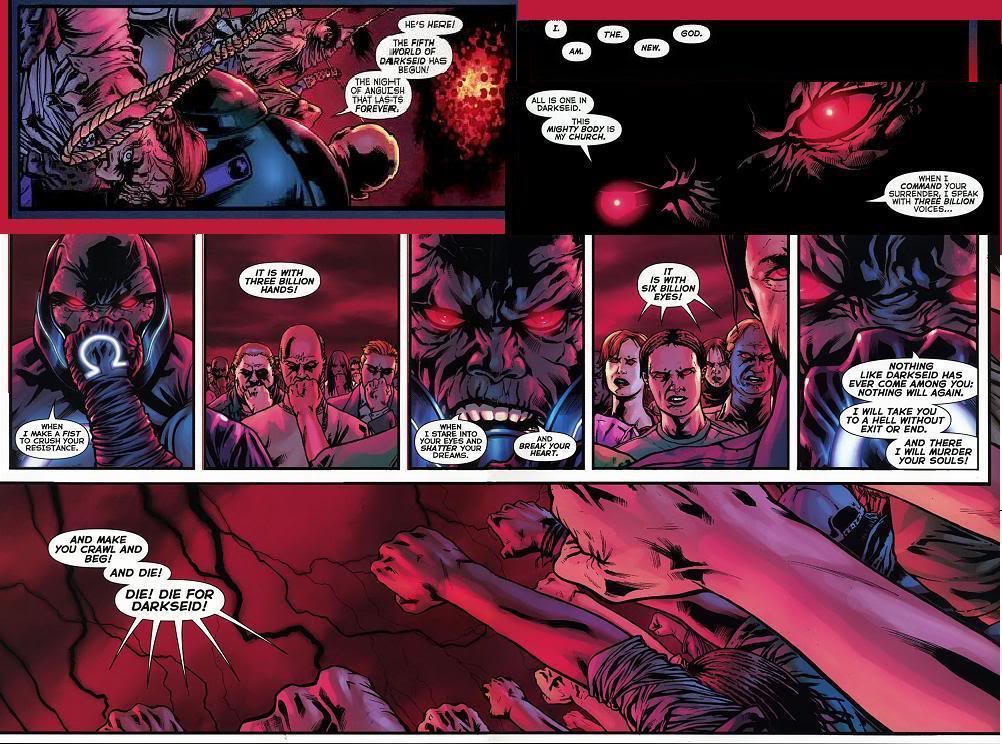
The city was surrounded by prismatic light and ended up in the light world, in the barren land where Lasseska once stood. Rath was already in the light world in the body of an avatar, ruling Darkseid-style over the people of Verdant, the central city of Exodus, the main agricultural hub and the home of the group. They found their way in and stopped Rath, at the cost of the life of one of the group, but they sealed the portal to the dark world.

This is very specifically the kind of Darkseid I was channelling with Rath.
Posted in rpg | Tagged , , , | 1 Comment

RPG a Day 2020, Part Twenty-Nine – Ships and Carts, When Your Ride is Your Home

I like a headquarters for groups. I’ve given folks taverns to restore and use as their home. I’ve often had players help make their hometowns and in Hunter: The Reckoning my players spent more time maintaining their lovely suburban house than killing monsters.

A lot of games take the adventure on the road pretty much constantly and that ends up with players simply renting out rooms, living in tents, getting the hobo side of the murderhobo lifestyle. Giving them a home gives them something to invest in, some roots, which helps lessen the kind of transient murderer vibe.

I’ve dealt with this by giving them a home which travels with them. AD&D was my first experience of this, as I only owned a handful of adventures in different campaign settings and my solution was to make them all different geographic entities in the same world. This meant needing a boat to get about from Forgotten Realms, Red Steel, Ravenloft, Al Qadim and some lands of my own making. The group loved their boat, adding a second, smaller boat on top of it hanging between the masts as storage for their underlings. They hired a dozen deckhands who they didn’t name at first. Time went on and the survivors started to get names. When some adventures I had required the group to be inland I decided to have them find an enchantment to allow the ship the power of flight.

This was the copy of the PHB I had. There’s an incredible book smell it has which hits a special nostalgic place in my heart.

A flying ship was pretty cool, even allowing me to use some new monsters who preferred the air. At one point I had a cockatrice attack the group, even turning some of the deckhands to stone. The group had difficulty using ranged attacks (which only one of them was any good with) against a flying enemy. One of the group, Albert, lassoed the cockatrice, tied the other end to a stone deckhand and booted it off the boat. It was a great way of finishing the beast, an unfortunate end to the deckhand and a random encounter they found years later in the campaign when they were wandering through the land.

A vastly fancier airship than the one the In-Fighters had.

Airships aren’t the only kind of moving home, of course. There was the Dobbin 5000, a covered wagon with legs instead of wheels. It didn’t need any horses pulling it, as it was magically half-horse. My brother made a great illustration sadly now lost to time, showing the suspension on the cart to make for more comfortable travel. This was in D&D Third Edition when the group were playing the next generation of their AD&D characters (although the characters didn’t know that). The first story arc was all set in their hometown, but the second onwards had them on the road. The cart was technically the possession of the group’s rogue and monk who had reached a great accord about each others’ philosophies. There were hidden boxes throughout the Dobbin 5000, and even boxes on the sides where they grew flowers and herbs. The rest of the group rode alongside them, but they all stayed inside overnight. Instead of posting watch around a campfire they would be able to keep riding with a lantern hanging by the driver’s seat. It was a very cosy home for them.

Just one of the types of ship you could have in Fellowship.

These days, there are games like Fellowship which manage to mechanise your ship with its own playbook. And by ‘ship’, the playbook could be anything like a zeppelin or a train. It’s great, you give folks different roles and can use advancements to add rooms or crew. Scum & Villainy takes the crew playbook from Blades in the Dark and shifts it from a gang to a spaceship. The crew types even shift to different types of ships with their own compartments and types of jobs. Now your home can be mobile and can have cool mechanics behind them. Personally that’s had me thinking about how better to mechanise the mobile homes in other games, as well.

The Stardancer from Scum & Villainy.
Posted in rpg | Tagged , , , , | 1 Comment

RPG a Day 2020, Part Twenty-Eight – Closing out a game with an epilogue

I love a good epilogue in an RPG. It’s tricky in a limited time slot to make sure that when a session ends, it can end properly in a satisfying manner. I’ve been trying to improve in this way as it’s a good way of finishing a character’s story once the action’s done.

Think of it like The Wire or Game of Thrones. The penultimate episode is normally where all the action happens, then the finale lets the dust settle, puts all the toys away and has some potential hints for the next season.

Ah, that orange sofa…

Most of the time for a one-shot I can get an at least a five minute epilogue from players, getting them to sum up their characters’ fate in a sentence or two. No one ever manages it in that short an amount of time, but that’s fine as long as its short. The King is Dead had a fun epilogue with each of us as youths vying to be the family to take the throne. My character was a naïve son of a duplicitous family. While two of the families were going to war, his family’s forces picked both sides off and took the throne. He was the king in name only, with the rest of the family ruling through him. His epilogue was the kind of solace he and one of the other nobles who was now under house arrest had in secret. Two of the other characters had an epilogue of regrouping in another country and scheming an eventual return.

So far the only Firebrands game I’ve played and its great.

Then there are the longer epilogues. My weekly group, The In-Fighters, have way too often narrated their own retirement, downfall or deaths. In tremulus, the group spent the finale having sent some gangsters to their death and then squabbling about whether to sacrifice the psychic aunt of the gravedigger to some mi-go. The player of the gravedigger and some of the others came to an impasse. The crook phoned a cab and sent the aunt away while everyone else was arguing, then told the group he’d sent her to a retirement home in Boston. The truth was he’d told the taxi driver to take her to the warehouse the mi-go were hiding in and leave her there. The players knew, the characters didn’t.

The epilogue started out with the vagrant who found a home and a job as an orderly, even starting to romance a diner owner. That was nice. The politician became mayor, but was surrounded by scandal, which was frankly inevitable as he was the one to hire the group to do all kinds of shady things. Then the fake psychic who’d stolen a Necronomicon from a man named Whateley was arrested, then the police station burnt down when the old wizard came looking for the book. This had the added bonus of fulfilling a prophecy that the psychic aunt said earlier in the campaign that the police station was going to go on fire. Then the gravedigger narrated finding out his aunt wasn’t in any care home in Boston. Finally the crook narrated coming out of a speakeasy, drunk and merry about how things went down. He sat down in his car and didn’t notice the gravedigger in the back seat, readying a garrotte. A grim, fun ending and a death entirely agreed upon by both players involved.

Mi-Go! Or ‘giant lobster-wasps’ as the group kept calling them as no one knew what a mi-go was.

Finally I’ll return to Dungeon World as its something I’ve run a massive campaign of. After two seasons, a journey through hell and out the other side, then a fight with the avatar of an anti-god, the group finished the action at the end of the penultimate session. I’d already pencilled in a final session to be a full epilogue to the game. I didn’t have anything specific planned, but instead asked the group to take turns telling me: what happens to them in the immediate aftermath of the finale, what happened a week later, then what happened a year later. Each scene could be anywhere from a top down third person description, or a scene taking several minutes to run through. There were happy endings, sad endings, a new beginning and one of the group became a kind of prismatic wolf creature sworn to protect the multiverse. You know, the usual kind of ending. We didn’t really use the system that much, as we knew the characters and the world enough, we knew this was the end of the line for the cast, so free play worked for us.

The next big campaign I run, I definitely want to do this sort of thing for. Players and GMs can get really invested in the characters, so while I’m not a fan of playing the same game forever, I definitely approve of this method of definitively saying goodbye to the story.

Return of the King’s endings may have taken a while, but are still fantastic. I could imagine the Scouring of the Shire being a great epilogue session.
Posted in rpg | Tagged , , , , , | 1 Comment

RPG a Day 2020, Part Twenty-Seven – Favours as a good plot starter

RPG a Day 2020, Part Twenty-Seven – Favours as a good plot starter

I thought this said ‘flavour’ at first and got excited about waffling on, saying about how some mechanics have a kind of flavour of their own.

Starting a quest can be a problem, especially getting groups invested. I’ve spoken before about the ‘what’s my motivation’ problem I had in tremulus. If the group don’t know each other or don’t care about the plot, things can meander and you can end up faffing around. I don’t even mean in a session zero kind of way, I mean doing that thing some Netflix shows spend way too long doing of spending episode after episode trying to figure out why they want to be heroes before finally trying to do anything. Our characters need to cut to the chase. We’re on the clock and want to get to the action.

I’m not posting anything by Adam Koebel here, so look at this cool cover for a DW setting that can be used in other systems, too.

There are variations on this, but those don’t fit within the theme so much. Owing someone a favour can be a great instigator for adventure. It might be contrived to have everyone in the group owe someone, but for a one-shot that’s completely fine. If the group all know each other then you can have one or two players owe an NPC a favour and have that called up.

In a Dungeon World one-shot I had the group acting as servants for Prince Khalid of Canbanton. It was a coastal town with a lot of guards protecting the place internally, but they outsourced to adventurers externally. In this case I did one of my favourite things and asked the players why they each owed him a favour. A lot of them were nebulous help or promises which meant if I ran other one-shots in the world (and I did) then they already knew why they owed him.

Another time I actually started with the group at the start of the adventure site, skipping past the initial briefing and simply saying that the group are troubleshooters enlisted by a noble to solve a problem. The problem turned out to be the noble, so the group were able to clean their slate and appease some ghosts by sorting him out.

In a recent game of Squamous the premade adventure in the book has elements of this. The group are tasked with recovering a book for a friend. I asked how they knew the friend and some of them made up the favour, others didn’t, but they all bought into their motivation right away.

A fun, light cosmic horror RPG.

It’s an easy trick and one you can do almost thoughtlessly. I know a lot of GMs like to start at the start and to have the discovery of a plot hook, but personally any tool to rocket folks into the story and get the buy-in is good with me.

Another potential way of doing this (albeit without favours… sorry RPG-a-Day deities!) could be to start with the group fleeing someone or something, then asking why during the action.

Posted in rpg | Tagged , , , | Leave a comment

RPG a Day 2020, Part Twenty-Six – Magic is Best When Its Strange

I like magic when its weird. That sounds like it should be a fairly basic statement, but actually that’s something a little difficult in RPGs when so much can get laid out like feats or special abilities with slightly different parameters or special effects.

I guess my main issues fall mainly in the field of traditional games, although indies can also have this happen. The main example, of course, is Dungeons & Dragons. I’ve run every edition but I must have run Third Edition the most. At that point, spells were their own thing, but they were still a list of useable resources. You could cast a certain amount a day and added it to your shopping list of things you could use like with feats and magic items. People started to get more used to the idea of purchasing magic items, things like +1 swords. I used an old Dragon Magazine article which had tables for the decorations on the magic items to help differentiate them, but it still became quite transactional.

The game culture was also a bit like that, where players would expect retailers to have magic items, but also for a wizard to be a specific thing. There would be schools, there’d be purchasable scrolls and they’d all act the same way. You know, the D&D wizard way. Sure there were sorcerers and clerics, but their magic was relatively similar.

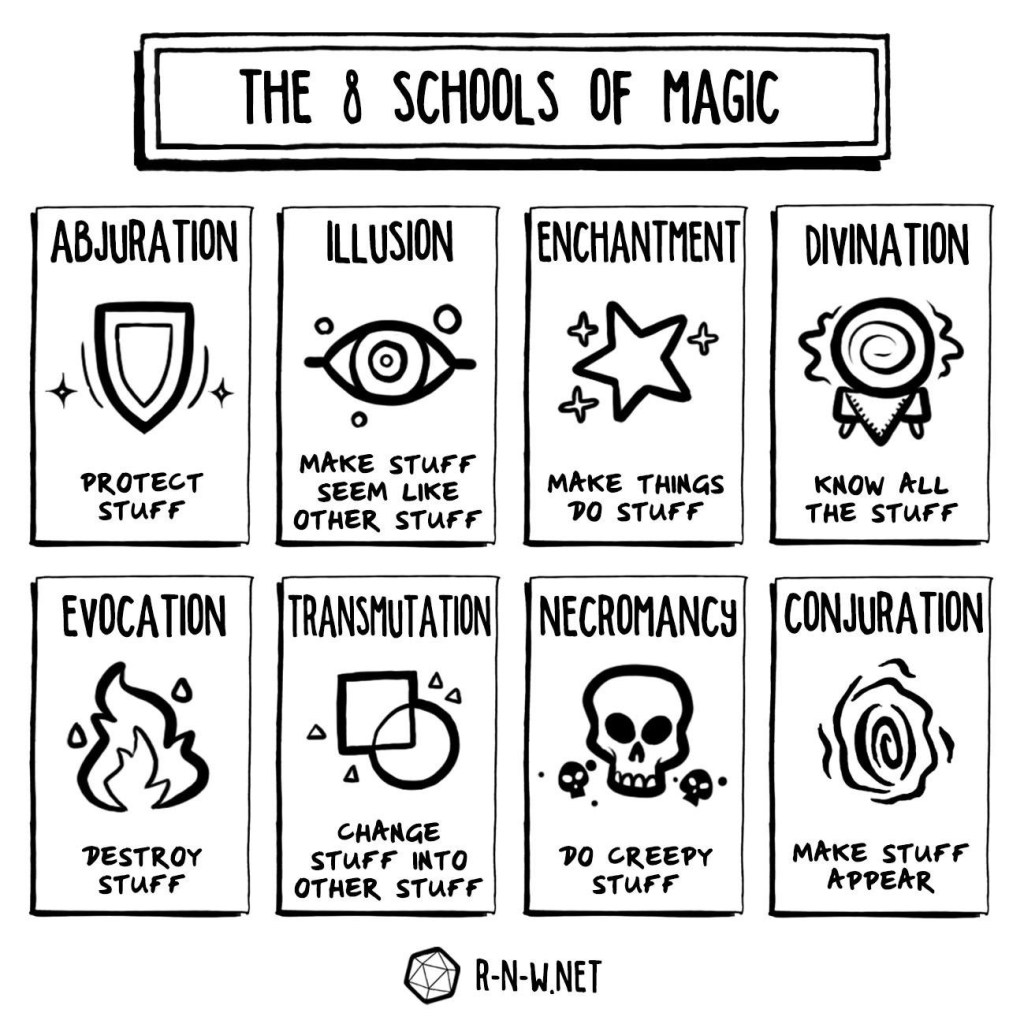
RNW’s great breakdown of schools

I enjoyed playing clerics and druids the few times I wasn’t GMing, so I had a bit of a bigger spell list and often tried to experiment with some of the weirder spells from sourcebooks for flavour. It wasn’t seen as all that optimal, which meant frowns from players, but there we were.

World of Darkness also broke powers down into different systems, but there were ways of playing with them so they felt different. Playing Mage: The Awakening and encountering a Vampire using the rules from Requiem were fantastic for telling the players they were dealing with a whole other creature. Even before the mix and match toolbox of the New World of Darkness I ham-fistedly slotted together the Old WoD creature types in Hunter: The Reckoning as the monster abilities in that game didn’t feel as flavourful and distinct as using each monsters’ own mechanics.

Dungeon World had listed spells for any magic classes, but there was a point where the Druid asked if he could ‘Defy Danger’ by turning into a moth just in time. It was a great moment where as the GM I realised that yeah, that totally works in the fiction given his powers. The same was able to be done with magic users quickly summoning up light or fire or something. Because all a Powered by the Apocalypse move needs is fictional positioning, being a magic user gives you ammunition to handle the magic as oddly as you want.

Quest has some fun ways of handling these sorts of things. First of all there are the narrative aspects of the character sheet. We had a person with a mechanical arm and a doctor cursed into the form of a grasshopper. We’re these choosable from a list? Nope. The players decided these would be in the fiction and now they are. I asked Arthur, the player of the grasshopper, whether there were grasshopper people and he explained that it was a curse placed on him. Now there are curses. We didn’t know how it happened or whether it could be cured, but it was a strange piece of magic which made him and the story unique. The same with the mechanical-armed character, as that moved the tech level of the fantasy world up a bit. The character’s community were a kind of techno-Amish, separate from everywhere else and fixated on making machines for agricultural means.

Some lovely Quest art

The next fun thing was the ability tree. The majority of the classes were magic in different ways and had some interesting, flavourful ways of being cast. They also are broad enough that you could make them seem however you wanted. The grasshopper was a Doctor class, which could be medics, clerics or necromancers. Being more of a man/grasshopper of reason, our hero ‘cast’ the ability to discern a creature’s death without casting any spell. They were simply able to discern through medical prowess. You could change up that ability to get a psychic flash of their death, you could speak with the dead or change it up in any number of ways to make yourself unique and the magic you use unique.

Exodus is a magical city made out of other cities, filled with immigrants from other dimensions who sought sanctuary. It’s a big old mess, and also one which has no set version of magic. It was originally used with Dungeon World and specifically the Class Warfare expansion which made character classes out of pieces of smaller classes mashed up. This meant we had an elemental mage-slash-martial artist, a magical lawyer and a knight who could psychically manifest weapons. These all worked and interacted, but they felt different. There weren’t really many schools, or at least the ones there were kept quite specific disciplines. The town of Littlewall had an academy of Brick Wizards, found throughout Exodus and trained here in order to help construct roads and buildings. Booze Wizards gravitated towards Solace, its vineyards and the harvest god who lived there. Magic could be a tiny effect a farmer had or a horrific ability to channel dead gods from other dimensions. This is my kind of default preference of magic. It’s anywhere from small to massive, it’s usable by players, its different in all its forms and sometimes it’ll demand a great cost.

I mentioned about flavouring things in D&D earlier this month, but I’d extend that and say that even in these trad games, it’s worth playing with a special effect or two, even if it’s not something which provides a quantifiable bonus. Maybe the sorcerer’s eyes occasionally give off glowing, swirling patterns. Maybe grass grows behind the druid when they’re happy, or there’s an ambient music in the air when a bard leaves town as people are inspired to take up instruments. It’s not difficult to do, but it’s often forgotten for the sake of simple function and numbers.

Magic! It’s weird and that’s awesome!
Posted in rpg | Tagged , , , , , | 2 Comments

RPG a Day 2020, Part Twenty-Five – Chaos Engines: Pulling Levers and Pushing Buttons

There are a lot of assumed player types; your rules lawyers, your munchkins. A lot of these have changed or been reframed over the years. A rules lawyer can actually be great if you turn them into your rules caddy. The munchkin could help teach the other players how to do better use their abilities.

There’s a role which I keep encountering and encouraging in my groups in the past few years. It’s the “Chaos Engine”. It’s been a phrase some of my players have worn with pride. They know they’re the person who’ll push the big red button or pull the random levers to see what happens. This sounds like it could be disruptive and occasionally it can be, but groups can get stuck. They might look around for something to do, they might be acting too cautious about their plans. At the same time, the Chaos Engine in the group has got bored and already pushed a button or wandered off down a corridor.

This guy did not get this way making good, safe decisions.

In the past I may have viewed this sort of thing as disruptive behaviour and when done with no respect or love for the party it still can be. Most of the time these days, the Chaos Engines I’ve known have been fantastic at initiating plot with their lack of impulse control.

My current incarnation of the In-Fighters has one player, Wade, who is my Chaos Engine. His motto has become, “No one was there to stop me” and that pretty much explains it. In the olden days of D&D I know that a group would have babysat him or lectured the player because they couldn’t count on a slow, cautious attempt at wandering through a dungeon and spending the least amount of spells, HP and so on while trying to get a victory. These days though, the group will load him up and get him to do things on his own as they need someone to do the bad/dumb thing. Sure, he’ll sometimes end up being shot off a castle with a ballista, but those are the risks the Chaos Engine takes.

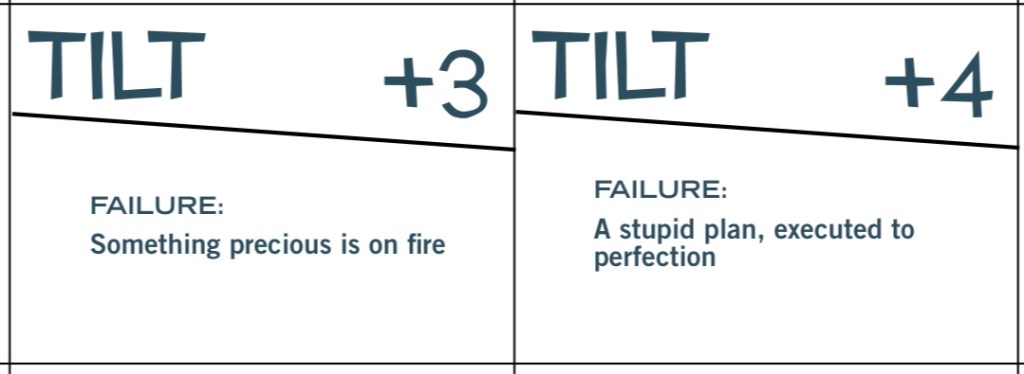
Some Fiasco Tilts which happen in far more games than just Fiasco.

Wade has had characters fly into The God Quarry, fly into the distant future, confront the avatar of an Anti-God and died several times. It hit the point where he realised character death would negatively impact the whole group in Band of Blades so he armoured his first rookie up to a massive level. This didn’t stop Wade being Wade, so the character still charged a scrum of the undead, played with explosives and is somehow still alive.

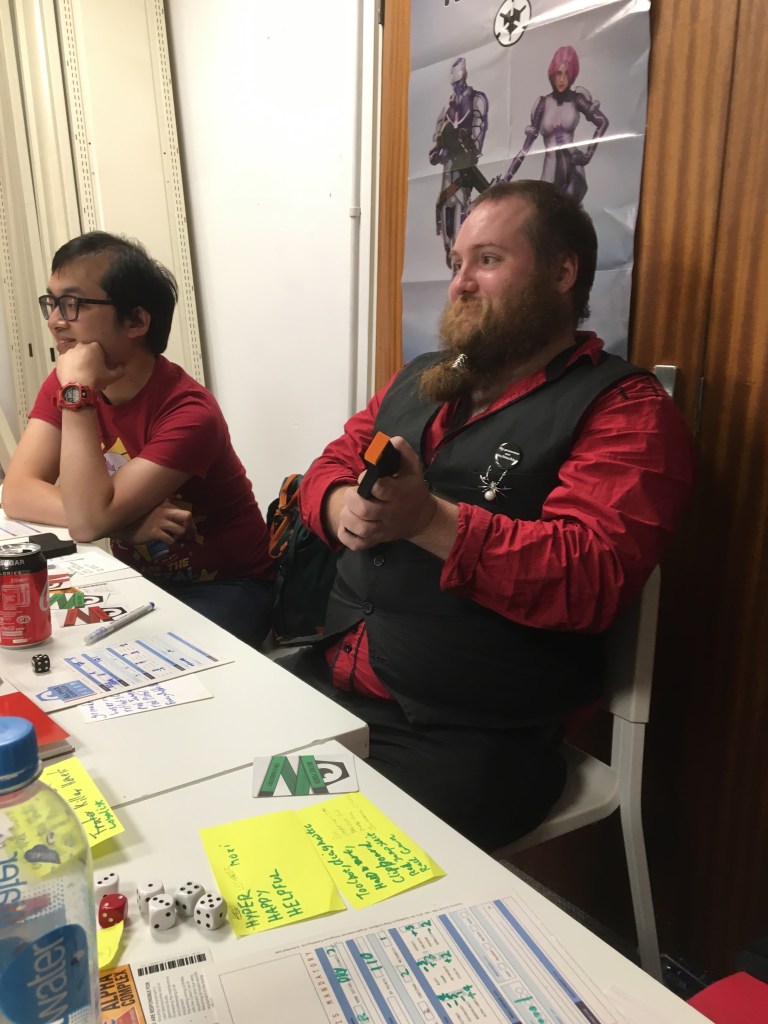
One of my chaos engines, Rhys, idly pointing a Cash & Guns gun at me in a game of Paranoia.

My RPG community nights have Rhys, who at times talks like I’m frustrated that he’s the Chaos Engine, the most likely to start a cult or lose a hand in a Blades in the Dark standoff. The thing is, he’s pushing the story forwards and as long as that happens then the Chaos Engine’s a great part of a group.

Posted in rpg | Tagged , , | Leave a comment

RPG a Day 2020, Part Twenty-Four – The Tricky Art of Humour in RPGs

I listen to the System Mastery podcast and they covered an RPG I’ve owned for years but never actually played. The Land of Og. It brought back all the memories of picking it up at GenCon UK, reading it and raving about it to my players over the years.

The expansion, because Land of Og was such a classic it needed an expansion.

The Land of Og is an RPG where you play cavemen. A comedy game about them. You use D&D stats and stat spreads, but where D&D players go from 3-18, you go from 1-6 for most of your stats or 2-12 for your primary stat. The joke is that cavemen are really bad at everything. Listening to System Mastery’s episode and looking at the books again I can confirm these cavemen would not have been the ones who survived and evolved. It’s funny saying that you’ve got a tiny vocabulary. There’s a table of words like ‘sun’ and ‘stick’ and ‘verisimilitude’ (which is how I first learnt that particular word). The problem is that communicating as players and characters only using a small vocabulary’s fine but I didn’t even realise how few they were until my reread. Overall, the concept’s funny but it looks like it would be a painful slog.

This is the problem with some comedy games. It’s traditionally been difficult to make a fun system which also makes a fun game. The humour often ends up inside the book, which will probably only be read by the GM. The Red Dwarf RPG and countless old d20 system era games suffered from this, where they were more funny than functional.

So what are some good examples of how to deal with this?

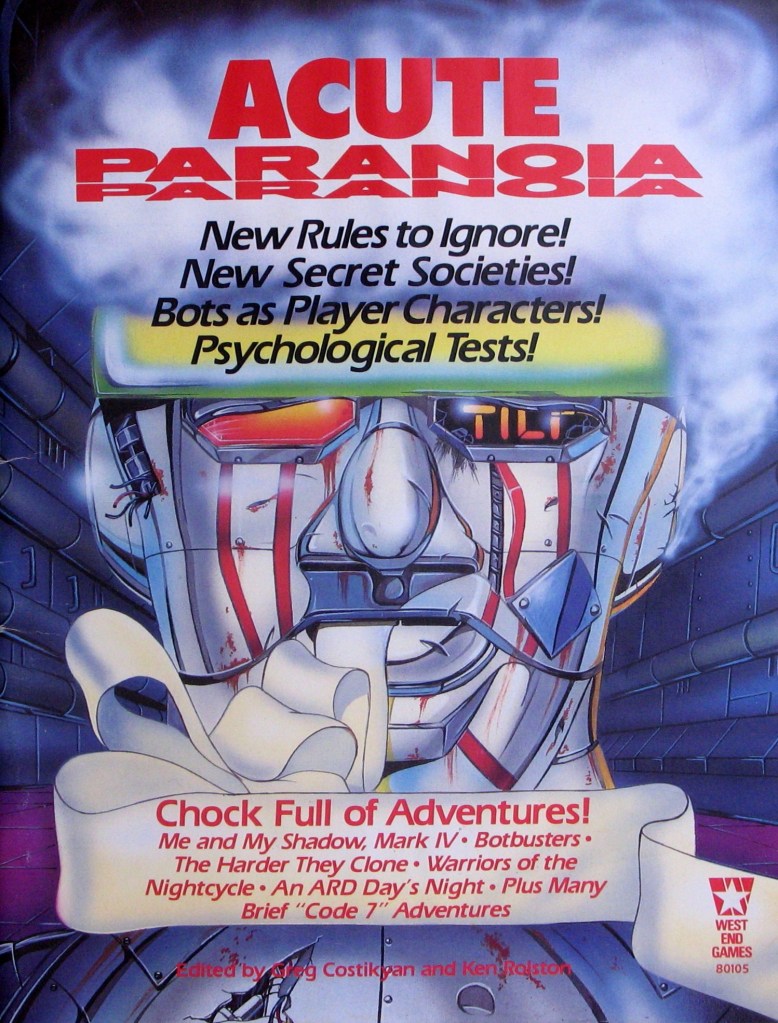
I ran my players through the psychological tests here and they were great fun. Having to point at the [blank] and the [blank] on the nearby Gamma World book had one of the players cracking up.

Paranoia’s an ancient game, but still works for the most part. The system has almost always been completely superfluous to the fantastic dystopian comedy world. I’ve played almost every edition but it’s only been the most recent one which has stuck in my head. In a way it survived because no one cared that much about the system. Paranoia’s world is a ‘utopia’ set underground in the year 214 (now and forever 214). The Computer runs the Alpha Complex, run by clones who in theory are perfect and compliant with its wishes. Only The Computer isn’t working right, the clones are all defective and the countermeasures against problems are based on a box of 1950’s propaganda which was uncovered. Players are ‘troubleshooters’ who have to hunt mutants and members of secret societies while all actually being mutants and members of secret societies. I ran my first session drunk and having managed to lose the core book. It made frankly no difference. The game was very much the case of when things start to go awry, the system is extreme enough that it rarely mattered what it did.

The most recent edition had a more robust system powered by picking what you were good at and what the next player was bad at. This drove players against each other and made erratic characters. A ‘Computer Dice’ was great for randomly making The Computer or other technology interfere. It mixed mechanics and the world to make a daft, entertaining game. My only gripe was the entirely superfluous card-based initiative and combat action system which I just replaced with Balsera or ‘Popcorn’ Initiative represented by the foam guns from Cash & Guns. This had the added benefit of making everyone weirdly trigger happy.

Paranoia took several editions and is one of the classics which still works, albeit with the added necessity of mentioning how GMs shouldn’t take the opportunity to be a complete dick to their players. We’re all watching the characters screw each other over together, as is The Computer. The GM doesn’t need to get hostile to the players as well.

In this modern age of fantastic indie RPGs we’ve got a lot of ways of handling comedy.

A grizzled gull.

Some games play the concept straight. My good friend WH Arthur has made, “B-Town Beak-Tectives” which tells noir mysteries from the point of view of seagulls. These are horrific monsters in Brighton, where we both live and B-Town is a kind of fictionalised version of. The world is ludicrous and the system’s brilliantly seagull-themed but in-world it’s all played straight. The mechanics and the mystery creation are all there.

Then we have the Grant Howitt one-page RPGs. There are several authors such as Ursidice and Minerva McJanda who also publish these kinds of games, but Grant Howitt is both prolific and silly. From the Actual Play darling Honey Heist to Jason Statham’s Big Vacation, Adventure Skeletons and more, these are all very fun, silly games. In this sort of game the humour is front-loaded to you can see the broad concept, get some prompts about what to do and then are sent on your way.

Bears. Hats. Crime. What’s not to love?

I remember before running Jason Statham’s Big Vacation having a moment of panic, wondering how I could be funny and whether I’d end up forcing it. Luckily the mechanics the group have prompt a lot of silliness, as did the tables. The conflict as a GM is less about being funny as it is being quick. I found myself having to work almost one step ahead of the players through fits of laughter and barely able to keep my notes together as I went. This is why I’ve ended up having to use notes my players made as well when writing up reviews of those games. Grant himself has said before that he forces a lot of cognitive load on the GM in return for everything being contained in a single page. It can seem daunting, but the payoff is fantastic. Finally, I also wanted to give a shout out to the 200 word RPG, “Fuck! It’s Dracula!” This was the first game I ran during lockdown. I figured I’d run something nice and simple, which it was. The tale was very daft, involving a relationship between Dracula and a vampiric cow who was his bride. The group rode a jet-powered coffin across a desert. It was a fun time and I’d recommend checking it out.

Posted in rpg | Tagged , , , , , , , , | Leave a comment