This entry is going to be entirely Mothership. I’d bought the original edition of Mothership a while ago and ran it during the Kickstarter for the full first edition, just to make sure that it ran well as well as looking pretty. It did, so I went all in on the first edition and backed a number of other Mothership books during Zinequest. I decided to read them all together.
So what is Mothership? It’s a space horror game in the kind of junky future that you’d see in films like Alien and Event Horizon. It’s got an OSR framework but uses that mentality to accomplish something very much its own. There’s been an incredible amount of adventures and resources for it, both from Tuesday Knight Games and third parties.
Mothership 1E
By Sean McCoy & Tuesday Knight Games. (Unconfirmed Contact Reports & Another Bug Hunt have a ton of other writers)
Read before? The 0th Edition
Played? Yes
Player’s Survival Guide
The player’s guide is the home of the main rules and it’s presented in a gorgeous fashion, even with the purposefully old school, scrappy style. Players’ eyes are guided through the steps of creation both on the character sheet and on the pages of the book. The classes are four simple ones:
Marine
Scientist
Android
Teamster
That’s it. Each one modifies the attributes and the skills you roll, as well as an effect that happens when you panic. You customise the character with some skills, items and some rolled extras, then you’re ready to go. It’s quick to make a character and this is a system where your character sheet has a ‘high score’ entry which ticks up for each session your character survives.
The system itself is percentile, which I already know is going to be a hard sell to one of my players as he’s developed a disdain for them. Skills get some useful bumps to help make this less of a problem and the style of game this is made it feel like it’s not as much of a problem. Like a lot of games, there’s also an advantage/disadvantage system. There are critical effects when you get a double on the percentile dice, whether that’s good or bad and that seems fun.
There’s a horror system using ‘Panic checks’ where you roll a d20 (the only time you do such a thing) and try to get more than your Stress in order to not panic. Stress goes up with failed rolls and other events.
There are a number of subsystems for dealing with things like air and other potential hazards you may have to deal with in space. Combat of course gets a good amount of attention, with illustrations and fallout boxes for armour, images for several weapons and a great two-page sequence of people sighting a monster in order to demonstrate range.
As far as space horror goes, if I want a pure horror then I’ll go for Cthulhu Dark (and specifically Graham Walmsley’s upcoming Cosmic Dark). This feels like its own beast and something I’m excited to try, mainly for the amazing scenarios which I’ll get to shortly. I’m holding off until I get the physical boxed set, though.
Shipbuilder’s Toolkit
Ship rules were fairly light in the 0 edition, but the boxed set comes with a book entirely about ships. I’m not a ship combat fan, but this provides tools to make a ship your home, as well as a thing you fight with.
Familiar to the Player’s Survival Guide, there’s a guide to creation of the ship, but this time the character sheet as a deck plan on it. The majority of the book are premade ships with stats and maps, all serving their own purposes.
This isn’t the most exciting book, but a lot of that’s on me. It’s fine. I like the illustration of the comparative scale of all the ships.
Warden’s Operation Manual
This is the standout book of the boxed set by a mile, and I love all the books in the boxed set (apart from the Shipbuilder’s Toolkit… again, it’s just fine).
This is the book that seals this as something which can be used for a first time roleplaying group. Where the previous books have double page spreads showing how to make a character and a ship, this does the same for a campaign. It literally tells you to get a notepad and what to put where to start things off. Throughout the book there’s good advice about running a game and also it returns to the notepad and maintenance for it.
There’s some advice about hacking, which is good as Mothership and the community around it have been making all manner of wonders and more ways of doing that it always good.
Unconfirmed Contact Reports
Mothership’s a game with some incredible adventures featuring great scenarios and monsters, but if you want to make your own scenario and need to add a monster, then there’s this book.
The World Worm
Each monster here could be a boss and is disturbing in new and different ways. There are a few which are more standard monsters, but there are haunted streams, nightmare items, weirdly ‘normal’ infiltrators… They’re fascinating to read and each have their own art style to evoke their specific horrors. The back of the book also has some simple stat blocks you can use for general enemy types. I always love when a game does this.
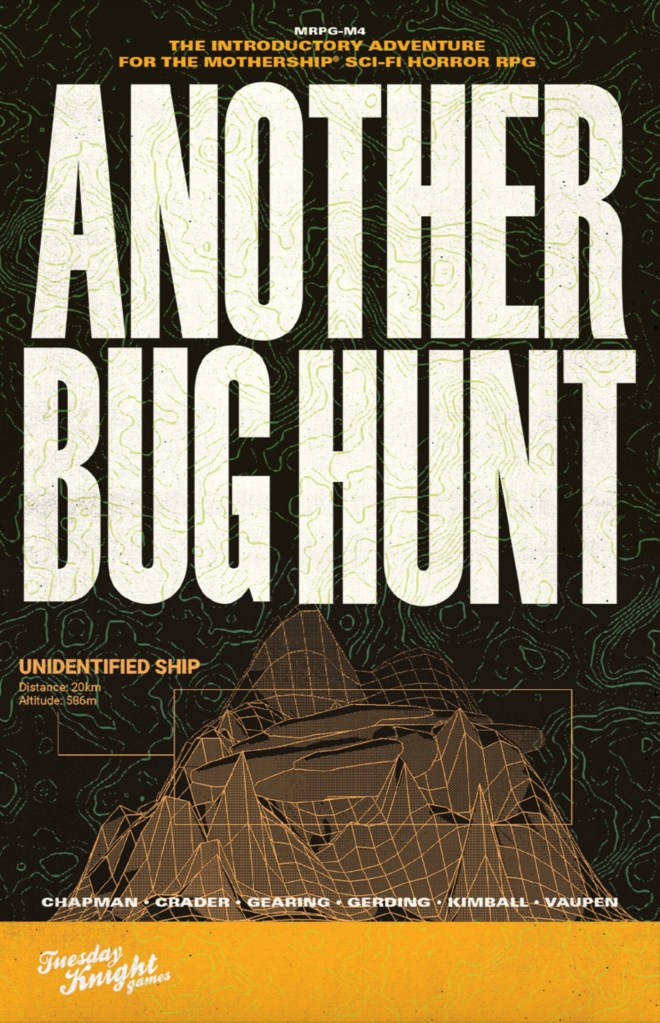
Another Bug Hunt
The last book from the core ‘boxed set’ is an adventure. Another Bug Hunt is a gorgeous multi-part scenario which follows suit from the Warden Operations Manual, having a little educational helper who’ll talk to you in sidebars to help you run the game.
There are four scenarios in total, starting with the crew looking to make contact with a colony who’s not checked in after a few months. There are a number of factions in play when the group arrive, and after their initial encounter with the titular bugs, they’ll have to navigate the people on the colony. The NPC illustrations are fairly basic, but the descriptions and motivations are all really good. The monsters sound horrific and there are a lot of secrets to pick away at.
The maps are really interesting looking, and the design work on the book is lovely, a perfect adventure for first time GMs.
Mothership: A Pount of Flesh
By Sean McCoy, Donn Stroud & Luke Gearing
Read before? 0th Edition
Played? No
This is an adventure based on a space station called Prospero’s Dream, filled with a number of different factions and a ton of plot seeds to use or discard as necessary. The Mothership adventures encourage taking what you want, abandoning what you don’t want and writing over the books (literally on page four here).
There are several people who can act as quest givers or enemies, depending on what the players want to do. Nicely there’s also a list of events which go on in different phases of the adventure, so even if you’re not interacting with everyone at all times, their lives will continue and abandoned groups will get up to mischief on their own. It gives a sense of a living, breathing station.
The station’s illustrated in a number of different ways with infographics, blocks, old style computer graphics and more. The book’s black, white and bright pink which is radiant on the PDF version, I’ll be interested to see what it’ll be like in the printed copy.
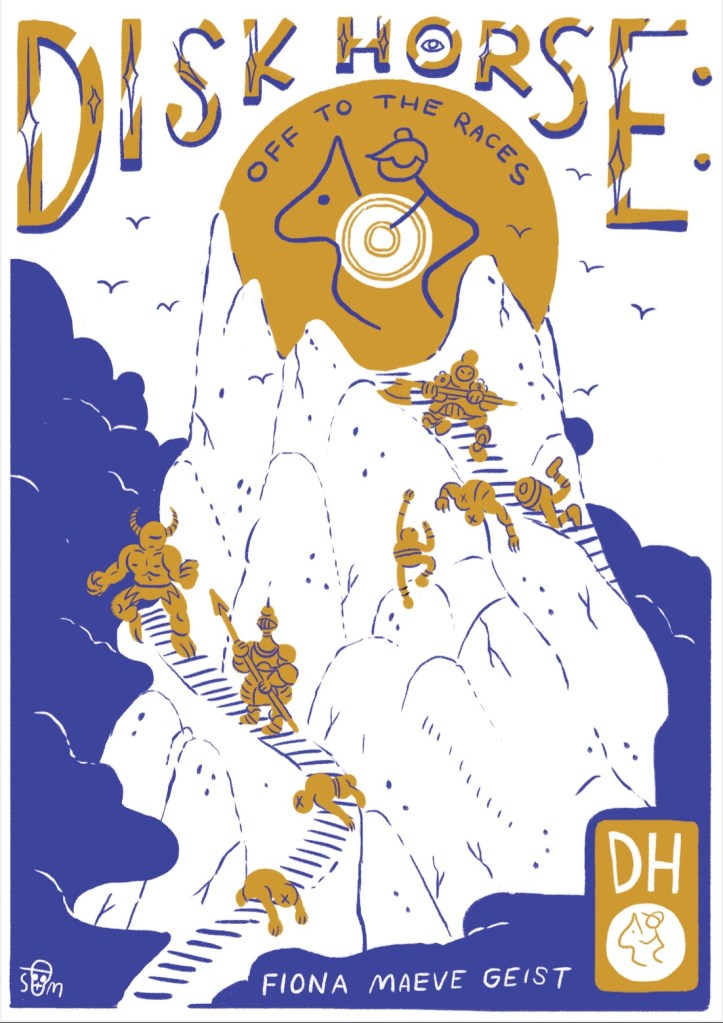
Mothership: Dead Planet
By Donn Stroud, Fiona Maeve Giest & Sean McCoy
Read before? 0th Edition
Played? No
I read this one back when it was a 0th edition booklet and I think even though there are some splendid adventures, it’ll be this or Another Bug Hunt that I’ll bring to the table as my first Mothership 1E adventure.
This adventure rips apart space and strands the group in the orbit of the titular Dead Planet. There are several different areas, each of which are their own adventure in different styles.
There are derelict ships to loot with one specific ship and a way of generating your own derelicts by rolling & stacking dice.
Moon Colony Bloodbath sounds like the kind of horror movie my dad would have shown me when I was younger. There are a couple of factions who have made the moon their home and have their own destructive agendas. Players can side with one, the other or neither faction. This does include some potential voluntary amputation to earn the trust of moon cannibals.
The Dead Planet itself has a map which looks like it belongs in a fancy version of a Ceefax page. There are several locations to explore in the hope of stopping the effect that keeps people here and stranding them.
There are also resources like tables of nightmares as this hellish place is not one to stay on for long.
Mothership: Gradient Descent
By Luke Gearing
Read before? 0th Edition
Played? No
For the unfamiliar, there’s a thing called a megadungeon which has been a phenomenon for a while. AD&D had some, and in the d20 boom (and bust) Alderac Entertainment Group made “The World’s Largest Dungeon!” Even the D&D 5E Mad Mage adventure has a nod to this idea. I’ve run RPGs since I was 13 and I’ve never been a fan of a long dungeon crawl.
That said, Gradient Descent is a megadungeon and along with Trophy Gold’s Ruins of Old Kaldhur, is one of the few I’d entertain doing.
Cloudbank is a gigantic facility made to create androids, but it’s been abandoned for some time. The group make dives into the ship and find their way around the remnants of what’s there. This includes actual people, fake people and the fear that you might be an android, yourself. The map of Cloudbank looks like the map from Paradroid, and has a ton of links back and forth. For a megadungeon, it’s 64 pages and each area has its own little chunk of map which helps figuring out where everything is.
This Paradroid-looking map may seem confusing at first, but is great when you read it alongside the locations
There’s an old abandoned rocket thruster floating nearby that can act as a temporary staging area for delves, but it has its own factions and people with motivations. The rooms are fairly sparsely detailed but in a way that encourages expanding on them rather than laziness like some much smaller dungeon adventures I’ve seen. There are tables of random events in areas, as well as items to find on your adventures. This is a really interesting location, and I’m curious how long a group would spend delving in it before going mad.
Next up are some third party Mothership modules:
Mothership: Adspace
By D G Chapman
Read before? No
Played? No
The first of a bunch of third party modules I’ve backed.
This is a trifold adventure where players are trying to get to the top of Crab Foot Tower in order to get a ticket to the moon. The tower’s covered in adverts and automated deterrents to make sure that people watching are entertained.
Mothership: The Drain
By Ian Yusem
Read before? Yes
Played? No
I’ve mentioned the megadungeon, now let’s look at another RPG phenomena I’ve yet to play with: Funnels. These are mainly found in OSR games, where players make up a batch of 0 level characters and run them through a meat grinder (sometimes literal). Any survivor gets to level one. These are people who are often ill-equipped and the deaths are often part of the entertainment as players try to work out how a ladle and a chicken will help them deal with a dungeon.
Here, you’re playing prisoners from PrayCo who are all fitted with explosive collars and sent to storm a rogue agricultural space station that’s gone a bit weird. They need to reach the centre, but the thing is they’re not hardened prisoners, they’re anyone who was on hand. Everyone’s fitted with tinfoil halos and explosive collars that go off if they’re separated from each other for too long. Like so many Mothership adventures the map’s weird. It’s a set of concentric circles representing each areas with pictures, going from the trenches you arrive in, a church, an amusement park and more.
This looks like a lot of fun and there’s a ship combat prequel: Wrath of God, and a sequel which is a proper Mothership adventure called Meatgrinder. Ian Yusem did a great job with this project.
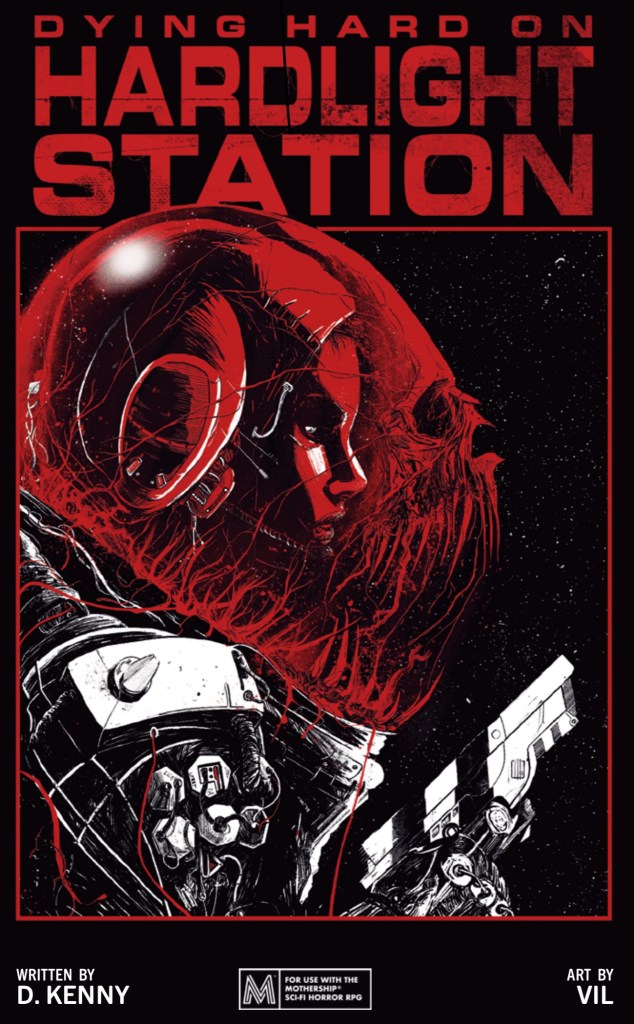
Mothership: Dying Hard on Hardlight Station
By David Kenny
Read before? Yes
Played? No
You know Aliens? You know Die Hard? This is basically both of them. Hardlight Station has had a break of horrific monsters and terrorists holding hostages. Can you deal with them both? There are ways of having just one of these stories rather than both and a lot of references, especially to Die Hard. This feels a little more daft in that presentation, but still pretty deadly.
Conclusions & Observations
Mothership looks awesome. I’ve only run a one-shot using 0th Edition, but I definitely want to give it more time. I think it’ll mostly be a machine for one-shots and miniseries, but there are a lot of tools for making campaigns both in each adventure and in the core books.
I think the core boxed set (Player’s Survival Guide, Warden’s Operation Manual, Shipbreaker’s Toolkit, Unconfirmed Contact Reports and Another Bug Hunt) is going to be one of the best ways to start roleplaying. The Warden’s Operation Manual is something which anyone aspiring to write GM advice should look at. The scrappy graphic design in all the products looks weird and loose but has had so much thought put into it. Going through all of these books took until the end of August and I know I’ve banged on about it a lot here, but it’s definitely been worth it.
I’ve been speeding up through books and in the chronological read I’m finally hitting Zinequest which was when I figured things would accelerate given the smaller books.
This is also The Month of Mothership, as the final PDFs of the space horror RPG’s first edition arrived and that consumed a lot of my reading time. I even skipped ahead in my chronological read to go through everything I’d backed for Mothership over the years. Expect a lot of that here.
7th Sea Khitai
By Chaosium, Mike Curry, John Wick & Friends
Read before? No
Played? No
Like a lot of 7th Sea fans, I’ve been waiting for this one for a while. I love the 7th Sea RPG and Theah as a setting. The main Kickstarter for 7th Sea Second Edition had a ton of delays, but covered some areas beyond the fantasy Europe in interesting ways, often with people on staff to make sure there weren’t the kind of mistakes that some fantasy versions of our world (including 7th Sea) have done in the past. The thing about 7th Sea 2E is that it was too ambitious in the amount of books, the amount of staff, it seemed to burn bright and quick, leaving a lot of unfinished books and a second campaign based on Asia which faced a ton of delays. Chaosium acquired 7th Sea and eventually, Khitai came out.
The cultures covered in this book are:
Agnivarsa – Moghul India
Fusō – Japan
Han – Korea
Khazaria – Korea
Nagaja – Thailand/Southeast Asia
Shenzhou – China
What era are each of these cultures represented? Purposefully vague/the more swashbuckling eras. This may not be a game telling exactly the same kinds of stories as 7th Sea, but it still has swashbuckling action at its heart.
Characters start out from one of these nations with a background from a long list, five traits from a list of seven and skills. Similar to 7th Sea you grab ten-sided dice equal to your trait + skill, as well as any other bonuses you might get. You say what you’re aiming to do and the GM tells you what additional risks you might face. You roll the dice and group the results together in set totalling 10 or more. Each set solves the main problem and mitigates the risks. Fights work similarly, with sets taking out mooks or potentially injuring named enemies.
I’ve lived through the eras of D&D’s “Oriental Adventures” and even 7th Sea 1E’s attempts at handling Asia, this version has had a massive do-over and goes thoroughly into religion, cultural practices and the interaction between everyone. It feels like a lot of care’s been taken, similar to the second edition in general.
Each nation feels packed with interesting problems and places to visit, similar to the core 7th Sea Second Edition, each with big gaps where the players can be inserted to do heroic things.
Agnivarsa’s ruler has murdered his way to the top while his mother is forming a rebellion. Fusō’s been isolated and busy with civil war which has got in the way of its ambition to expand to its neighbours. Han’s got a mad king and the results of a slave uprising that it’s dealing with. Khazaria’s filled with nomadic groups and looking like it’s going to be invaded by Shenzhou. Nagaja’s an empire of city-states dealing with constant attacks from monsters and monster hunters who are often a problem, too. Shenzhou has a corrupt bureaucracy and seeks to invade everywhere, while being attacked by pirates and bandits.
There are definite themes of rebellion against those in authority, changing the status quo if it’s stagnating or fighting for its return if it was at all progressive.
The book is nicely laid out and instantly familiar if you’ve read 7th Sea itself. I’m still curious how the new take on traits works. In 7th Sea 2E you have five traits which are closer to old ability scores. In Khitai, there are seven based on what you value and you only get five of them. Like 7th Sea 2E you get bonus dice if you keep changing which skill and trait you use, so people won’t constantly be spamming the same thing. If there’s one criticism of latter 7th Sea books including this one, it’s that they have a lot of black & white art which feels a bit jarring compared to the pretty colour layout and art in the rest of the book. I’m aware the campaigns ran low on funds they could put in for art so this was a necessity, it’s just a bit of a shame.
I’ll definitely be running this at some point, like 7th Sea in general.
By the Author of Lady Windemere’s Fan
By Lara Paige Turner and apparently not Oscar Wilde
Read before? Yes
Played? No
You’re all actors who haven’t been paying attention to what theatre production you’re going to be doing. The director’s quit and the show’s starting sooner than you thought. It’s time to use the sets from whatever other plays have been going on and make your own production in the style of Oscar Wilde.
By the Author of Lady Windemere’s Fan is one of those games that sounds like an amazing resource for fun one-shots. Players make a character and between them list out some sets without discussing what they are, then you go through scenes, trying to make a play, steal scenes and generally work out how to make it to the end without everything going awry.
The game feels like Fiasco or What Ho, World in its tone. The voice of the book is really good, including talking about using a battlematt to map out the theatre, but warning that if you LARP the game, then you’re just doing a theatre performance. This feels like a perfect one-shot system for a night where you’re down a player.
Operators RPG
By Kyle Simons and Samjoko Publishing
Read before? Yes
Played? No*
I generally back anything the Simons siblings have launched on Kickstarter. Operators isn’t necessarily a theme I would have gone with, but my liklihood of running it has only gone up over time, mainly after watching the John Wick films.
Operators is a game of highly competent ex-military characters who go through fight and chase-filled action movie stories.
Characters have skills which go down the better you are, as you’ll be rolling Fate Dice and looking for + results equal to your skills. Minuses can cause complications. You have ‘specials’ which are your training, discipline and trademark, each of which help you fudge with the dice and some of them need to be ‘primed’ by referring to them in the narrative. This replicates the kind of Chekhov’s Gunning of things in stories, letting the audience know you’re a master hacker and then getting to use those skills later.
Fights are interesting, using a deck of cards to help narrate the beat by beat play of a quick fight between two characters. While I’ve not run the game, I’ve used the deck when writing prose to help cover the blow-by-blow play. There are chase cards which are similar.
A few Simons staples appear here, like suggestions of everyone making a collage on somewhere like Pinterest in order to create the palette for the players and GM to use.
If there’s one negative, it’s a personal one, as there’s a LOT of military fluff in here. Personally if I ran this kind of game, I’d probably go down the direction of a John Wick or a Kyle Starks comic about assassins rather than needing to know anything realistic.
Kids on Bikes RPG
Yes, I went for the fancy edition
By Jonathan Gilmour, Doug Levandowski and Hunters Entertainment
Read before? Yes
Played? No
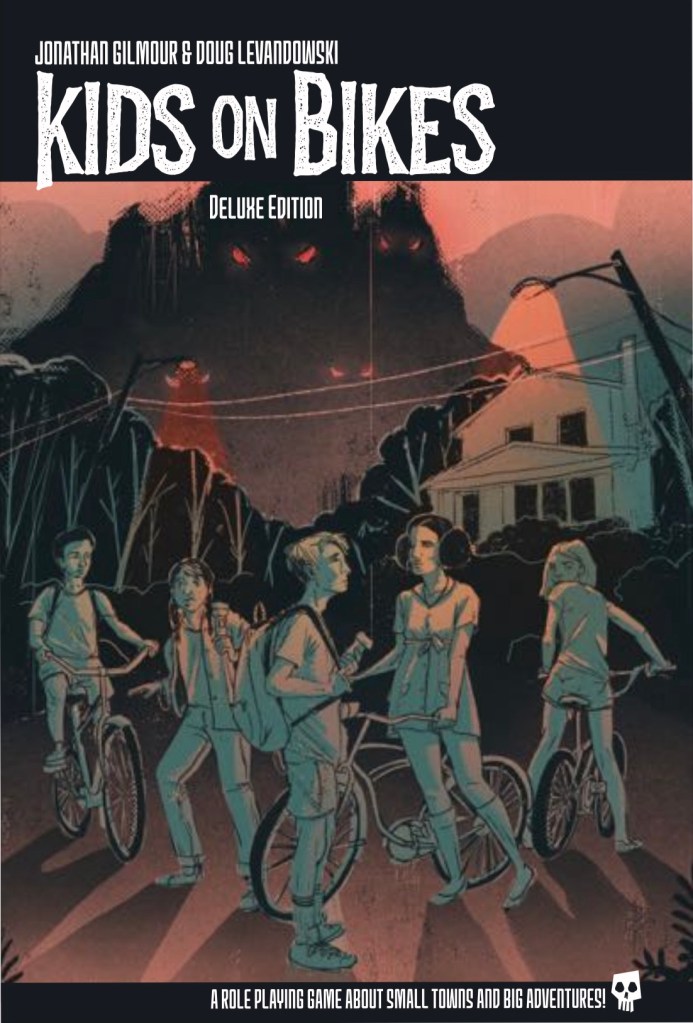
Kids on Bikes references things like Stranger Things, The Goonies, It and Paper Girls, as well as having a lovely art style of its own to represent stories of kids on bikes dealing with supernatural things.
Characters are fairly simple to build with escalating die types for their attributes and a selection of traits. It’s really simple, and goes beyond just the aforementioned bike-wielding kids as you might play teenagers or adults joining them on their journeys (again, like in Stranger Things).
The system’s pretty generic and broad, but there’s one core element which is different. There’s a Powered Character who isn’t controlled by any one player or the GM, instead they’re controlled by everyone as each player takes an index card with one aspect of them. It could be telekinesis or a fondness for cookies. That player can pipe up, directing the Powered Character to action. They have tokens making sure that their game-changing abilities are limited and you can’t just TK your way through all problems.
I backed the special edition which has a nice comic at the front and then a TON of scenarios in the back. These include a few sets based on the author’s towns when they grew up, or variations like “Dads on Mowers” which looked like it could be some Barbie movie style weirdness.
I don’t know whether I’d run this or not, the system feels pretty basic, but a lot of the worlds are inspirational enough that I might have to run one of them, just to see what it’s like.
Sigmata: This Signal Kills Fascists
By Chad Walker and Land of NOP
Read before? No
Played? No
Okay, here’s a controversial one. Probably more than it needed to be, but certainly enough that it had to have a follow-up supplement to modify, correct and clarify different elements.
At its basic level, Sigmata is a cyberpunk superhero game in a 1980’s dystopia where Joseph McCarthy became president and while he was got rid of fairly quickly, he put in enough tools for totalitarian rule to take over.
Players are enhanced by a radio signal and work for a rebellion because of this. They are ‘receivers’ with cool powers and cybernetic enhancements. They’re here to help overthrow the Regime and to expand the radio signal as they grow more powerful the nearer they are to it.
There’s a lot of fiction to the world, showing how America could very easily slide (both in the fiction and the real world) into fascism. The easy inaction from a lot of people and the intentional horrors done by the Regime.
The big problem here is that one of the core elements of resisting The Regime is that there are other groups who are sighting them, but most of them are incredibly problematic in different ways. It made the game feel like some weird centrist thing about having to work with one bunch of fascists and problematic actors in order to stop the main ones. Chad goes into great depth replying to this in his follow up, “Repeat the Signal”. The core book also mentions very early on about never giving fascists an inch and that all people have a right to exist, all people have to fight against any fascism and tyranny. Chad’s work in Repeat the Signal clarifies the four factions and specifies that they’re all based on the resistance against the Assad regime, but he feels obscuring things gave a message incredibly far from what he wanted. I’m not his defence force, but after reading both books it feels like the reaction to this project wasn’t entirely wrong, but was incredibly disproportionate and unnecessary in how loud it all got.
Anyway, back to the book. The system has players roll five dice, with d10’s equal to the stat being used and d6’s for the rest, trying to get a 6 on one or more dice. The amount of successes changes up how well or badly a success is. The four stats of Judgement, Guile, Valor and Aggression do pretty much the same things in fights, evasion and intrigue which are the main modes of drama. Repeat the Signal changes things a bit so you can be good or bad at different actions in those modes rather than having a high Aggression meaning you’re always Storming in fights, Rushing in evasion and Confronting in Intrigue.
I admit I’m not won over by these systems for dramatic scenes, but hopefully a playthrough of it would give me a better feeling. There are also different abilities, training and cybernetic pieces which can modify how you do things. After hearing about Chad’s work with Cryptomancer I expected it to be more complex than I’d like, but this is a bit simpler than that.
At the same time, like Operators, I felt the back matter about hacking in the 80’s was possibly a little too long when I read it. If I ran the game I’d probably be thankful for it, but it’s just a bit dry.
Summerland Second Edition
It’s weird seeing the cover as the PDF didn’t have it.
By Greg Saunders and Fire Ruby Designs
Read before? No
Played? No
One day the world became trees. Civilisation was shattered as they pushed through roads, buildings, cities. Then people started feeling the call and left civilisation behind, going into the forest and mostly, they weren’t seen again.
You play survivors of this arborial apocalypse, some of the few people who travel through the woods between cities, helping folks out but also too damaged to stick around communities for too long. Eventually you’ll heal and be ready to settle down, but not yet.
This uses the MiniSix system. You select a skill or attribute and roll d6’s equal to that number, one of which is a Wild Die which will explode if it gets a six, letting you roll it again and again, adding each 6 you get until you roll something else. Tags allow you rerolls and help can lower the difficulty of a task.
The world’s interesting and evocative, although I feel Wildsea which was released later might be an arborial apocalypse which might interest me a little more. The layout of the book is pretty basic and at times I found myself wishing they would get to the point. When looking for the core system there’s so much establishing terms before we actually see how the system works. Given the simplicity of it, an infographic or cheat sheet would have been really nice to help guide the eye through the system.
Hack the Planet
Not the cover image, but more evocative than the cover image
By Fraser Simons & Samjoko Publishing
Read before? Yes
Played? No
I last read this book on a coach home from AireCon in March 2020, just as things were beginning to feel really apocalyptic. I was going to read Apocalypse World Second Edition and couldn’t bring myself to given how things were going. Instead I read this which was also apocalyptic, but in a different way.
Hack the Planet is a Forged in the Dark cyberpunk RPG set in a world which has been environmentally devastated. As everything fell apart, three corporations finally did something to help. Kind of. They created Shelter One, a giant mega-city controlled by the corporations to such a level that the food grown is modified to monitor the people who eat it. There is, of course, classic cyberpunk disparity between the people most at risk from the elements battering even the people in Shelter One, to the decadent rulers in their own safe zones.
You play a gang of Glitches who have hacked their copies to be able to move off the grid and whose gang type can utilise the Acts of God in order to help their missions.
Cleaners are mercenaries
Clippers are a biker gang
Shifters are storm-chasers
Wired are fences of illicit goods
Comets drop in to steal stuff from their airships
Characters are one of a few different playbooks:
Edge – fighters
Lens – trackers
Torque – builder
Fuse – infiltrator
Haunt – hacker
Faint – strategist
Quirk – wanderer & scholar
There are some other game types in the back of the book along with all the stretch goals from the campaign. Keeping them a separated is quite nice for showing what’s part of the essential experience and what isn’t.
Mechanically this is Blades in the Dark. It’s an early hack, so it’s excusable for its lack of ambition in changing things up. The main differences are cybernetics which are mostly stat modifiers and Acts of God which are clock-based devastation which can hit in different ways during missions.
The thing is, I sound a bit negative in saying this hasn’t been too ambitious in what it’s done, but the system’s good and with the small mods here works with the setting. Then you get to Shelter One. Both the factions and the locations make the game. This is an incredible location filled with detail both from what places you’ve got to play in and the agendas of each faction.
I definitely want to run some games in this world, I love Blades in the Dark and Shelter One makes for an interesting, different cyberpunk setting. One which feels a bit less confusing than The Veil was and more relevant to our time than Cyberpunk Red.
Cartel
By Mark Diaz Truman & Magpie Games
Read before? No
Played? No
Cartel is a Powered by the Apocalypse game about people in or around a cartel, under the constant pressure that provides. It focuses more on the narofiction side of things and nicely elaborates what that means. It takes stories like Breaking Bad, The Wire and Desperado as its inspiration to tell desperate, dramatic stories.
The basic moves are framed around this kind of genre like, “Justify your behaviour” and “Turn to violence”, showing how you’ll be interacting with each other and the world. There’s also “Get fucking shot” which highlights the incredible lethality. You’re able to control an amount of that, but you’re best trying not to risk it.
You build up Stress instead of having hit points or harm (after all, if you Get Fucking Shot you just be dead). Like Darkest Self states, when you’ve got too much Stress you’re going to act up, lose yourself or do something else which will get you in trouble. You’re flawed characters, after all.
The playbooks are:
El Cocinero – The cook, smart and vital but fairly low level
La Esposa – The spouse of someone who’s involved in the business
El Halcón – a ambitious lower manager running the street operations
El Narco – upper management, in charge and responsible for keeping order
La Polizeta – a corrupt cop, playing both sides
La Rata – a mole in the organisation, always moments from being found out
La Sicaria – the enforcer, brutal and surrounded by death
When Cartel was first announced there were concerns that it would be glamourising of the life in some way or cheapening the seriousness of it. The book does a great job of navigating making a compelling drama that’s larger than life the way a television show would be.
It’s an interesting setting and I’m curious to see how it plays, especially for a mini-campaign where you could get into some really messy situations.
Imp of the Perverse
By Nathan D Paoletta
Read before? No
Played? No
First of all, I’ve hired Nathan Paoletta to do a cover and logo for a project of my own in the past.
This book was a difficult read. I’d bounced off it a couple of times previous to this quest. I’m pleased to say that after a while of delving through and wondering if it would be the undignified end of this quest, I eventually got the hang of it.
In Jacksonian America, you are investigators who all have a demon on their shoulder. A ‘perversity’ made manifest that’s eager to nudge you towards being consumed by it. You’ll be carrying out investigations into people who have similar problems but are in a much worse state, often entirely taken over by their imps.
Success in your investigation is a given, but how well it goes and how much of yourself it costs if going to vary. The mechanical terms are a little tricky to get into, especially a month after reading this.
Ratiocination is how you discover clues, using your Standing, Resources and Reason are spent to get your clues, costing an amount equal to the current Anxiety of the threat which will escalate as the game goes on.
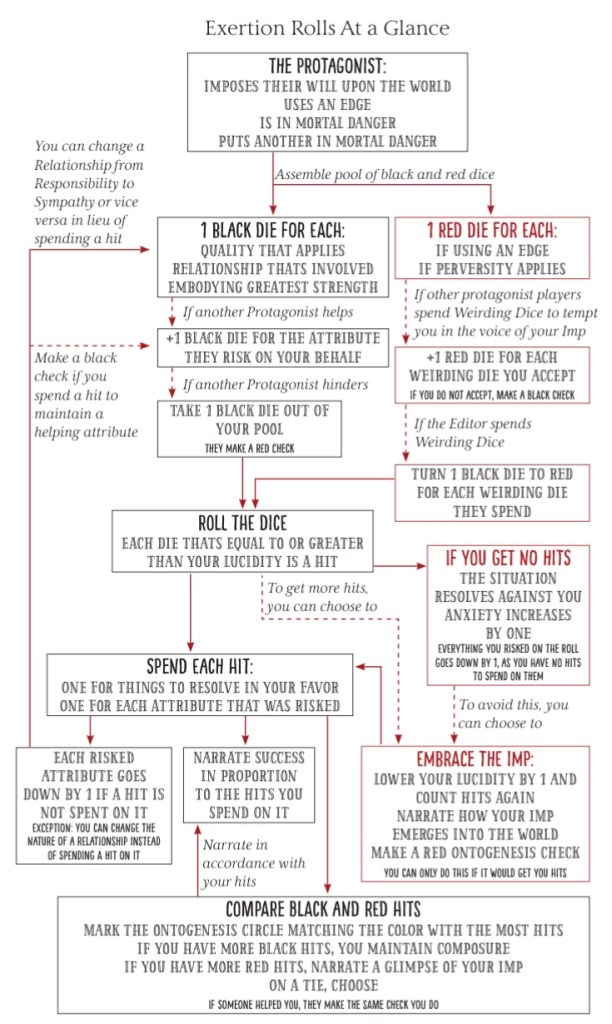
Exertion is the die-rolling process which can look a bit involved at first glance. This is the layout of how it goes:
So yeah, it took a bit of time to warm to, and by the end I think I got it. I’d definitely be interested to give this a go, mainly for a one-shot and ideally as a player to get a feel for it. There are elements of the mechanics which remind me of Yellow King like the division of clue-getting and active rolls. There’s also a vibe of an American version of The Between (no, not Ghosts of El Paso). I think if I wanted to do something of this style I’d go with them first, but hopefully if this gets a play I’ll see how it stands out from them and not simply be baffled by the flow of the actions.
Journey Away
By Jacob S. Kellogg
Read before? Yes
Played? No
Here’s an interesting one. Journey Away is a chill fantasy game which works without big challenges and tells small tales set in a small area between a few towns.
Characters are fairly simply built with escalating dice for stats, although you’re not limited by how much you put in each one. This could mean you put all of the stats in at the highest level, but hopefully people will put in whatever’s fitting for the character.
Stories may involve travel between towns, encounters on the way, interactions with each other and the world, but it’s not going to have fights or world-ending battles.
Talking with one of my players about this, he was as horrified as I was at the idea of putting whatever you want in any stat and got a bit hung up on it. I think after reading enough Possum Creek type games I’m a bit more fine with it, but I definitely get the concern.
It’s a nice idea, but I think it sits in an odd halfway house between lighter, more traditional games and the kind of games like Wanderhome which don’t concern themselves with ideas like success or failure and don’t even present the tools which normally engage with those things.
Star Crossed
By Alex Roberts & Bully Pulpit Games
Read before? Yes
Played? No
Star Crossed is a fascinating concept, inspired by the horror game Dread and the idea of doing it, but kind of in reverse. You and another player create characters who are attracted to each other, but can’t be together.
You decide who is the ‘lead’ and who is the ‘follow’ like in dance. Then you take turns taking actions as you play through eight scenes. Some actions require you to pull from a tumbling block tower, and actions like talking require you to be touching the tower to help create a sense of rare importance to the conversations.
A lot of the actions earn you points and collectively you’re wanting to build up a lot of points before you knock the tower down. Yes, unlike Dread you actually want the tower, and your characters’ inhibitions, to fall. The thing is, if it falls too early then this is just a clumsy moment, an awkward revelation or a brief fling. Leave the tower standing by the end and you’ll both let the moment pass. This does mean you’ll pass through a number of scenes, but you actually don’t always want the game to go to the full amount of scenes.
This is a game I definitely want to try, although the only tumbling tower I have is a slightly uneven WH Smith own brand tower which I’ve covered in fake blood and the names of dead Dread characters, which feels like it’d only be fitting for some very specific genres of Star Crossed game.
At time of writing, there’s a BackerKit campaign for an expansion to Star Crossed.
Dream Apart & Dream Askew
By Avery Alder, Benjamin Rosenbaum & Buried Without Ceremony
Read before? No
Played? No
We’re at the founding of Belonging Outside Belonging. I downloaded a copy of Dream Askew a long time ago when it was a much smaller book, and a while after release, it received a proper printing in a book alongside another game in the same system called Dream Apart.
Both games use modified versions of the same system. You have No Dice, No Masters (the other term, which as far as I know is synonymous with Belonging Outside Belonging). Each player creates a character from a playbook, filling in details and possessing moves which gain tokens or require the expenditure of them (weak and strong moves, respectively). You also have a ‘lure’ which encourages people to interact with you in certain ways in order to gain themselves a token. Each player also takes a part of the GM type role in controlling part of the narrative beyond their character. This could be a group of people, a concept or a part of the community. The player with a specific environment defines anything relating to that thing, asks players questions about how they relate to it and throw in story elects based on it.
Dream Apart
Dream Apart is about a queer commune during the apocalypse. The world’s going to hell, but you were already living that kind of life, so your community’s hopefully going to be alright in among it all.
The roles are:
The Iris – Marked by the psychic maelstrom
The Hawker – A trader and hustler
The Stitcher – The person who fixes things and people
The Tiger – The one who fights
The Torch – An inspirational figure
The Arrival – someone new
The setting elements are:
Varied Scarcities
Psychic Maelstrom
Society Intact
Digital Realm
Outlying Gangs
Earth Itself
Dream Askew
Set in a Jewish shtetl, a small market town in the countryside, you’re interacting with other communities and with the unseen world.
Roles include:
The Sorcerer – someone who interacts with the invisible world
The Matchmaker – you’re trying to help arrange matches and handle gossip
The Midwife – you help the births in the community and have seen all manner of things in your work
The Klezmer – a charmer and performer
The Scholar – a smart and methodical person
The Soldier – a protector of the community, lost and violent
The setting elemtns are:
The Market
Unseen World
Goyishe World
Text & Traditions
Gossip & Reputation
Wild Forest
I have minimal knowledge of that side of my family who lapsed over the generations. Luckily in this game there’s a glossary and a lot of information to make it feel accessible for folks.
Looking at the listing of the roles and settings you can see why both use the same skeleton but how they differ quite a lot from each other. It’s also been adapted into several different games whether it’s Umbrella Academy style superheroism in Molotov College, travelling animals in Wanderhome, space adventures in Galactic and more.
I’ve wanted to read this for a while, but the PDF copy I’ve got kept crashing iBooks. I’ve redownloaded it for this quest, so this is the first time I’ve been able to read it since the original, smaller version of Dream Askew.
Behind the Masc
By Beau Sheldon & More
Read before? Yes
Played? No
This is an anthology about looking at masculinity in RPGs, with a number of different materials and articles. All of the pieces have a set of designer notes explaining the purpose behind them which is a nice touch. The authors all have a wide range of backgrounds and experiences which definitely helps make this a good, broad look at the topic.
The Mabon Monastery – a D&D 5E background about moon worship.
Ming Dynasty Transgender Man – Artwork
Chosen of the People – A premade character for D&D 5E
The Minotaur – A Monsterhearts Skin about protection and of course, a labyrinth
The Harlequin – Artwork
The Demi – A Monsterhearts Skin about being a demigod, impressive, powerful and of course, in need of the prayers of your worshippers
Palisade – A Twine game which I have not tried and can’t speak on
Echoes – An audio only game which I’ve also not played yet
The Grifter – An Apocalypse World playbook about being a tricksy so and so
I will say, this is possible the only thing I’ve backed which includes some 5E content. I’m a fan of Beau and there’s enough other material that I don’t begrudge it being here.
Flotsam: Adrift Amongst the Stars
By Joshua Fox & Black Armada
Read before? Yes
Played? Yes
I was writing about Belonging Outside Belonging earlier and here’s another version of it already.
Flotsam is a game about the people living in the lower decks of a science fiction setting, living under the pressure of numerous internal and external challenges. There are tools to create your own setting or several premade ones included. Like Lovecraftesque before there’s an amazing teaching guide which allows you to run the game just with the printed resources.
The system feels a little simpler than the other BoB games, although that might be because it’s the first one I facilitated and the teaching guide did a lot of hand holding.
The playbooks are:
The Thunder – an enforcer
The Spider – a sneaky character
The Voice – a community leader
The Cast-Off – an outcast
The Sybil – a prophet
The Hybrid – a human mixed with an AI or alien
The Scum – someone connected to the community
The Outsider – someone trapped in the station from outside
The Vapour – an AI, ghost or something else
The situations are:
The Community
Poverty
The Gangs
The Above
The Spirits
Outside
The Resistance
War
There are more situations than there can be players, allowing you to pick and choose which elements are relevant in your game. The premade scenarios definitely take advantage of this, with required playbooks and situations for the minimal player counts, then others which can be added with each player.
I’ve facilitated a one-shot using The Grey Plague scenario where we were in the bowels of a space station, mostly abandoned to our own devices due to a medical outbreak the upper levels didn’t want to get too near. We had dwindling amounts of medicine and unscrupulous people who’d learnt where the drops of supplies were landing. There were some stand-offs in allotments, intrigues with a hologram bartender playing multiple sides and a drunken enforcer with dwindling authority. It was a really fun time and more dramatic than I thought a game with this structure would be. I’d love to give it another go sometime.
The next part will be basically all Mothership books, so look forward to that…
Welcome to part two of the RPGs I read in July this year. There’s a lot of Spire as it’s had several books on Kickstarter and I figured I’d read them all together.
Spire RPG
An ominous scene with suspicious lads… and you play those lads!
By Grant Howitt, Christopher Taylor & Rowan, Rook and Decard
Read before? Yes
Played? Yes
This was like coming home after so many books I’ve read for the first time. I’ve run Spire since the demo came out, I read it when the PDF came out, when the physical version arrived and again when I ran a lengthy campaign of it last year. It’s a good read.
Spire was a mile high city filled with strange magic, strange gods and a lot of drow. Then the aelfir came and took it over. They’re kind of like elves if elves were every villain in a Bioshock game with kind of eldritch powers. You play as drow who work for The Ministry, a spy organisation dedicated to bringing the aelfir down.
Your character is made from a Durance which is how you spent your years as an indentured servant of the aelfir (or what you did instead of that if you like to live dangerously). Then there are highly-thematic character classes:
Azurite – merchants, able to cut deals, talk their way out of problems and see what people really want
Bound – acrobatic vigilantes who enchant their gear with small gods to help them in their journey
Carrion-Priests – worshippers of Charnel, a carrion god who worships the eating of the dead. Tactical masterminds with giant pet hyenas
Firebrand – a shotgun-wielding revolutionary able to inspire riots and survive long enough to make a change
Idol – a celebrity and artist, able to make a party anywhere and enchant people with their work
Knight – formerly of an honourable order, now mostly drunk bouncers and enforcers
Lajhan – priests of an approved deity, able to heal, earn trust and use that trust to their advantage
Masked – a master of disguise, appearing to be a servant and able to put on a selections of masks for different effects
Midwife – a caretaker who looks after the young and gradually becomes more and more of a literal spider
Vermissian Sage – a genius who uses the forbidden interdimensional train line as a library, hiding place and can pull things out of it
The system uses a number of d10’s, with players rolling 1d10 for luck, plus one for a relevant skill, domain, any masteries from gear or abilities. Your highest die measures your level of success and whether you suffer any Stress. The different Stress tracks are unique in here instead of hit points, they act as measurements of your Blood, Mind, Silver, Reputation and Shadow. Stress builds up and the GM rolls to see whether you suffer Fallout, which takes away some of your Stress but has something awful happen. Sometimes this could be death, sometimes it could be a broken limb, debt collectors, or in one case in our campaign, a character’s Shadow fallout had their block of flats raided and public executions of anyone there suspected to be linked to the Ministry.
The system’s good, but the part that shines is the setting. There’s so much to use in a campaign here, so many NPCs, strange concepts and things for players to poke at. Howitt and Taylor do a great job of mixing a fun, weird world and the horror of both the situation and the things that lurk in Spire.
Spire: Strata
A sickly strange yellow sky you’ll be hiding from as your skin burns in the light
The first expansion book for Spire provides a closer examination of some areas in Spire, a couple of character classes and a bunch of campaign frames to start off your game of Spire.
The new classes are:
Inksmith – a journalist-slash film noir protagonist, using magic to craft the story
The Shadow Agent – A stack of fake identities with a person underneath, leaving their burdens behind as they shed their disguises
The domains covered in the setting are High Society & Low Society, covering areas all over Spire. I mainly used Ivory Row from this area, but I’ve taken bits from all over when running my campaign.
The frames are:
Eye of the Beholder – An aelfir noble is ‘improving’ drow using horrible surgical procedures and mind-breaking methods. You need to plan an ugly death, the kind of thing to serve as a warning not to do this again. My group used a cannon and a cake filled with explosives
Home is where the Hatred is – You’re pretending to be servants of a squabbling dynasty, trying to get to the sealed away heart of the head of the house in order to kill her
Bisquiet – You’re infiltrating a grimdark fantasy Greggs popular with the aelfir, trying to figure out how to leverage this knowledge. My group put a dead aelfir in a pie, were discovered by an aelfir who’d already developed a taste for dead aelfir (these guys really are awful) and had to burn any trace of their existence
The Fall of Glasshelm – An aelfir’s seen fit to clean up Red Row of drugs and lawlessness by buying everything up, gentrifying it and of course doing all manner of horrible things
Better the Devil – You’ve returned to Spire after time away and an aelfir house so awful they were almost all murdered by other aelfir have returned. Yeah, that’s bad
The Forgotten – A drow cleric who has been looking after any sick, disabled and poor drow has vanished and a suspicious new cult has been offering to take people in
Ironshrike – A market has sprung up and something’s wrong with it, almost like the market itself might be aware and feeding
The Sulphurous Presses – You set up a newspaper for the Ministry, having to deal with rivals and keeping yourself from being exposed as operatives
Lines in the Dirt – You’re living in a building where the tenants are all being evicted. You’re going to develop relationships with the locals and keep them from having to move out
Dark Harvest – After an operation goes wrong, you flee to the countryside, as much as they have that in a mile high city. The thing is, even the rural life is fraught with mystery and horror, Wicker Man style.
Spire: Sin
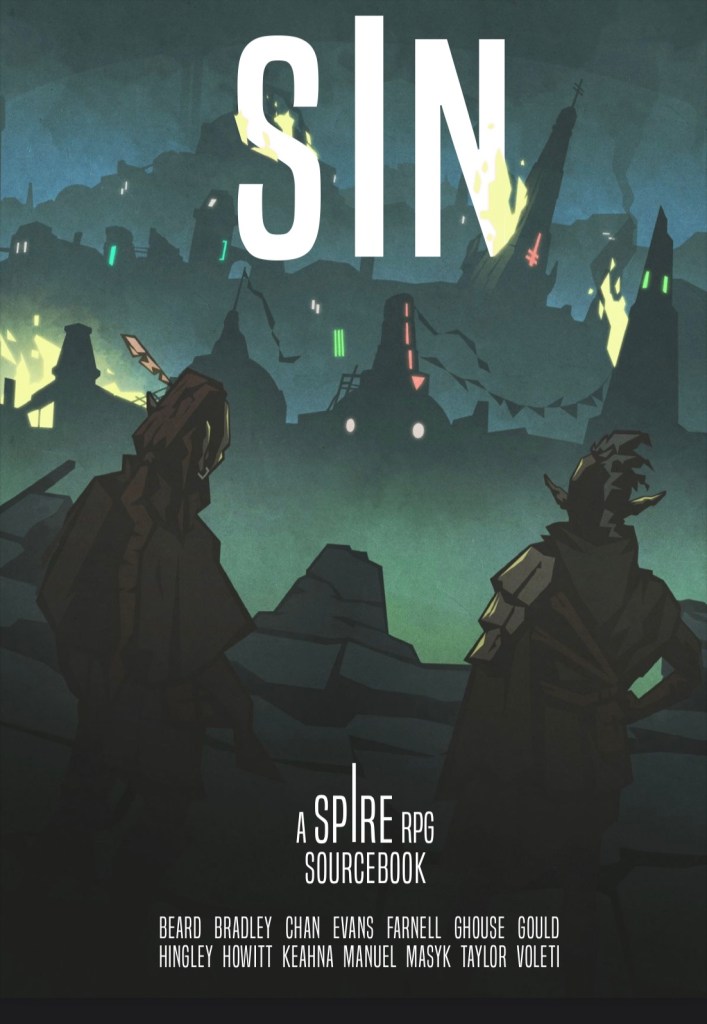
Familiar art with another look at Spire, but the inside’s quite different to the last two
I thought I read more of this than I did. It arrived just as I was in the home stretch of a campaign, so I harvested it for anything related to the areas I was running a game in, then ignored the rest. That meant this was a lovely surprise. It’s also beautifully designed. The previous books look good, but the background was a little distracting.
The new classes are:
Gutter Cleric – Your worship of gods is focused more on quantity than quality, talking to the gods who infest objects and making scrappy mirables
Mortician Executioner – A bureaucratic murderer, you declare people dead and then make that a reality
The Domains covered are Crime, Order and Religion, with some fun new facts and even some maps. Crime is especially good, with a selection of brilliant pub names.
The scenarios are each shared out by domain:
Second-Hand Rain – You’re installed as film noir style private detectives in the North Docks while weird weather’s going on
Birth of Brother Harvest – A Solar cult to Brother Harvest has been doing some worrying things to manifest their murderous deity and the Ministry needs to nip that in the bud
In the Hands of the Gods – You’re trying to take advantage of cult war over a holy relic
Legacy: Life Among the Ruins Second Edition
The post-post apocalypse looks pretty apocalyptic here
By Mina McJanda & UFO Press
Read before? Yes
Played? No
Legacy is a post-post apocalyptic roleplaying game about watching different factions over a long stretch of time, how they interact with each other, how they deal with problems that everyone’s facing and how that changes over time.
The system’s PbtA, but it scales in and out from your character and your faction, each with their own stats and moves. You all play your character interacting with each other, but when you’re with your own faction there are systems for making quick characters to make sure other players are still able to join in. Once a problem’s gone, you move forwards in time, make new characters and see how your world’s evolved.
The core book contains a lot of resources to use including playbooks for factions and characters, but between this and the follow-up Kickstarter there are a ton of world books you can use and resources for even more customisation.
I got excited while reading this, so I read The Engine of Life and End Game, which are the main toolboxes to add more things to the game. These include new playsets based around even more growth or nihilistic destruction, respectively. There are also scenarios in both books to experiment with the new playbooks.
I’ve run Rhapsody of Blood which my group weren’t as keen on as it felt like there was a bit too much going on at once, but I do want to get this to the table and see what the baseline Legacy is like.
Red Carnations on a Black Grave
Not pictured: Black Grave
By Cat Ramen & Aviatrix Games
Read before? Yes
Played? No
I hadn’t heard about the Paris Commune until I listened to an actual play of this… I think on One-Shot, around the time this was on Kickstarter. This topic is entirely my jam, being about the last revolution in France, both the highs and lows.
The game itself is played using a pair of characters each, going through scenes taking place from the founding of the Paris Commune, the ways it runs and the tragic end. It doesn’t feel like an easy sell, the same way as I love This War of Mine but can only get one friend to play it with me.
It’s all played out through character and scene cards, with free play each time developing the stories of each character. Eventually when The Bloody Week happens, one of your characters will die and one of them may die, depending on what you decide they do followed by a draw from the relevant deck. I’m jealous of a friend of mine who bought the physical copy as I just have the PDF. Hopefully I’ll get to play it at some point in the near future.
Wanderhome
Go on a lovely journey
By Jay Dragon & Possum Creek Games
Read before? Yes
Played? Yes
Wanderhome is a game about animalfolk in a pastoral setting, looking for a place to call home. There were bad times, ones which have displaced all of you and set you out on your journey, and one day your journey will stop, but not yet.
A Belonging Outside Belonging game, there are no dice and there’s no GM. Instead everyone has a playbook which says what characters are and are not, the latter of which is an interesting aspect I don’t often see in games. You have moves which you can always do like the Veteran drumming on the pommel of their sword, then there are moves which earn you tokens and ones which cost you tokens. They aren’t mapped onto your success or failure as the game doesn’t concern itself with that sort of thing. Instead spending a token might ease someone’s pain temporarily or know something about a place. Gaining a token can be for sacrificing something to help someone or leaving an offering for the small, forgotten gods. One of the things I love is that you also gain tokens for describing the beauty of the world, which encourages people to gain coins by taking a moment to bask in nature. When you’re travelling in RPGs characters tend to bee-line directly to their next point unless they’re ambushed. Some games like The One Ring have mechanics for travel, but they’re still fairly transactional. I like walking a lot in real life, and I appreciate that they’ve found a way to encourage people to linger.
The whole tone is like that, telling you to take your time, reminding players that any talk about the game is also the game. When you’re making characters, talking about what they’re doing, where they’re going and building things.
Each player has a character with their moves, but they also work together to make a location out of three natures. We talk through the creation and linger there, often arriving when some drama’s already underway and probably leaving before it’s resolved. Your goal is to wander, to spend some time in a place and to move on. It can feel quite different from other RPGs, but there’s beauty in it. At the time of writing I’ve played a couple of sessions online and I’m facilitating a campaign with my weekly group. I’m looking forward to getting back to some drama at some point, but I’m loving existing in this space.
Alice is Missing
Alice doesn’t look like this, she’s not a tree person.
By Spenser Stark & Hunters Entertainment
Read before? Yes
Played? Yes
Alice is Missing is a unique idea for a game. The pitch is similar to Tall Pines in that it’s a bit Twin Peaks-ish in a quirky American town hiding secrets. In this game, the protagonist is missing rather than dead. That’s not the unique bit, though, it’s that this is a silent roleplaying game.
You play Alice is Missing as the friends of the titular Alice, all talking on a group chat on their phones. After rounding out your premade character, you start a 90 minute timer and then play the rest in silence round a table or VTT. Every 5-10 minutes a player will turn over a card which might point them to a suspect or a location, or do other things. They can differ quite a bit, but one warning at the start of the game is that you need to know where the light switches are. Any communication is in the chat either to the group or in separate chats with people.
You won’t find Alice before the 90 minutes are up, but it’s less about that than it is about how your characters react to a tense situation. I’ve found the gameplay often starts fairly light and chatty, but as the timer gets further down and the event cards are more frequent, it can get incredibly tense. After the end, whether you’ve found Alice in trouble, safe or dead, it’s recommended to have some time to decompress.
So far I’ve played it three times, twice in person and once virtually. Each experience has been different thanks to the selection of different cards for each event, the decks of suspects and locations and the players I’ve done this with.
Alice is Missing: Silent Falls Expansion
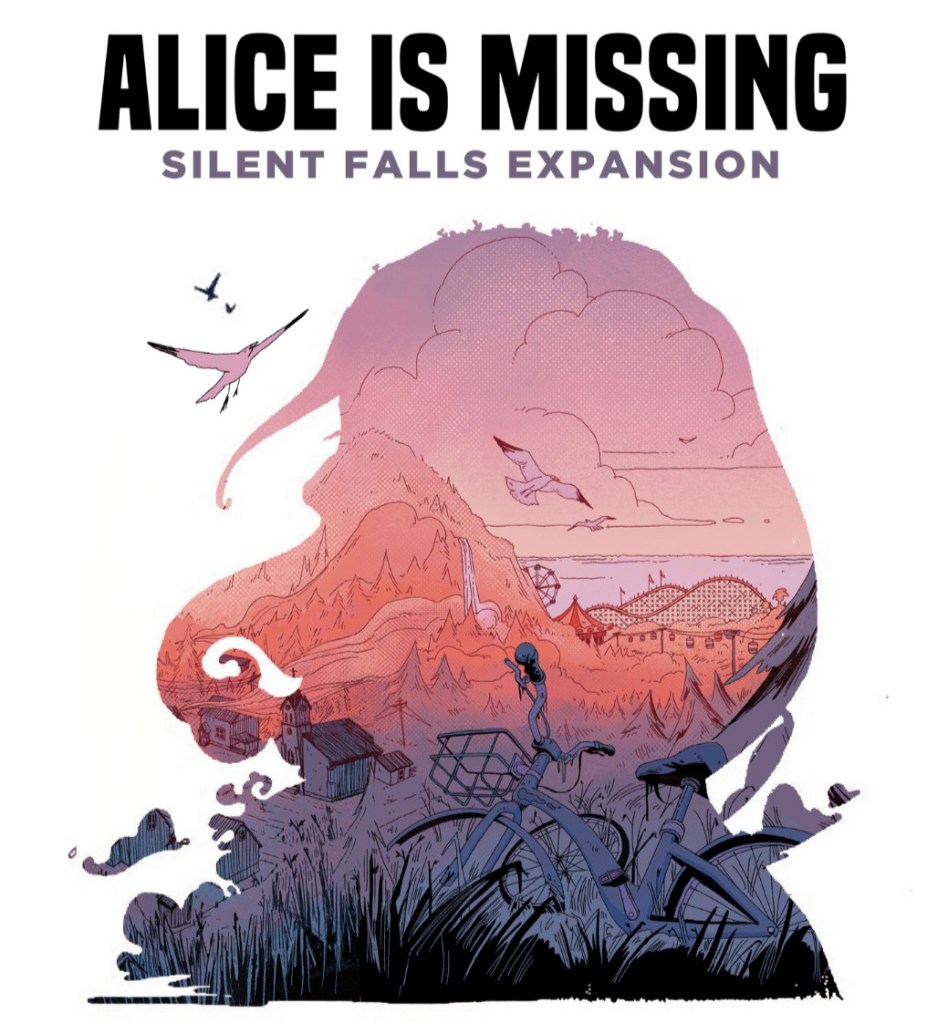
Alice also isn’t some hills or mountains.
That said, I wouldn’t say no to more cards. Silent Falls is basically that, more of the same. You get six new characters to use alone or mis with the originals. The same goes for suspects, locations and event cards. There are also cards for little twists or additional things to add into the story if it all feels a little simple or like it’s going too well. This expansion has QR code versions of those cards. I’ve only read this in PDF, so I’ve not seen how that works yet, but I’m curious how it’ll work when the physical copy arrives.
Korg Slayer
This isn’t the business card version, this is the cover to the PDF
By Caleb Englike
Read before? No
Played? No
I love the idea of solo RPGs. A lot of them go into things like journaling, but there are a few games which go a bit more tactical. Rune even uses a mini and a grid for fights. Korg and Korg Slayer are so small they fit on a couple of plastic cards that easily fit in a wallet. In Korg proper you can shop for items or go exploring. The items you have and the luck of the dice will show how far you get and what might stop you, ‘push your luck’ style. There are traps to bypass and enemies to fight. Korg Slayer introduces boss level enemies.
The cards are neat, there are also PDFs which really take that Mork Borg style of artwork and go into a bit more detail about the places to explore and the things you’re there to kill. I’ve had Korg in my bag for a while in case I get some time to myself and want something to do. I’ve yet to play it, but I’ve added Korg Slayer to the plastic sleeve I’ve put basic Korg in.
Conclusions & Observations
With Spire I’ve hit a point where there are RPGs I’m incredibly familiar with and enjoy a lot. The later entries were all because I was using them (Wanderhome, Alice is Missing) or intended to and failed (Red Carnations, Korg Slayer).
I was on holiday for some of this time, and when I hit Legacy, I decided to just keep going with that style of game rather than move on. I did resist reading all of the Legacy books as there are tons of different campaign worlds to try for it. I’ll probably get round to reading some when I’m done with this quest. As much as my regular group didn’t gel with Rhapsody of Blood, there’s still something appealing with the baseline Legacy so I will try it again.
Yes, I’m still behind, but I’m ploughing through anyway. I’m not even at the start of Zinequest yet, which might speed things up when that happens. Anyway, onto the games…
Cortex Prime: A Multi-Genre Modular Roleplaying Game
By Cam Banks & Fandom Tabletop, maybe Dire Wolf Digital…
Read before? No
Played? No
I’m not normally one for fairly trad generic RPG systems. Normally if I want a game for a specific genre or topic, there are already several specific games that can do that.
Cortex is a bit of an exception. I first read the most generic and uninteresting versions with Battlestar Galactica and Supernatural which felt like variations on Savage Worlds and not mechanically near enough to the shows they were emulating. Then two quite different superhero RPGs came out and I missed them both. Marvel Heroic had primarily premade characters and an interesting way of representing skills & powers in ways which would allow someone like Hawkeye to be in a team with Thor and not feel like he was a weakling. This was because it wasn’t all granular about how much you could lift, but a focus on the narrative impact of your abilities and the trouble you can end up in. Then there was Smallville, which sounded shockingly interesting for a license I really didn’t give a shit about. Characters had stats in values rather than physical attributes. You created relationship maps which also had dice in them. This way you could be invulnerable, but still have dramatic stakes.
Similar to Savage Worlds, you use sets of dice for attributes, skills, etc. They scale up and after rolling, you pick the highest two. It’s a fairly nice, simple method of rolling dice and represented in clear, clean infographics. The problem is that it’s quite easy to get a bit mixed up in all the widgets. When I first read the book this was a massively off putting thing, but returning it wasn’t as bad as I feared.
Similar to Fate, there are some incredible settings in the book. My favourite is a kind of Thunderbirds style disaster response game. It advances the climate catastrophe even further and has you with high tech vehicles trying to rescue folks.
I don’t think this is great for a new GM, although if someone made a Cortex book for a setting with the core rules built in, that’d probably help make it more accessible to newbies.
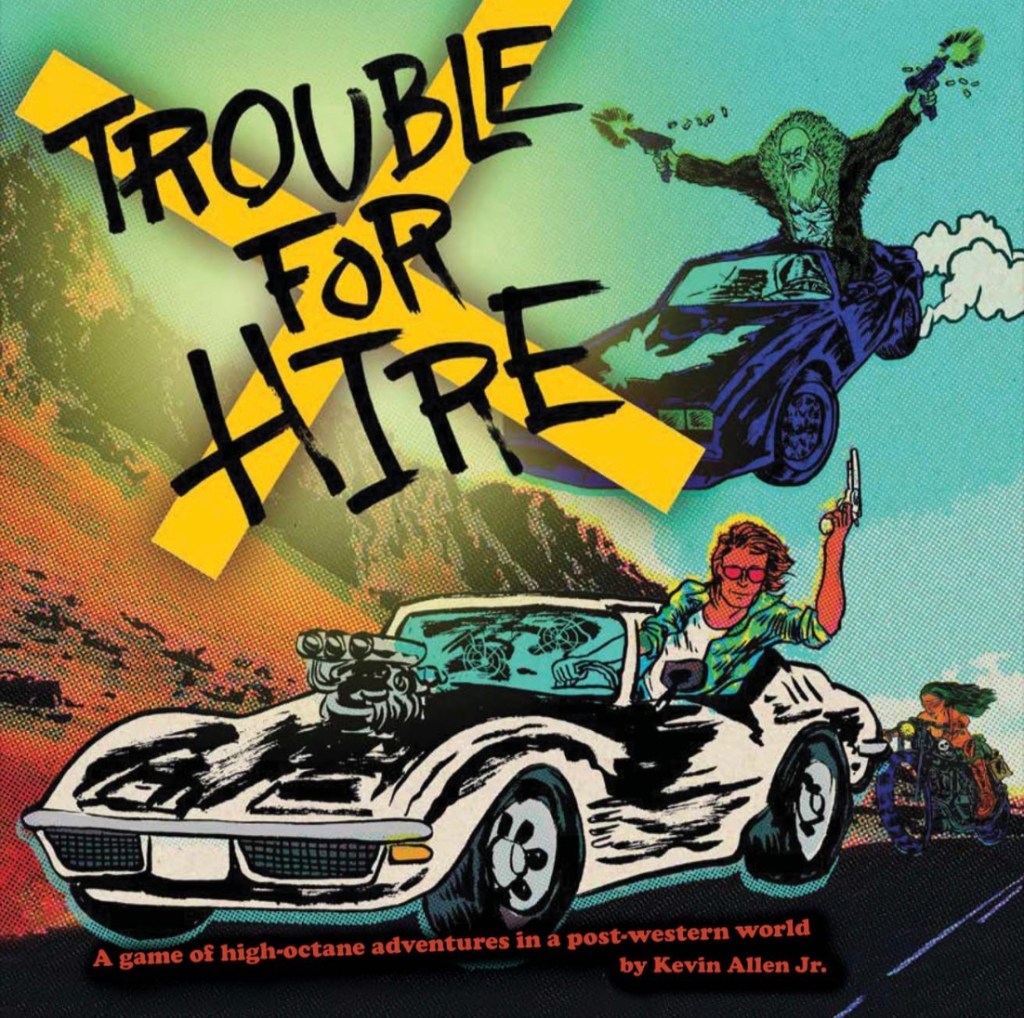
Trouble for Hire: A Game of Hi-Octane Road Adventure
By Kevin Allen Jr & NDP Design
Read before? Yes
Played? Yes
This game is a lot of fun. This game follows Ruben Carlos Ruiz in action movie like tales of his often criminal misadventures on the road.
The thing is, you all control Ruben at different points in the game. There are eight roles and each player will switch them during the game:
Ruben Carlos Ruiz – our lead, the person who interacts with the world either as a Wild Card, Fighter or Driver
Los Campañero – Whoever’s Rubén’s sidekick for the story
La Villanos – The bad guy of the story
The Editor – a meta role, editing scenes, retconning things and switching things up
The Road Through the World – literally that
Los Espectadores – Any extras, whether a crowd or a named person who’s neither a sidekick or enemy
The Rider – An enigmatic foil, acting as ally or enemy
La Extraño – Anything supernatural
There are several scenarios which give a rough idea and dramatic beats which happen at set points based on how much you spend RPM, the currency of the game. Each role has actions which cost an amount of RPM and a few free ones. You get more by switching roles and the more you spend, the more you barrel Ruben through the story to its dramatic conclusion.
It feels like a glorious, energetic mess to play, pushing the drama ever forward. The scenarios in the book are good, and there are tools to make more. I definitely want to run this again, and I might have to get a physical copy of the book as it’s gorgeous in PDF.
Tall Pines – A Surreal Murder Mystery Roleplaying Game
By Miles Gaborit & Self-Critical Hits
Read before? Yes
Played? Yes
Tall Pines is basically Twin Peaks as an RPG using some decks of cards to represent the victim, the investigators, clues and even symbolism itself.
There’s been a murder, and through three acts, your characters will look into it, but also into themselves, uncovering the secrets in their town and each other.
Each Act has cards which provide clues. You take turns running through scenes, adding them and their relevant symbols, potentially unlocking a secret depending on the combination you get.
In addition to the clues and secrets, you have Symbolism cards which are played and recycled in interesting ways which keep the ones you play coming back up.
Some of the cards from the Symbolism deck
My first time running the game was a little inconclusive, partially as we ran short on time, partially as my lovely group can often be a bit noncommittal with who did a murder in order to keep their options open, and partially as I’d not explained enough that solving the murder is secondary to the personal mysteries.
The second time was stellar, as were the stories a friend told me when she borrowed it to run the X-Files-based expansion. That second time I ran it, we had a high school football star who had died and ended up not just uncovering the murderer, but ended up encountering a weird fraternity of murderous footballer werewolves.
The Veil: Cascade, A Post-Cyberpunk Roleplaying Game
By Fraser Simons & Samjoko Publishing
Read before? No
Played? No
I’d heard about Cascade and assumed it was a sequel to The Veil, which I backed and read for the first time on this quest. Cascade’s set after The Veil and experiments with a bit more of a posthuman vibe to it. There’s technology for people to transmit their consciousnesses into other bodies. There’s a bit more of a sense of exploring the self and what it means.
The new playbooks are:
The Aesthetic: An artist who’s part of the local counterculture
The Percipient: A sneaky scout who may be compromised by their creators
The Denotation: You examine and hack the hybrid reality of physical objects
The Mnemologist: A trader in memories
The Telepresence: A newscaster/streaming reporter
The Futurist: An observer of past, present and future, owned by a weird Society
There’s advice and hacks, as well as some scenarios which I personally find quite useful as it helps get a grip on what you do and how things work.
I originally thought this was a standalone sequel, but it’s definitely an expansion book. Not only does it need the first book for the core rules, but the concepts all feel like they add to it, rather than act as their own separate thing.
Damn the Man, Save the Music
By Hannah Shaffer & Make Big Things
Read before? Yes
Played? Yes
I hadn’t seen Empire Records until I was preparing to run this game, and the moment I did, this all clicked into place. It’s basically Empire Records the RPG.
You’re all employees of a struggling music shop preparing for a Big Shot musician’s arrival, balancing whether you help deal with the problem at hand or advance your personal goals.
There are a number of roles which have minor differences, mainly in the way you play:
The Local Rockstar
The Aspiring Poet
The Troubled Artist
The Brain
The Overachiever
The Space Case
The Flirt
The Kid (bonus)
The Wizard (bonus)
The arc has players run through scenes where the boss gives out tasks and the cast either do them, ignore them to follow their own goal, or heal a relationship with a colleague. It’s going to be tricky getting all of these things done as you’ve only got a scene each per act. Things escalate nicely as everything goes on and people will have to start deciding what they actually want to achieve by the end of the day.
There’s a list in the back which acts as a nice cheat sheet, and example tunes along with the suggestion that everyone make up musicians so people who weren’t around in the 90’s or didn’t follow music aren’t left out.
This is a game that reads well and plays better, making for a quite specific, fun experience.
The Yellow King
By Robin Laws & Pelgrane Press
Read before? Yes
Played? Yes
This game’s actually four books in one, and quite an undertaking to read. I love Chambers’ King in Yellow series of short stories, so I had to get this. It uses the Gumshoe system, but tweaked into a simpler version called “QuickShock”.
Characters will investigate mysteries themed around Chambers’ stories and the horrors of Carcosa, with several ideas of what it might be and encouragement to kind of use all of them as a way of keeping things weird.
You each have characters made of two halves: Your Profession gives Investigative Abilities which will give you clues without rolling (e.g. Sculpture will let you see something off when looking at some sculptures). Your Background gives you General Abilities which can be spent when rolling a d6 to deal with a problem (e.g. someone with Fighting 5 might spend 2 points to make their Fighting roll d6+2). You get a couple of Pushes to ‘push’ the narrative based on your Investigative Abilities.
Combat’s a bit weird, and I created a couple of characters to run through a test combat. You pick an approach to the encounter, roll and try to get above a threshold based on what the approach is. There are cards for shock and injuries you might take depending on how bad things go. Combat tends not to last long which I always appreciate, and the concept of picking an approach worked better than I thought it would.
Rules & Paris
The first book contains the rules and the first setting. You’re all art students in 1980’s Paris. You don’t come from here (unless you’re a Muse, in which case you might). This way it keeps you a bit out of place and uncertain. There’s a big focus on weird art horror, which felt like it could go a bit Velvet Buzzsaw, a bit Grant Morrison’t Annihilator. This is the version I ran, with the group encountering a plaza which only existed in a painting and popped up occasionally, living sculptures, getting trapped in a painting as it repeated again and again and an attempt to create a weird reflection of the Eiffel Tower. It was great fun and very weird.
The Wars
The next setting puts the cast in part of a war which spans Europe but might pivot around France. The war started in the 1910’s and is still going by the late 40’s, with weird Carcosan technology in a kind of Wells/Verne style way. This is intended to be run after the Paris campaign, with character choices directed by what you played previously and the sides in the war based on events in the campaign. There are some interesting different group concepts such as people faking the presence of soldiers to misdirect enemy forces. Technology includes things like weird dragonfly planes, communication via haunted typewriter and weeping mines that float around like deadly jellyfish.
Aftermath
The third setting once again has players’ choices of characters based around who they were previously, but we move over to America. After the events of Paris (and the Repairer of Reputations short story), America became a weird dictatorship in worship of the King in Yellow, ruled over by the Castaigne Dynasty. Aftermath starts in the present day after a victorious rebellion against the dynasty and has you as forces dealing with what happens next. Everything feels like it’s kind of somewhere between the 50’s and 80’s after stagnation and dystopia. There are Carcosan loyalists and monsters still around, there are different political factions all with their ideas about how things should be run. The system adds a few changes to the rules involving the concept of your group, missions and influence.
This is Normal Now
The final setting, which is set in the present and has you playing the same characters in an alternate reality. This one’s our reality, or at least it looks that way. The characters have slight career changes and echoes from the other world. There’s obviously more going on, but it’s best discovered in play. This book also has advice about running the full campaign, moving through (and sometimes back into) other eras. The Yellow King is best when it is weird, jarring, meta and kind of artistic.
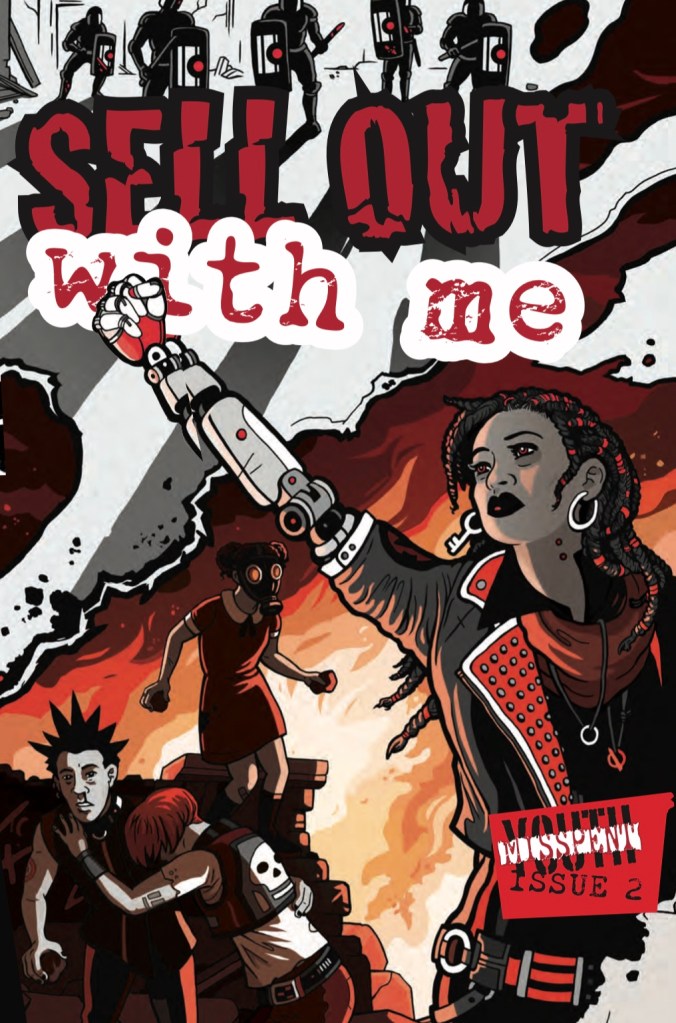
Misspent Youth & Sell Out With Me
By Robert Bohl
Read before? No
Played? No
Technically the Kickstarter item involved here was just Misspent Youth: Sell Out With Me, but it’s an expansion to the main book which I bought from Robert Bohl’s remaining stock when he was having a closing business sale. Still, I needed to give it a reread to remind myself of the system.
Misspent Youth is a game about Young Offenders who are resisting The Man. It’s generally set in a dystopia, with people rising up and sometimes having to compromise their ideals to succeed. As the GM you literally ask “Who will rise up?” And hold out the dice for someone to take. The players and the GM mark out numbers on a track, claiming them as the story goes on. With any luck by the end, the kids have succeeded and not sold out too much along the way.
There are tools for making your own scenario and characters in the main book, but also a few premade ones (the Codex zine also has one I want to try where you’re all the nemeses of a bat-themed superhero).
Sell Out With Me has so many different scenarios, all grouped by themes. I’m going to list them all as there are so many, but these are the themes:
Real Worlds
Flip the Table
One Giant Leap
Youth is Wasted on the Young
Make America Hate Again
Venusian Worlds
Fuck Labels!
There are so many RPG authors who have taken part in this, like Kira Magrann, Alex Roberts, Misha Bushyager, Quinn Murphy and more.
There’s also Outrageous Youth by Daniel Levine, a spin on the system turning it from a dystopia to a game about a band.
Here’s part two of the RPGs I read in June 2023 and brief looks at what I’ve found in them.
Dust, Fog and Glowing Embers, an RPG
By Slide Stolar
Read before? No
Played? No
Dust, Fog and Glowing Embers is a kind of Industrial Age Bioshock kind of game. It’s set in a darkly humourous world.
Players roll light and dark dice, giving narrative control to the GM or taking it for themselves. This allows you to succeed but also add soft and hard details to the fiction. You can exploit details to give oyu bonuses to the light die, making you more likely to succeed.
Characters have a choice of their background and one of three archetypes which change whether you’re relatively balanced in your stat spread or vastly weighted towards just one. You also get humours which you pick one of to determine how you react to people. This can shift over time as you balance or change your humours.
The main treat of this book is the city of Stome, which is a world of weird academia ruled over by tons of picklists to roll or choose elements for each area. This was an approach I loved in Trophy Loom and works well to keep things fresh.
It looks interesting, although I think for this sort of tone I’d probably use Electric Bastionland or Into the Odd and scavenge bits from here.
Sensational: A Superpowered RPG Where Empathy Matters
They’re all feeling something
By Thomas Constantine Moore
Read before? No
Played? No
I like superhero RPGs and it’s often interesting seeing where different games prioritise different things. This one advertised that it’s a game with powers and feelings.
The system’s fairly basic in the rolling mechanic: you roll a number of d6’s and count anything with a 4+ as a success. You move around on an emotional scale from Plutchik which was weird as I read this around the same time that I read DIE, which handled it better. The more you feel things, it modifies you like Masks with conditions, just more of them. There are powers and while they’re varied, there wasn’t really much that inspired me here. That feels like the statement of the RPG as a whole. While there’s a simple base to the game, the emotions are a bit too fiddly. I think I’d try to play it to see if it’s easier than it looks, but I probably wouldn’t try running.
Exuvaie: Relics of House Dragonfly
I don’t fancy this drink (although some of the cocktails in the book sound nice)
By Sean Smith
Read before? No
Played? No
I love film noir, and adding some weird elements to a real world setting. You’re characters uncovering a conspiracy relating to an insect cult. You’ll use a deck of cards to built elements of the conspiracy but also to determine your level of success. There’s some interesting stuff going on with the deck in a kind of solitaire-style mechanic, but I found a quick initial read still had be a little confused. I wondered whether I’d need to grab a deck of cards and run myself through some of it just to get a feel for it, but handily Sean had a tutorial video to help.
This is a one-shot I’ll have to remember and run when I’m feeling a bit noir-ish. Unlike some of these kinds of one-shot story games, I’ll definitely need to reread the rules beforehand to make sure I’ve got it all right.
The Sword, The Crown & The Unspeakable Power
By Todd Nicholas, Todd J & Wheel Tree Press
Read before? No
Played? Yes, the playtest version
Back in the Google Plus days (RIP), I saw a shout out for playtesters for a Powered by the Apocalypse game which was a kind of high council Game of Thrones type affair. I’d been running Dungeon World a lot and liked the idea of this different perspective.
In SCUP, you all take the role of people in charge of a location, utilising power both soft, hard and strange. There are different playbooks who leverage power in different ways and have interesting abilities to deal with each other. It’s all a bit more mysterious and enigmatic than Dungeon World, and worked brilliantly for a zoomed out perspective on the world we’d created together.
The classes are:
The Adept: A magician, filled with knowledge and odd abilities
The Beloved: Someone loved by the dark power
The Black Hood: An assassin, quietly offing people
The Bloodletter: A doctor, a rare and valuable trade
The Crown: Someone in charge or related to a person in charge
The Gauntlet: An enforcer for someone
The Hex: A witch, mysterious and worrying
The Lyre: A musician, able to influence hearts and sway the public
The Screw: A torturer, gathering information in questionable ways
The Spur: A soldier, generally loyal to money
The Voice: Basically Grima Wormtongue
There’s also guidance for making places, belief systems and how to determine the needs everyone has, creating the initial drama for everything to escalate out from.
I loved the game I ran of this and where running the people in charge of a city went poorly in a more traditional game, given the freedom it presented, the tools in use here are fantastic for generating drama. I think the tension and backstabbing might fatigue a group, but I’ve not tried it myself yet.
The Imposters, A Conspiracy Game Anthology
By Jeremy Morgan, Banana Chan, Nick Wedig, Alex Carlson, James Mullen, Todd Crapper, Josh Jordan & Tim Hutchings
Read before? Yes
Played? No
This is an anthology of different games, themed around conspiracy and some taken from RPG design contests in the past. They are:
They’re Onto Me: Red – ones a week, record videos about noticing people in your life acting strangely, and then abruptly stop.
LOVEINT – A 200 word RPG about making a messy tangle of agents working together while pursuing emotional, romantic and/or professional goal.
The Meet – Pairs of players arrange their covert meetings in false identities, trying not to be noticed.
The Thought Police – A game where you’re all describing your thoughts, only one player is secretly telepathic and is the only one who can hear them.
The Light of Day – A kind of heist game, where one player’s trying to catch the conspirators leaking data, actually using phones, laptops or other ways of covertly communicating.
The Way of All Flesh – Agents attend the funeral of a colleague, using drawn cards to determine their relationship with the deceased and what their active case is. These can end up being quite surreal, like a treasure map, a fight with rival agents or a werewolf’s appearance!
Field Notes #23 – This game gets players to wander about a bit, finding and interpreting conspiracies, hiding information and so on. It’s an interesting read, possibly a tricky sell.
The book is nicely designed with photos and conspiracy-looking art in the games, as well as dividing them. Like any anthology some of these grabbed me right away (like They’re Onto Me: Red) and others kind of drifted out of memory. If I’m feeling suitably conspiratorial I might give some of them a try.
The Quick: Nordic Noir Ghost Stories
By Ville Takanen & Myrrysmiehet Oy
Read before? Yes
Played? No
I’m not a big Nordic Noir person, so I think I backed this partially for the interesting, clean look and partially for the supernatural side of it. I’m also curious about checking out TTRPGs from outside of the UK and America.
You’re part of a group of damaged people solving supernatural mysteries. You roll a pool of dice when you make a move, some good, some bad. You get them based on your concept, background, aspects and harm, with 4+ counting as a success. The moves are things like “Try” and the book goes through the results whether you succeed, fail or get more perils with the bad dice than good. I like that the violence move is “Cross the line” as you’re only going to resort to violence in an act of desperation and things are going to go badly whether you succeed or fail.
The character classes are:
Seeker – Someone desperate to uncover the truth
Spook – Someone who worked for The Man
Touched – A psychic able to touch things and get visions
Bloodbound – Part of an influential family
Old Soul – Someone who’s seen too much
Channel – A bridge between the living and the dead
Rogue Ops – Someone working for a shady corporation
This is a game which I forget about and once I start reading it, I’m interested all over again. For a mystery it’d be difficult thinking about running it in anything other than a Carved from Brindlewood style, but this feels like it’d be an interesting game for the vibes it’s putting down.
Beak, Feather & Bone
An adorable bird in a cape
By Tyler Crumrine
Read before? Yes
Played? Yes
We’re at the new games part of this month’s reading, both of which are part of my ‘bucket list’ for 2023. This one I didn’t manage to play, but read and have printed out ready to go at some point soon.
Beak, Feather and Bone is a game about colouring in a map. Each player represents one community in the city and has a felt tip of a unique colour. You’ll be drawing cards and determining the following:
The type of building & level of influence (based on the card drawn)
Beak – What people say about the building
Feather – How it looks on the outside
Bone – How it looks inside
You keep going a few rounds and determine who rules the main seat of power. It looks nice and simple, it’s bird-themed, but could easily be used to help with worldbuilding for a bigger RPG.
DIE: The Roleplaying Game
Some of Stephanie Hans’ gorgeous art which is all over this book
By Kieron Gillen and Rowan, Rook & Decard
Read before? Yes
Played? Yes
DIE is a comic by Kieron Gillen and Stephanie Hans about a roleplaying group who vanished into their campaign world as teenagers and came back changed, unable to speak about what happened. As older people with lives and families of their own, they’re sent back and have to deal with both representations of their real world, of games and of fiction in general.
So that makes this a roleplaying game about a comic about a roleplaying game. There’s a very specific ritual to set up play, where you are a former roleplaying group who have a reunion and end up trapped in their campaign world thanks to their GM (who is also a character played by the game’s facilitator).
Each character class is based around a die type, as well as classic character classes, play styles and of course, the characters from the comic:
D4 – The Dictator, a terrifying bard able to tell people to do things with a word
D6 – The Fool, a swashbuckler with simple rules that involves drawing on their dice
D8 – The Emotion Knight, the fighter type who can annihilate more and more things as they feel their dedicated emotion
D10 – The Neo, a rogue who uses pilfered Fair Gold to power cybernetics
D12 – The God-Binder, able to communicate with and bargain with gods for miraculous feats
D20 – The Master, played by the GM, generally the antagonist and able to cheat
I’ll keep this brief as I have a full review I want to do for this. The system’s fairly simple, almost too simple, especially in fights. My group didn’t quite gel with that side of it, despite the really interesting rituals to set things up and the ways to construct the story.
The standard mode of play is Rituals, which is around 3-4 sessions starting with the character creation, has you play in first person and make a persona before ending up trapped in the fantasy world. From there, you need to decide whether you’ll stay or leave. This means you’ll even need the GM’s agreement and they’ve just vanished. I used my own set of fancy dice for each players’ specific dice, the worst d6 for The Fool and some old fragments of abandoned campaigns as fodder.
There’s a Campaign mode which has more options for advancement and goes into mapping out the 20 sides of the game world, or several one-shot setups including being in a horror movie shoot that’s become real and being trapped in the dungeon of a killer GM.
It’s a fascinating game, gorgeously drawn, with some spectacular ideas. I have a few more praises and criticisms which I’ll get into in my full review one day soon.
Cthulhu Hack Second Edition
This person looks pretty jolly
By Paul Baldowski & Just Crunch Games
Read before? No
Played? No
I’ve run a lot of Lovecraftian RPGs and I have some clear favourites which go more on the story game side. Cthulhu Hack’s a Lovecraftian RPG which is more on the OSR style of things. I’ve been eager to play it before running, to see the style of play and make sure that my attitudes from other games don’t get in the way.
This second edition is better at putting the style of play across and I feel a bit more confident in trying it out as a GM first. The system uses Saves which you’ll roll against when facing horrors, and Resources which you’ll spend to try and investigate or gain things in the world.
Like a lot of OSR type games it uses the standard D&D style spread of attributes: Strength, Dexterity, Constitution, Intelligence, Wisdom and Charisma. Then there’s Sanity, Flashlights, Smokes, Hit Die, Armed Damage & Unarmed Damage which are fixed by your Archetype. The first three are your resources, which start with a Die Type and might shrink as you use them up.
The Archetypes are:
Adventurer
Bruiser
Performer
Philanthropist
Ruffian
Scholar
You also have abilities and skills to help you out. The characters from this will be a little more advanced than the Squamous ones, but less than Call or Trail of Cthulhu.
The layout of the book highlights where everything is, although in the PDF the bestiary layout meant a bit of flipping back and forth to see what monster is being talked about. The physical book is small and gorgeous, and worth picking up anyway, so I don’t begrudge it too much.
There’s an adventure called “Save Innsmouth” which I gather is a revamp of an old adventure and it looks like a lot of fun. At some point I’ll have to run it either with my weekly group or as something to show my Arkham Horror group between campaigns.
Conclusions
For the most part these were positive reads. I bounced hard off Age of Anarchy, despite the interesting time period, and Sensational. I think this is the first time in this quest that I’ve had some difficulty pushing myself onwards. Hopefully July will be a bit better.
I’ve been behind both in my reading of RPG books from crowdfunding platforms and in reporting on them. I’m finally catching up and writing this as we’re in the end of June (I assume you’ll see it in July (I was wrong, it’s now September, it’s been a busy time)).
We’re hitting a slightly newer era of books I’ve backed on Kickstarter, including one which I’d consider an old favourite by now. There are a few I’ve just not read, possibly with a pre-emotive instinct that I wouldn’t actually like them once they arrived. I had that with Board Game Quest, when I finally played some games I’d owned since the mid-oughts. Once I got them to the table, they turned out to be stinkers. These aren’t quite so bad, mainly as I’m just reading them.
Perseverant RPG: A Survival Story Game
I’m not quite sure how they got across, maybe some kind of catapult?
By Sibilant Stone Publishing
Read before? No
Played? No
Perseverant is a game about people stuck somewhere, trying to survive. You set a primary problem as well as determining character traits which will help get you some dice to roll to overcome the challenge for a scene.
To be honest, this felt very similar to Magpie Games’ Our Last Best Hope, but the world-ending stakes make for some ludicrously over the top scenes. The survival mentioned here can be a little broader than literally just, ‘survive the wilderness after a plane crash’ sort of scenarios with examples like like travelling the Silk Road, colonising a region of space or surviving a flood.
I think I’ll probably stick with Our Last Best Hope, unless folks want a specific kind of gaming experience. I’ve used OLBH to introduce a campaign and this could be used in a similar way.
Monsterhearts 2
Some teenage monsters
By Avery Alder & Buried Without Ceremony
Read before? Yes
Played? Yes
Monsterhearts was the first ever Powered by the Apocalypse game I played, after listening to a podcast AP and seeing it was being demoed at Dragonmeet. It’s a game of teenage monsters, replicating shows like Vampire Diaries, Buffy and so many more these days, but with a much queerer, more feral tone to it. The game perfectly emulates the genres of those shows, empowers characters, but also can lead to some moments of beautiful patheticness which only happens during teenage years.
The game book itself for Monsterhearts 2 is one of those ones I always hold up as a perfect example of game design. The page layout is sparse and purposeful in every element, it keeps things personal but without obfuscating the rules.
Players select a ‘skin’ to inhabit, out of the following which are a specific monster, but also a kind of teenagerhood, whether it’s one you were or saw:
The Fae: Mysterious and whimsical, the Fae is your playful friend who plays in promises, suddenly turning serious if you don’t keep them.
The Ghost: Solitary and sad, the Ghost haunts the story, lurking in the background blaming everyone for their poor fortune. They target people to blame for their condition and lash out, even fading away if things get too bad.
The Ghoul: Both exiting and terrifying, the Ghoul binges on things like fire, chaos, possibly even flesh. They gorge themselves and worry folks around them, they’re fun until they indulge way too much,
The Hollow: A construct like Galatea or Frankenstein’s Monster, you aren’t real and you know it. Will you get a life of your own, or do you even deserve one?
The Infernal: You’ve got a benefactor who gives you a lot of cool shit, and you might even push some of that onto others. The thing is, it all has a cost and the thing giving you all those gifts can take them away again, or worse.
The Mortal: Often the scariest playbook, you are incredibly dependent and in love with someone supernatural. You can use their name in threats, you can get put in trouble for bonuses. Your love doesn’t have to reciprocate, and if things go really badly, you can move on.
The Queen: Whether a queen bee of high school or the leader of a supernatural hive mind, you’re in charge of the social scene as well as several NPCs you can offer up as social leverage. A terrifying playbook and the only one I’ve seen a player recoil in shock from after doing some of the moves and realising what they’ve done.
The Vampire: Cool, aloof and withholding, you benefit from drawing people in but also from shutting them down. I’ve been the Vampire and had a great time being part of a relationship everyone wanted to see flourish, then wreck it all because of my vampiric nature.
The Werewolf: A font of often undirected anger, the Werewolf loses control and unleashes their rage at the wrong times, often needing to be brought out of it before they hurt someone they love.
The Witch: The Ghost blames people for their lot in life, but The Witch is pure teenage spite boiling up into plans for revenge. They steal items from people and curse them with witchy powers. They speak of justice, but it’s barely ever actually that they’re aiming for.
There are also two bonus Skins which you can download from Buried Without Ceremony’s site, both of which are a little more complex than the ones in the book:
The Chosen: A Buffy type character, a chosen one who is destined to fight monsters including a Big Bad who only exists if you take the playbook. You gain benefits from going it alone, getting your friends in trouble and who knows, you might even fall for a monster?
The Serpentine: Part of a large, strange dynasty, the Serpentine’s a complex playbook because of the amount of upkeep required both from the player and the MC to manage this failing, complicated family.
The characters have four stats: Hot, Cold, Volatile and Dark which manage what they do.
Hot is primarily used for moves to attract people, such as Turn Someone On. This is a teen drama, but one where it’s teenagers by way of 20-something CW actors. You’re all just hormones and a lack of articulation. With this move you can attract people, but what they do with that is up to them, keeping play consensual in this tricky world.
Cold is used to shut people down, call them out and be unaffected. You can give people conditions like “gossipy bitch”, “loser” or “Wardrobe by the Pound Shop” which can hurt your rolls.
Volatile is used for fighting and fleeing primarily. Harm’s pretty abstract and works well that way. Fleeing might launch you into a new type of trouble, even if you get away from the immediate threat.
Dark is an introspective, emo stat. You can do something to gaze into the abyss and get an answer to a question either by thinking it through or actually meddling with something supernatural. There’s no perception rolls in this game, so this is the closest there is
Aside from all that you get Strings on other players and NPCs which you can ‘pull’ to encourage people to do things for XP, or give conditions or Harm to people. It’s a social currency which moves around a lot. Each Skin gets a Sex Move and a Darkest Self. I know, I know, ‘Sex Moves’, how shocking and frankly in games like this and Apocalypse World, they’re fine as mechanics but tend to dominate any discourse about the game. Think about when Buffy slept with Angel and he went evil, or any of those moments. It’s basically a mechanic which happens when you hit that dramatic point in this kind of story, and all folks I’ve played or run with generally fade to black or cut away rather than describe the scene itself. Anyone who has sex with the Mortal will enter their Darkest Self shortly afterwards, the Werewolf can appear and help anyone they’ve slept with, the Witch takes an item for potential future vengeance and the Vampire’s is all about turning people down. The Darkest Self is a kind of limit break of badness, a scripted moment of awful things for you to do when you’re full up of Harm or something else happens to trigger it. The Werewolf sees red and starts murdering, the Fae sees everything as a promise to enforce, the Witch takes revenge on everyone and the Ghost fades away until people remember them.
It’s all lined up for so much drama. There are Small Towns which are premade settings to play in if you’re doing a one-shot, which had tended to be my way of running it. We’ve run games in towns where summer never ends, or had an In-Betweeners style pathetic outing to Chessington World of Adventures where some animal-masked men stalked the group and one of the players tried to impress another by punching a tiger. It didn’t go well.
Monsterhearts 2: Skin Deep
The new monsters, a bit of a different style to the core book, but still fitting
By Sawyer Rankin
Read before? Yes
Played? No
Extra playbooks in PbtA games can be a bit tricky. Some can seem like they’re reinventing the wheel and some can get way too conditional. I generally like to sprinkle just a few in here and there for new playbooks when I’m offering up selections for one-shots, just in case there’s anything game-breaking with them all together.
Sawyer Rankin made a whole selection of them for Monsterhearts:
The Bakenoko: A cat-themed hipster who has a very Jughead feel to them.
The Bedlam: A kind of Alice in Wonderland type character who’s not really in this world, mentally (and sometimes physically)
The Devil: You grant and call in favours
The Dragon: Demanding of attention and destructive when their whims aren’t catered for
The Fomorian: You should have been a ruler elsewhere, but you’re here and perceived as different by folks.
The Immortal: You’ve lived forever, potentially Highlander style, and you can’t really die, but your long life makes you alienated from everyone.
The Leshy: You’re more in tune with nature and animals than people.
The Prometheus: A Victor Frankenstein, Herbert West or even a Reed Richards, you’re smart, a little creepy and you’ve got all-consuming projects which may have weird side effects.
The Siren: A performer, both inspiring and needy, but also destructive when they need to be.
The Veela: A master of drama, either supernatural or far too mortal. You’re about the attention for better or worse.
There are also a couple of Small Towns and some rule mods at the end for good measure. One of the small towns, Lodestone, has a great setup about having ten days to prevent or cause the end of the world, which could be good fun to play in.
Some of these feel like there’s some overlap with existing Skins which mean I’d limit them to just one or the other in play at a time, but some like the Veela, Bedlam and Dragon definitely appeal.
Monsterhearts 2: Brave New Worlds
A spooky exercise book cover
By Creatively Queer Press
Read before? Yes
Played? No
Another third party expansion to Monsterhearts. This time it’s all Small Towns.
There’s Rockwell, for reframing Monsterhearts around a Roswell kind of vibe, Ennesmouth which is basically Innsmouth, a town where everyone’s predestined into remaining in the same role forever, a town where someone vanishes every few days and no one’s noticed yet and a community out in nature, away from civilisation and the players are the kids who have to commute into town from there.
Again, it’s an interesting selection of Small Towns and as time’s gone on I’ve started gathering up these for one-shot play. I love when you get some outlandish high concept drama ones like Siren’s End (the one where people vanish).
Age of Anarchy RPG
Empress Matilda
By Paul Mitchener
Read before? No
Played? No
Paul’s done a lot of good work for Call of Cthulhu and for Liminal, so it brings me no joy to say this really didn’t do it for me.
Age of Anarchy’s a historical RPG set during The Anarchy in the 12th century. That’s right, this isn’t about anarchists (I’ll get to Comrades later), but about the civil war between King Stephen and Empress Matilda. This is an era I’ve got no experience of, so it was interesting delving into it.
The system is “The Perpetual Motion Engine”, apparently a new thing. You roll 2d6+a skill and any abilities, aiming for a result of 7+challenge rating. You Pick three professions, each giving three skills at different levels depending on what you’re prioritising. You also get some gear and abilities from doing this. It sounds fiddly, but could be fine.
A lot of the setting is working for a patron, and rather than just one default one, there are a number to choose from. At the same time, I didn’t feel entirely sure what the example stories would be with this game. The layout and the art were a bit uninspired, to the level where I had to check and make sure I had the most recent version of the file.
Alas for the Awful Sea: Myth, Mystery and Crime in 1800’s UK
A suitably dour cover
By Hayley Gordon, Vee Hendro & Storybrewers Games
Read before? Yes
Played? No
This was the first Storybrewers Games game that I backed on Kickstarter. The idea of a historical PbtA game in a setting I’d not really seen before, so I had to check it out. The game’s one of grim sailors in a grim sea, generally in a kind of Hebredian landscape. It’s all communities in tumbledown shacks and vague folkloric strangeness working its way through the land.
There are a selection of roles to choose:
The Captain
The Boatswain
The Mercenary
The Merchant
The Old Sea Dog
The Scholar
The Strider
The Surgeon
The Cook
The Stowaway
These are all fairly descriptive of what they do and are the core playbooks, but rather than just defining characters by their professions, they also get descriptors:
The Lover
The Kinsman
The Believer
The Confidant
The Outcast
The Creature
The moves are mostly fairly familiar to people who have played PbtA games, with things like Acting Under Pressure and Act With Force. The closest to anything new with the core moves is “Sense What’s Bayond” which is the equivalent of “Open Your Mind” in Apocalypse World.
Normally I get a bit cynical when I see moves lifted pretty much verbatim from Apocalypse World, but here the setting is expressed so well in the text that it helps keep this feeling distinctive.
There’s a core adventure also called “Alas for the Awful Sea” which sees the players having to seek shelter in the town of Greymoor. There are tons of different plots to get embroiled in with the locals and even potentially something a bit supernatural going on. It’s very evocative, very busy and breathing.
While this isn’t a priority for me to run, it’s something I’d be very interested in trying out. My oldest tab still open on Chrome is a page on Benbecula as I’ve had thoughts about running Alas for the Awful Sea somewhere like that.
The Watch RPG
This feels like it’d be good as sequential art
By Ash Kreider
Read before? Yes
Played? No
Men can be monsters and in here, literally so. The Watch is a grim fantasy RPG where a force called The Shadow has infected the hearts of men and the primary military force is made up of women (this includes trans women and nonbinary folks). This is a game which is about patriarchy, literalising the demons within it all.z
The playbooks are:
Bear – a fierce protector
Eagle – a glory-seeking danger junkie
Fox – the weird one
Lioness – the charismatic leader
Owl – the sneaky one
Raven – the smart, philosophical one
Spider – the sinister one
Wolf – the aggressive member of the pack
There are a number of different clans with their common professions and some character creation questions to help define your characters.
The moves include things like Blow Off Steam as this is a high-pressure situation and you need to be able to calm down or you’ll burn out. As a defensive group there’s Prevent Bloodshed as a move and Rely on Your Training to get past things. This time, the move to gaze into darkness is Let the Shadow In, which is incredibly risky given it’s an actual entity here.
Reading the book it feels similar to Band of Blades in a way. There are several ways of customising what The Shadow is like and how it acts, and there’s a whole structure for running a campaign which is really nicely made. I don’t need a set campaign structure like Night Witches or Band of Blades, but I definitely appreciate even a rough framework.
Noir World
An understated cover for a big book
By John Adamus
Read before? No
Played? No
This was a Kickstarter that was pretty late and while a PbtA noir game sounded near, I reached a point of not caring so much as there was my beloved Noirlandia. Finally reading this book, I’ve realised how wrong I was. This is a really interesting way of running a film noir style story.
The system’s a dimple PbtA type game, but it has you create the setting and the mystery first, then rotate GMs as you travel through the mystery. The structure’s pretty fixed in aiming for a one or two shot game.
There are a TON of playbooks, all pretty descriptive in what they are and do:
The Good Cop
The Dirty Cop
The Fatale
The Mook
The Private Eye
The War Vet
The Politician
The Career Criminal
The Gambler
The Reporter
The Starry-Eyed Kid
The Citizen
The Socialite
The Disgraced Doctor
The Musician
The Attorney
The Gangster
The Celebrity
The Ex-Con
The Girl/Boy Friday
The good news is that they’re all pretty basic and it’s often good to establish ahead of time the kind of story as that’ll help direct you to which playbooks to include. The pick lists for each one includes your belongings and motivations to help push the action forward. There are even scenarios to choose from (some with their own playbooks, just to add even more!).
As you rotate GMs, the game makes clear the actions to make and ways to build off of what other players have built.
Here are the rest of the games I’ve read in May, including a few newer offerings which I either read to run, or just in an attempt to keep on top of everything new that arrives.
My friend Graham asked me why I didn’t limit my readthrough to everything between my first backed project and 31 December 2022, so I wasn’t constantly updating my list and moving the goalposts. I… don’t have a good answer for that. Oh well.
Eden
Just some of the animals you could play in Eden.
By Marc Hobbs
Read before? Yes
Played? No
This is a map-drawing game about creating your own garden of Eden, then providing lessons to the humans from the perspective of an animal or group of animals. I love The Quiet Year as far as map-drawing goes, but this feels like it might be a bit more chilled than that. The book handles the ritual of play pretty well, so I feel confident in being able to run it even when the rules have faded from my terrible memory.
Ghost Court
I want a gavel, not for any reason, just in general.
By Bully Pulpit Games, Jason Morningstar & Steve Segedy
Read before? Yes
Played? No
This is another LARP-ish game. There really seem to have been a lot released around this time. I love Bully Pulpit’s games anyway. This one’s a courtroom drama where the living and the dead settle petty disputes. You need people to fill various courtroom roles like judge, prosecution and defence, and then you hand out the cards for each case. Players have to argue their side and anyone in the jury needs to make a decision. It feels like it would be the perfect game to have people drop in and out of, although I’m not sure how I’d organise the logistics of it. If I get a big table, I might just run it there.
Bluebeard’s Bride
That’s quite a lot of a beard
By Magpie Games, Whitney “Strix” Beltran, Marissa Kelly and Sarah Richardson
Read before? Yes
Played? No
This is an incredible-looking horror game. It’s beautifully made and incredibly creepy.
The idea is that you play out the story of Bluebeard from the perspective of his bride, taken from her home, wed to this strange man and left alone to travel through his extremely Silent Hill style mansion, allowed everywhere but one room. She investigates items and ghosts in the rooms, deciding bit by bit about whether to resist or obey Bluebeard, eventually reaching a choice to open the final door or not.
The Bride isn’t just one player, though. The Bride is played by multiple people, all representing different aspects of her:
The Animus – bold action, confrontation
The Fatale – sultry and controlling
The Mother – authoritative, helpful and judgemental
The Virgin – naive and innocent
The Witch – mystical and intimidating
One person at a time controls the Bride as they travel through rooms, but give up control to keep themselves safe. The other Brides and whisper to them, tell them to do things or notice things, but it’s only the one in control who can affect the physical world.
There’s a move in this game about when you shudder from fear. Not the character, but the player. I love that. If things go bad, one aspect of the Bride may shatter, becoming lost to the mansion and helping the Groundskeeper (the GM) with the downfall of her sisters.
This is a specifically feminine horror story, and one which I really want to try, but I’m also painfully aware that I’m a cis man in a group full of cis men, and it feels like something I could fuck up quite easily. One day I will get this to the table, it’s too interesting not to.
Follow
By Lame Mage & Ben Robbins
Read before? No
Played? No
I’ve played Microscope and Kingdom by Ben Robbins. The first creates a timeline which could be in any genre. The second creates a location with a hierarchy and how each strata deals with problems.
Follow creates a group of people accomplishing a task and the challenges they face. It’s an interesting idea, but feels like the broadness of the concept is something dealt with by most other RPGs. You’re almost always on a mission to do something.
If you want to represent that kind of task from beginning to end, this might still be the game for you. The resolution is with a bag and tokens which gets modified as you play, often in ways which might make things trickier as you go on. The type of quest can be quite broad, too. You might be on a journey to put a cursed ring in a volcano, but you might also be handling a space launch, research into a virus, some espionage. It feels like it can handle smaller stakes than Our Last Best Hope, but can still give us similar types of stories even if the world isn’t on the line.
Personally I think I’m more likely to run Microscope or Kingdom, but if I do this, it’ll definitely in be more of a mundane setting.
Home By Dark – A Story Game of Hope and Fear
Such a nostalgic-feeling cover.
By Protagonist Industries
Read before? No
Played? No
This is an RPG of kids on bikes and strange encounters in the style of Stranger Things and 80’s movies. Unfortunately it isn’t Kids on Bikes, a game which went onto Kickstarter a bit later, and it suffers a bit for that.
This is another game where I feel I need to invoke Our Last Best Hope (I realise there may be another game presceding that which does these things, if so I don’t know it). Characters have cards representing the Fear, Insecurity, Responsibility and Hope. You pick a divide between Hope and Belief to represent your innocent wonder and cynical awareness, which might change in the game.
There are three piles of dice as the pillars: Danger, Pursuer and Secret, trying to clear them off as you go towards the finale and deal with either the Pursuer or the Danger.
It’s fine, and I might be more amenable to it if Kids on Bikes wasn’t a bit easier structured, beautifully designed and filled with more different scenarios.
Trophy Gold
Open the big scary door, you won’t regret it, even if your character will.
By Hedgemaze Press, Gauntlet Productions & Jesse Ross
Read before? Yes
Played? Yes
We’re up to more recent games now, and this is one I read half as a treat to me, half because I was running a Trophy Gold campaign anyway.
I’ve reviewed Trophy Gold, I recommended it in an episode of Casual Trek, I will not stop talking about Trophy Gold.
The gist, just to keep things brief is thus: You are desperate treasure hunters going into horrific places to pry loose any treasure and return alive, ideally closer to the thing that drives them to go to these terrible places.
Yes, capitalism is the real monster at the heart of this game. You might be a blighted farmer, an ex-cultist, a fallen priest, you’ll have a drive like buying and destroying the orphanage you hated, finding a banner of a lost legion, even just retiring in peace in a nice part of the capital city of Ambaret.
Each Incursion is based around a specific theme like ‘Harvest’ and is made up of sets filled with traps and treasures. You’ll interact with them like you’re in a point and click adventure, just one filled with a lot more horror which you may never escape.
The Hunt Roll is how you interact with the world, getting valuable Hunt Tokens by talking to people, prying open floorboards, checking suspicious statues, looting bodies and so on. Hunt Tokens allow you to answer the goal of any particular set, sometimes unlocking other sets, sometimes getting treasure, sometimes understanding the horrors a little better. You can also cash them in for money, and lose them if things go really badly, so sometimes you’ll want to cash them in even if it’s not too helpful.
There are more rolls than that. Risk Rolls are needed to avoid harm when doing anything risky which isn’t clue gathering. It tags in the players aside from the roller to pitch ideas about what could go wrong if they fail or bottle it, and Devil’s Bargains where the roller will get a bonus die if they accept something wrong which will happen whether you pass or fail. It sounds a bit metagamey and yeah, that’s still part of the game. Zooming out of the moment and letting players into this GM space is fantastic. If gives suggestions the GM wouldn’t necessarily have thought out themselves, adds to the players’ ownership of the game and lets everyone embrace horror on their own stakes.
There are some supplemental rolls for helping or hindering, but the other big roll is Combat. The group all describe how they open themselves up to potential harm, roll a die as their ‘weak spot’ and then a bunch of dice which they’ll pick the highest of and try to match the Endurance of a monster. If any of the dice (used or not) hit your weak spot then you’ll be hurt, closer to your destruction.
It’s a game which manages to be the most video gamey and the most narrative thing I’ve seen for this kind of adventuring. The incursions are a joy to read and were wonderful to play. It’s a simple system and character creation takes minutes which is great, as luck can run out easily in this world.
Fight With Spirit
Go Sports!
By Storybrewers Games
Read before? No
Played? No
I’m not a sports person. I’ve never given a crap about watching it and I was taken out of team sports between the dyspraxia and later all sports due to childhood health problems. I loved watching Friday Night Lights after being told that it was about sports the same way that Buffy’s about vampires. It was a great show, and when I was marathonning series of teen drama movies a while ago, the Bring it Ons were more good than bad. Oh, and I did actually play basketball for a year or two. We were utter amateurs and I loved it. There was another short dyspraxic person so we were put on opposing sides, making a blend of actually alright blocking and the occasional incredibly powerful but aimless throw. In my case it was “The Etheridge-Nunn Bullet” which would go pretty much in a horizontal line from where I was, rarely into the hoop, sometimes at an ally and often a long way away.
So aside from the above things, I’m not a sports person. Storybrewers are a company I’ll back anything from, and this is no different. I love Good Society and the Littlebox RPGs, I’ve not run Alas for the Awful Sea, but it looks interesting.
Fight With Spirit is a sports drama as an RPG. It doesn’t concern itself with the actual rules of the sport and as long as it involves teams and is played competitively then it’s all the same (there are solo sport rules, too).
You pick one of four teams and your characters, along with typically sporty drama like you’re being poached by another team, or you’ve got a rivalry going on. The group run through cycles of pre-match and match play, going through not rigid details about the rounds, sets, innings or whatever that you’re playing, but instead you’re going through dramatic beats. There’s a chance to show up a rival on the same side, you’re out there on your own, you hear people on the other side talking about weak spots on your team. Each match event might have a slightly different ritual for how the play of it goes and whether you win or lose, things are going to get dramatic.
Spindlewheel
Some of the gorgeous Spindlewheel cards
By Sasha Reneau
Read before? No
Played? Yes
Spindlewheel isn’t a rulebook. At least, there’s a rulebook, but mostly it’s a deck of cards. A really pretty deck of cards with gold trim on the sides and a few smaller stacks based around specific themes. Spindewheel’s a kind of tarot-style thing where each card has a name, then two different descriptors for it, all fairly vague and open to interpretation.
The idea here is that you can use them in games, or make up brand new games with them. I’ve used the deck to help add elements to adventures, especially the mini-decks when I had relevant Trophy Gold incursions. There are a ton of games which use the deck and I’ve used a printed set to play them before the official one arrived.
My favourite Spindlewheel game so far was Spindlewheel Detective, where you make and solve a murder mystery using the cards to imagine each element of the murder, the suspects, pick the murderer and then the decision of how it was resolved.
I admit I expected a selection of games, like the Spindlewheel Microgames PDF with Detective in it, but this had a single game in it. It’d be interesting to try, but for the most part I’m still eager to try more minigames and to modify some of my fiction & RPGs with it.
NULL
Into the Null tunnel with you!
By Gila RPGs and Spencer Campbell
Read before? No
Played? No
I’ve loved running the Lumen system as a quick hit of tactical combat roleplaying in an indie game frame. It shows that if you want fighty action and combat optimisation you don’t have to only look in the trad space.
Null is the latest game by the prolific Spencer Campbell, founder of Lumen. This game sees you as operators facing off against a malicious nanotech and its forces. Similar to Nova you enter a zone, attack enemies and collect drops from them, but here you graft tech to yourself, fight as far as you can in the knowledge you’re probably not all making it out.
The classes are:
Medic
Commander
Scout
Researcher
Soldier
Each of these have weapons and abilities. It feels like gear’s more of a factor here, similar to Light, an earlier game of Spencer’s. You don’t have the epic frames from Nova, filled with superpowers. Here you might have some grenades, you might have the ability to make a static wall, to fire some lasers and so on. This game cites Trophy in its ‘play to lose’ style and has built everything accordingly.
I think Nova (both the current version and oncoming second edition) will be my go to Lumen game as I run enough play to lose games and cutting loose with a fun, stupid power fantasy can be great fun. That said, I’m eager to get this and Light to the table to see what other Lumen games are like.
Conclusions & Observations
Was I specifically backing LARPs around the era I’m reading or did it just pan out that way? I’m still not sure, maybe it’s that the designers I liked (Bully Pulpit, NDP and Burning Wheel) all came up with them around the same time.
I was a little cold with some games as they’ve been replaced in my eyes by later games, sometimes by the same author, but this was a good selection to read.
It was this or taking the worst birthday card I could find and using that.
August marked one year since the start of Casual Trek. In our first 27 episodes we’ve managed to cover 7.91% of Star Trek history.
That includes
65 episodes
Two movies
One graphic novel
One chat about having a lovely walk
One chat about Lord of the Rings
Several deaths in a Star Trek choose your own adventure type book
A LOT of tangents
It’s been a fun time, and in episode 26 we took a little time to chill out and talk about our findings so far. We also discuss a little bit about what we’re hoping for in the coming year.
I was tickled by the idea of 1990’s Khan, so I made this.
We’d intended on covering Star Trek II: Wrath of Khan a little earlier to try and make a habit of doing a movie every twelve episodes. Better opportunities came up, so we put it off until episode 26, and of course there was a perfect episode to pair it up with.
Star Trek: The Original Series “Space Seed”
I’d seen barely any episodes of The Original Series prior to starting Casual Trek. I’d known there was an episode where Khan came from, but never sought it out. After watching this episode, that was probably for the best. It’s fine, with a few weird things, but not essential viewing for Star Trek II unless you’re covering it for a Star Trek ranking podcast and need to see everything Star Trek.
Star Trek II: The Wrath of Khan
The main feature, and my word, what a film. I’d not seen this for at least a couple of decades and it was a joy to come back to. I know it’s hardly a controversial statement to say that this movie which has a great reputation is good, but we get into what we liked in particular, what holds up, the connective tissue between Space Seed and the movie, set design, space rats and whether Khan’s actually pursuing a one-sided grudge against Kirk.
We’ve had a few episodes which have been linked to recently-released episodes of Strange New Worlds. It means we’ll have less to cover in the long run, but at the same time it’s been a joy watching the episodes and we’ve been able to match them quite well to other Star Trek episodes.
Star Trek: Voyager “Virtuoso”
This episode ended up being a talk about AI art and the slurry of ‘content’, as a bunch of artless aliens get all excited about how The Doctor can perform music. They become weird fans, although they’re really more into him for the maths of what he does instead of the art. Of course, he finds this out only after letting this all go to his head. It’s a fun episode, and shows that there are some real jerks in the Delta Quadrant.
Picard “Two of One”
It sounds almost unbelievable that this episode inspired our musical theme on the spreadsheet a while before hearing Subspace Rhapsody was ever going to be a thing, but we need ways to crowbar in episodes of Picard and its so serialised it’s kind of tricky to do. This one is both a heist and a musical episode as the Borg Queen possessing one of the cast ends up performing a musical number. It’s a weird choice, but in a show where it’s difficult remembering any single episode, it makes this one stand out.
Star Trek: Strange New Worlds “Subspace Rhapsody”
Finally we have the reason this theme was bumped to the top of the queue, a full musical episode. Not only is this a musical episode in the style of Buffy, The Magicians and so on, but it actually uses the mechanics of musicals to present problems and solutions. Thanks to some probability shenanigans, the cast find themselves starting to sing. Similar to Once More With Feeling, this means truths get spilled in song form and a lot of personal drama can be aired before the horrors of the finale.
I decided to focus a bit more on getting through some RPGs this month. There were a couple of quick wins and a couple of lengthy reads, albeit fun ones.
The Veil: Cyberpunk RPG
By Samjoko Publishing & Fraser Simons
Read before? No
Played? No
The covers for The Veil all have different art, but the design and layout keep them all unified.
I’ve backed each of Fraser Simons’ RPGs, including multiple Veil-branded games, but I’ve yet to read this one, even though it was the first one I backed. I love Hack the Planet by him (that’ll be later in this marathon), but this one’s a bit weird.
This is a Powered by the Apocalypse cyberpunk game in a world where the virtual world is projected on top of the physical one. There are several interesting, strange playbooks with a number of different sources in cyberpunk media. The biggest twist is that the stats are emotions. You perform better or worse in different emotional states, but you need to keep from spamming the same emotion of you spike it, making things generally worse.
There are so many playbooks in this book and they all take a bit of explaining:
The Apparatus is a new AI in a physical body
The Architect is able to change the digital environment around them
The Attached has a relationship with a strange object
The Catabolist is obsessed with grafting more cyberwear onto themselves
The Dying is is well… dying. They have a limited time here, but a gift that this state grants them, too
The Empath is able to better deal with emotions, a core element of the mechanics
The Executive is involved in the business side of cyberpunk fiction with all the horrors that includes
The Honed is a rare person without cyberpunk upgrades
The Honorbound is all about obligations and social currency
The Onomastic is unique, strange and hunted
The Seeker is someone with faith, which can give them information beyond what the cyberpunk world normally can
The Wayward explores the idea of something ‘more’ than just the relationship between person and machine, bringing nature into the story
There are touchstones for these playbooks listed which is good, although a numbe rare from anime I’ve got no knowledge of, which feels fitting for both Samjoko and for me.
It was an intimidatingly large book at nearly 400 pages back when I was reading <200 page PbtA games like The Warren and Night Witches, which was the main thing putting me off running it. There are a ton of cyberpunk games out there now and I hate to say, most of them feel like a bit of an easier sell than this. I won’t turn down a game of The Veil and with some work I’d be up for running it, but if I just want a ‘cyberpunk’ game, I’m probably going for Hack the Planet, Hard Wired Island or CBR+PNK.
Threadbare RPG: A Stitchpunk Tabletop Role-Playing Game
By Stephanie Bryant
Read before? No
Played? Yes
Onwards, Plastic T-Rex!
A rare RPG I own and have played but never read.
In Threadbare, you are all toys in a post apocalyptic setting where all the humans are gone. You’ll be either a charming soft toy, a hard plastic toy with accessories or a sock. The latter feels like a bit of a stretch, but they all have a number of different things you can do to customise them. Yes, even the socks.
The game itself has different modes from charming Toy Story hijinks to Wall-E ruin or straight up Fury Road with toys. Your character will lose pieces and customise themselves as they go on.
I realised I’d only read preview rules of the game and hadn’t seen the finished package. For something with a simple concept, it goes further into it than I thought.
A friend of mine, Rhys, ran a festive session of this back when I hosted an indie RPG night at the Dice Saloon. I played a group of little army men.
A Grandiose Disaster – A Live Action Roleplaying Game
By NDP Design & Mike Young
Read before? Yes
Played? No
All the different places you might face disaster, all in your living room!
This isn’t the only LARP I’ve backed, or the only one in this selection. This is a ‘parlour LARP’, the kind of thing you can play in a short amount of time in a space like a living room, ideally in this case with a bunch of chairs to use as props.
A Grandiose Disaster is a system for running disaster movie stories, with one example scenario set in a hotel in a volcano that’s totally safe. There’s a selection of roles and scenes play out from a deck of cards. Characters have symbols on their sheet which will go off at certain times, causing a kid to panic, a scientist to die and so on. This is all playable in about 90 minutes, and looks like it’ll be a fun time. I’ve not run it, mainly as I’ve not been certain of how to organise it yet, but I reckon it’ll be fun.
Meridian: A Story Game of Journeys Wondrous and Fantastical
By Christian Griffen
Read before? No
Played? No
A classy card back.
In retrospect I should have backed this to a physical level. It’s an RPG based on things like Labyrinth, His Dark Materials and such, but it uses a TON of cards. The files from the Kickstarter are all individual sheets with cards on in different shapes and sizes, which would make them an incredible faff to print out and sleeve, so I’ve not bothered with this yet. It does look pretty, though.
One of the locations from the game
Similar to Lovecraftesque you have one person playing the main character, one as the Guide and the rest as ‘Touches’. You’ll travel through locations with the Journeyer meeting companions and working their way through to a final choice based on the set of locations and the story you’re going through.
It all looks nice, but I think if I want this kind of story, I’ll probably go with Girl Underground.
What Ho, World! – A Roleplaying Game of Farce and Elegance
By Mina McJanda
Read before? Yes
Played? Yes
You too could be one of these oblivious toffs!
A short card-based farce set in the early 1900’s, with a lot of foppery. Each player picks a character and ability, they have goals and play cards to see how things go.
The moves each have triggers to activate, providing one thing to happen and then extra effects you can use your facedown move cards to activate. You each have goals which you can succeed at and gain wild tokens to help you across the winning line, or you can ditch them and draw another if you mess it up.
The rules are a simple sheet and there are a number of decks. Unlike Meridian, I backed this to a physical level with not just this but the standalone expansion, “Wizards Aren’t Gentlemen” about magicians.
The game itself felt like a lighter, fluffier game than Fiasco, but just as chaotic. Our failed attempts to host a nativity in the village church ended up with all but one character naked. I forget the other particulars about the event, but heartily recommend the game.
Rockalypse: The Fate Core RPG of Musical Conflict
By Eric Simon
Read before? No
Played? No
Do you all want to play that dude with the guitar from Fury Road? This game can do that!
I like Fate, even if it’s not everyone’s cup of tea. I had my fill of incredible settings and adventures from the Fate Core Kickstarter alone, but when I saw the theme of this one, I had to check it out. The world ended, but this system prioritises music and the creation of it as your way of interacting with the world. I love that about these kinds of expansions.
There aren’t many changes, but there are a few which help encourage the themes of the game. As an example are the new skills:
Harmony – Adding layers to musical performances, disrupting other bands
Melody – Providing beauty & power in music, an attack skill in this world instead of fighting or shooting
Rhyme – Inspiring people, an attacking skill (with words)
Rhythm – The backbone of music and a potential defence skill
There are also a few different uses for existing skills in order to help them be relevant for both the apocalypse and music.
I’ve yet to run this, or so many Fate worlds. I’ll offer it up like the others and see what players like the sound of.
Inheritance
By Burning Wheel & Luke Crane
Read before? No
Played? No
Not quite Norse Succession, but not not that.
Another LARP, this one concerns two families brought together after the death of a patriarch in Jutland. There’s the matter of the inheritance and where it lies, as well as what to do when an exiled family member returns seeking his cut. This one’s tricky to describe as there are a lot of spoilers and it looks like it’ll need a lot more prep than A Grandiose Disaster, along with an incredibly specific number of players (nine plus a facilitator).
The cast are:
Thorvaldsen – A retired Viking
Fulla – Powerful matriarch
Daxo – Back after being exiled
Ring – Youngest son, a dreamer
Tyr – A one-armed ex-berserk
Gefjon – Wild priestess
Ran – Bereaved daughter
Ansgar – A Christian priest & accountant
Aurvandil – Daxo’s boon companion
Each character has a sheet providing the simple overview of the rules and their opinions on each other. There are some basic resolution systems, but this is more about picking sides in a family dispute than being quantifiably better at bending bars or lifting gates. Handily, they even have illustrations of how to stand and intervene during the disputes, which for a LARP type thing is a good shout.
I like the idea of this story, I think it’s possibly going to be a little fiddly to organise.
MASHED: A Korean War MASH RPG
By Brabblemark Press & Mark Plemmons
Read before? No
Played? No
An army game not about actually fighting? That’s how I like them.
I love playing clerics, healers and support characters in general. This here’s a Powered by the Apocalypse game about playing a MASH unit in the Korean War. It’s not MASH the TV show, but it’s not not that, either. You have to deal with the challenges of daily life and keeping sane during it all.
I don’t know of Mark Plemmons’ background, but the book feels like a ton of research was done with a large bibliography provided. Fortunately, it also reads nicely, without getting too dry.
You’re not all doctors and nurses, but there are a bunch of different playbooks:
The Angel
The Corpsman
The Cowboy
The Cutter
The Doc
The Grunt
The Padre
You also take on a role, to mix things up from the job you’ve got in the unit, providing a move and some HX (history) modifiers:
The Bully
The Casanova
The Clown
The Gray
The Misanthrope
The Operator
The Sky Pilot
The Stickler
It doesn’t quite reach Night Witches as far as war games for me, but there are some points of comparison and some interesting ideas here.
The Frost Papers: Ten Games to Play in the Dark
By Arcana Games
Read before? No
Played? No
A fairly modest cover.
I was tickled by the idea of games you play in the dark and yes, this is another LARP-ish game. It’s presented in the form of letters, each with ominous rituals to perform.
The games are all highly ritualised, asking things like to sit facing a wall while encircled by others, stopping clocks and so on.
The Hallway Game has you enter a strange place from your seat
The Walking Game allows you to travel in your dreams
The Calling Game has you call a demon
The Black and White Game is a game of necromancy where you speak to the dead and ask them questions
The Doll Game involved burying a doll in a grave in order for a spirit to inhabit it and is not recommended
The Jack’s Game involves mutilating a deck of cards
The Lantern Game is a warding game which needs twigs
The Talking Game is used to speak to spirits or people trapped in The Fog Between, using a planchette and a board
The King’s Game has someone act as the King while questioned by The Crone and the Fool, looking for information about things to come
The Hiding Game One of you is the Traveler and everyone else is a Guide who enters and hides, to be spotted through a mirror as you look for The Shadow Man.
I’m not sure if I can get this to the table (or the dark room), but it might make for a fantastic prop and ritual for The Between.
I originally aimed not to run as long after splitting March’s reading list into two parts. The thing is, while some of these books were quick reads or didn’t make a great impression with me so I kept them quick, there are also some great books I read this month, and that led to me covering them far more.
Noirlandia
By Evan Rowland
Read before? Yes
Played? Yes
You don’t necessarily investigate giant bones, but you can if you want.
Noir’s one of those genres I like a bit more than average, but I”m not a massive fan of. I studied it in my Media Studies A-Level and it was a good time. Here, we’ve got an RPG which can run through a noir murder mystery all in one night. Even better, it’s a game that encourages using pictures, a cork board, pins and pieces of string.
You play through scenes as you investigate the suspects and locations around the crime, rolling dice and amending the murder board as you go, getting closer to the culprit.
There are rules for creating a mystery, but there are some fantastic premade mysteries provided. One of these is basically an investigation into Mario’s death with the numbers filed off which was the one I’ve run. It was a good time, and there are several genres they’ve put noir mysteries in.
Cthulhu Dark
By Graham Walmsley, Kathryn Jenkins & Helen Gould
Read before? Yes
Played? Yes
One of the strange pieces of art indicative of the section of the book you’re entering. In this case, Consume.
This is one of my favourite Locecraftian roleplaying games (for people keeping that, that’s Lovecraftesque and Cthulhu Dark). It’s an ultra-minimalist system which encourages both investigation where the plot won’t get stopped just because you rolled badly, but also embraced the utter nihilistic tragedy of it all. This is the game I’ve used safety tools the most with, the only one I’ve seen the Open Door tool used with, and it’s been so utterly dark that I’m really proud of my players for engaging with those tools.
The system’s simple and the Trophy games actually use rules inspired by them. You have two rolls: Investigation and Doing Anything Else. For both rolls you take one d6 if what you’re doing if within the realms of human possibility, one if your background or occupation might help and another of a different colour if you’re willing to risk your mind. You roll them and check your highest die. For Investigation 4 is a success, 5 is a success with something extra and 6 is a success where you see too much and the world gets a little strange. Specifically on a 1-3 you don’t necessarily fail, but things go wrong in a way that pushes the fiction forward. This is unlike old Call of Cthulhu games where a failed Library Use roll might hold up the story until you try again and success. Doing Anything Else rolls are a little different as you won’t see more than man was meant to see by climbing really quickly or running away from a security guard.
The different coloured die I mentioned earlier is called an Insight Die and there are a couple of times you might roll it. Whenever you do that, you check it against your only stat: Insight. If beats your current Insight then the stat goes up (in a roll, it also needs to be the highest die). At 6 Insight, you’re done, gone. Eaten, destroyed, broken by the realisation of the horrors of the world. Anything like that.
The rules are tiny, originally made to be contained on a sheet of paper, so why make them a massive book?
This book goes into the base rules, then expands them twice. One time is for players to know more, one time is for the GM and goes into the intent a lot more. There’s information on running games, on horrors you might face. Then there’s the majority of the book which are four settings:
London 1851 & Screams of the Children: The only mystery I’ve run from the book. A house of women find a friend of theirs who was supposed to have run off with a fancy man. She’s returned, she’s missing her baby and is terrified. The investigation was harsh before it got anything supernatural, and has to this day been the one use of the Open Door safety tool that I’ve ever seen. I was so happy at a player for being willing to invoke it and sit out of the latter half, which was brutal.
Arkham 1692 & The Doors Beyond Time: Set in old Arkham, the scenario sees a family being tormented the day after a witch trial. Perception is messed with and there’s potential to use this as a framing device for the rest.
Jaiwo 2017 & The Curse of the Zimba: Set in a fictional African nation, the scenario deals with themes of colonialism and appropriation of beliefs which really should have been left alone.
Mumbai 2037 & Consume: Set around a building so large that it almost defies physics, as a family look for one of their number who vanished. Not for anyone with a fear of heights.
The Kickstarter had a ‘season pass’ with two scenarios, one of which I’ve run as my first ever game with the system, set in Dustbowl America in the 30’s. I’ve run it once as a replacement system for Call of Cthulhu and it worked very well for that. This and Squamous are probably going to be my go to conversion systems.
Apocalypse World: Extended Refbook
By Meguey & D. Vincent Baker
Read before? Yes
Played? No
Apparently the apocalypse has a lot of gas masks.
I thought I’d read all of the Apocalypse World 2E books right up until the start of April when I saw this. Oops. It’s more playbooks which are a bit weirder then the originals, which is saying something.
The Child-Thing: A feral child and inheritor of the world, including the things which hunt
The Contaminated: A kind of disease vector, but a bit more supernatural-themed
The Landfall Marine: You’re part of a crew from space hoping to make Earth more habitable
The No One: An interesting enigma who may eventually become a person
The Quarantine: The Fallout playbook, where you came from a bunker in stasis and aren’t used to the weird new world
The Show: The centre of attention with the ability to draw in fans and change the world
The Skiller: A selection of new moves belonging to no playbook which you can select when asked to take a move from another playbook. It adds abilities not necessarily tied to any one thing, which is a nice idea
The Symbiote: A hive mind
The Waterbearer: You help people by providing water, making it a new challenge for folks to deal with, but also a valuable resource.
The Barbarian’s Bloody Quest, The Wizard’s Grimoire, The Last Adventure and The Thief & The Necromancer
By D. Vincent Baker
Read before? No
Played? No
For the best effect, get this and the companion book as they fit together as nice covers.
These are a ton of short RPGs, so I’m lumping them together. I was so far behind, I needed some quick wins. Also I added these to the list despite not actually backing them on Kickstarter. As a member of the Bakers’ Patreon, I get their Kickstarters as part of that and if I was counting the Apocalypse World Burned Over books, I’m going to include these (also later on Under Hollow Hills and World Wide Wrestling 2E).
Each of these books are in pairs between a character book and an adventure book. These are generally for a hero and two GMs playing their enemies. The Thief & Necromancer is a bit different, with two players as heroes who are friends but sometimes may be in conflict.
Using The Barbarian’s Bloody Quest as an example, you have a series of questions which determine your initial stats and a sheet to hand to volunteers to play the wizards you’ll be butchering, explaining what they need to do. The Barbarian triggers moves and rolls dice when they need to in the fiction, while the Wizards have pick lists to mark as they go, all linked to prompts from the Barbarian’s moves. Eventually the Barbarian will find the right Wizard, but until then they’ll kill as many as they have to in order to reach their target.
It’s an interesting system, but one I’m not entirely confident about without playing first. I’ll have to print them out and test them on my group when we’re down a player or two.
Yazeba’s Bed & Breakfast
By Jay Dragon & M Veselak
Read before? No
Played? No
The B&B, the residents and a number of the guests.
This is one of the biggest books in my marathon, and the one that made me realise this won’t just be Kickstarter in my quest. I’m looking forward to the physical version arriving, but as the digital version (and a video gamey VTT interface, oddly) are out, I figured I’d give it a read.
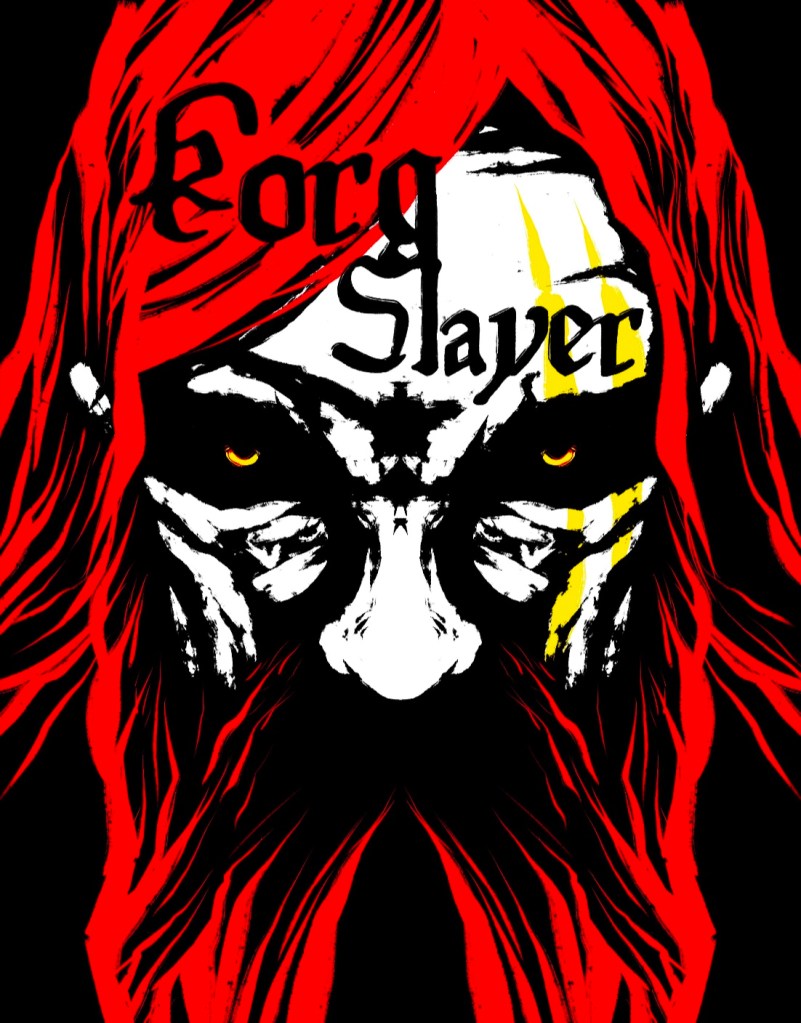
You’re playing through the lives of the staff and guests at Yazeba’s Bed & Breakfast. She’s a witch who closed off her heart a long time ago, but keeps letting odd people and outcasts into her home. This game delights in toying with the idea of what a roleplaying game is. The scenarios are all chapters in the book, but some of them are locked until you do certain things or fill in spaces in the book with stickers. There are a handful of guests, but more are unlockable and there’s even a bonus character.

The play of the game is easy enough, with characters gaining and losing tokens by performing actions which are disruptive, bad or dumb ‘whoopsies’ or positive, useful or supportive, ‘bingos’. There are only a few different types of chapter, mechanically, but they all change a bit with each one. At one point you’re doing the laundry but using actions which will disrupt the process in order to eventually get it right. You’re suggesting ways to entertain an impatient demon child (another player) and building tokens up on them or watching everything go awry if they ever run out.
The characters are shared, with each chapter suggesting a couple of fixed characters and guests, then the players can pick from anyone else they’ve unlocked. Each character has their own track of achievements or progress or programming.
Gertrude – A perspective character, masked and living on the washing machine in a B&B where everyone has a room, she’s growing in confidence and learning who she is. They have an achievement list to evolve.
Hey Kid – A pesky demon child, they don’t know who they are yet, other than a mischief. They’ll develop character traits and doodle a comic on their sheet. Eventually they’ll even become Hey Teen.
Sal – A chill dude with a sweet van and an interest in music. He’ll be working on a song. He’s also scribbled all over his sheet already.
Parish – A knight who was cursed into frog form and now works at Yazeba’s in the kitchens. His customisation is based around recipes.
Amelie – A robot housekeeper who has programming you can customise as you play.
Yazeba – The witch judging everyone else, gaining and crossing off enemies.
Sal, probably my favourite of the residents.
There are evolved versions of some characters like Hey Kid, The Moon Prince as an unlockable character and ways to retire some characters. You also get guests like an evil skeleton called Rag-And-Bones and The Rabbits in The Garden Who Wear Little Outfits.
It looks beautiful and interesting, I’m really curious about trying it out. There’s a demo version which was out in beta and I’m thinking about printing the proper book’s pages which were shown in that document. That way I can test the waters with my group before stickering the full book. The only negative I’ve got at the moment is that if you’re running from the PDF instead of the One More Multiverse VTT or the physical version when it shows up is that there wasn’t a file with the stickers to print out.
Gertrude’s backpack, slots for stickers and what they unlock.
Broken Cities
By Côme Martin
Read before? No
Played? No
Some of the nice, crisp design of Broken Cities
I’ve realised that any Côme Martin game will be an interesting one. This game is about existing and traversing a strange city, inspired by things like Italo Calvino’s Invisible Cities, making it doubly interesting to me.
The game uses a deck of playing cards to establish the city and the people travelling in it. The city has quirks and a need. And it can change over time. The people have primary and secondary goals, as well as odd pasts. The City plays a card as the focus of the scene and players react to it, making actions and either accepting or refusing any compromises the city makes of them. The city itself is mapped out using the cards and these can move around as you play.
The game is glibly written with a fun tone and a ton of footnotes, although only reading it the game feels like it’s not yet entirely in my grasp. While it could come across a little broad at first for traversing a city, you drill down into the oracles for what you draw and it gets suitably weird. I found this with the author’s Green Dawn Mall, too. I’ll have to play it and see how it goes. This feels like one of those games such as Brindlewood Bay and Trophy Gold where just reading isn’t going to be enough to make a solid judgement of it.
R’lyehwatch
By Jayme Antrim & Jesse Ross
Read before? No
Played? Yes… just recently
Just another day at the beach.
I’ve picked up anything Jesse Ross has done, and after the grim portents of the Trophy games, this one was a weird pitch. It’s Baywatch meets Call of Cthulhu. That’s the pitch. Luckily we’re in an age where a game with that basic a premise actually has good mechanics and rules ro back it up.
You’re all lifeguards with one out of three ticked and a role. You also get an ability or piece of equipment and there are nice tables to help you generate your character randomly if the whim takes you. There are negative quirks which you take to make tasks a bit harder in return for rewards. Every character automatically has the ‘slow motion’ quirk to justify running in slo mo like in Baywatch itself. Here it’s explained away that you’re in a spooky city where time doesn’t always work right.
The basic system is that you’ll be given a difficulty between four and six and a stat. You roll a number of dice: one if it’s your stat, one if your role works and one if you spend a Luck and use your perk. You roll the dice and aim to get the difficulty or higher. You can increase the difficulty by tagging in a quirk and gain a Luck point. If you’re successful, you can restore your Grit, the stat working as your health, your composure and your insight into the horrors.
There are tons of tables and pick lists to help you generate episodes, and two scenarios of which I’ve run one do far. It was really good fun, and I’m eager to run it for folks again in the future.
Conclusions
Out of these books, I’ve run three of them on the month I’ve read them.
I’ve added one IndieGoGo book and four which I got through Patreon, along with their companion books. Going forward, there will be other books from crowdfunding platforms beyond Kickstarter arriving, hopefully not so many as to make this an insurmountable task.