RPG a Day 2020, Part Twenty-Seven – Favours as a good plot starter
I thought this said ‘flavour’ at first and got excited about waffling on, saying about how some mechanics have a kind of flavour of their own.
Starting a quest can be a problem, especially getting groups invested. I’ve spoken before about the ‘what’s my motivation’ problem I had in tremulus. If the group don’t know each other or don’t care about the plot, things can meander and you can end up faffing around. I don’t even mean in a session zero kind of way, I mean doing that thing some Netflix shows spend way too long doing of spending episode after episode trying to figure out why they want to be heroes before finally trying to do anything. Our characters need to cut to the chase. We’re on the clock and want to get to the action.
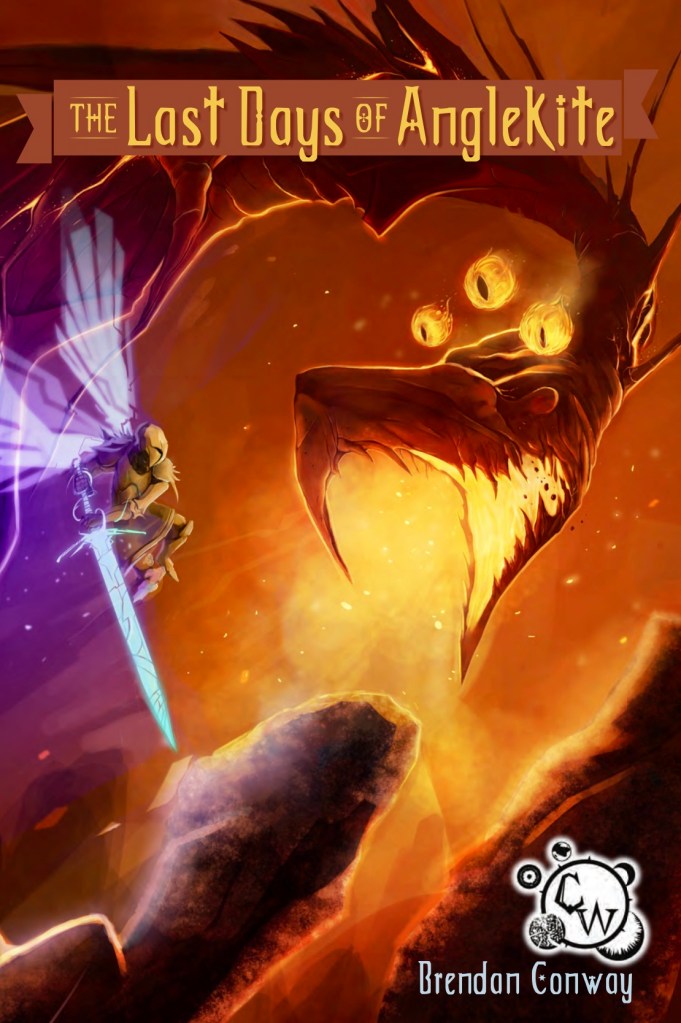
I’m not posting anything by Adam Koebel here, so look at this cool cover for a DW setting that can be used in other systems, too.
There are variations on this, but those don’t fit within the theme so much. Owing someone a favour can be a great instigator for adventure. It might be contrived to have everyone in the group owe someone, but for a one-shot that’s completely fine. If the group all know each other then you can have one or two players owe an NPC a favour and have that called up.
In a Dungeon World one-shot I had the group acting as servants for Prince Khalid of Canbanton. It was a coastal town with a lot of guards protecting the place internally, but they outsourced to adventurers externally. In this case I did one of my favourite things and asked the players why they each owed him a favour. A lot of them were nebulous help or promises which meant if I ran other one-shots in the world (and I did) then they already knew why they owed him.
Another time I actually started with the group at the start of the adventure site, skipping past the initial briefing and simply saying that the group are troubleshooters enlisted by a noble to solve a problem. The problem turned out to be the noble, so the group were able to clean their slate and appease some ghosts by sorting him out.
In a recent game of Squamous the premade adventure in the book has elements of this. The group are tasked with recovering a book for a friend. I asked how they knew the friend and some of them made up the favour, others didn’t, but they all bought into their motivation right away.
A fun, light cosmic horror RPG.
It’s an easy trick and one you can do almost thoughtlessly. I know a lot of GMs like to start at the start and to have the discovery of a plot hook, but personally any tool to rocket folks into the story and get the buy-in is good with me.
Another potential way of doing this (albeit without favours… sorry RPG-a-Day deities!) could be to start with the group fleeing someone or something, then asking why during the action.
I like magic when its weird. That sounds like it should be a fairly basic statement, but actually that’s something a little difficult in RPGs when so much can get laid out like feats or special abilities with slightly different parameters or special effects.
I guess my main issues fall mainly in the field of traditional games, although indies can also have this happen. The main example, of course, is Dungeons & Dragons. I’ve run every edition but I must have run Third Edition the most. At that point, spells were their own thing, but they were still a list of useable resources. You could cast a certain amount a day and added it to your shopping list of things you could use like with feats and magic items. People started to get more used to the idea of purchasing magic items, things like +1 swords. I used an old Dragon Magazine article which had tables for the decorations on the magic items to help differentiate them, but it still became quite transactional.
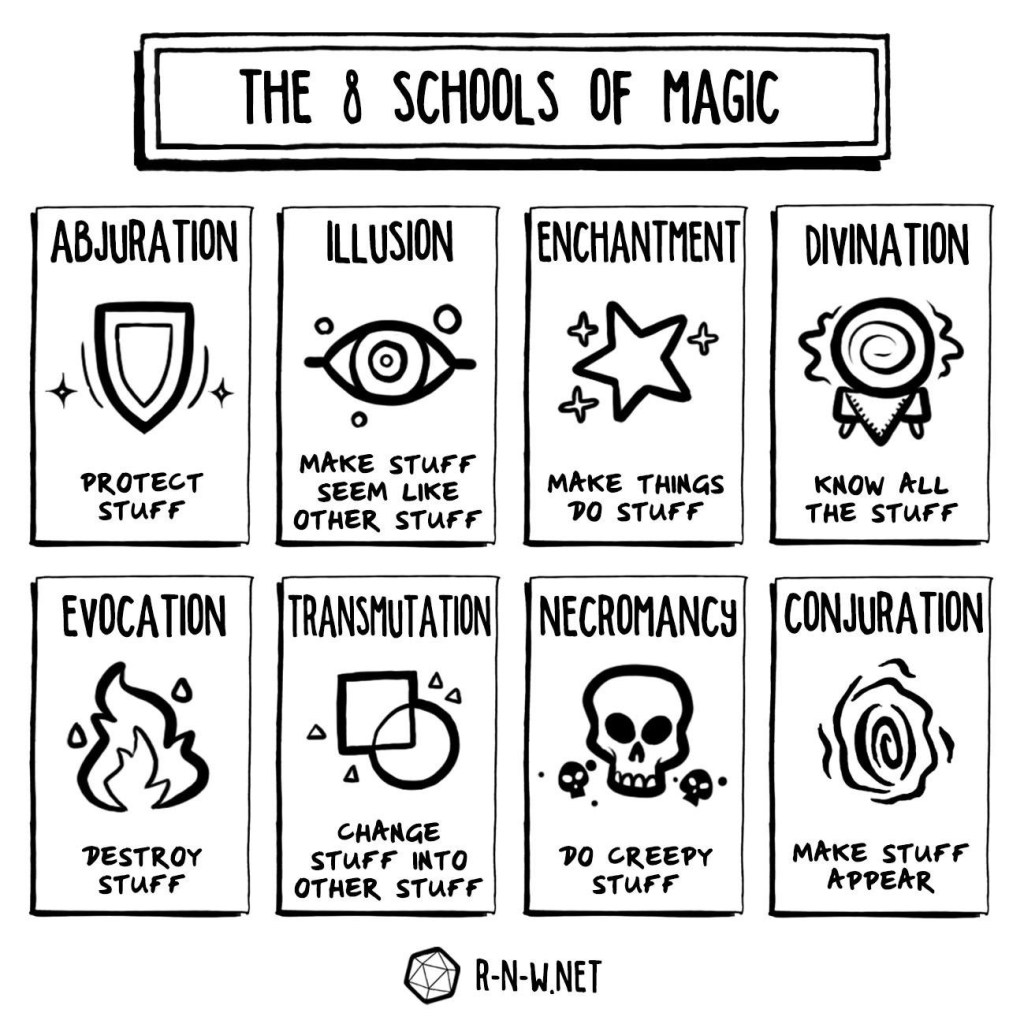
The game culture was also a bit like that, where players would expect retailers to have magic items, but also for a wizard to be a specific thing. There would be schools, there’d be purchasable scrolls and they’d all act the same way. You know, the D&D wizard way. Sure there were sorcerers and clerics, but their magic was relatively similar.
RNW’s great breakdown of schools
I enjoyed playing clerics and druids the few times I wasn’t GMing, so I had a bit of a bigger spell list and often tried to experiment with some of the weirder spells from sourcebooks for flavour. It wasn’t seen as all that optimal, which meant frowns from players, but there we were.
World of Darkness also broke powers down into different systems, but there were ways of playing with them so they felt different. Playing Mage: The Awakening and encountering a Vampire using the rules from Requiem were fantastic for telling the players they were dealing with a whole other creature. Even before the mix and match toolbox of the New World of Darkness I ham-fistedly slotted together the Old WoD creature types in Hunter: The Reckoning as the monster abilities in that game didn’t feel as flavourful and distinct as using each monsters’ own mechanics.
Dungeon World had listed spells for any magic classes, but there was a point where the Druid asked if he could ‘Defy Danger’ by turning into a moth just in time. It was a great moment where as the GM I realised that yeah, that totally works in the fiction given his powers. The same was able to be done with magic users quickly summoning up light or fire or something. Because all a Powered by the Apocalypse move needs is fictional positioning, being a magic user gives you ammunition to handle the magic as oddly as you want.
Quest has some fun ways of handling these sorts of things. First of all there are the narrative aspects of the character sheet. We had a person with a mechanical arm and a doctor cursed into the form of a grasshopper. We’re these choosable from a list? Nope. The players decided these would be in the fiction and now they are. I asked Arthur, the player of the grasshopper, whether there were grasshopper people and he explained that it was a curse placed on him. Now there are curses. We didn’t know how it happened or whether it could be cured, but it was a strange piece of magic which made him and the story unique. The same with the mechanical-armed character, as that moved the tech level of the fantasy world up a bit. The character’s community were a kind of techno-Amish, separate from everywhere else and fixated on making machines for agricultural means.
Some lovely Quest art
The next fun thing was the ability tree. The majority of the classes were magic in different ways and had some interesting, flavourful ways of being cast. They also are broad enough that you could make them seem however you wanted. The grasshopper was a Doctor class, which could be medics, clerics or necromancers. Being more of a man/grasshopper of reason, our hero ‘cast’ the ability to discern a creature’s death without casting any spell. They were simply able to discern through medical prowess. You could change up that ability to get a psychic flash of their death, you could speak with the dead or change it up in any number of ways to make yourself unique and the magic you use unique.
Exodus is a magical city made out of other cities, filled with immigrants from other dimensions who sought sanctuary. It’s a big old mess, and also one which has no set version of magic. It was originally used with Dungeon World and specifically the Class Warfare expansion which made character classes out of pieces of smaller classes mashed up. This meant we had an elemental mage-slash-martial artist, a magical lawyer and a knight who could psychically manifest weapons. These all worked and interacted, but they felt different. There weren’t really many schools, or at least the ones there were kept quite specific disciplines. The town of Littlewall had an academy of Brick Wizards, found throughout Exodus and trained here in order to help construct roads and buildings. Booze Wizards gravitated towards Solace, its vineyards and the harvest god who lived there. Magic could be a tiny effect a farmer had or a horrific ability to channel dead gods from other dimensions. This is my kind of default preference of magic. It’s anywhere from small to massive, it’s usable by players, its different in all its forms and sometimes it’ll demand a great cost.
I mentioned about flavouring things in D&D earlier this month, but I’d extend that and say that even in these trad games, it’s worth playing with a special effect or two, even if it’s not something which provides a quantifiable bonus. Maybe the sorcerer’s eyes occasionally give off glowing, swirling patterns. Maybe grass grows behind the druid when they’re happy, or there’s an ambient music in the air when a bard leaves town as people are inspired to take up instruments. It’s not difficult to do, but it’s often forgotten for the sake of simple function and numbers.
There are a lot of assumed player types; your rules lawyers, your munchkins. A lot of these have changed or been reframed over the years. A rules lawyer can actually be great if you turn them into your rules caddy. The munchkin could help teach the other players how to do better use their abilities.
There’s a role which I keep encountering and encouraging in my groups in the past few years. It’s the “Chaos Engine”. It’s been a phrase some of my players have worn with pride. They know they’re the person who’ll push the big red button or pull the random levers to see what happens. This sounds like it could be disruptive and occasionally it can be, but groups can get stuck. They might look around for something to do, they might be acting too cautious about their plans. At the same time, the Chaos Engine in the group has got bored and already pushed a button or wandered off down a corridor.
This guy did not get this way making good, safe decisions.
In the past I may have viewed this sort of thing as disruptive behaviour and when done with no respect or love for the party it still can be. Most of the time these days, the Chaos Engines I’ve known have been fantastic at initiating plot with their lack of impulse control.
My current incarnation of the In-Fighters has one player, Wade, who is my Chaos Engine. His motto has become, “No one was there to stop me” and that pretty much explains it. In the olden days of D&D I know that a group would have babysat him or lectured the player because they couldn’t count on a slow, cautious attempt at wandering through a dungeon and spending the least amount of spells, HP and so on while trying to get a victory. These days though, the group will load him up and get him to do things on his own as they need someone to do the bad/dumb thing. Sure, he’ll sometimes end up being shot off a castle with a ballista, but those are the risks the Chaos Engine takes.
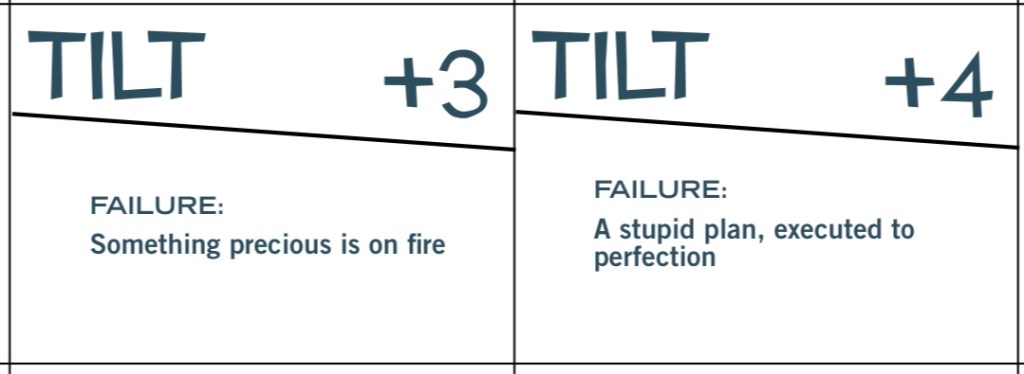
Some Fiasco Tilts which happen in far more games than just Fiasco.
Wade has had characters fly into The God Quarry, fly into the distant future, confront the avatar of an Anti-God and died several times. It hit the point where he realised character death would negatively impact the whole group in Band of Blades so he armoured his first rookie up to a massive level. This didn’t stop Wade being Wade, so the character still charged a scrum of the undead, played with explosives and is somehow still alive.
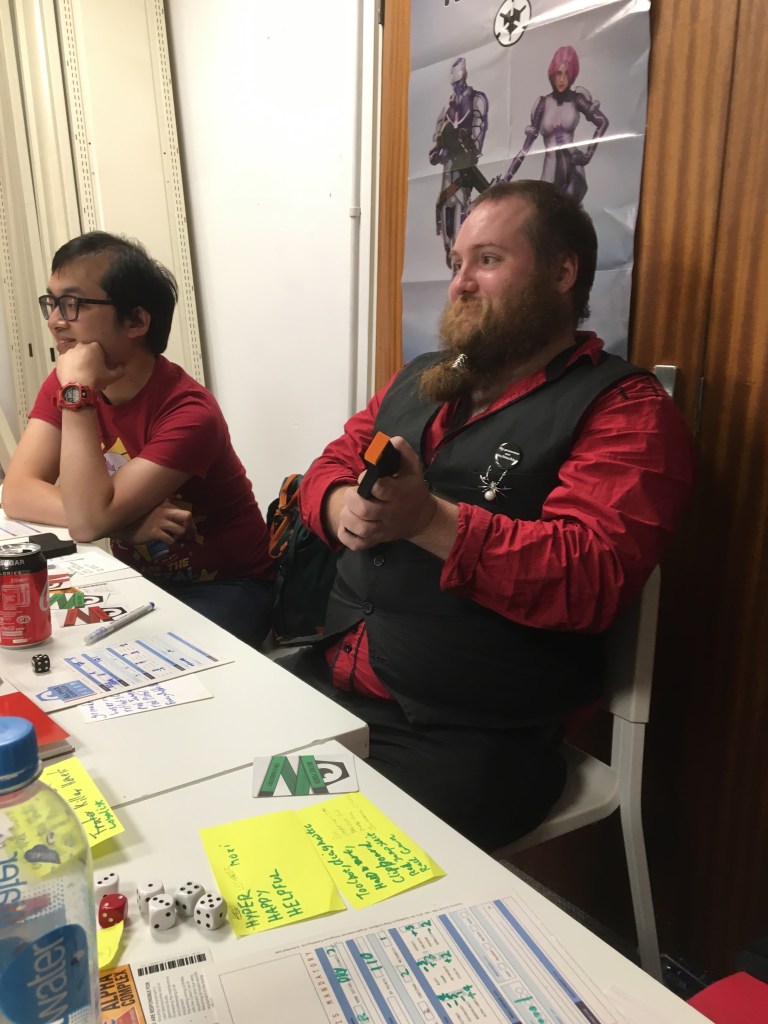
One of my chaos engines, Rhys, idly pointing a Cash & Guns gun at me in a game of Paranoia.
My RPG community nights have Rhys, who at times talks like I’m frustrated that he’s the Chaos Engine, the most likely to start a cult or lose a hand in a Blades in the Dark standoff. The thing is, he’s pushing the story forwards and as long as that happens then the Chaos Engine’s a great part of a group.
I listen to the System Mastery podcast and they covered an RPG I’ve owned for years but never actually played. The Land of Og. It brought back all the memories of picking it up at GenCon UK, reading it and raving about it to my players over the years.
The expansion, because Land of Og was such a classic it needed an expansion.
The Land of Og is an RPG where you play cavemen. A comedy game about them. You use D&D stats and stat spreads, but where D&D players go from 3-18, you go from 1-6 for most of your stats or 2-12 for your primary stat. The joke is that cavemen are really bad at everything. Listening to System Mastery’s episode and looking at the books again I can confirm these cavemen would not have been the ones who survived and evolved. It’s funny saying that you’ve got a tiny vocabulary. There’s a table of words like ‘sun’ and ‘stick’ and ‘verisimilitude’ (which is how I first learnt that particular word). The problem is that communicating as players and characters only using a small vocabulary’s fine but I didn’t even realise how few they were until my reread. Overall, the concept’s funny but it looks like it would be a painful slog.
This is the problem with some comedy games. It’s traditionally been difficult to make a fun system which also makes a fun game. The humour often ends up inside the book, which will probably only be read by the GM. The Red Dwarf RPG and countless old d20 system era games suffered from this, where they were more funny than functional.
So what are some good examples of how to deal with this?
I ran my players through the psychological tests here and they were great fun. Having to point at the [blank] and the [blank] on the nearby Gamma World book had one of the players cracking up.
Paranoia’s an ancient game, but still works for the most part. The system has almost always been completely superfluous to the fantastic dystopian comedy world. I’ve played almost every edition but it’s only been the most recent one which has stuck in my head. In a way it survived because no one cared that much about the system. Paranoia’s world is a ‘utopia’ set underground in the year 214 (now and forever 214). The Computer runs the Alpha Complex, run by clones who in theory are perfect and compliant with its wishes. Only The Computer isn’t working right, the clones are all defective and the countermeasures against problems are based on a box of 1950’s propaganda which was uncovered. Players are ‘troubleshooters’ who have to hunt mutants and members of secret societies while all actually being mutants and members of secret societies. I ran my first session drunk and having managed to lose the core book. It made frankly no difference. The game was very much the case of when things start to go awry, the system is extreme enough that it rarely mattered what it did.
The most recent edition had a more robust system powered by picking what you were good at and what the next player was bad at. This drove players against each other and made erratic characters. A ‘Computer Dice’ was great for randomly making The Computer or other technology interfere. It mixed mechanics and the world to make a daft, entertaining game. My only gripe was the entirely superfluous card-based initiative and combat action system which I just replaced with Balsera or ‘Popcorn’ Initiative represented by the foam guns from Cash & Guns. This had the added benefit of making everyone weirdly trigger happy.
Paranoia took several editions and is one of the classics which still works, albeit with the added necessity of mentioning how GMs shouldn’t take the opportunity to be a complete dick to their players. We’re all watching the characters screw each other over together, as is The Computer. The GM doesn’t need to get hostile to the players as well.
In this modern age of fantastic indie RPGs we’ve got a lot of ways of handling comedy.
A grizzled gull.
Some games play the concept straight. My good friend WH Arthur has made, “B-Town Beak-Tectives” which tells noir mysteries from the point of view of seagulls. These are horrific monsters in Brighton, where we both live and B-Town is a kind of fictionalised version of. The world is ludicrous and the system’s brilliantly seagull-themed but in-world it’s all played straight. The mechanics and the mystery creation are all there.
Then we have the Grant Howitt one-page RPGs. There are several authors such as Ursidice and Minerva McJanda who also publish these kinds of games, but Grant Howitt is both prolific and silly. From the Actual Play darling Honey Heist to Jason Statham’s Big Vacation, Adventure Skeletons and more, these are all very fun, silly games. In this sort of game the humour is front-loaded to you can see the broad concept, get some prompts about what to do and then are sent on your way.
Bears. Hats. Crime. What’s not to love?
I remember before running Jason Statham’s Big Vacation having a moment of panic, wondering how I could be funny and whether I’d end up forcing it. Luckily the mechanics the group have prompt a lot of silliness, as did the tables. The conflict as a GM is less about being funny as it is being quick. I found myself having to work almost one step ahead of the players through fits of laughter and barely able to keep my notes together as I went. This is why I’ve ended up having to use notes my players made as well when writing up reviews of those games. Grant himself has said before that he forces a lot of cognitive load on the GM in return for everything being contained in a single page. It can seem daunting, but the payoff is fantastic. Finally, I also wanted to give a shout out to the 200 word RPG, “Fuck! It’s Dracula!” This was the first game I ran during lockdown. I figured I’d run something nice and simple, which it was. The tale was very daft, involving a relationship between Dracula and a vampiric cow who was his bride. The group rode a jet-powered coffin across a desert. It was a fun time and I’d recommend checking it out.
For a little treat, let’s look at a villain for Masks.
Edgelord was the first villain I ran in Masks. Masks is possibly my favourite superhero RPG and I’ve run a lot of them. It’s about young superheroes who haven’t quite figured out who they are as people or heroes. The moves all relate to how the heroes see themselves and instead of hit points you have ‘conditions’ such as ‘angry’ or ‘afraid’ which have effects and can be removed by certain actions in play.
Masks!
The first session included character creation and I had to have a villain ready who could be a one shot enemy worthy of both setting the tone and getting out of the way when I figured out how to use the origin details the group made into a wider story. They gave me the Periodic Table of Evil which is just fantastic. In the meantime though, I had a piece of paper with “Edgelord” on it.
Some, uh… edges. Look, I can’t draw, I don’t have a picture of Edgelord.
The group were at their headquarters which was a sofa and a small patch of land on an island just outside of Halcyon. It was decided that there were so many superheroes that the oldest, most famous ones had statues on little islands all down the coast, like a ton of Statues of Liberty. The group were on an island which had a half-destroyed statue of a hero who’d been completely forgotten. This meant no visitors anytime soon (it would later be attacked and destroyed by Krill the Conqueror). They heard about a villain holding a bunch of kids hostage in an ironworks where a school tour was happening.
The group found the ironworks has suspiciously powerful defences in it which had been activated, linking back to Apollo, a liquid metal boy who was the group’s Newborn. But then there was Edgelord.
One class of kids was held hostage by him, an angry, sweaty boy who’d home made his villain outfit on the fly and had a pair of hands which kept changing between different kinds of bladed forms. The group fought him, but ultimately it was seeing beyond the mask which worked. Stalker, a nerdy kid whose body had been turned into a bladed alien, performed the move. He realised that two of the kids being held hostage bullied Edgelord and put his hands in some experimental metal goo which is how they got changed into what they were now.
The group eventually got him to stand down and they went out to a Vietnamese restaurant/karaoke joint called “Pho Show”. Edgelord started to turn his ways round. I loved that the ‘guilt’ condition was able to make him stop what he was doing.
The kids from Masks just hanging.
Later on Edgelord was seen trying to be a bit more considerate and well-behaved as hero, even having a Blademobile, although it got stolen by the heroes when they needed to race around town stopping a bunch of their villains from ruining a parade. Later, when the Periodic Table of Evil took over the city by pretending to be heroes, Edgelord was the first ‘villain’ they captured. He was seen a couple of times in their super-prisons, but that’s been it so far.
You can read about Edgelord and the other villains the group fought against at Who Dares Rolls. I’ve even included the rules to run them in your own series.
I know this is a bit of a stretch, but I’m going with it. Fire’s a fun thing in an RPG. At least, in some RPGs it’s fun.
I have an index card which was used in Fate Core. It said, “On Fire”. I used white index cards for Aspects and orange index cards torn in half for Boosts (one-off Aspects). These were narrative parts of the game which could be weaponised by players and NPCs alike for a bonus. You could use, “Sand in yer eyes” to temporarily blind a person and get a +2 to your roll. Environmental Aspects were more like, “Heavy Winds” which anyone could use, often with a free use or two. Players could use moves to add or remove Aspects.
So then we have “On Fire” and why any of this is important. I liked piling up the Aspects and Boosts at the end of a session as it created a weird collage of words. There was one which happened multiple times during a game of Spirit of the Century. I ended up realising that I needed to keep only one Aspect card between sessions. “On Fire.” No matter what, the group ended up burning things. It’s a nice Aspect for hindering people, but also for using in fights or dramatic scenes. Folks were able to set light to weapons when fighting someone or having bits of scenery fall down on an NPC.
My collection of aspects and boosts. I don’t know where my ‘On Fire’ is at the moment as I only need a virtual one these days.
The John Wick (not that one) games use fire as a good tool against the players as options for Risks in Houses of the Blooded and 7th Sea Second Edition. As an example you have the initial challenge, “Get through the burning room” and add risks like, “You get burnt” or “You lose something in the fire.” You can even have opportunities like, “You find evidence of who set the fire.”
7th Sea is very dramatic.
Finally, I have a cautionary tale about fire, from an RPG I still have a lot of fondness for. Fantasy Craft. The player-facing side is mostly great, even for a d20 system game. It had backgrounds before 5E and did more interesting things with them. It had so many great actions which could be done in combat without you having to be great at fighting. We had an actual pacifist priest in ours who would tire or stress out foes. Most of the problems were with the GM-facing side such as the weird need to have scaling foes complicating any enemy creation. The biggest exception to this player side good, GM side bad structure was fire. Fire was not fun for anyone. Fire was incredibly infectious and fiddly.
The fire rules, which I remember being about a million pages longer back in the day.
One of my group, Steve, decided to run Pathfinder’s Rise of the Rune Lords using Fantasy Craft. A noble idea, especially as it meant I didn’t have to play Pathfinder, but for a first GMing attempt I’d have recommended something requiring less work. One of the group, Josh, decided he’s play a priest type character and pay all of his money into a donation box with the expectation the plot would provide something interesting. Again, a nice idea, maybe less so with a new GM. So he got a stick when we went into a dungeon, didn’t have any armour and promptly went on fire when facing a monster. Everyone had played a couple of seasons of Fantasy Craft with me at the helm, so they knew I had a literal print out of the fire rules handy just in case I had to deal with them. I also had Alex, a player who actually engaged with crunchy rules more than I did and was willing to be my bookkeeper when it came to fire. So Josh’s priest was on fire, and everyone saw the rules sheet come out. We all stood back. He wasn’t able to put himself out and we weren’t willing to help him as fire spreads like you’re covered in petrol in Fantasy Craft. We all stood there for a few rounds, watching our priest burn to death from damage which armour he could have bought would have soaked before it hit his surprisingly flammable flesh.
Maybe ‘rare’ was the wrong word for that anecdote?
I was originally thinking about writing yet more praise of Trophy and the addictive ‘push your luck’ mechanics found there. I’m going to stick with pushing your luck but I want to talk about a different system I’ve not written about yet.
This nasty boy, ready to give you a chomp.
I was a massive fan of the Alien franchise as a kid. My dad showed us the first one when I was eight and my little brother was six. He figured we’d want to see an 18-rated movie and we should do that with him so he could talk us through everything afterwards. I can see some logic in that and hopefully it didn’t warp me too much. We saw Aliens shortly afterwards and when there were UK reprints of the Dark Horse comics, I picked them up from my newsagents. I bought the Kenner toys. I was going to be an easy mark for the Alien RPG by Free League even if I thought I was long removed from any Alien fanboyishness.
My favourite Alien toy… I might still have the blue facehugger somewhere.
The system used is similar to Coriolis, Forbidden Lands and others Free League have, which I own a few of but haven’t really read beyond a cursory skim. You have a pool of six-sided dice you roll, looking for a six. It’s a bit difficult not even being like Blades in the Dark’s system where you can succeed at a cost with a 4+ as your highest dice.
Hide if you can, it probably won’t save you, though.
So then there’s Stress. As the game goes on your character will get stressed out. You’ll see dead bodies, you’ll get attacked by monsters. It’s all really stressful. They’re a different set of d6’s which you add to your pool. The theory is that you’re getting hyper-vigilant, tense and focused on trying to get through the situation. That’s great, right? Extra dice are lovely. The problem is that they’re different for a reason. If you roll a 1 on any Stress dice, your character panics. There’s a table of results which show how you freak out. At first, they aren’t even all too bad when you’ve got a little Stress, so you kind of want to suffer some for that sweet bonus. You can perform some actions to calm down and lower it, so you might be able to fine tune it and try to keep some bonuses. Then it slips and gets a bit too much. Perhaps someone else panicking adds to your Stress of makes you panic as well. You can only manage so much and then it all explodes. This is what led to three of the surviving characters all going berserk and attacking each other in the grand finale of the game of Alien I ran. For some of the rolls they had, the Stress was perfect and really helped. Alas, in the end it didn’t and they weren’t able to escape LV-426, dying at each others’ and a xenomorph’s hands.
I like a good mystery and back when I was first roleplaying Call of Cthulhu was my game of choice. It combined investigations with horror. The problem was that in a lot of the writing things could end up gated off by a success on a die roll. If you fail your Library Use roll, you just have to keep going. The 7th Edition of Call of Cthulhu has apparently been a bit better at dealing with these sorts of things and it was of course possible to hack the system or adventures to behave better. Rather than do that, here are some games which have tackled investigation in interesting ways.
Trail of Cthulhu and Yellow King’s Investigative Abilities
Both born out of the Gumshoe system, Trail of Cthulhu and Yellow King bypass the need for a pass/fail system when clues to pursue are on the line. If you have a relevant ability then you can get any clues which are present. Nice and simple. I mainly know this from Yellow King as I’ve been working my way through that series of books at the moment.
As an example, an art student in Yellow King’s Paris setting is in the workshop of a friend who went missing. They have Sculpture as an Investigative Ability so they look around and the GM explains that there’s one statue which stands out from the others. Specifically the style doesn’t match the artistic flourishes which the missing friend put in his work. Maybe the feet are more normal than the artist makes them or the expression doesn’t fit those he tends to make. The player can accept that this is a clue and the statue stands out, or they can spend a Push to get a bit more. Maybe the Push allows the character to see wet footprints just about visible leading up to where the statue is but not away, or explain that the stone is not like anything found on Earth.
The King in Yellow?
Squamous and Cthulhu Dark’s Relentless Clues
These are two games which have quite different ways of handling cosmic horror. Cthulhu Dark is a game which follows the descent into forbidden knowledge and the innate tragedy befalling the cast. If you fight a monster, you’re dead right away in Cthulhu Dark. You have one stat which is your Insight slowly cracking as you see horrors you were not meant to see. Squamous takes more of an investigatory approach, allowing success in fights, campaigns and levelling up of characters.
Both these games do one specific thing with these stories: Even on a failed roll, you get a clue. Cthulhu Dark has you roll 1d6 plus one if you’ve got any character details (background, career, etc) which will help and another if you’re willing to risk your body or mind. You pick the highest result. On a four you get what you want, on a five you get a bit of a bonus and on a six you get too much. On a one to three you get only enough information to continue but with a sting in the tail like taking a lot of time, getting hurt or anything else along those lines.
Squamous uses 1d6 and you roll trying to get a result equal or above your stat. As an example you might roll against Mind to carry out research or Person to interview a suspect. You can get a minor bonus or penalty to the rolls, but not much. If you succeed you get a major clue: direct & clear actionable information you can make use of. If you fail you get a minor clue: vague & indirect, leading you to something which might help but you’ll need to work to get further with it.
I love that both of these games keep momentum even if you’re hurt or impeded somehow.
Some brilliantly bizarre art from Cthulhu Dark.
tremulus’ Lore Currency
The PbtA Lovecraft game tremulus gives out clues as the result of certain moves like Puzzle Things Out. This is in the form of Lore, a currency powering a move each playbook has, as well as any spells. The great thing is that the information gained can be anything to help drive the plot, but in giving them an amount of Lore you’re saying that this is specifically relevant to what they’re doing and providing them with a prize. The Lore Moves don’t always directly affect the investigation, as they can include things like healing other characters or asking questions about an object. Still, that kind of ‘Achievement Unlocked’ sort of thing in saying, “Have a point of Lore!” means the players know the information they’ve got is relevant to what’s going on in the story itself. Players can get lost or follow false leads, but in Puzzling Things Out, they might become aware of what’s in the scene which advances the story.
A small town with inevitable dark secrets in tremulus
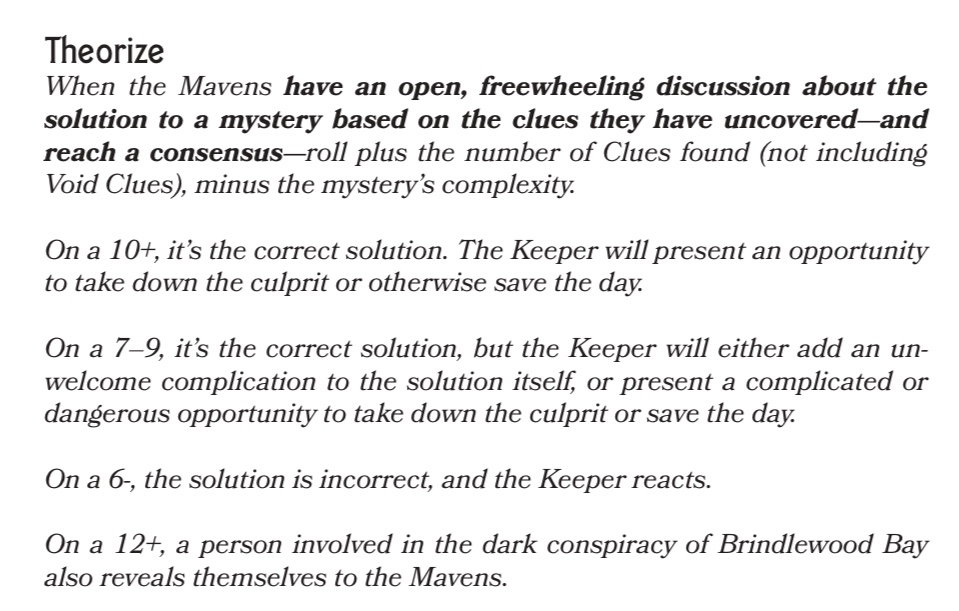
Brindlewood Bay – The “Theorize” Move
This is something I love from a game I’ve been reading lately. Brindlewood Bay has you playing old ladies who are a book club, but also they solve murders.
The GM in the game creates or uses an existing scenario, but they don’t know who the murderer was. They interact with the suspects and the world, meddling and doing cosy moves as they go. The GM will have a list of clues, not specifically leading to any one suspect. Players may interpret where and how they’re found and GMs can skew them towards or away from someone. After the players think they’ve got enough clues they can make a Theorize move which looks like this:
That’s really cool. It means that not only can people play the same scenario multiple times but it keeps things interesting for the GM and players alike as we all build towards an answer which feels like it was always there from the fiction we built together.
Let’s do it, let’s talk about Dread. It feels inevitable with the “Tower” theme.
Dread’s an early story game, relative to where we’re at these days with so many fantastic story games out there. The book is, as admitted by the author, a little padded because it was believed that any RPG should be pretty big. The system itself is pretty short but incredibly thematic. I’m a horror movie fan and despite being someone with lousy hand-eye coordination, the idea of the game appealed to me.
The bloody cover of Dread.
I’d watched an actual play of Dread on Tabletop which was great fun, but also meant that the kind of gamers I’d be running for could have seen it. I abandoned that scenario and moved onto the second, a science fiction one. I bought an off-brand WH Smiths version of a Jenga Tower which is charmingly rough and with slightly uneven pieces. I decided to consider that a feature rather than a bug. I also had a couple of plans.
First of all I got a toothbrush and some fake blood, then flicked it over the pieces so it was already bloodstained and even more thematic-looking. My second plan had to wait until play began.
The Tower.
I brought permanent markers to my first game of Dread and waited until a player died. One of the group, Maggie, did her best to never have to pull a block from the tower. You could do that, as there was always an option to stop pulling or to give up and fail. If a player does that, the GM can do anything short of killing the character. If they pull and succeed then that’s great, they’ve passed the action. It’s when you pull and the tower falls, that’s when you’re done. Maggie had what seemed like a wise plan at first, just not doing anything great or impactful first, but the problem is the group don’t pull blocks in a vacuum. The rest of the group had been pulling from an almost intact tower. This meant when a monster was racing through an airlock to get to Maggie’s character, she pulled and the tower fell.
The creature ripped her throat out and went on its way, continuing the hunt. I gave Maggie a pen and had her write her character’s name on the tower. The same happened with Saffy and her character who nobly sacrificed herself to save the group. Another name for the tower. These names would remain forever, along with the next characters to die in the second scenario, and the third.
I’ve been accumulating names now for a while, making a kind of evolving graveyard for future groups to see. If they die, their character will be trapped there forever. I’ve lent out the tower a couple of times so there are even names on there I don’t recognise. I love that, it means the tower’s got a life of its own. No one will ever know the fates of everyone who died there. It is eternal, waiting for the next deaths.
Some of the dead. I don’t know who Clippy is, but they probably had it coming.
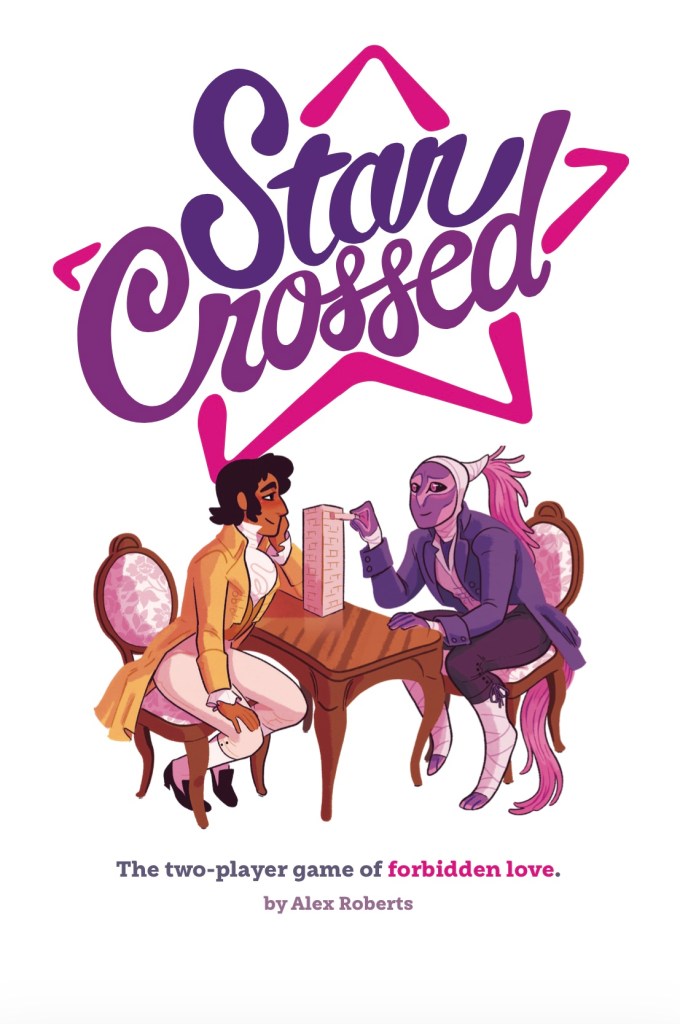
There’s one last thing with this. Despite my dyspraxia putting me solidly on Team “I’ll run Dread but never play” I kind of need to practice with a Jenga type tower. There’s a really cool looking two player RPG called Star Crossed which I want to run. It’s about a star-crossed romance between two people attracted to each other but unable to act on it, like a programmer and hologram, an alien and first contact worker, a planet and its unstable moon… those kinds of relationships. As you play, you pull from the tower. You need it to fall at some point to let the inhibitions fall, but you need a certain amount of pulls to have happened in order to get the best level ending for your story. Too soon and the relationship will burn out too quickly; too late and you’ll never act on it at all. It sounds fantastic, but my current problems are my coordination problems and that the tower is covered in fake blood. It kind of sets an expectation of the sort of story the star-crossed romance I play will be.
It’s not happened a ton, but it’s happened more than you’d think. Certainly more than I thought likely. Meeting someone who seems normal and like other people, but then you find out they’re a fellow roleplayer. It’s great, kind of magical and understandably impenetrable to anyone else around, at least at first.
One of my first encounters was the older brother of one of my friends from primary school. Ollie Ballance and I would play with DC Super Heroes and Marvel Secret Wars action figures, with no care about crossing the franchises over. Once or twice we snuck into his older brother’s room and it was weird. It was a bit like a library with the amount of books in there. Who would need so many books? And why are so many hardback and A4? Ollie might have known but to me it all seemed alien, almost wizard-like. I discarded the thoughts and went back to our games.
Paranoia… possibly the edition I was using at the time. I definitely own this version.
At News International I probably had my biggest surprise appearance of roleplayers. I had a month of work experience in their library, back when they had one. It was a really interesting place, with journalists grumbling that there used to be a bar in its place and endless rows of rolling shelves. One of the longer stretches of time I had was with the data guys, who had to record on their databases each news article which came in and subjects so it could be easily sorted. My role was a bit different, having to catalogue some of the older court cases against them as all the new ones were already on a spreadsheet but the old ones were in rusty filing cabinets. It was mindless, but it was Excel, which I have a deep love for and I could listen to music.
I’d taken in an RPG to read… probably a D&D Third Edition book thinking of when this was. One of them saw this and started explaining that he and some of the others in the office were big into Paranoia, having played a bunch of games of it over the years. I’d only just got into Paranoia having bought a copy at GenCon UK a year before. I was amazed at hearing anyone acknowledge it out loud, especially in a place like this which was so… Alpha Complex at times. We didn’t really speak of it again, but it broke down the barriers between us and created a shared understanding.
At a colleague’s 50th birthday I was drunkenly confronted by a friend from work who started asking questions about D&D (he meant roleplaying in general, but like a lot of people, he just said D&D). After a few minutes I realised he was trying to ask to join a session and see what it’s like. He was die-curious and approached it like he was angling to join some kind of secret society. I agreed and while he was too shy to initially, he joined one of my weirder community nights running Trophy Dark. In that game I ran for him, having never played an RPG before, one of my writing group who often ran games at those nights, science fiction author Jeff Noon and his friend who’d also never roleplayed before. They all bought in beautifully to the tragic horror of Trophy Dark and it was an amazing session.
Ah Trophy… So wonderful, so horrible…
At the same workplace I’ve also found other roleplayers starting to come out of the woodwork. Some new hires in my old team, one of whom tried out a newbie night and instantly got hooked. A board game and basketball friend even told me about how he used lockdown to start exploring playing RPGs rather than board games. They started with D&D but quickly moved to Lasers & Feelings and now Breakfast Cult.
It’s been fascinating meeting so many people who are roleplayers and not as painfully ingrained into the online culture or anything. They’re just there, under the surface playing their games or pining to meet a group and start playing again. Who knows where the next one I find will be?












 Faked Tales