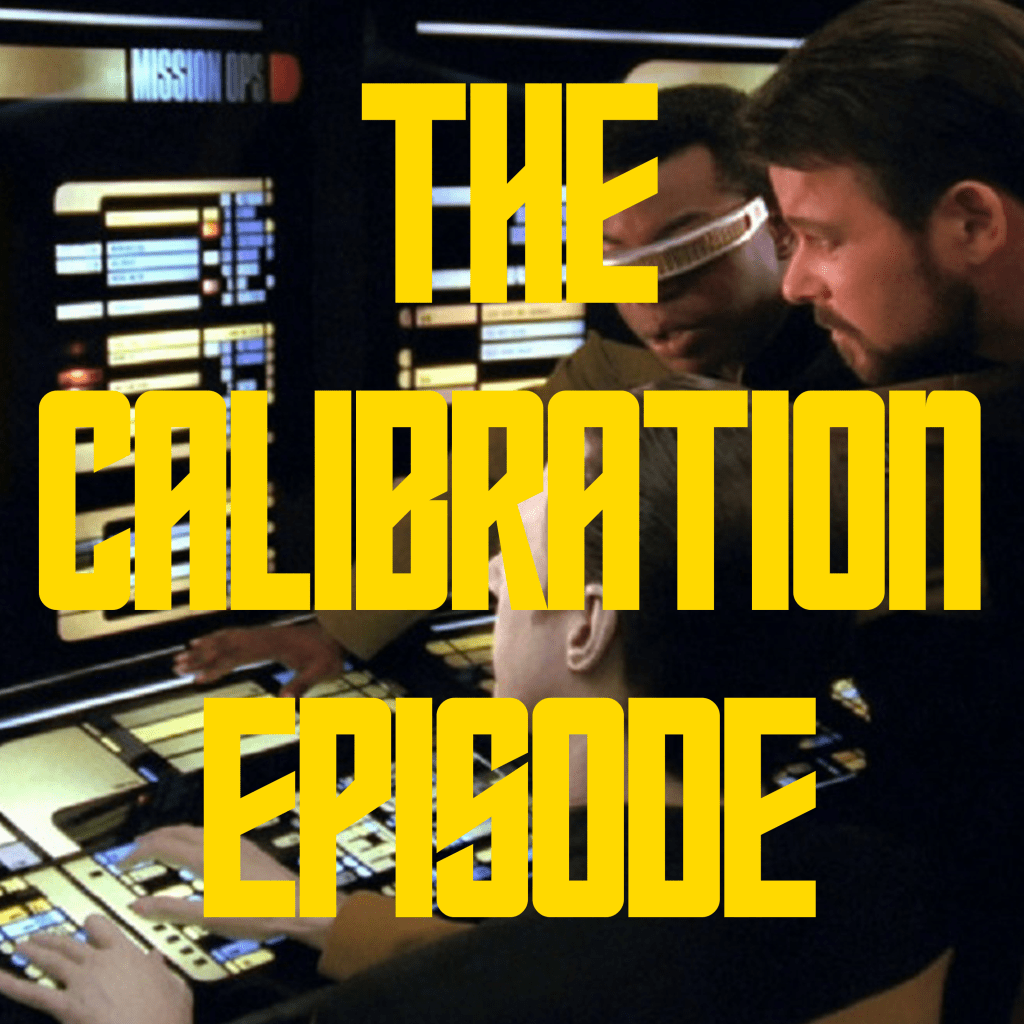
Technically this is the first episode of Casual Trek Miles and I recorded. We wanted to make sure that the tech worked, we could manage scheduling and our interactions were good.
Calibrating systems! I barely resisted putting Garrus from Mass Effect on the cover.
The plan was to talk about our experience of Star Trek as we’re casual Trek fans, but still massive nerds enough to have a long, storied history with it.
We talk about our first Trek experiences, our opinions of the shows and our favourite characters from each show.
We also talk a lot about niche Brighton nerd shop lore. It sounds woolly and it is a little, but it’s still entertaining and we do refer back to this episode so if you’re a hardcore Casual Trek canon fan, check this one out.
The episodes can be found on all podcatchers, on Spotify or using these links:
I announced my Star Trek podcast, Casual Trek, but I realise I’ve been remiss in not mentioning the episodes here as they come out. This is supposed to be the repository of what I’ve done creatively, after all.
Miles and I watched the first six pilots of Star Trek television shows: Original Series, Next Generation, Deep Space Nine, Voyager, Enterprise and Discovery. Then we recorded ourselves recapping the details for folks and put them on a big list of best to worst.
This is a podcast in the style of Battle of the Atom, BatChat and Every Story Ever, but we figured with Star Trek television shows, folks might not always remember what happened in an episode. For our first show, “Flat Galaxy Theory” we didn’t set any limits and ran a bit long on the recap. From the second show, “Attack of the PS1 Aliens!” we set a timer and that helped us move more of the discussion over from the recap to general discussion of the episode, the themes and ideas in it, as well as where it stands on our big list.
Ultimately the list is just an excuse to chat about the episodes we liked and didn’t, and as a fan of weird quests, this kind of arbitrary mission is entirely up my alley.
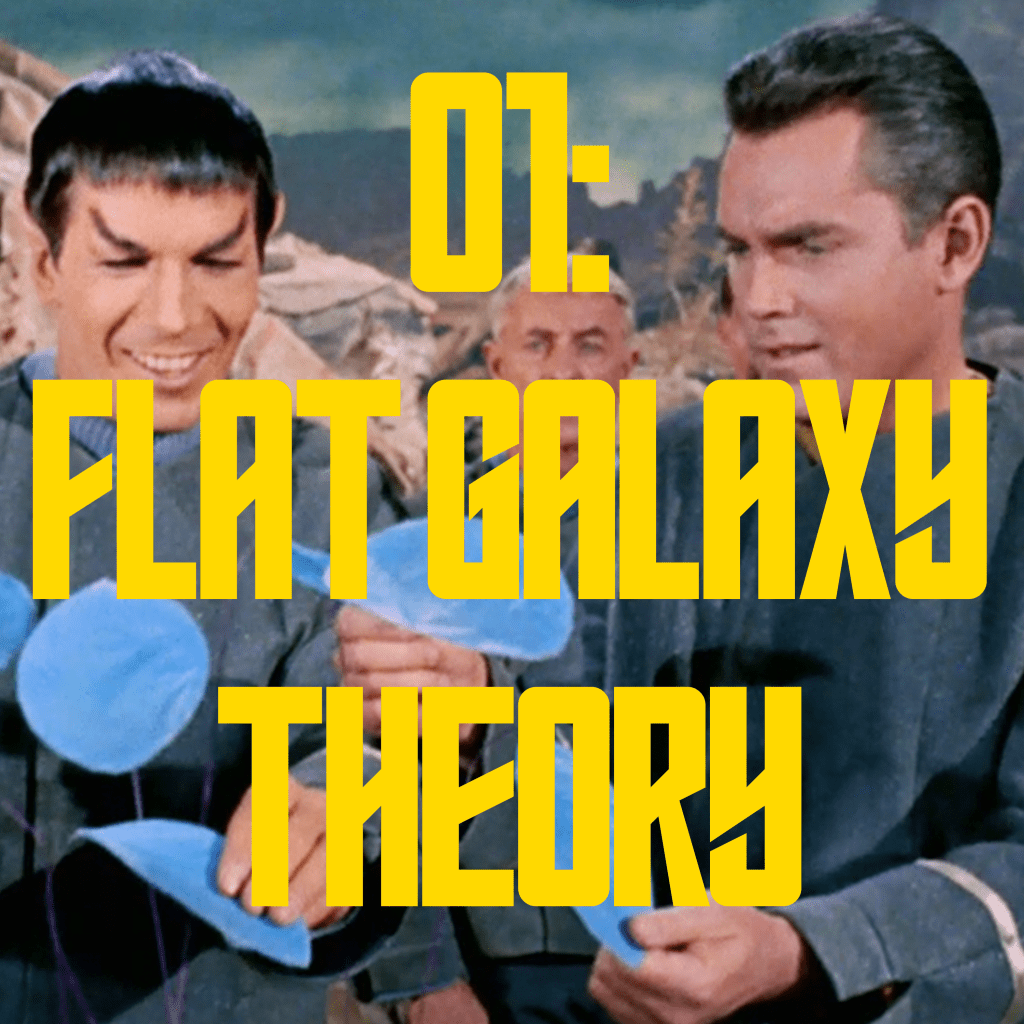
Episode One: Flat Galaxy Theory
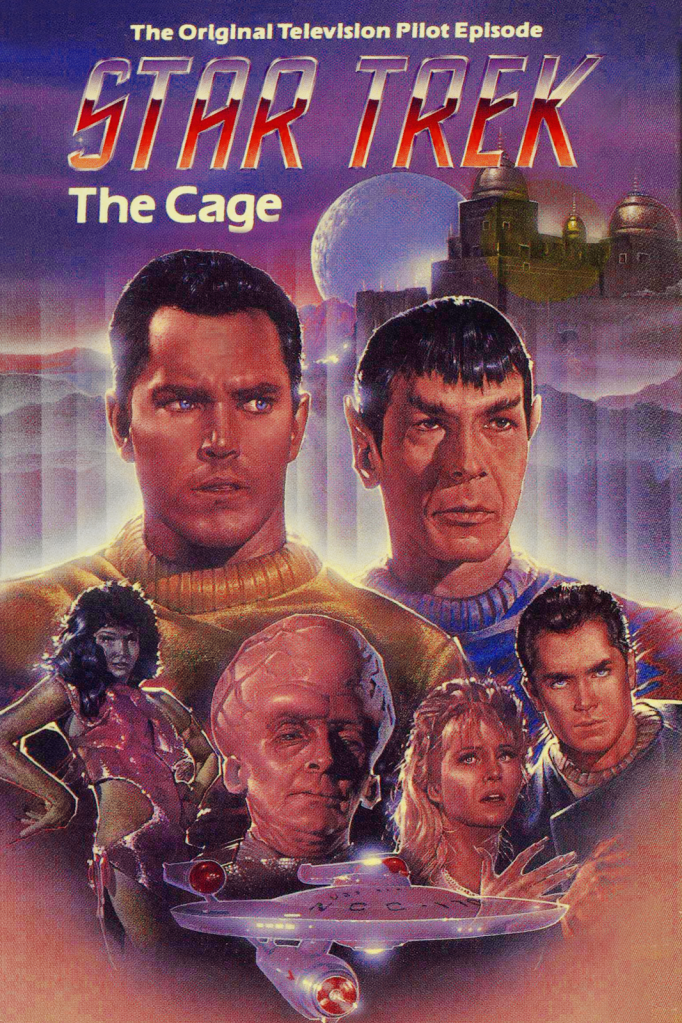
Spock and Pike admire some vibrating flowers
This episode covers The Original Series, The Next Generation and Deep Space Nine.
It was interesting revisiting these shows. The Cage was one of the few Original Series episodes I remembered watching and while there were some elements I’d forgotten, I’ve become massively more forgiving to the hokey effects, shaky sets and weird space fantasy looking elements.
I forgot to mention The Singing, Ringing Tree in the discussion about The Cage, as the vibrating flowers reminded me of that, and while we ran long, I was pretty proud of this as a first podcast episode.
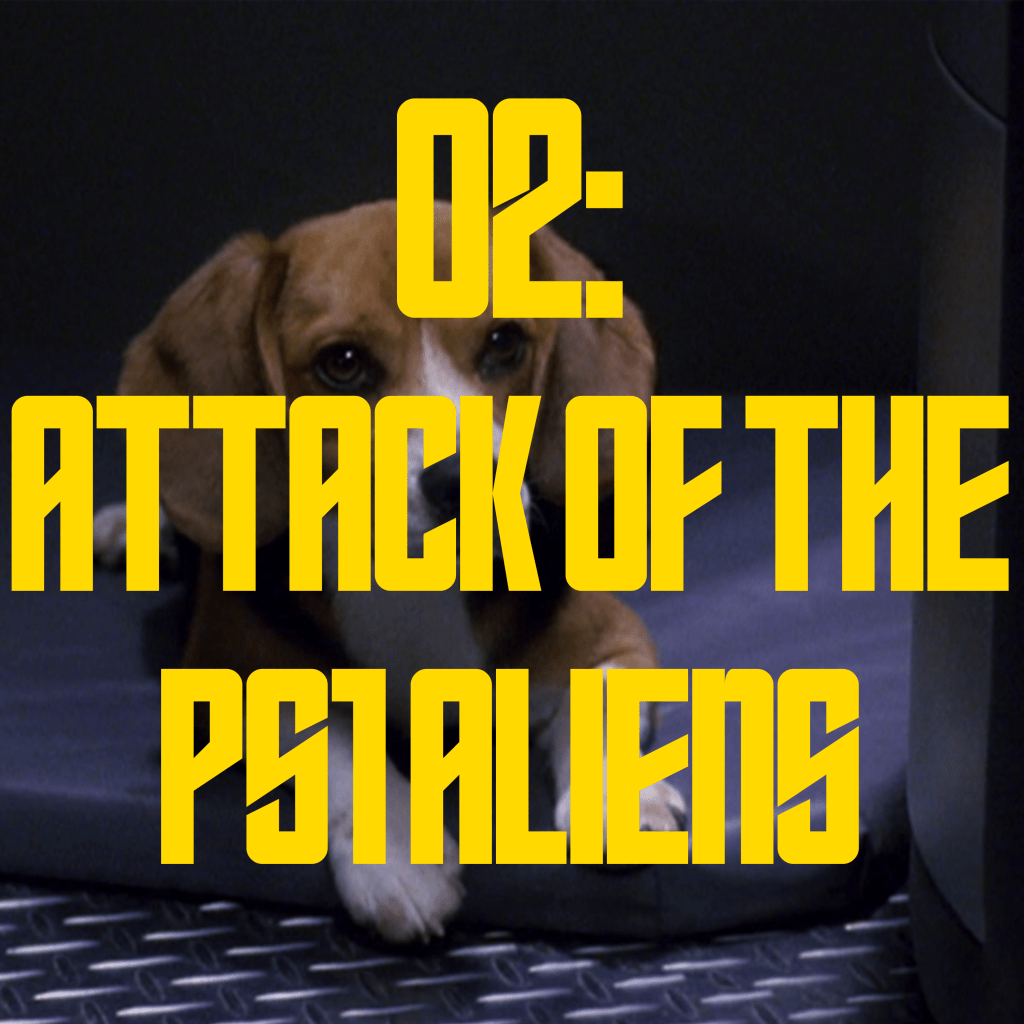
Episode Two: Attack of the PS1 Aliens!
The best character on Enterprise
This episode covers Voyager, Enterprise and Discovery’s pilots.
Voyager was watched mostly on a train, while Enterprise and Discovery were watched at home. With Discovery, I realised partway through “The Vulcan Hello” that it was a two-parter and I’d need to keep watching the show, but also that we wouldn’t meet most of the cast. Still, a pilot’s a pilot, so I pressed on.
The episodes can be found on all podcatchers, on Spotify or using these links:
I’ve been in a Star Trek mood for a little while and it’s not gone away. I’m a fan, but not a massive fan. During lockdown I started a rewatch of Deep Space NIne and after running Modiphius’ Dishonored RPG I started reading up on their Star Trek one. I think that in that time and even now, I needed a glimpse of something a touch utopian.
Starfleet… they’re not a perfect organisation, but they’re generally on the right track. While there are some bad seeds, the group as a whole are pretty good. It feels like there’s a split of turbo nerds and swashbuckling idiots in Starfleet. People who love examining rocks and people punching and/or sleeping with anything they find in space. That combination seems to work out for them as a whole.
I’ve run RPGs set in the Star Trek universe a few times and once had a couple of massive bin bags of Star Trek VHS tapes thanks to a friend. They were mostly unlabelled tapes taken from the television, so I watched and filed most of them before eventually getting them disposed of because VHS tapes weren’t a thing anymore.
A video case for The Cage, the first of the Star Trek pilots.
Anyway, podcasts… I’m a fan of podcasts like Battle of the Atom, BatChat with Matt and Will, and the podcast within the War Rocket Ajax podcast, Every Story Ever. They cover a few comics in each episode, ranking them on a big list from best to worst. I found BatChat when I was playing Arkham City, and I started looking for a Star Trek equivalent. There wasn’t one, and the idea of making my own version game into my head.
Enter Miles.
We were part of the same writing group who met every November for NaNoWriMo, and would keep meeting up even when the other people dwindled away. Every Sunday we’d write, chat about things and write some more. Miles moved to Wisconsin to be with his love, and we fell out of contact. He visited Brighton once after, we got chatting like old times and each realised the other religiously listened to Jay & Miles X-Plain the X-Men. From that point, we would regularly chatter on Facebook Messenger about comics and general other things.
I told Miles about my idea to make a Star Trek podcast, and the bastard called me on it.
I appeared on the Who Dares Rolls podcast, but I literally just showed up, spoke into a Rock Band mic (later a fancy gamer headset from my brother) and that was all the experience I had.
The challenge was set, and I figured I’d try it and pretty much learn as I went.
An advert for Star Trek: The Next Generation’s pilot on Videocassette
Miles and I recorded a test episode, calibrating our tastes in which Star Trek series we liked more than others, our own experiences of the shows and our favourite characters. I used that to try out Audacity and learn how to edit. It worked, so we came up with more of a plan for episode one, and even more of one for episodes two onwards. I’ve edited the first three episodes and the fifth’s been recorded. You’ll hear our test episode as a bit of bonus content between episodes two and three.
This Monday, you’ll get to hear our first episode, “Flat Galaxy Theory”, where we watch the first three pilot episodes from Star Trek series, discuss them and put them on a big list of best to worst. We’re both fans of Star Trek, but it’s not our biggest fandom, so as folks who think Star Trek’s “Pretty decent”, we should be the objective authority about whether or not any given episode of Star Trek is better than the last.
Episode one’s cover. Surprisingly I made no Singing Ringing Tree references when talking about The Cage
You can subscribe to the show on Apple Podcasts, Google Podcasts, Stitcher, Spotify and probably a number of other podcatchers. If you do that, then on Monday morning at 11am, you’ll get an episode of our podcast, followed by another every fortnight.
This podcast is part of the Nerd & Tie Network, and you can find the official announcement along with some of those podcatcher links here.
We got a couple of the small Edward Gorey books in at Dave’s Comics when I was working there. I immediately enjoyed the Gashleycrumb Tinies and when Amphigorey came in, I picked it up right away.
The one time Nick Cave came into the comic shop, we ended up talking about ceilings and about Edward Gorey’s work as he was unsurprisingly, a fan.
The Plot
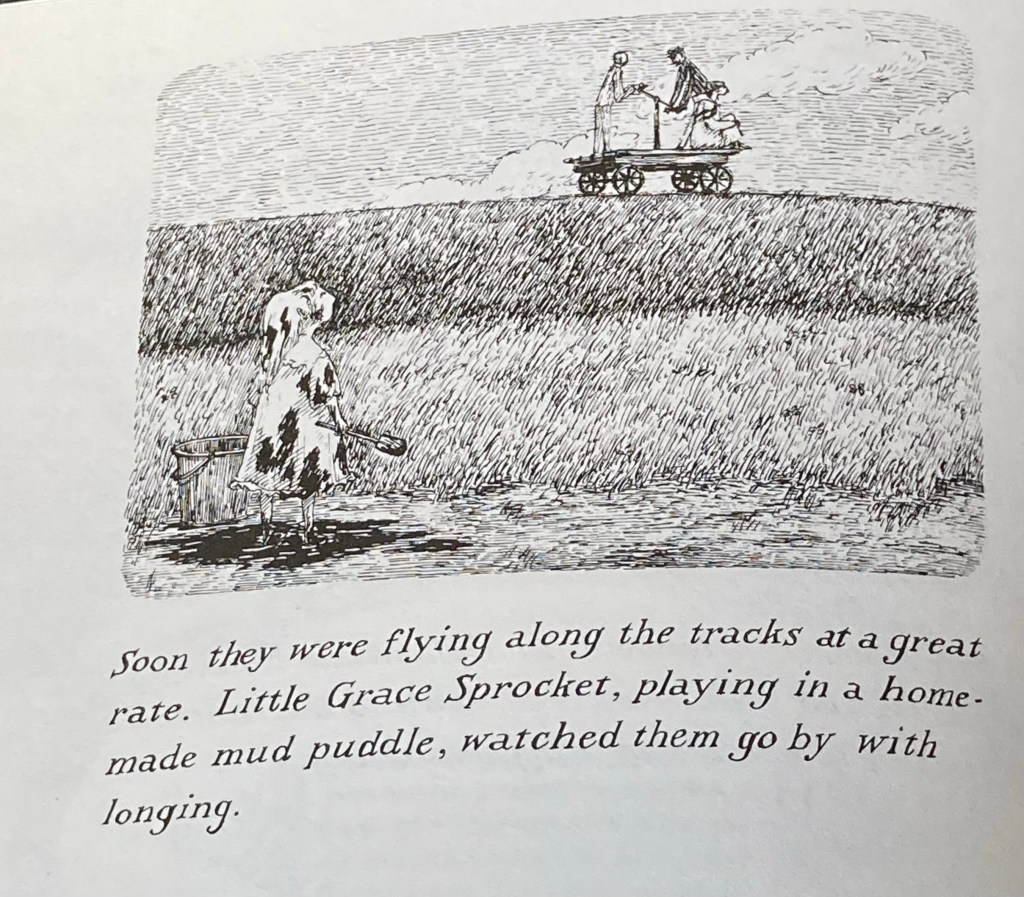
It’s difficult to really get into the plot, as this is a collection of several morbid short stories, illustrated two to a page, sometimes with a caption, but sometimes the images just stand on their own.
The stories are all entertainingly creepy. The Gashleycrumb Tinies is a rhyming A-Z of infant death, although they’re often teased at in the images and all adorably dark. The Bug Book is a weird, colourful change from the black and white the rest has. The Willowdale Handcar is a fun journey which goes past a number of odd locations as we follow a trio on a handcar. The Doubtful Guest is kind of adorable, but also a little unpleasant.
They’re best taken one at a time and digested in that fashion rather than binged. I know I’ve raced through it before and aside from a couple, they didn’t all sink in so much.
Is it any good?
Yes, it’s very good. If there are still the individual volumes, you might want to check those out instead, but this is a fantastic collection and a good book to dip into from time to time.
Am I keeping it?
Yes, and I’m annoyed I can’t find my copy of the second volume.
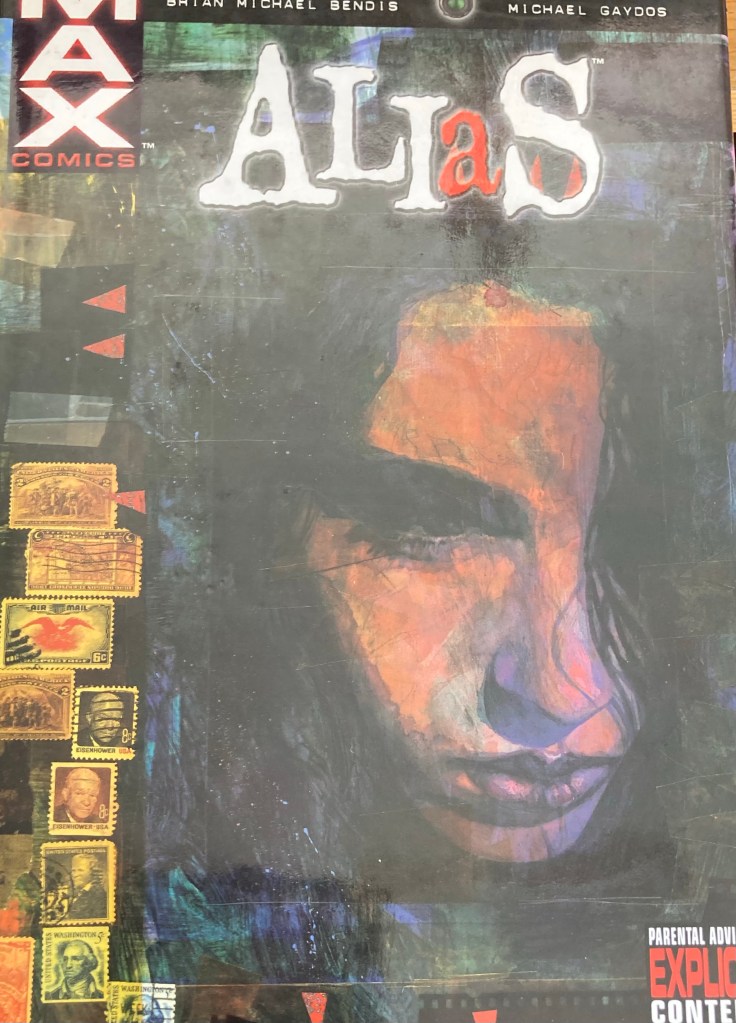
Art by Michael Gaydos, Colours by Matt Hollingsworth and Letters by Richard Starkings
Marvel Comics went hard when they decided to launch their ‘Max’ line of Comics Codeless ‘mature readers’ comics. They also tapped Brian Michael Bendis who most people might have known from Ultimate Spider-Man, but also had a background in crime comics (more on those later this year).
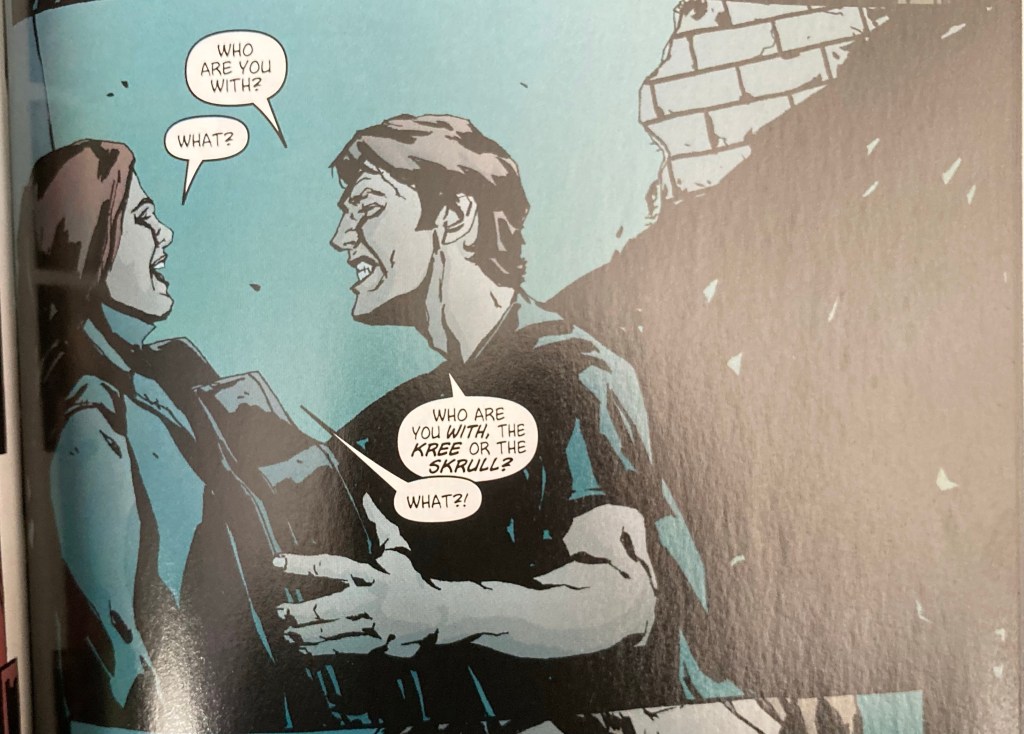
Alias may have the same name as the spy show which came out the same year, but it’s a totally different story. Handily, a lot of you will know the basics from the Jessica Jones television show which aired a few years ago, although this is a lot closer to the Marvel Universe than that show, it’s also a bit similar to DC’s Chase, which was one of my motivations for buying the series when it first came out.
This is literally the start of Marvel’s mature readers ‘Max’ line. They really start as they mean to go on.
The Plot
Jessica Jones was an Avenger for an incredibly short time. That’s okay, they’ve had tons of members who no one remembers. Did you know they had Gilgamesh from the Eternals on their roster? Or that Mr Fantastic was an Avenger briefly? I only did because they were in an Inferno tie-in.
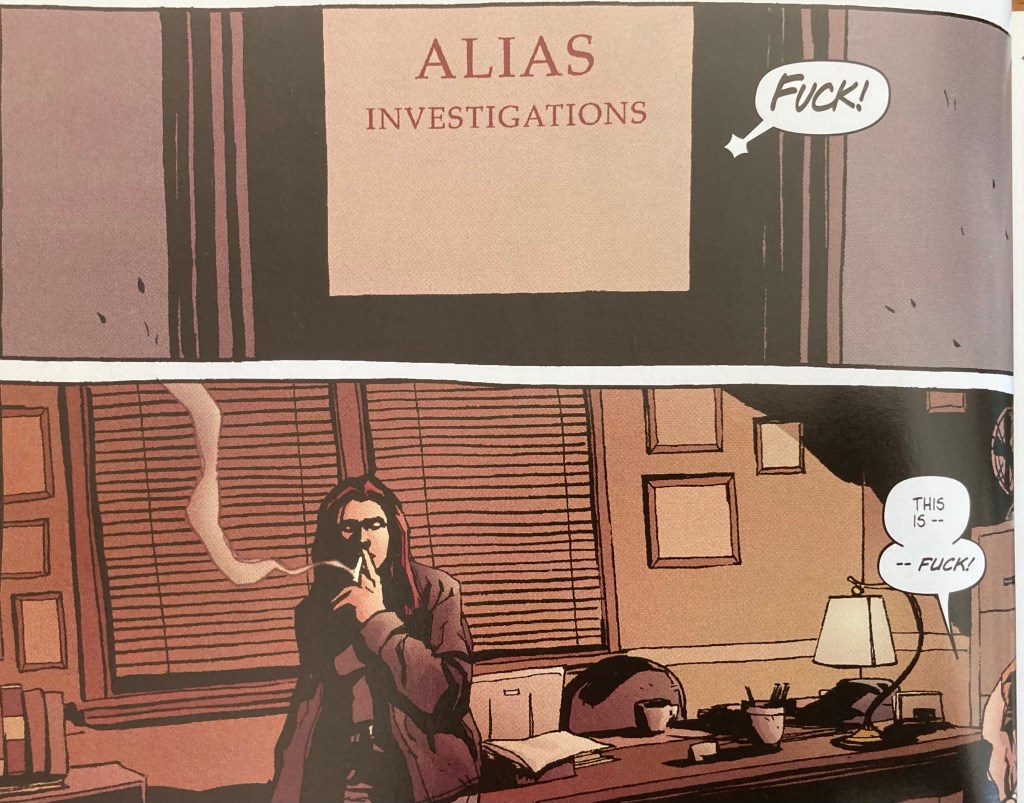
Anyway, Jessica was an Avenger and then *something* happened, which is alluded to but not discussed openly in this volume. We get two stories and several hints about Jessica’s life both as the super-powered Jewel, and as a post-heroic private detective.
A memento from Jessica’s brief stint as an Avenger.
The first story arc has Jessica hired to spy on someone and getting some footage of Captain America with them, shortly before their death. She has to navigate a superhero community which she ditched and suspicious motivations from her employer.
The second story has Jessica searching for Rick Jones, the constant sidekick to Captain America, Hulk and the Avengers as a while. He’s apparently married, mooching off folks and now vanished.
I enjoyed the Jessica Jones show, but I did wish there were some cases which weren’t all tied back to her origin and her superhero times. I can understand how it would be impossible for an MCU to have all the appearances of Captain America, Captain Marvel and many other heroes whose names don’t begin with Captain.
Some classic Bendis patter
Is it any good?
There are valid criticisms for his style, but I’m a sucker for a Bendis page. This is a good book, although it is only half of the comic, all of which I still have in floppies. Gaydos’ art definitely feels of the era and you wouldn’t recognise Jessica if you’d only seen the television show, but it’s still a classic.
Rick Jones, who I was confused by after reading the Peter David Captain Marvel. There is a reason for his presence here, though.
Am I keeping it?
This one’s difficult. I am definitely keeping it in some form. I’ve got the whole thing in individual issues and while I’d like a collection of it, the hardcover version I’ve got is very out of print, so I’d need to either get rid of the collection and replace it with modern softcovers which collect the whole thing, or stick with the individual issues.
Akiko is a human girl who one day gets an invite to the planet Smoo, a slightly squished-looking planet. She’s sent to save the young Prince Froptoppit due to what seems like an administrative error but is actually an attempt to get the pair to meet as the prince fancies her.
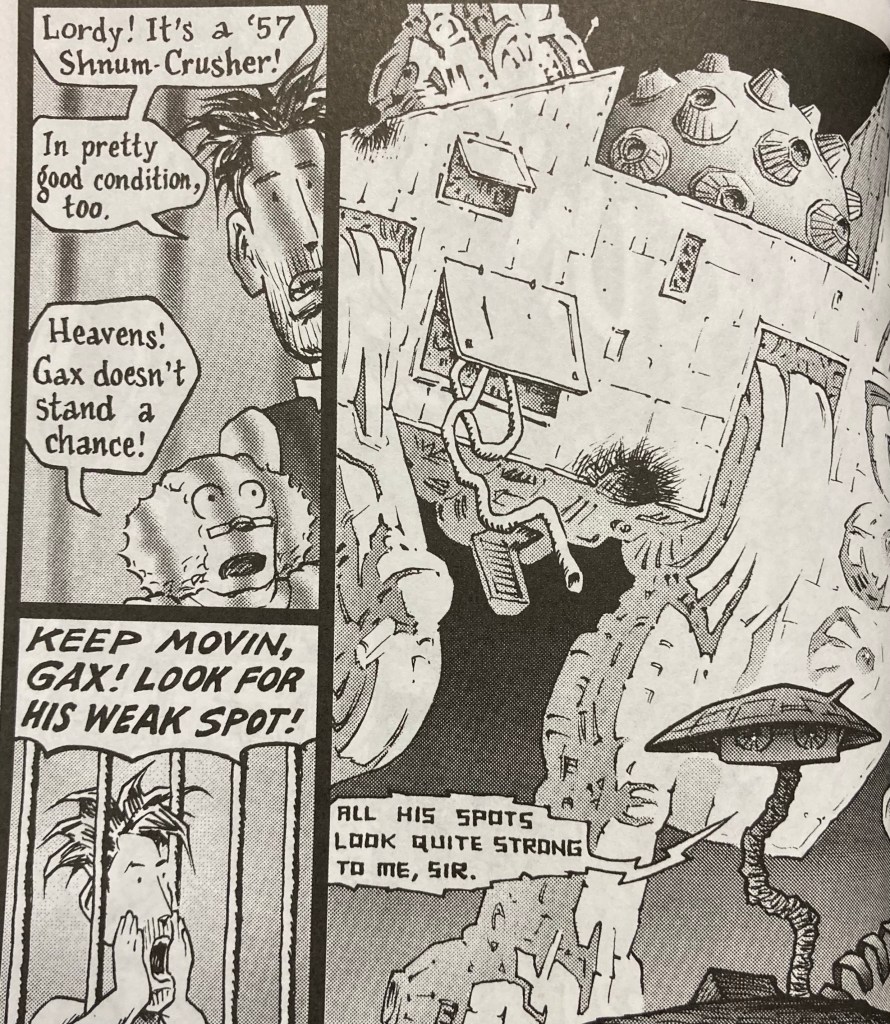
On this journey, her companions include Spuckler Boach, a messy rogue, Gax, a loyal robot who keeps losing parts, Mr Beeba, a pompous academic and Poog, a floating orb with eyes and a mouth who few can understand. They’re a brilliant, messy cast, often clashing with each other but at their best when they’re working together.
The ‘working together’ thing doesn’t happen often.
Smoo and the other worlds are all brilliantly weird, illustrated gorgeously by Crilley and explained to Akiko who acts as our viewpoint for the stories. It feels like a precursor to things like Adventure Time, as a heroic, chaotic mess which works well for children and adults.
Volumes 1-3: The Menace of Alia Rellapor
Folks, I’ve done the bad thing and I have Akiko volumes from two different runs. Volume One is from the pocket book versions which are roughly manga-sized, then the rest is from the regular-sized run. This is because the pocket book version contained the original “On the Planet Smoo” comic as well.
Akiko’s returned to the planet Smoo as Prince Froptopit’s actually been kidnapped this time. The quest goes through all sorts of wonderful, strange places and a motorway service station in the middle of a bridge. This feels like the series proper, where the original strip was a proof of design. It’s the longest story, stretching over three volumes. There are a few twists which are guessable, such as the identity of the evil Alia Rellapor, but it still throws in some fun surprises and incredible visuals. If you had to only read one Akiko story, this is definitely the one to go with.
Volume 4: The Story Tree
The next volume is a series of short stories from the cast, including Beeba meeting some religious zealot fanboys of an old novel, potential romance for Spuckler, a congregation of weird robots with Gax and even a brief interlude from Poog which is as odd an nonverbal as you’d expect from the singing, floating head.
Volume 5: Bornstone’s Elixir
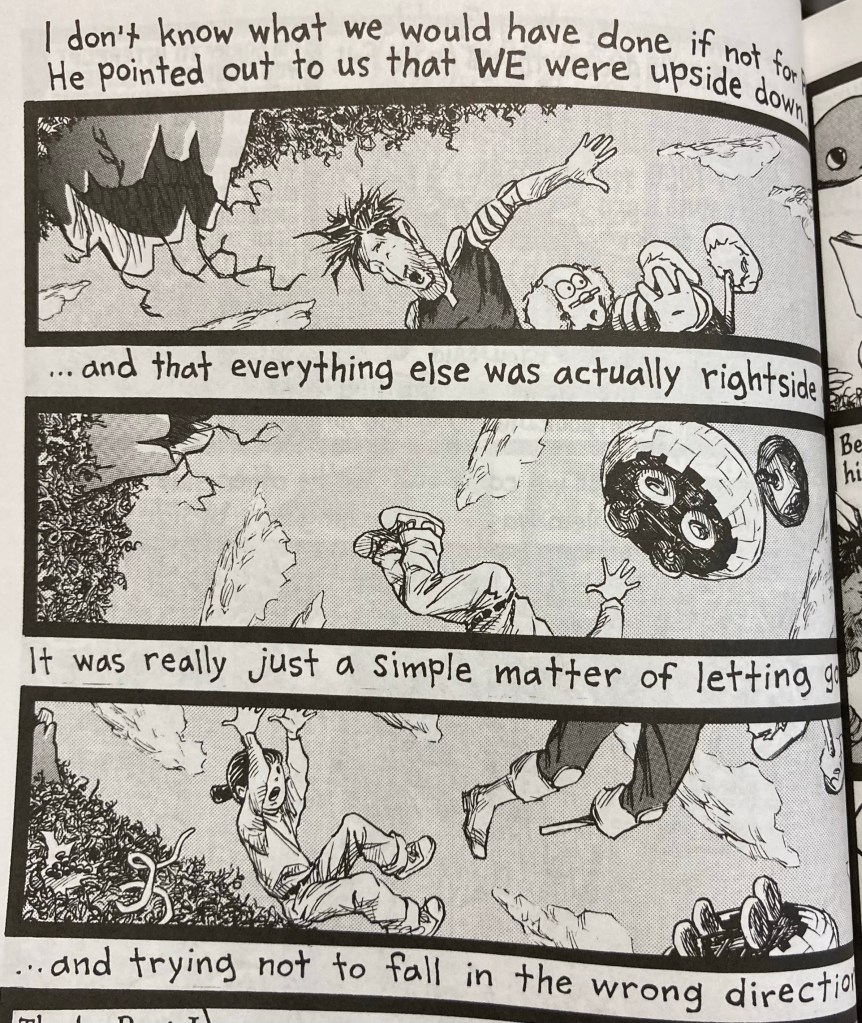
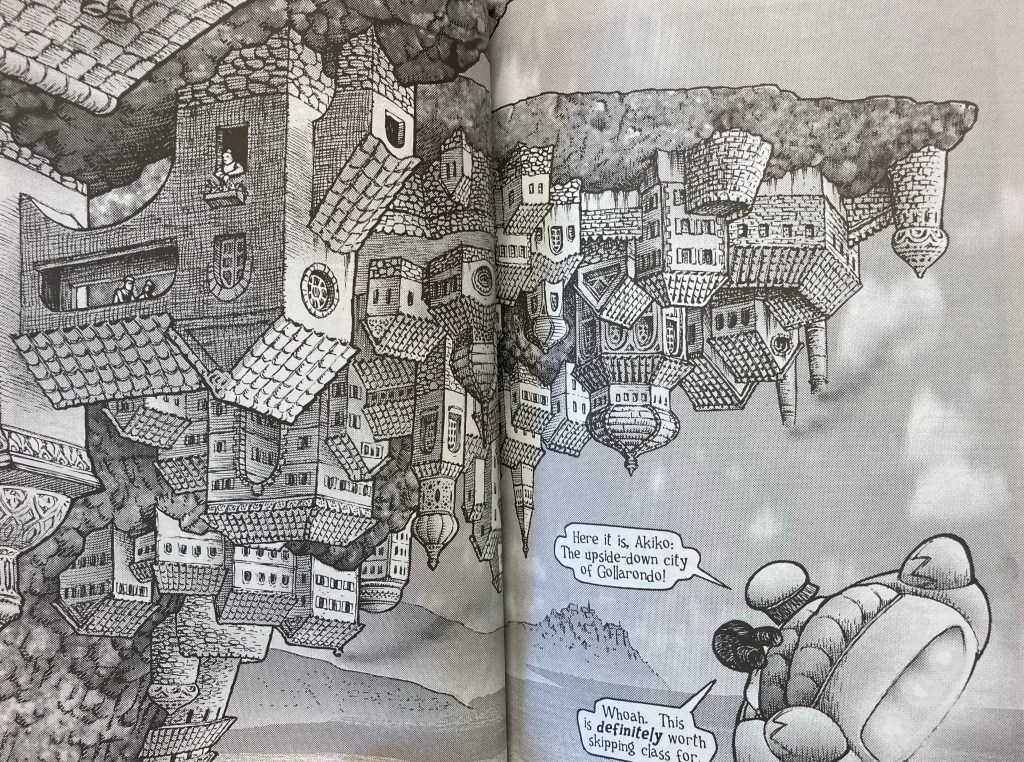
Beeba’s mentor is dying and only a mythical elixir could help him. The mentor doesn’t want this to happen, but Beeba gets the band back together regardless. There’s an upside down floating city in here, and that’s just the place they set off on their quest from.
The city’s upside down, but everyone else is the regular way up.
Volume 6: Stranded in Kimura/Moonshopping
This volume’s split into a couple of shorter arcs. Stranded in Kimura takes us out of Akiko’s head and into a human who ends up looking after Akiko and the aliens as they land on Earth and don’t have a way back off. The change of perspective is really interesting and Akiko’s worldliness from her previous adventures makes her seem alien.
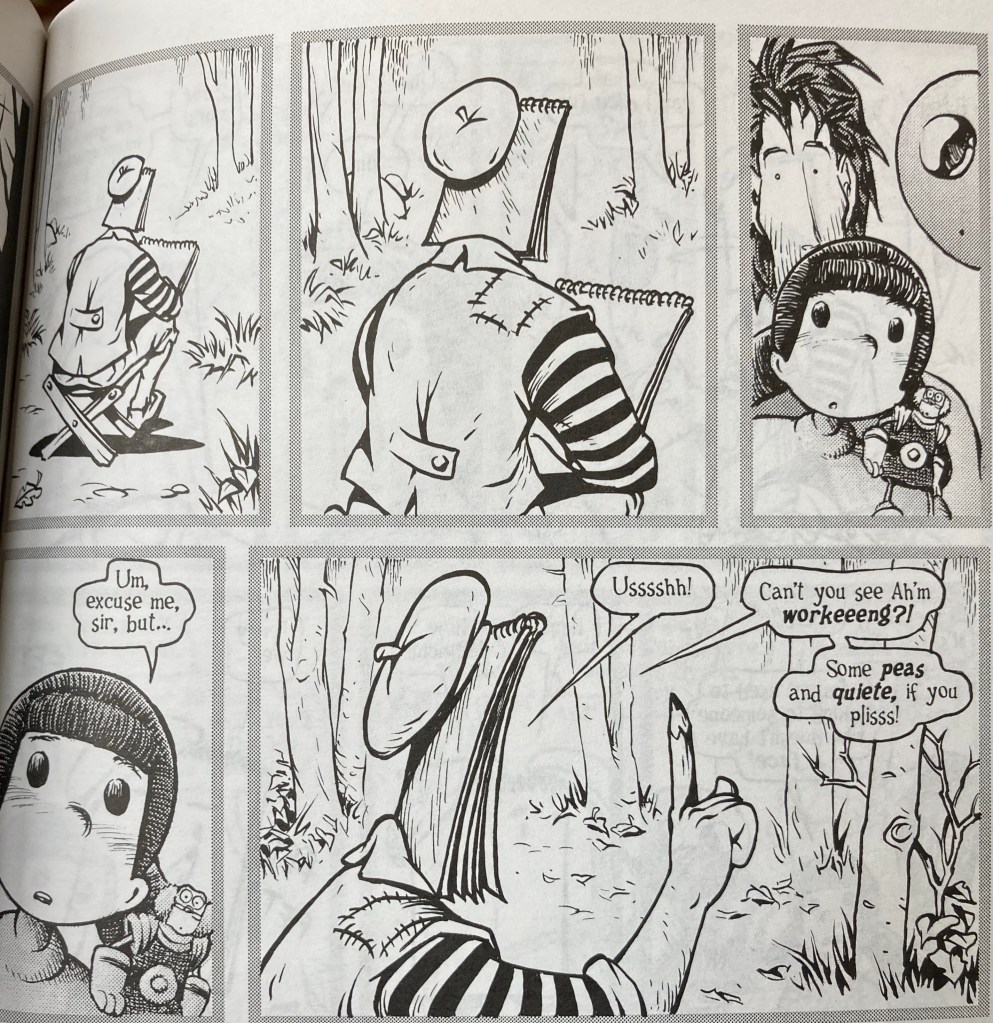
Moonshopping is back to the usual affairs as Smoo needs a new moon and the aliens are sent into another dimension to try and get one. It’s somehow weirder than the usual Smoovian stories, including this awesome-looking guy who has a pad for a head.
Volume 7: The Battle of Boach’s Keep
A curious end for the main stories, this one has Spuckler selling his family’s falling down farm to a corporation, then waging a one-man war against them when he realises what he’s done. Akiko’s story is separate from Spuckler’s for the majority, but both are dealing with GothTek, a giant corporations somewhat like if Amazon became The Empire from Star Wars. More so than they already have.
While GothTek are far from innocent here, a real focus is on Spuckler’s personal state as he loses more and more in order to grasp onto land which he did sell. It’s a sad story, but still manages to end in a satisfying manner.
Flights of Fancy
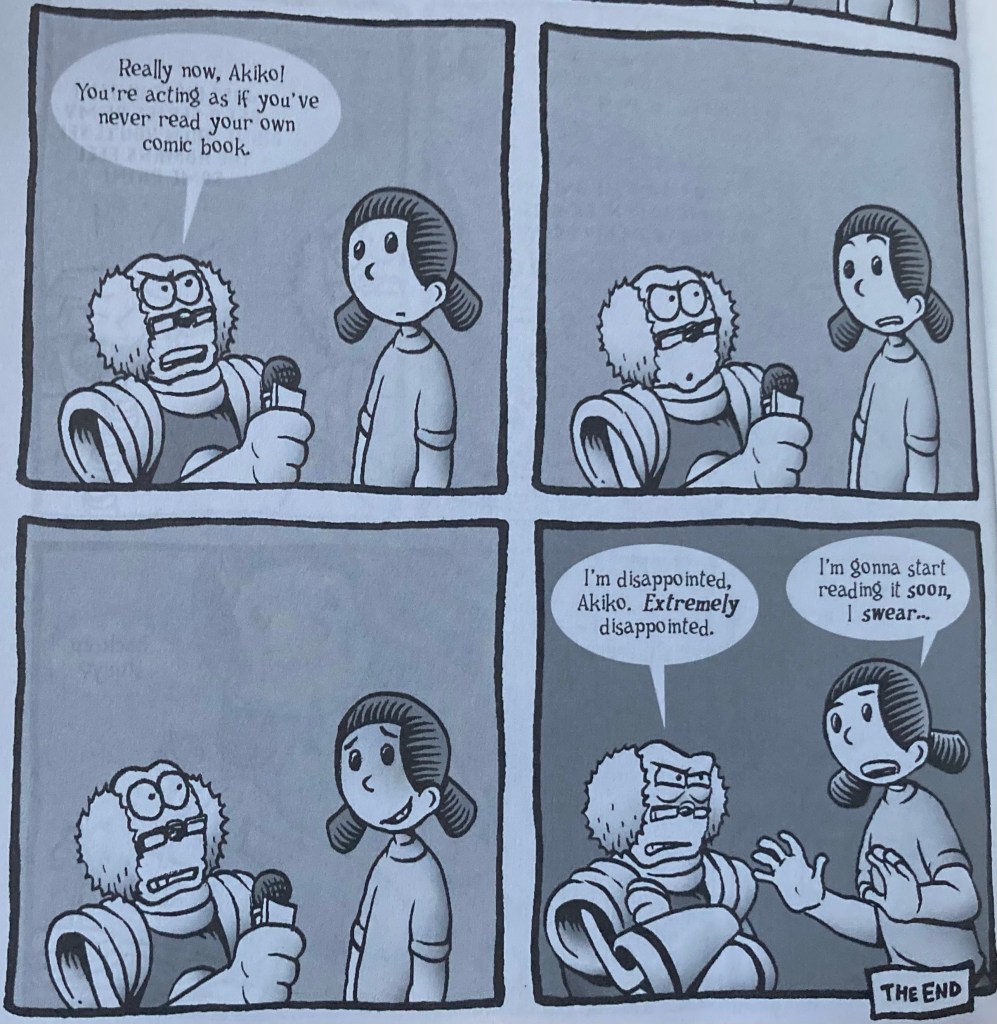
The final volume of Akiko contains small strips contained in the back matter of the individual Akiko issues, and a new one, as well. They vary in length and style, but there are some fun little tidbits including a few fourth wall breaks which work well with the sprawling chaos of the first few strips as they interweave with each other.
Is it any good?
Yes, very good. As a GM of roleplaying games I can see where I took some influences for the landscape as far back as the days of Advanced Dungeons & Dragons. Things like the upside down city and living castle are great visuals. During the ongoing unprecedented times, I finally got round to watching most of Adventure Time and it’s got that same kind of sensibility to it. Even though it’s very much an ‘all ages’ joint, it’s definitely worth the time of kids and adults alike.
Am I keeping it?
Yes, although I’ve made a note to see whether or not I can find any other version of it, given the mismatched copies I’ve got of the series. Despite the size difference, I might keep the smaller first volume on the shelf with the larger ones, as that might get me reading it more often.
Amelia Cole and The Unknown World
Written by Adam P Knave and DJ Kirkbride
Drawn by Nick Brokenshire
Lettered by Rachel Deering
I’m pretty sure I heard about this on the War Rocket Ajax podcast. It’s a Monkey Brain comic, which released digitally first. I read a few series that way, but I fell off pretty quickly when Apple stopped letting me buy comics directly through the ComiXology app. I’ve since got more used to using the browser to buy and app to read, but I basically just lost momentum.
Plot
Amelia Cole is a magician who lives between a world of magic and a world of mundanity, but she finds herself stuck in a world which does a bit of both. Normal humans are second class citizens, with the police and a hooded vigilante looking after anyone magical.
Amelia’s got ties to this world beyond just accidentally ending up here. She also makes a golem out of tools and replaces her wand with a hammer. The series is brightly made, fairly chill in its world despite the darker tones of it all. Even though stylistically it doesn’t look like a Ghibli movie, it has that tone of a beautiful world that’s kind of sad and dangerous, with a lot more going on under the hood.
Lemmy’s a good golem.
Is it any good?
Yeah. The story’s fairly simple but the world’s great, even the supporting characters are fun, the art’s lively and engaging.
Am I keeping it?
Probably, yes. I like it, but I’m not in a massive rush to continue with the books yet. I think I’m a few volumes behind but I’ve no idea how long it went on for or whether it even ended.
Art by Eduardo Risso, Colours by Patricia Mulvihill, Letters by Clem Robins and Covers by Dave Johnson
The Agents Shepherd and Graves
I didn’t get into Vertigo when it first came out as a line within Detective Comics Comics. Instead, I started with Preacher and Transmetropolitan which were long-running Vertigo series which had a beginning, middle and end. As someone who mostly reads cape comics which are an eternal soap opera, there’s something quite satisfying when I stray from that genre when a series actually ends.
100 Bullets was a crime comic I bounced off initially, despite the great concept. I’ll admit it’s mainly because of the art. Again, I was used to cape comics and there was a stylistic flourish which I found a bit ugly. Still, I peservered and despite not caring for it at first, Risso’s art really grew on me.
Things don’t end well for a lot of characters in this series.
It’s a crime comic I was getting into a little after I’d started watching shows like The Wire and Oz, so it goes in that kind of bucket in my head. It has some fascinating morality plays, although reading it again in 2022 makes me wonder whether there was research by Azzarello, whether he spoke to people of other cultures when writing extremely stereotypical sounding dialogue for them. It comes across more potentially cringey than racist but then I’m a Southern English fop, so I’m probably not the person to judge it for appropriateness.
The Plot
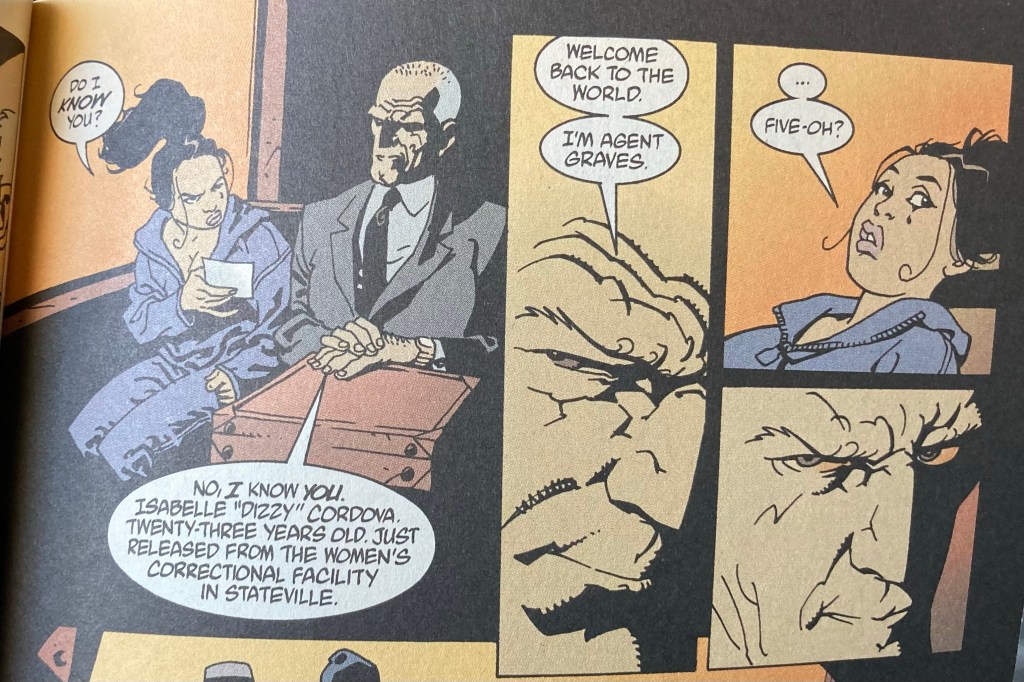
The first meeting of Graves and someone for his ‘game’ in the series.
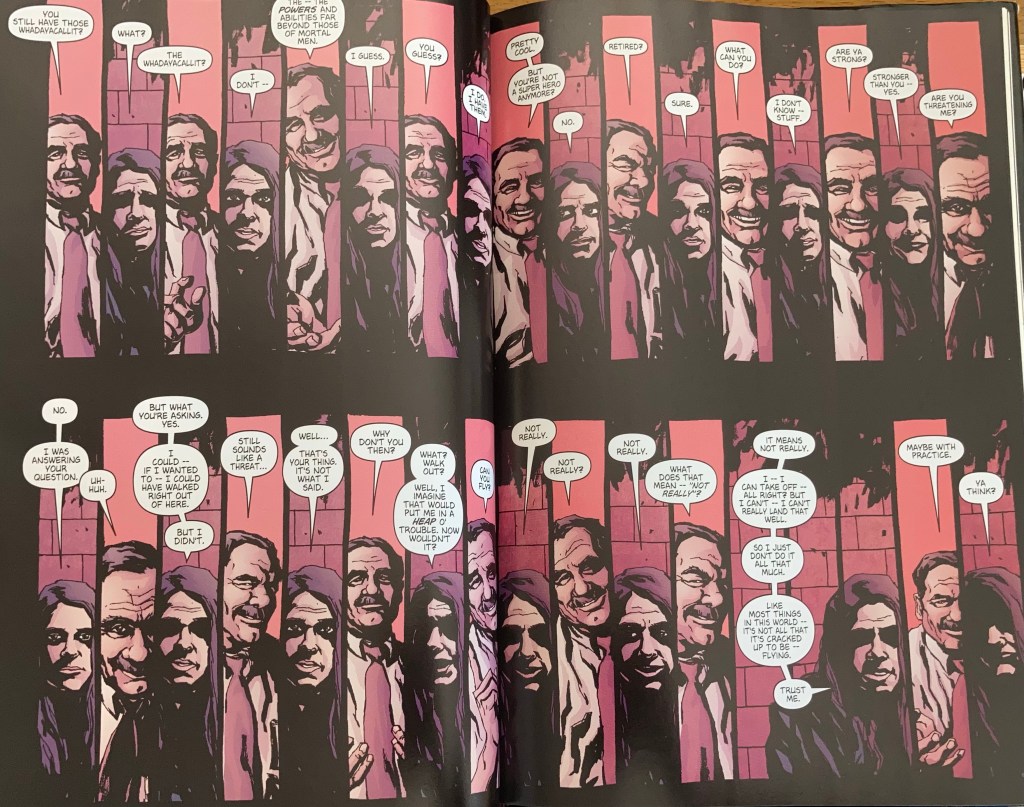
100 Bullets is primarily a question of morality, shown in different ways. The main one is a question easily pitched to the audience themselves.
An old man appears one day with a briefcase. He explains to you that there was a point in your life where things went wrong. Your life was ruined in some way, and it’s all attributable to one person. The briefcase has a photo of them, proof, a gun and one hundred bullets. They’re not traceable, if you’re caught with them then the police will throw you back out on the street.
The man, Graves, doesn’t tell you to kill the person who did this, but the implication is there. The temptation.
This isn’t even the main story for this issue, but there’s always something going on with Graves.
For the first half of the story, it’s mostly contained in vignettes of one to five issues, so you normally get a couple per volume. Graves’ game has been going on for a while, but we first see him deliver the case to Dizzy Cordova, fresh out of prison and armed with the knowledge of the two policemen who were the murderers of her husband and child.
Dizzy doesn’t just dive into things; instead she goes to the police, she sees old friends, she really goes over it before finally fighting both the officers and a surprise culprit.
The story moves on, although Dizzy returns later. We see people given this information who dive right into their murder, who fail incredibly, or are in the background while other plots are going on. Graves keeps at this game, even while there are other people like Agent Shepherd, who seems to be following him.
Even when you get a one-off story of a person being armed, there seems to be some kind of connective tissue behind it all. To quote Lester Freamon from The Wire, “All the pieces matter.”
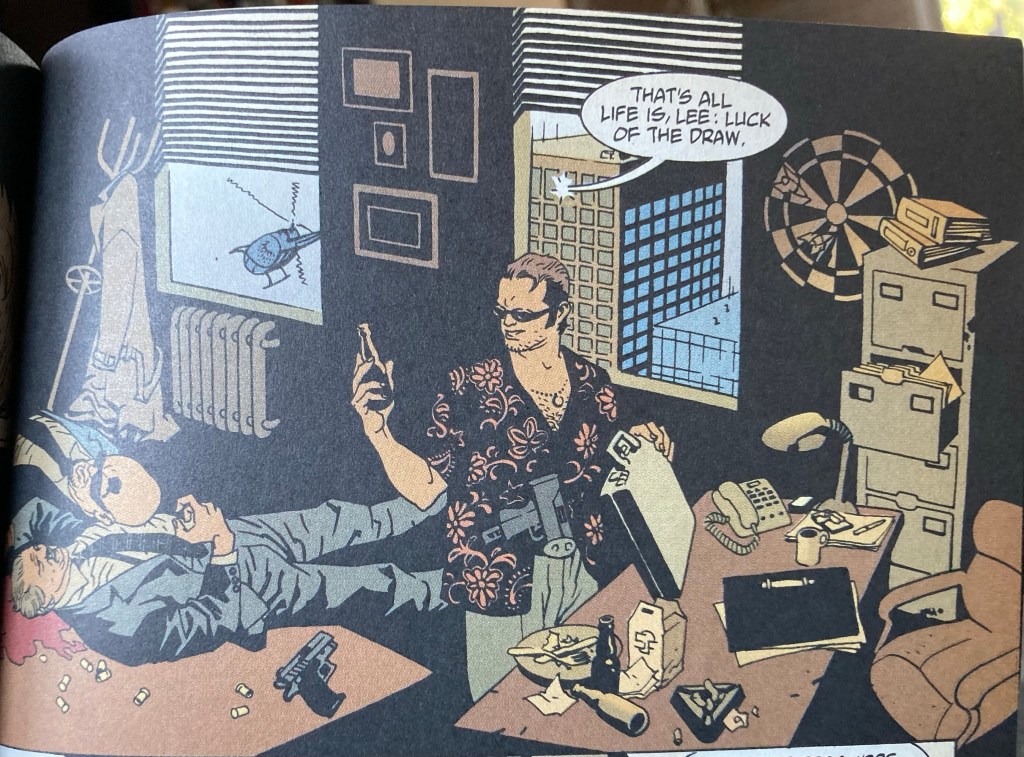
Our first close-up appearance of Lono.
The Real Plot… spoilers
100 Bullets is a story about a criminal organisation. No, THE criminal organisation. The Trust are an ancient order of thirteen families who carved up America between them. They were policed by a group called The Minutemen, who were the biggest, baddest murderers, activated when a house made moves against another. Traitors would be dealt with swiftly, brutally.
Agent Graves acted as the leader of the Minutemen who have charming names like The Monster, The Saint, The Bastard and so on. The Trust waged a war on the Minutemen who responded in kind, then went to ground. Hypnotic triggers were put in most of them and they were sent out to live their lives until they see or hear the word, “Croatoa”, apparently a victim of ancient Minutemen.
The first time we see the trigger word used, it’s an amazing impact, just to show how big an epiphany it causes.
The word wakes them up and a bloodbath often ensues. Sometimes it works in their favour, sometimes it doesn’t. Most of these characters are sent on their path by Graves, hoping that his game will have a way to reactivate them, even though not everyone will survive them. He even has a couple of new potential Minutemen like Dizzy and Loop, the son of an old Minuteman.
The game’s not the only thing on the table though. Some houses in The Trust are using the lack of policing to close ranks, killing and absorbing other houses. Agent Shepherd has mercurial interests, seeming to be helping both The Trust and Graves. Lono, a former Minuteman who wasn’t there during one of their massive moves against The Trust which solidified the war between them is a beast of a man. He’s an evil Wolverine, a Lu Bu, a voracious and compelling monster who seems near invincible, making his encounters with the far too mortal Minutemen terrifying.
The volumes I bought were of various sizes, collecting specific story arcs up until the final four volumes which are all neatly of similar length as it’s all one story by that point. The games are over and no one’s making it out alive.
Another Minuteman stumbling closer to the truth.
Is it any good?
Yes, although that is with an a couple of criticisms.
It can get a little busy, story-wise when it’s still playing keep-away with what Graves and Shepherd are up to, and their loyalties. The obfuscation can make things a bit tricky to keep track of, but that’s a problem that sorts itself out as time goes on and the cast get whittled down.
The other point of confusion is the nicknames the cast have. That most of them are amoral stubbly white guys of roughly the same build and the nicknames are kind of generic doesn’t help. It feels a bit like a Three Jokers problem, as most of them could be, “The Bastard” or “The Point Man”. Again, between body count and the fact the nicknames are more historical aspects of the characters means that it’s a problem that sorts itself out.
My final issue is the dialogue. It might be that Brian Azzarello did a lot of research and hopefully he did. I know he’s been praised for his dialogue and the specificity. He uses a Tarantinoian amount of the N word and goes all over the place with crudeness. It just made me cringe a bit and ponder the level of research Azzarello did while I was reading the series.
This is a horrible, seedy world where pretty much everyone’s up to no good. The background characters are as likely to be up to something as our protagonists. Risso draws a vibrant, lively world which is as colourful as it is shady. Some standout moments include Lono’s introduction in the background of an early story as he fights a helicopter on a clear blue day, all while our protagonist and antagonist don’t notice, or the sight of a tiger which feels almost supernatural compared to the street level everything else has here.
Good news, the tiger survives.
Am I keeping it?
Yes, and I’m keeping these volumes. I know there are thicker ‘complete’ versions which turn the thirteen volumes into five, but I think I prefer them this way, contained in the different arcs and mostly given a name referential to the number of the volume. While I’m likely to read the whole run, these specific break points are all great for the flow of the story.
One of The Trust, too powerful and too confident in his victory over the Minutemen.
Written by Geoff Johns, Grant Morrison, Greg Rucka & Mark Waid
Layouts by Keith Giffen
Art by Joe Bennet, Chris Batista, Eddy Barrows, Todd Nanci, Rudy Jose, Jack Jadson, Derick Robertson, Ken Lashley, Phil Jimenez, Dan Jorgensen, Justiano, Mike McKone, Jamal Igle and Dale Eaglesham.
When I was a kid, I loved the Superman movie, Batman ‘89 and the DC Super Powers toys, but it was more passing than my love of Marvel. Part of the blame there’s probably because of the Marvel Secret Wars UK reprints. As a teenager, I read a bunch of Batman at sleepovers at a friend’s, and the Legion of Super-Heroes. My friend Adam and I bought a ton of Legion of Super-Heroes and New Warriors comics as they were generally in cheap boxes, and something new to get into.
I came into DC around the time of Infinite Crisis, which I’ll have some words about later on in Graphic Novel Quest. It’s a weird start point, but a perfect platform to launch into 52.
Infinite Crisis temporarily took Batman, Superman and Wonder Woman off the table, then fast forwarded all of DC’s comics for a year. Back then, I was only getting Legion of Super-Heroes, but this was a great jumping on point for me. 52 was a weekly comic which showed what happened in a year without the major trinity. It was supposed to be a tour of the world, but it became a lot more by focusing on a few specific storylines.
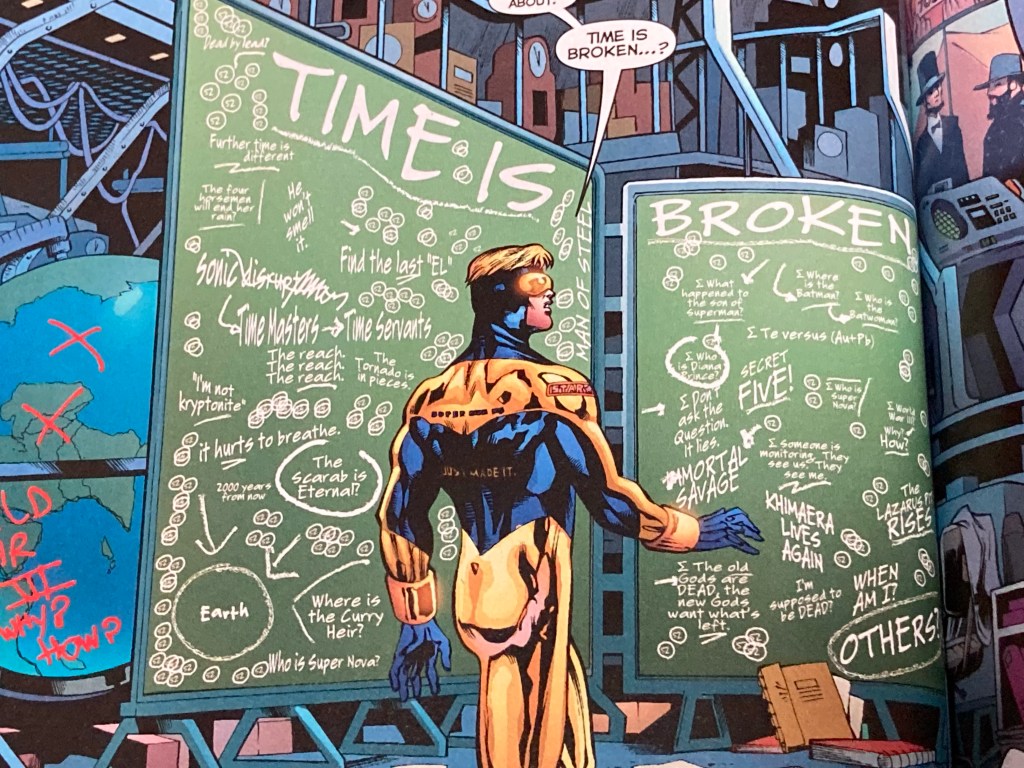
A fantastic dump of references to events in 52, beyond it and a few things which didn’t end up happening, either.
The Plot
It’s a tricky one to summarise. Basically we go week by week, issue by issue for a whole year, shown here in four collected volumes. You have a few different character arcs which often intersect and start or end at different points.
Steel has a story where he’s relating to the average Metropolitan on the street and trying to get his niece to understand how to be a hero. She wants a shortcut which leads her to Lex Luthor, fresh from another round of ‘I didn’t do all those crimes, it was an evil imposter’ and now he’s trying to make his own supermen. He’s still obsessed with Superman and the new hero, Supernova. Steel uncovers the truth behind the heroes, most of whom Luthor kills just to mess with Supernova, and the pair get in a massive fight leading to Luthor again going down, but blaming everything on a weird shapeshifter.
Lex Luthor with a symbolic empty S shield, representing his lack of any values.
Renee Montoya gets a mostly great story taking her from ruinous alcoholism to becoming the new Question. She goes on a tour with the old Question, finding out information about the Crime Bible and reuniting with her ex-girlfriend, Kate Kane, aka Batwoman. The old Question’s an irritating mentor, as you’d expect, but also priming Renee to replace him as he’s dying from lung cancer.
I like the old Question, but the Renee Montoya Question’s fantastic.
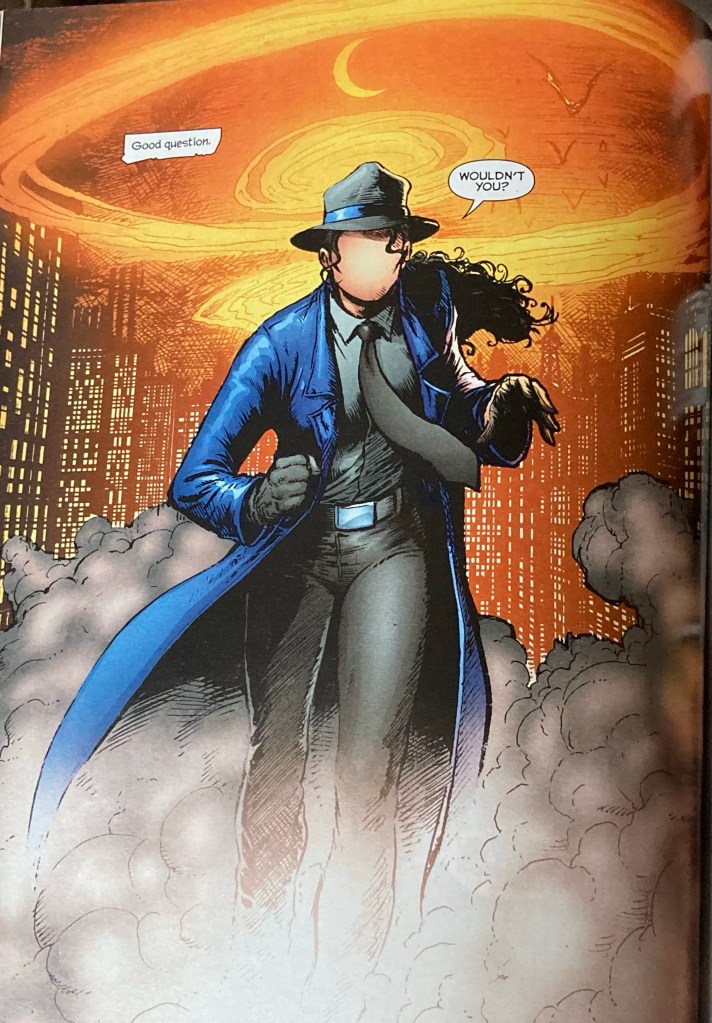
The story collides with a few others, most notably Black Adam’s, and hits a dramatic peak when Renee’s dragging a dying Question through the snow, trying to find Nanda Parbat despite having no real direction, no supplies and no hope. It’s such a low point for someone whose story’s been little other than that, but she takes the moment, becomes the Question and kicks some arse in a way which makes you know this was a Greg Rucka favourite.
I loved the JLI era, having gone back to it after loving Keith Giffen’s Legion of Super-Heroes (turns out, they’re very different, but still good). Booster Gold is one of the surviving remnants of that era who hasn’t been killed or made evil and then killed. He gets a ton of sponsorships, acts like a tool and gets a resentment of the new hero, Supernova. He ends up dying and being barely remembered.
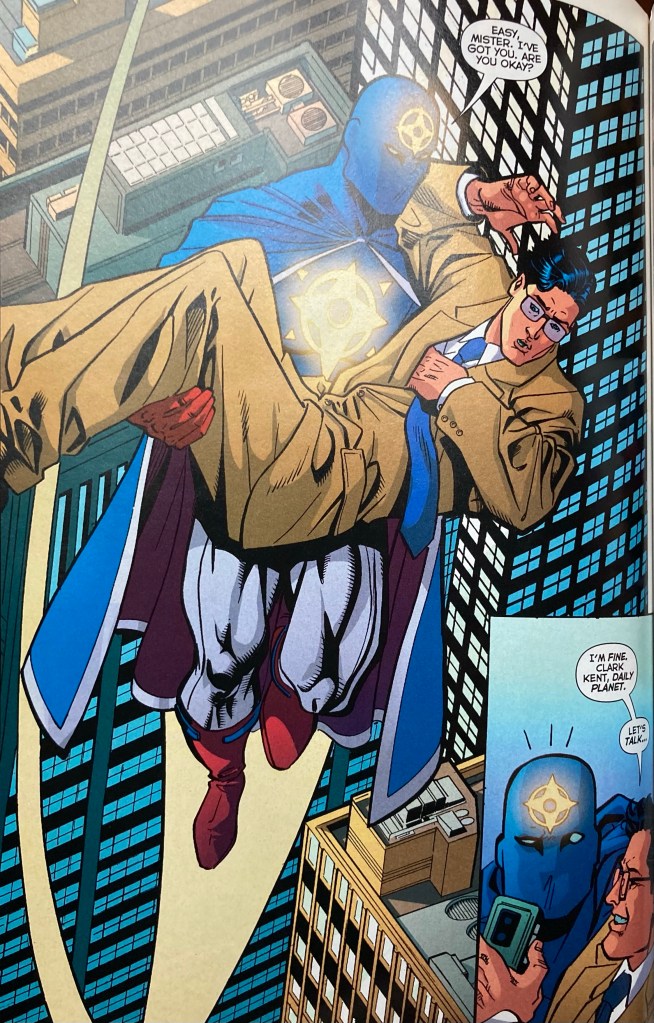
A depowered Clark Kent flings himself out of a window in order to get an interview with Supernova
Only he doesn’t. The cover of volume four spoils this, but Booster’s floating sidekick isn’t who we thought and has been infested with something awful. Booster goes into hiding by faking his death using his corpse from the future. He and his present day ancestor have been Supernova all along, to help figure out what’s going on and buy time.
This is why I lent this out to friends one at a time, so they didn’t see this cover.
Ralph Dibny’s story is one I always forget in this series. His wife died in Identity Crisis (more on that later in the year). He’s trying to find a way to resurrect her, going from hard time to hard time, including a horrifying moment with a cult trying to resurrect Connor Kent and a wicker Sue Dibny who actually starts moving. The story floats about, not really doing anything, until a denouement which reveals his floating sidekick isn’t who we thought. He dies at the end, but he goes out a hero, even if it’s all picking at the Identity Crisis scab a bit.
Ralph takes Jean Loring back in time to witness her murder of Sue Dibny, accidentally knocking a vase, fixing one stray plot element of Identity Crisis.
Will Magnus shows up, along with a ton of mad scientists of various obscurity. They get up to shenanigans and create an apocalyptic Four Horsemen, before colliding with Black Adam in a disastrous manner. This feels like Grant Morrison and/or Mark Waid had fun plumbing the DC continuity depths.
The mad scientists celebrate Thanksgiving.
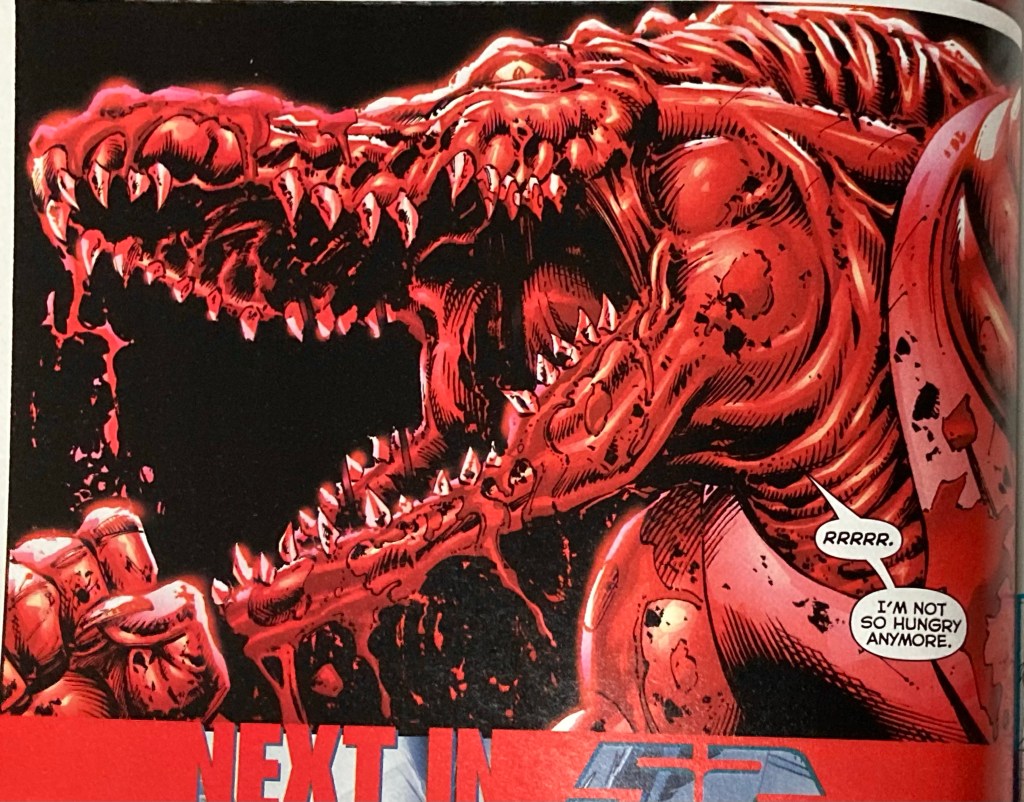
Black Adam goes through a rough time. He starts as a kind of super-dictator, learns to love by getting a girlfriend who calls him on his crap, gets powers and helps guide him towards being decent. Her brother also gets powers and a giant crocodile sidekick. After all this growth, everything goes awry, the crocodile turns out to be one of the horsemen, kills the brother, kills Black Adam’s now-wife and leads into World War III. He rips a lot of people apart and the comic takes so much joy in the violence, it has the stink of Geoff Johns all over it.
The post Identity Crisis to Early New 52 era was full of all of this kind of stuff, to diminishing returns.
Adam Strange, Animal Man and Starfire are lost in space, travelling home. This is another storyline I generally forget about. They meet up with Lobo who’s a pacifist now, and encounter some cosmic zombies.
Is it good?
Mostly. There’s a lot of good, a lot of nostalgia, but also a few things which have aged badly. The adolescent ultraviolence of DC around this era would eventually require the reboot of The New 52 and still continue for a few years after. As I said, the stench of Geoffrey Johns is throughout this book and it’s only got worse with age. I fear for when I reach the Green Lantern series by him.
Am I Keeping It?
Yeah. There’s more good than bad. It’s quite a journey and there’s a lot to love here both from the story and my own nostalgia.
Everyone fights Black Adam
40oz Comics Collection
40oz Comics is a tiny volume, packed with stuff.
I also read the 40oz Comics Collection, which collects several Jim Mahfood zines. I love his art style and sense of humour. I know he still works now, but he feels like a very specific point in time for me; specifically my comic shop days, listening to Pharcyde and Quannum in the office while sorting out standing orders. There’s not much story here, a lot of sketch comedy and stoner humour, but it’s entertaining and makes me want to make zines.
If your sidekick is slacking, your alien hero’s awful or your deity’s down in the dumps, you can always send them to Explosion High to learn how to be a superhero!
The school’s got a beautiful jungle campus surrounded by lasers, dinosaurs and laser dinosaurs, but don’t worry, the forcefield around the campus works 90% of the time!
Professor Explosion’s strict courses involve training students in skills needed for both your hero and secret identities, punctuated with deadly traps to keep students on their toes!
Kid, Trouble, Dawn, Mercury, The Mighty Z, Knight Lite and Skyshark are some of the newest students in Explosion High! and possibly the best, if they survive the first day!
Split into three stories, Explosion High follows our doomed students:
The Exploding Race literally drops the characters into the action and blows them up! Kid, Skyshark and Mercury have to pass the final test, fleeing through the jungle to the campus, being chased by dinosaurs. Art by Norrie Millar and colours by Faye Stacey.
Bad Guy follows Trouble, Knight Lite and Dawn as they’re late, lost and surrounded. Can they survive each other, let alone the dinosaur jungle? Art by Debora Lancianese.
The Faulty Stars brings the surviving cast members together and drops an alien into the mix, as we finally see our team! Art by Mike Armstrong, colours by Debora Lancianese!
The stories are written by me, lettered by Rob Jones, edited by Matt Hardy and there’s even an epilogue with my previous collaborator on Blob Detective and Tales from the Quarantine, the wonderful Russell Mark Olson.
If you like the X-Men, Venture Bros and Clone High, then this is the place for you. It’s some high energy superhero nonsense, able to be both brightly coloured fun despite all the deadliness.
Digital Copies
There are a few different places you can pick up Explosion High at the moment.
ComicHaus is a kind of ‘Netflix for indie comics’, where you can subscribe to get access to anything from their library with a subscription fee (or a free trial if you just want to check it out for this). As well as Explosion High, there’s work from Mad Robot Comics and the regular creators we team up with.
Itch.io is a digital platform for creative indie content. That includes video games, RPGs, prose and comics. I’ve put up Explosion High up on there as I’m curious to see how comics do on that platform, and I know creators generally get a better cut, even if it’s not the most searchable platform. If you go here, you’ll get the comic in PDF.
DriveThruComics is a digital storefront similar to Itch, but with better search functionality and a lot more content already on there, so it’s swings and roundabouts as far as what’s better. Again, you can get a PDF copy here.
I’m also proud to say that I’m the first of the Mad Robot Comics empire to be on BuySmallPress with Explosion High, so you can get it there, too!
Physical Copies
Mad Robot Comics are currently seeking distribution through Diamond, who have had what could be called ‘a year’ for the last two years. I used to spend hours every month putting through orders with them back in my comic shop days, so it’d be interesting actually listing a comic through them. That’s a little while off, though.
Speaking of my comic book days, I’ve been selling physical copies through Dave’s Comics in Brighton, my alma mater and one of my favourite places. There are limited supplies there, so if you’re in the city, pick one up ASAP.
Similarly, my current home away from home is the Dice Saloon, where I professionally GM indie RPGs every other week. They also have a limited supply of the comic, so you can pick them up there.
Finally, follow the Mad Robot Comics Twitter account as the Magnificent Matthew Hardy (Cyberarchy, Cadavers, Vehicle-Kill) and Awesome Ash Deadman (Murder Most Mundane, Saxon’s Second Hand Books) are currently attending comic conventions on the Mad Robot Comics stall. They’ve been to several last year and depending on how everything goes with the pandemic, hopefully they’ll be back out in 2022 and I’ll be joining them in the future to shill all our comics.
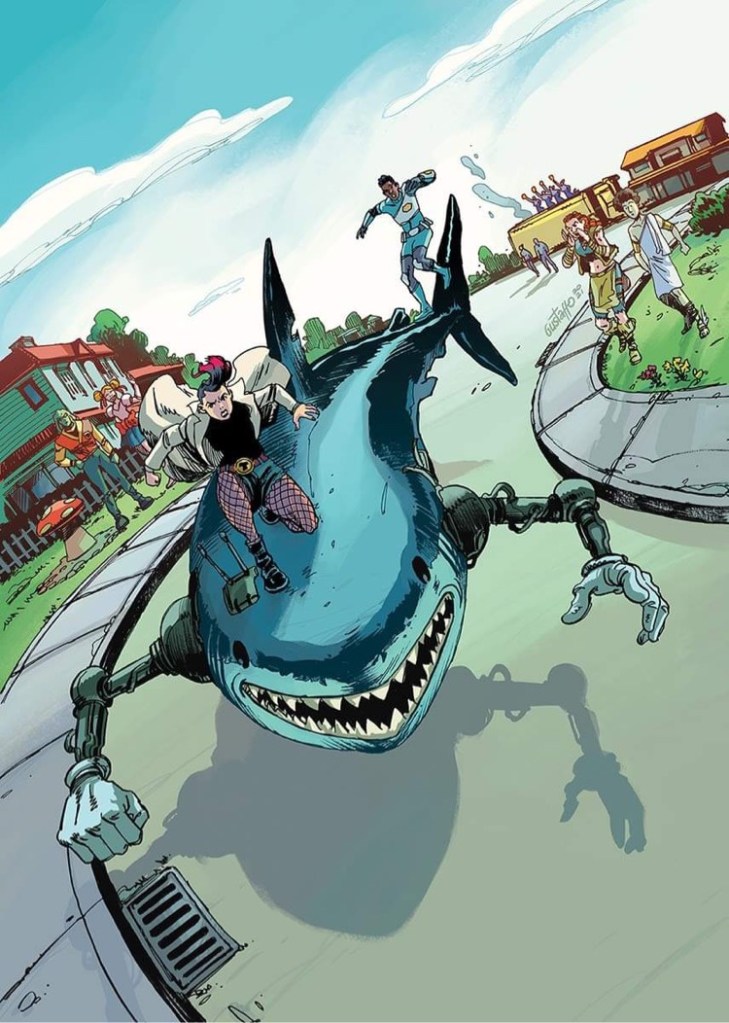
The amazing pin-up by Gustaffo Vargas!
The Kickstarter and The Future
Explosion High Issue One’s Kickstarter is done. Everything’s been shipped out apart from a couple of physical copies which people have not given me addresses for. I’ll be checking in every few months to see if they’ve finally updated their details, but I figure at this point I’m calling it done.
I need to start sending copies to reviewers, as I want not only to get this issue into more hands, but to get more eyes on issue two.
Speaking of which, I am planning to have issue two out on some crowdfunding platform this year, although I’ve got a lot of things to consider with that at the moment. I have most of the original art team returning and a pair of more tightly-connected stories going from a dorm party to gym class.
The annotated script reward level was a joy, but it was incredibly labour intensive, so I’m thinking I’ll create one annotated script, scan it and then have a less limited tier where I’ll vandalise one part of each annotation in a unique way. That was more people will get to see the tangents I go on both in the script and annotations, the pictures I put in, and any puzzles, tears, burns and cut-out sections. I’ve also put in a couple of spots where people can back and have themselves as superhero students, probably not surviving Explosion High.
During CabinCon, a mini-convention with friends, I wrote the script for a 16-page ‘zine style comic which I’m also hoping to find an artist for an get up on Kickstarter next year after the EH2 project. It’s somehow even scrappier and weirder than Explosion High, a kind of cross between Masters of the Universe, Kamandi: The Last Boy on Earth, Adventure Time and Yor: Hunter from the Future. I’ll share more noise about that when I can.
Last year I played every board game in my collection. It was a lot, especially as I didn’t take the task seriously in the first half of the year and then way too seriously later on. It hit the stamina of my beloved and my lodger pretty hard, and I had to get them trying some terrible, terrible games which are now out of my collection, on their way out or in one case going to a recycling bank.
This year I decided to take on a similar challenge, but one where I’d end up only causing myself harm by going through an arbitrary checklist of things I enjoy or have previously enjoyed.
This time I’m going to read every graphic novel I own in the house. I’ve got two and a half long bookshelves in my living room with graphic novels, but also several pods in a kallax shelving unit in the workroom and a number on a bookshelf and various piles in my bedroom as well. I decided this quest last year, but I only counted how many I’ve got in the gap between Christmas and New Year. What I mean by this is that I’ve got three hundred and sixty six graphic novels to read, there will be more I’ve forgotten or will find in the house, and I should have checked this before deciding to do this and now I’ve told enough people that I feel I ought to crack on.
A few rules and exceptions
I’ve already removed some graphic novels from the collection prior to 2022 if I knew I was going to get rid of them, and more will go on the ‘cull’ pile, probably ending up in local charity shops.
Emma has a ton of graphic novels. I’m not reading hers even though a couple ended up on my shelves. She’s a massive Vertigo person and while I’ve got some Preacher-era books, I’ve not read most of the early Vertigo titles. If I somehow end up doing well with this, I might finally get round to reading all of Sandman, which I’ve not done before.
My brother brought down a few graphic novels to try and get the lodger to read. They ended up on my shelves, but they’re his and are exempt from this challenge.
I’m missing some graphic novels in runs of a series, and if they’re mid-way, I’ll end up filling them in before I get to them. The main example is my Walking Dead collection, which is inexplicably missing volume twenty-five. I have no idea how I missed that then they were coming out. There are some I stop abruptly with, either as that version went out of print, I got board, I started collecting individual comics or some other reason. Part of the reason I’m doing this is to see what to keep, what to ditch and what to mark for completion.
I’m not going to read any X-Men collections, as I’m already doing another weird ritual thing by reading an issue of X-Men a day ever since I turned 40, then posting my findings on Facebook and Twitter.
I’ve not added any manga. Maybe that’ll be next year’s challenge.
I’ve listed everything in alphabetical order and that’ll be my guiding direction for what to read next, but it’s not law, so I might skip ahead or pick a smaller volume if I need something portable for a trip or holiday.
Finally, this may change depending on my patience, stamina and time, but I’ll try and write a little something about them.
My most recently bought graphic novel, mid-read on a train.
Lists
There are some graphic novels which are glorious one-offs like I Kill Giants and All-Star Superman. There are some which went on forever, and here are a few I’m going to encounter soon:
100 Bullets – I’ve cooled on Brian Azzarello, but I loved his crime drama with the compelling hook that people are delivered 100 untraceable bullets and a photo of the person who ruined their life, then set loose. It goes way beyond that, but it’s a fantastic hook.
Akiko – An adorable science fiction series with an entertainingly weird cast. It’s been so long since I read any of these, I forgot there were so many volumes.
Avengers by Brian Michael Bendis & Jonathan Hickman – I loved the Avengers Disassembled/New Avengers era. It looks a little old now with the weirdly shiny effects on everyone and some of Bendis’ dialogue, but it’s still a time I loved. Then Jonathan Hickman came along and wrote what I think is still my favourite Avengers run.
Batman: Knightfall – This is only three volumes, but they’re the thickest graphic novels I’ve got. They’re classics from my childhood and the last time I read them, I realised how different my sequential art reading comprehension was after decades of more decompressed storytelling.
Fables: Deluxe Edition – A series about fairytale people living in New York, starting with a murder mystery and meandering along from there. I enjoyed it, especially Mark Buckingham’s art in the early run. The hardcovers I bought felt like they were stalling by including absolutely everything, and my enthusiasm wore out. Like so many series, I might pick it back up after reading this.
Freakangels – Ugh, this is going to be one of many difficult Warren Ellis reads. A post apocalyptic webseries about psychic cooler-than-thou youths.
Invincible – I have two thirds of the series in hardcover. I enjoyed it, then it went on too long. The problem with making a superhero series where everything changes and sticks is that Robert Kirkman’s not great at either sticking to that rule or keeping things interesting for a long time. It might get better, hell, I might read this and feel that I was too harsh in this judgement.
JSA – This is a fractured run as I have a lot of these issues in ‘floppies’. I was converting them, I found a few cheap volumes and then cooled on Geoff Johns.
Legion of Super-Heroes Archives – I’ve got a gap in this collection which won’t be filled due to rarity, but these are some lovely hardbacks putting together the earliest appearances of the far future superheroes.
Morning Glories – A deadly school with weird goings on. As a fan of Lost style mysteries, and a writer of my own deadly school, I knew I had to check this out.
Preacher – I used to buy myself a volume of Preacher as a treat when I worked Christmas Eve at Dave’s Comics. It’s a modern (for the 90’s) Western and a story about a literal search for god. Gloriously violent, vulgar and sacrilegious, it wasn’t without heart and I have no idea how well it’s aged.
Thieves & Kings – Half-comic and half-prose, this is a fantasy series which I really love and it’s always a surprise how it’s never really got any attention from anyone.
Transmetropolitan – Another Warren Ellis series, this time about a bitter journalist in a cyberpunk future which always feels like it’s probably too close to ours.
The Walking Dead – A fast read, despite being the longest series in this collection by a long way. The challenge the author set himself was to write an ongoing zombie narrative where so many end quickly and either unrealistically positive or a real downer. I got bored with the constant miserablism of the television show ages ago, but the series kept me entertained until it ended.
Predictions
I’ll get rid of less graphic novels than I intended.
I’ll feel embarrassed about some of my earliest blog posts being so favourable towards Identity Crisis.
There’ll be some lukewarm takes about Dark Knight Returns and Watchmen.
All-Star Superman and I Kill Giants will make me cry again.
I’ll get Batman fatigue, and conversely I’ll feel like I want more Superman in my collection, but not Death of Superman.
So, with all that out of the way, let Graphic Novel Quest 2022 commence!
My Legion Archives and Walking Dead, taken when I was working out my graphic novel spreadsheet.

























 Faked Tales